2026 Audi e-tron at a Glance: The Finance-First EV Review
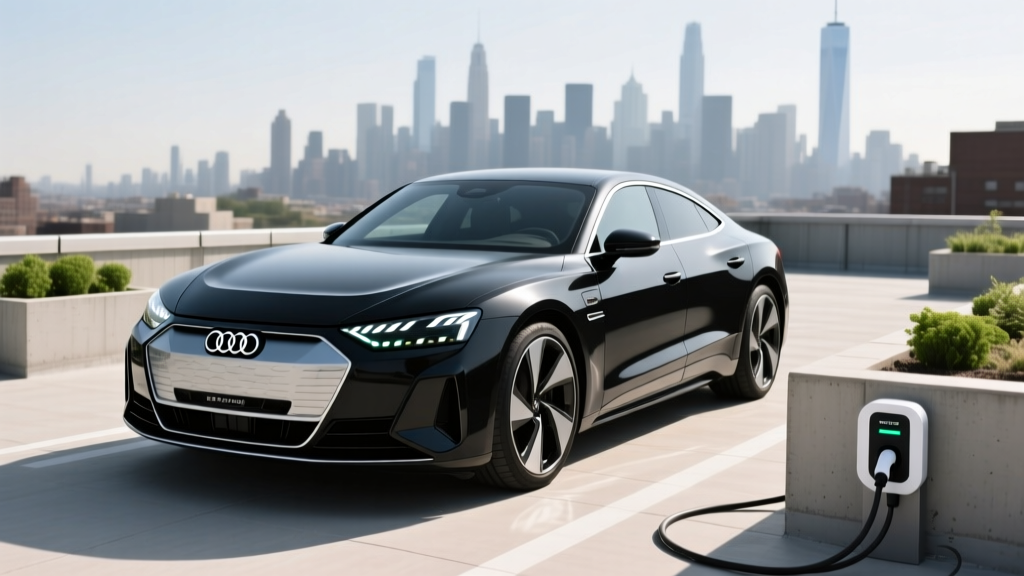
The Audi e-tron — now officially branded the Audi Q8 e-tron in the U.S. market — occupies a specific niche: luxury SUV buyers who want German build quality, a comfortable ride, and a premium badge without the Tesla-minimalist interior. But for 2026, the real question isn't just whether the Q8 e-tron drives well. It's whether the Audi e-tron finance incentives and ownership economics actually justify its starting price.
This review breaks down the numbers that matter to your wallet: EPA range, real-world efficiency, charging costs, federal tax credit eligibility under current IRS §30D rules, and how the Q8 e-tron stacks up against rivals like the BMW iX and Mercedes EQE SUV when you factor in every incentive available.
| Spec | Q8 55 e-tron | SQ8 e-tron |
|---|---|---|
| EPA Range | 285 miles | 258 miles |
| Battery (Usable) | 106 kWh (NMC) | 106 kWh (NMC) |
| Max DC Charge Rate | 170 kW | 170 kW |
| 10–80% DC Fast Charge | ~31 minutes | ~31 minutes |
| Level 2 Home Charge | 19.2 kW (44 mi/hr) | 19.2 kW (44 mi/hr) |
| Horsepower | 402 hp | 496 hp |
| 0–60 mph | 5.0 seconds | 4.3 seconds |
| Drivetrain | quattro AWD (dual-motor) | quattro AWD (dual-motor) |
| MPGe (combined) | 81 MPGe | 73 MPGe |
| Efficiency | 42 kWh/100 mi | 46 kWh/100 mi |
| Base MSRP | $75,600 | $96,600 |
| Battery Warranty | 8 yr / 100,000 mi | 8 yr / 100,000 mi |
Source: fueleconomy.gov and Audi USA official specifications for the 2026 model year. EPA estimates; actual range and efficiency vary with conditions.
Real-World Range: What the EPA Sticker Doesn't Tell You
EPA Estimated Range: 285 miles (Q8 55 e-tron) / 258 miles (SQ8 e-tron)
Real-World Expectation: In mixed driving at moderate temperatures (60–80°F), expect 250–270 miles from the Q8 55 e-tron. Sustained highway driving at 75+ mph drops this to approximately 230–250 miles. In freezing conditions (below 32°F), range loss of 20–30% is typical, bringing effective range down to roughly 195–225 miles without preconditioning.
The Q8 e-tron's 106 kWh usable battery (114 kWh gross, NMC lithium-ion chemistry) gives it substantial energy reserves, but the vehicle's 5,800-pound curb weight works against efficiency. At 42 kWh per 100 miles combined, this is not a range-maximizing SUV — it's a comfort-maximizing one.
Where the e-tron platform shines is in its thermal management system. Audi's active liquid cooling and heating keep the battery in its optimal temperature window, which means less degradation over time and more consistent charging speeds in extreme weather. If you live in a cold climate and can garage the vehicle, preconditioning while plugged in recovers most of the winter range penalty.
Charging Speed: DC Fast, Level 2, and the Charging Curve Reality
| Charge Level | Power / Voltage | Miles Added per Hour | Notes |
|---|---|---|---|
| Level 1 (120V) | 1.4 kW | ~3 mi/hr | Emergency/trickle only; not practical for daily use |
| Level 2 (240V, 48A) | 11.5 kW | ~27 mi/hr | Standard home charger; full charge in ~10 hours |
| Level 2 (240V, 80A) | 19.2 kW | ~44 mi/hr | Requires hardwired 100A circuit; full charge in ~6 hours |
| DC Fast Charge | 170 kW peak | — | 10–80% in ~31 min; tapers significantly above 80% |
The Q8 e-tron peaks at 170 kW on DC fast chargers. That's competitive but not class-leading — the Hyundai Ioniq 5 and Kia EV6 hit 240 kW on 800V architectures. However, the e-tron's charge curve is notably flat through the mid-range. It sustains close to 150 kW from roughly 10% to 55% state of charge before tapering, which means real-world charging sessions at Electrify America or Tesla Supercharger (with NACS adapter, available through Audi's partnership) are efficient in the range that matters most.
Above 80% SoC, the charge rate drops to under 50 kW — this is normal for NMC chemistry to protect battery longevity, but it means you should plan road-trip stops around 10–80% increments rather than topping to 100%.
For home charging, the Q8 e-tron's onboard charger supports up to 19.2 kW on Level 2 (240V, 80A). This requires a dedicated 100-amp circuit and hardwired EVSE installation — expect $1,200–$2,500 for a professional install depending on your panel capacity. Most buyers opt for a 48A/11.5 kW setup on a NEMA 14-50 outlet, which still delivers a full overnight charge and costs $500–$1,200 to install.
Audi e-tron Finance Incentives: Federal Tax Credit, State Rebates, and Leasing
The federal EV tax credit landscape for 2026 is complex, and the Audi Q8 e-tron's eligibility depends on several factors that buyers must verify before signing. Here's the breakdown:
| Trim | Base MSRP | Federal §30D Credit | Est. After Federal Credit | Lease Credit (Commercial) |
|---|---|---|---|---|
| Q8 55 e-tron Premium | $75,600 | Up to $7,500* | ~$68,100 | $7,500 passed through lessor |
| Q8 55 e-tron Premium Plus | $81,200 | Up to $7,500* | ~$73,700 | $7,500 passed through lessor |
| SQ8 e-tron Prestige | $101,200 | $0 (over MSRP cap) | $101,200 | $7,500 passed through lessor |
*Eligibility depends on buyer income, battery critical-mineral sourcing, and point-of-sale transfer rules. See IRS §30D details below.
Federal §30D Tax Credit Rules for the Q8 e-tron
- MSRP Cap: SUVs must be under $80,000 MSRP. The Q8 55 e-tron Premium ($75,600) and Premium Plus ($81,200) trims fall on opposite sides of this line. The Premium Plus may exceed the cap depending on destination charges and dealer-installed options — verify the window sticker.
- Income Cap: Modified adjusted gross income (MAGI) must be ≤ $150,000 (single), $225,000 (head of household), or $300,000 (joint filing).
- Battery Sourcing: The full $7,500 requires meeting both critical-mineral and battery-component sourcing requirements set by the IRS. Partial credits ($3,750) apply if only one requirement is met. Audi's supply chain sourcing for 2026 should be confirmed with the dealer and cross-referenced at IRS.gov's eligible vehicle list.
- Point-of-Sale Transfer: As of 2024, buyers can transfer the credit to the dealer at purchase, reducing the sale price directly rather than waiting for a tax refund. This is available for the Q8 e-tron if all eligibility criteria are met.
The Lease Loophole
Here's where Audi e-tron finance incentives get interesting: under the commercial clean vehicle credit (§45W), vehicles leased through a qualifying lessor can receive a $7,500 credit regardless of MSRP caps, income limits, or battery-sourcing rules. Many Audi dealers pass this savings directly to the lessee as a capitalized-cost reduction. This makes leasing an SQ8 e-tron Prestige — which exceeds the $80,000 purchase cap — financially viable with the $7,500 applied.
Before committing, ask the dealer explicitly: "Is the $7,500 lease credit being applied as a cap-cost reduction, and is it reflected in the money factor and monthly payment?" Get it in writing.
State and Utility Incentives
Beyond federal credits, many states and utilities offer additional rebates. California's CVRP, Colorado's state credit, and various utility company rebates (PG&E, Xcel Energy, ConEdison) can stack $1,000–$5,000 on top. These vary by jurisdiction and change frequently — check your state energy office and local utility for current programs.
Performance, Interior, and Technology
The Q8 55 e-tron's dual-motor quattro all-wheel-drive system produces 402 hp and 490 lb-ft of torque, hitting 60 mph in 5.0 seconds. That's not sports-SUV territory, but it's effortless highway merging and confident in all weather. The SQ8 e-tron bumps output to 496 hp and drops the 0–60 time to 4.3 seconds — a meaningful upgrade if you value acceleration.
Where the Q8 e-tron earns its luxury positioning is ride quality. The standard adaptive air suspension smooths out road imperfections in a way that the stiffer BMW iX and Tesla Model X cannot match. Cabin noise is among the lowest in the EV SUV segment, aided by acoustic glass and Audi's aerodynamic optimization.
Interior Space and Cargo
- Front legroom: 41.6 inches
- Rear legroom: 39.1 inches
- Cargo (rear seats up): 28.5 cu ft
- Cargo (rear seats folded): 57.0 cu ft
- Frunk: Not available (no front trunk)
The lack of a frunk is a notable omission in a vehicle this size. Competitors like the Rivian R1S and Ford Mustang Mach-E offer front-trunk storage. Rear cargo space is adequate but trails the BMW iX (35.5 cu ft behind the rear row) and the Rivian R1S.
Technology and Driver Assistance
The Q8 e-tron runs Audi's latest MMI touch response system with dual screens (10.1-inch upper, 8.6-inch lower) and wireless Apple CarPlay/Android Auto. The 12.3-inch Virtual Cockit Plus digital cluster is standard.
Driver assistance comes via Audi adaptive cruise assist — a Level 2 SAE system combining adaptive cruise control with lane-centering. It's competent for highway driving but requires hands-on-wheel engagement at all times. This is not a hands-free system like GM's Super Cruise or Ford's BlueCruise. Audi does not currently offer a Level 3 or Level 4 autonomous driving feature on the U.S.-spec Q8 e-tron.
Ownership Costs: Charging, Insurance, and 5-Year TCO
| Cost Category | Audi Q8 55 e-tron | BMW iX xDrive50 |
|---|---|---|
| Purchase Price (after fed. credit) | ~$68,100 | ~$80,100 |
| 5-Year Electricity (15,000 mi/yr) | ~$4,800 | ~$4,500 |
| 5-Year Insurance (avg.) | ~$12,500 | ~$13,200 |
| 5-Year Maintenance | ~$1,800 | ~$2,100 |
| Estimated Depreciation (5 yr) | ~$32,000 | ~$35,000 |
| Estimated 5-Yr TCO | ~$119,200 | ~$134,900 |
Estimates based on national-average electricity rates ($0.16/kWh), home-charging-dominant usage, and current insurance data. Actual costs vary significantly by state, driving profile, and electricity rate. Depreciation estimates based on historical Audi e-tron resale trends.
The Q8 e-tron's advantage in TCO comes primarily from its lower entry price and competitive federal-credit eligibility. Insurance premiums for the Q8 e-tron run 15–25% higher than comparable gas SUVs — a common EV pattern driven by higher repair costs and parts pricing. Get quotes before purchasing.
Pros, Cons, and Who Should Buy
Pros
- Exceptional ride comfort with standard air suspension
- Flat DC fast-charge curve sustains ~150 kW through mid-SoC
- Eligible for up to $7,500 federal credit on base trims
- Strong lease incentive path via §45W commercial credit
- Quiet, well-insulated cabin with premium materials
- quattro AWD with excellent all-weather capability
- 19.2 kW Level 2 onboard charger (fastest in class for home)
Cons
- 285-mile EPA range trails competitors (BMW iX: 324 mi)
- No frunk; cargo space below segment average
- Heavy at 5,800 lbs — efficiency suffers on highway
- Premium Plus trim may exceed $80K MSRP cap for §30D
- Driver assist is basic Level 2 — no hands-free highway mode
- Higher insurance premiums than gas equivalents
- 170 kW peak DC charge is adequate but not class-leading
Who This EV Suits Best
Buy the Q8 55 e-tron if: You prioritize ride comfort and cabin refinement over maximum range, you have home Level 2 charging, your daily commute is under 80 miles round-trip, and you can capture the $7,500 federal credit or lease incentive. It's an excellent luxury daily driver for suburban commuters and families who take occasional road trips under 250 miles between stops.
Look elsewhere if: You need 300+ miles of range (BMW iX, Tesla Model X), you want hands-free highway driving (GM Super Cruise vehicles), or you regularly tow heavy loads (Rivian R1S). The Q8 e-tron is not a road-trip champion — it's a comfort champion.
Frequently Asked Questions
What is the real-world range of the 2026 Audi Q8 e-tron?
In moderate temperatures with mixed city/highway driving, expect 250–270 miles from the Q8 55 e-tron. Sustained 75+ mph highway driving reduces this to roughly 230–250 miles. In sub-freezing weather, plan for 195–225 miles unless you precondition the battery while plugged in.
How fast does the Audi Q8 e-tron charge at home and on the road?
On DC fast chargers, it peaks at 170 kW and charges from 10–80% in approximately 31 minutes. At home on a 240V/48A Level 2 charger, it adds about 27 miles per hour (full charge in ~10 hours). With an 80A hardwired charger, it reaches 44 miles per hour — among the fastest Level 2 rates available in any EV SUV.
Does the Audi Q8 e-tron qualify for the $7,500 federal EV tax credit?
The Q8 55 e-tron Premium ($75,600 MSRP) qualifies if the buyer meets IRS §30D income limits (≤$150K single / $300K joint), and the vehicle's battery meets critical-mineral and component-sourcing requirements. The Premium Plus and SQ8 trims may exceed the $80,000 SUV MSRP cap for purchase, but leasing through a qualifying lessor can unlock the $7,500 credit via the commercial-vehicle loophole (§45W). Always verify on IRS.gov and with your tax professional.
Is the Audi Q8 e-tron worth buying vs. the BMW iX or Tesla Model X?
If ride comfort, cabin quietness, and traditional luxury are your top priorities, the Q8 e-tron is the strongest choice. If range is paramount, the BMW iX xDrive50 (324 miles EPA) wins. If you want the most Supercharger access and the lowest cost per mile, the Tesla Model X is hard to beat — but its interior quality and ride comfort don't match Audi's. The Q8 e-tron is the comfort-first pick in a competitive segment.
What is the battery warranty on the Audi Q8 e-tron?
Audi covers the high-voltage battery for 8 years or 100,000 miles, whichever comes first, against defects and excessive capacity loss (typically defined as dropping below 70% state of health). The powertrain is also covered for 8 years/100,000 miles, and the vehicle limited warranty is 4 years/50,000 miles.
What are the biggest Audi e-tron finance incentives beyond the federal credit?
Key incentives include: the §45W lease credit ($7,500 applied to any trim regardless of MSRP cap), state rebates (California CVRP up to $2,000, Colorado up to $5,000 for income-qualified buyers), utility rebates for home charger installation ($250–$1,500 depending on provider), and Audi's own promotional financing rates which periodically include 0.9%–2.9% APR for well-qualified buyers. Stack these strategically for maximum savings.