Quick Verdict: The 2024 Audi E-Tron at a Glance
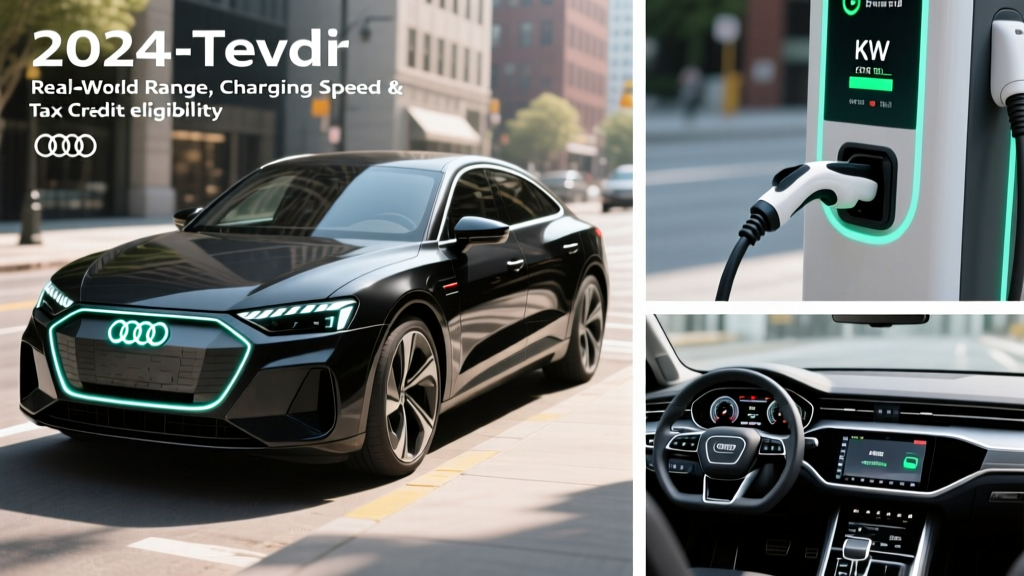
The 2024 Audi E-Tron (badged as the Q8 e-tron for this model year) represents Audi's mid-cycle refresh of its flagship electric SUV. With a larger 114 kWh battery pack (106 kWh usable), improved aerodynamics, and a refined dual-motor quattro drivetrain, the 2024 model addresses the two biggest criticisms of the original E-Tron: mediocre range and high energy consumption. The result is an EPA-estimated 285 miles of range in the SUV body style — a meaningful jump from the outgoing model's 222 miles — and sustained DC fast-charging performance that remains among the best in the luxury EV segment.
But at a starting MSRP above $74,000 and with federal tax credit eligibility hinging on complex battery-sourcing rules, the 2024 E-Tron demands careful evaluation. This review breaks down every spec that matters to real buyers.
Spec Table: 2024 Audi Q8 E-Tron Key Numbers
| Specification | Q8 E-Tron Premium Plus (SUV) | Q8 Sportback E-Tron |
|---|---|---|
| EPA Range | 285 miles | 300 miles |
| Battery (Gross / Usable) | 114 kWh / 106 kWh | 114 kWh / 106 kWh |
| Battery Chemistry | NMC (Nickel Manganese Cobalt) | NMC |
| Drivetrain | Dual-motor quattro AWD | Dual-motor quattro AWD |
| Horsepower (Boost Mode) | 402 hp | 402 hp |
| Torque | 490 lb-ft | 490 lb-ft |
| 0-60 mph | 5.5 seconds | 5.5 seconds |
| Max DC Fast Charge | 170 kW | 170 kW |
| 10-80% DC Charge Time | ~31 minutes | ~31 minutes |
| Level 2 Home Charge Rate | 11.5 kW (AC) | 11.5 kW (AC) |
| MPGe (Combined) | 81 MPGe | 87 MPGe |
| kWh/100 mi | 42 kWh/100 mi | 39 kWh/100 mi |
| Base MSRP | $74,400 | $79,900 |
| Battery Warranty | 8 years / 100,000 miles | 8 years / 100,000 miles |
Source: EPA Fueleconomy.gov and Audi USA
Range and Efficiency: EPA Sticker vs. Real-World Miles
Real-World Expectation: 240-265 miles on highway road trips at 70-75 mph; 200-230 miles in sub-freezing winter conditions; 270-290 miles in mixed city driving with regen braking.
The 2024 Q8 E-Tron's 285-mile EPA rating (SUV body) is a welcome improvement, but buyers should calibrate expectations. The NMC battery pack's 106 kWh of usable capacity is generous, yet the vehicle's 5,776-pound curb weight and 42 kWh/100 mi combined consumption rate mean real-world highway driving — where aerodynamic drag dominates — will typically yield 240-265 miles before you need to plug in.
Cold weather hits harder. In sustained sub-30°F temperatures, expect 15-25% range reduction due to cabin heating demands and reduced battery chemistry efficiency, even with the E-Tron's heat pump system. That translates to roughly 200-230 miles of usable range on a freezing January morning.
The Sportback variant's 300-mile EPA figure benefits from a lower drag coefficient (Cd 0.27 vs. 0.28 for the SUV), and its slightly better 39 kWh/100 mi efficiency makes it the more road-trip-friendly choice if cargo space isn't your top priority.
Charging Performance: DC Fast, Level 2, and the Charge Curve Reality
The E-Tron has always been a charging benchmark, and the 2024 model maintains that reputation with a peak DC fast-charge rate of 170 kW. More importantly, Audi's thermal management system sustains high charge rates longer than most competitors — a critical distinction that spec sheets often obscure.
| Charging Level | Power / Rate | Speed (Miles Added per Hour) | Notes |
|---|---|---|---|
| Level 1 (120V household) | ~1.4 kW | ~3-4 miles/hr | Emergency/trickle only |
| Level 2 (240V home) | 11.5 kW | ~28-32 miles/hr | Full charge in ~10 hours |
| DC Fast Charge | Peak 170 kW | Up to ~400 miles/hr (peak) | 10-80% in ~31 min |
The charge curve matters. The E-Tron sustains near-peak 170 kW rates from approximately 10% to around 60% state of charge before tapering. Between 60-80%, power drops progressively to roughly 80-100 kW. This is why the 10-80% time of 31 minutes is realistic — Audi engineered the thermal system to avoid the severe tapering seen in some competitors that claim higher peak kW but can't sustain it.
For home Level 2 charging, the 11.5 kW onboard charger is a strong point. On a 48-amp dedicated circuit (60-amp breaker), you'll add roughly 30 miles of range per hour of charging, meaning a full overnight session easily replenishes a day's driving. Budget $800-$2,500 for professional Level 2 installation depending on your electrical panel's proximity to the garage and whether a panel upgrade is needed.
Performance and Driving Dynamics
The dual-motor quattro all-wheel-drive system produces 402 horsepower and 490 lb-ft of torque in boost mode, delivering a 5.5-second 0-60 mph time. That's not Tesla Model X territory, but it's brisk for a 5,776-pound luxury SUV and more than adequate for highway merging and passing.
The E-Tron's strength has never been straight-line performance — it's refinement. The adaptive air suspension standard on Premium Plus and Prestige trims provides a composed, near-silent ride quality that few electric SUVs match. Steering is precise if light, and the regenerative braking system offers three levels of recuperation selectable via steering-wheel paddles, though it does not achieve true one-pedal driving in its softest setting.
Towing capacity is rated at 4,000 pounds with the factory tow package — competitive with the BMW iX and slightly less than the Rivian R1S.
Interior Space, Cargo, and Technology
The 2024 Q8 E-Tron provides generous interior volume for five passengers:
- Front legroom: 41.6 inches
- Rear legroom: 38.2 inches
- Cargo (behind rear seats): 28.5 cu ft (SUV) / 26.5 cu ft (Sportback)
- Cargo (rear seats folded): 56.4 cu ft (SUV) / 54.5 cu ft (Sportback)
- Frunk (front trunk): Not available — the space houses power electronics
The dual-screen MMI touch response infotainment system (10.1-inch upper display, 8.6-inch lower climate/functions display) is visually striking but demands more attention than physical buttons. Wireless Apple CarPlay and Android Auto are standard, as is a 12.3-inch Virtual Cockit digital instrument cluster.
Driver assistance includes Audi adaptive cruise with stop-and-go, lane centering, intersection assist, and traffic sign recognition — all SAE Level 2 systems requiring continuous driver engagement. The available parking system with 360-degree cameras is particularly useful given the vehicle's width.
Pricing, Trims, and Federal Tax Credit Eligibility
| Trim | Body Style | MSRP | As-Tested (Typical Options) |
|---|---|---|---|
| Premium Plus | SUV | $74,400 | $78,000-$82,000 |
| Prestige | SUV | $82,800 | $88,000-$94,000 |
| Premium Plus | Sportback | $79,900 | $83,000-$87,000 |
| Prestige | Sportback | $88,300 | $92,000-$98,000 |
Does the 2024 Audi E-Tron Qualify for the $7,500 Federal Tax Credit?
This is where buyers must exercise caution. Under current IRS §30D rules, the 2024 Q8 E-Tron faces significant hurdles to qualifying for the full $7,500 federal clean vehicle credit:
- MSRP Cap: SUVs must be at or below $80,000. The Premium Plus SUV at $74,400 clears this, but the Prestige SUV ($82,800) and all Sportback trims (classified as cars, $55,000 cap) may not qualify depending on final configuration.
- Buyer Income Cap: Modified adjusted gross income must not exceed $150,000 (single), $225,000 (head of household), or $300,000 (joint filers).
- Battery Sourcing Requirements: The critical minerals and battery component sourcing requirements have tightened annually. Audi's battery supply chain for US-market vehicles must meet evolving thresholds. Verify current-year eligibility on the fueleconomy.gov credit lookup before purchasing.
- Point-of-Sale Transfer: If eligible, the credit can be transferred to the dealer at purchase, reducing the upfront price rather than waiting for a tax refund.
Bottom line: Do not assume eligibility. Confirm with your dealer and consult a tax professional. The IRS §30D page has the latest sourcing and income rules.
How It Compares: E-Tron vs. Key Rivals
The 2024 Q8 E-Tron competes directly with the BMW iX xDrive50, Mercedes-Benz EQE SUV, and Tesla Model X. Here's how the numbers stack up:
| Metric | Audi Q8 E-Tron | BMW iX xDrive50 | Mercedes EQE 350+ SUV | Tesla Model X LR |
|---|---|---|---|---|
| EPA Range | 285 mi | 324 mi | 279 mi | 335 mi |
| Battery (usable) | 106 kWh | 105.2 kWh | 90.6 kWh | ~100 kWh |
| Peak DC Charge | 170 kW | 195 kW | 170 kW | 250 kW |
| 0-60 mph | 5.5s | 4.4s | 6.4s | 3.8s |
| Base MSRP | $74,400 | $87,250 | $77,900 | $79,990 |
The BMW iX offers more range and faster charging but starts significantly higher. The Tesla Model X dominates on performance and Supercharger network access but sacrifices interior material quality. The Audi's advantage is ride refinement, build quality, and the most sustainable DC charging curve in its class.
Pros and Cons
- Excellent sustained DC fast-charging curve (170 kW peak, minimal taper to 60%)
- Class-leading ride quality with standard air suspension
- Significant range improvement over pre-2024 E-Tron (285 vs. 222 mi)
- Premium interior materials and cabin quietness
- Strong 8-year/100,000-mile battery warranty
- 4,000-lb towing capacity
- Heavy curb weight (5,776 lbs) hurts efficiency at 42 kWh/100 mi
- No front trunk (frunk) — lost cargo opportunity
- Touchscreen-heavy infotainment lacks physical shortcuts
- Federal tax credit eligibility uncertain due to sourcing rules
- Rear visibility limited in Sportback variant
- Real-world highway range notably below EPA sticker
Who Should Buy the 2024 Audi Q8 E-Tron?
The 2024 Q8 E-Tron is best suited for luxury-oriented buyers who prioritize ride comfort, cabin refinement, and reliable DC fast-charging performance over maximum range or outright acceleration. It's an excellent daily commuter for those with home Level 2 charging access and a strong choice for families who need a composed, quiet highway cruiser with legitimate towing capability.
If you regularly drive more than 250 miles between charging stops, the BMW iX or Tesla Model X offer more range headroom. If you need maximum cargo space or a frunk for gear, look at the Rivian R1S. But if your priority is arriving relaxed in a beautifully appointed cabin with minimal charging fuss, the Q8 E-Tron delivers exactly that.
Frequently Asked Questions
What is the real-world range of the 2024 Audi E-Tron?
The EPA rates the 2024 Q8 E-Tron SUV at 285 miles. In real-world highway driving at 70-75 mph, expect 240-265 miles. In cold weather below freezing, plan for 200-230 miles. The Sportback variant achieves 300 miles EPA and roughly 260-280 miles real-world highway.
How fast does the 2024 E-Tron charge at home and on the road?
On a Level 2 home charger (240V, 48A), the E-Tron charges at 11.5 kW, adding roughly 30 miles of range per hour — a full charge takes about 10 hours overnight. On a DC fast charger, it peaks at 170 kW and charges from 10-80% in approximately 31 minutes, with the charge curve sustaining high rates well past 50% SoC.
Does the 2024 Audi E-Tron qualify for the $7,500 federal tax credit?
Eligibility is not guaranteed. The Premium Plus SUV ($74,400 MSRP) meets the $80,000 SUV price cap, but battery-sourcing and buyer-income requirements under IRS §30D may reduce or eliminate the credit. Always verify on fueleconomy.gov and consult a tax professional before relying on the credit in your purchase decision.
Is the 2024 Audi E-Tron worth buying over the BMW iX or Tesla Model X?
Choose the Q8 E-Tron if you value ride comfort, cabin quietness, and a flat DC charging curve over maximum range. Choose the BMW iX if range (324 mi EPA) and performance matter more. Choose the Tesla Model X if Supercharger network access and acceleration are priorities and you can accept a less luxurious interior.
What is the battery warranty on the 2024 Audi E-Tron?
Audi provides an 8-year/100,000-mile warranty on the high-voltage battery pack, covering defects and capacity degradation below a specified threshold (typically 70% state of health). The general vehicle warranty is 4 years/50,000 miles.
Does the 2024 E-Tron have a frunk?
No. The 2024 Q8 E-Tron does not have a front trunk. The space under the hood houses power electronics and the HVAC system. All cargo must go in the rear compartment (28.5 cu ft SUV, 26.5 cu ft Sportback).