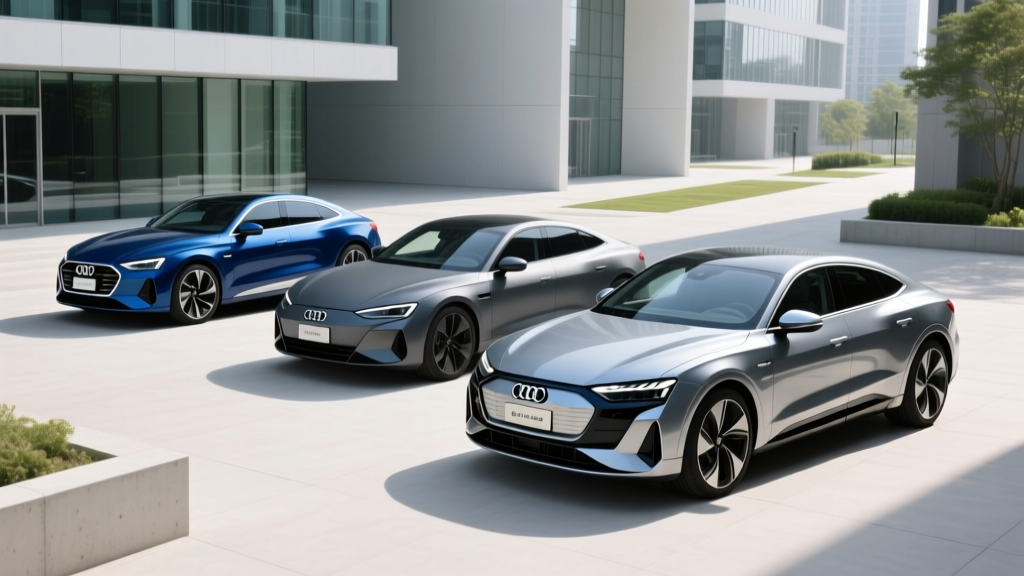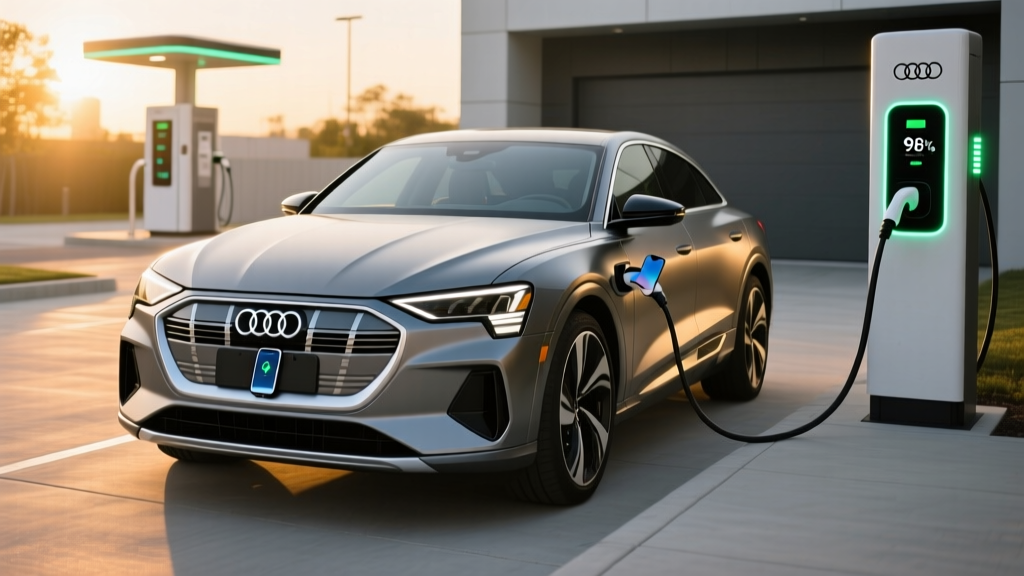
The 2022 Audi e-tron occupies an unusual space in the used-EV market of 2026. It's a luxury electric SUV that prioritizes refinement, ride quality, and build solidity over headline-grabbing range or acceleration numbers. Now available exclusively on the pre-owned market (Audi replaced it with the Q8 e-tron for 2024 and beyond), the 2022 e-tron offers a compelling value proposition for buyers who understand exactly what they're getting — and what they're giving up.
This review breaks down the real-world ownership picture: actual range you can expect, charging behavior on today's networks, current used pricing against federal tax credit eligibility, and how it stacks up against competitors you'll cross-shop.
2022 Audi e-tron Quick Specs
| Specification | Value |
|---|---|
| EPA Range | 222 miles (Premium Plus), 218 miles (Prestige) |
| Battery Capacity | 95 kWh gross / ~86.5 kWh usable (NMC chemistry) |
| Max DC Fast Charge | 150 kW peak |
| 10–80% DC Charge Time | ~30 minutes |
| Level 2 Charge Rate | 11 kW (on-board charger) |
| 0–60 mph | 5.5 seconds (Boost mode engaged) |
| Horsepower | 355 hp standard / 402 hp Boost mode |
| Drivetrain | quattro AWD (dual-motor) |
| EPA Efficiency | 78 MPGe combined (39 kWh/100 mi) |
| Cargo Volume | 28.5 cu ft (rear seats up), 57.0 cu ft (folded) |
| Original Base MSRP | $65,900 (Premium Plus), $71,800 (Prestige) |
| Battery Warranty | 8 years / 100,000 miles |
Real-World Range: What the EPA Number Doesn't Tell You
The EPA rates the 2022 Audi e-tron at 222 miles for the Premium Plus trim on 20-inch wheels. The Prestige trim, which adds weight and equipment, drops slightly to 218 miles. The Sportback body style (the coupe-like variant) rates at 218–222 miles depending on trim.
- City/mixed driving (mild weather): 225–240 miles — the e-tron's strong regenerative braking and thermal management help it meet or slightly exceed EPA in stop-and-go conditions.
- Highway driving (70 mph sustained): 185–200 miles — the e-tron's brick-like 0.30 Cd drag coefficient and 5,700+ lb curb weight take a toll at speed.
- Cold weather (below 30°F): 160–185 miles — expect 20–30% range loss without preconditioning. The e-tron's heat pump (standard on 2022 models) mitigates some cabin-heating drain but doesn't eliminate cold-weather chemistry losses.
- Towing (max 4,000 lb rated): 120–150 miles — heavy towing roughly halves range at highway speeds.
Audi engineered a substantial top and bottom battery buffer — roughly 8.5 kWh combined — which protects long-term battery health but explains why the usable capacity (~86.5 kWh) is significantly below the 95 kWh gross figure. That buffer strategy has proven effective: degradation reports from high-mileage 2019–2022 e-tron owners typically show 5–8% capacity loss over 100,000 miles, which is favorable for NMC chemistry.
Charging Performance: 150 kW Peak with a Flat Curve
The 2022 e-tron's charging story is about consistency rather than peak numbers. While competitors like the Hyundai Ioniq 5 (240 kW peak) or Tesla Model Y (250 kW peak) boast higher maximum charge rates, the e-tron sustains its rate unusually well.
| Charging Level | Power / Rate | Speed | Notes |
|---|---|---|---|
| Level 1 (120V) | ~1.4 kW | ~4 miles/hour | Emergency/trickle only; full charge in 60+ hours |
| Level 2 (240V) | 11 kW max | ~22 miles/hour | Full 0–100% in ~9 hours; requires 48A circuit |
| DC Fast Charge | 150 kW peak | 10–80% in ~30 min | Sustains ~120+ kW through 70% SoC before tapering |
Here's what makes the e-tron's charge curve interesting: it holds above 100 kW from roughly 10% to 75% state of charge before tapering sharply. Many EVs spike to their peak rate briefly then drop off. The e-tron's curve is flatter, which means your average charge session is closer to peak than you'd expect from the 150 kW headline number. On a 350 kW Electrify America station, expect to add roughly 140 miles of range in 20 minutes when starting at a low state of charge.
Preconditioning note: The e-tron will precondition its battery for fast charging when you set a DC fast-charger as your navigation destination. This is critical for achieving the advertised charge speeds, especially in cold weather. Without preconditioning, expect peak rates of 80–100 kW in temperatures below 50°F.
The 2022 e-tron uses the CCS1 connector (standard for all non-Tesla EVs of that era). By 2026, with the industry shifting to NACS, CCS1 chargers remain widely available on Electrify America, EVgo, and ChargePoint networks, though NACS adoption is accelerating. A CCS-to-NACS adapter from Audi or a third party may be needed for future-proofing as networks transition.
Driving Impressions: Performance, Ride, and Efficiency
The dual-motor quattro powertrain produces 355 hp in standard driving and 402 hp when you engage Boost mode (available for 60-second bursts via the shifter's secondary position). The 5.5-second 0–60 mph time in Boost mode is respectable but not thrilling next to a Tesla Model Y Performance (3.5 seconds) or a BMW iX xDrive50 (4.4 seconds). The e-tron was never engineered to win drag races.
Where the e-tron earns its luxury badge is ride quality. The standard adaptive air suspension delivers a genuinely plush, isolated ride that absorbs broken pavement with composure. Cabin noise levels are among the lowest in the EV segment — Audi's acoustic glass and extensive sound deadening make highway cruising remarkably quiet. The steering is precise if numb, and the 5,700-pound mass is well-controlled through corners thanks to the low center of gravity.
Efficiency is the e-tron's weak point. At 78 MPGe combined (39 kWh per 100 miles), it consumes significantly more energy per mile than rivals:
- Tesla Model Y Long Range: 122 MPGe (28 kWh/100 mi)
- BMW iX xDrive50: 86 MPGe (35 kWh/100 mi)
- Mercedes EQS 450 SUV: 84 MPGe (36 kWh/100 mi)
That efficiency gap means higher electricity costs per mile and is the primary reason the e-tron's 222-mile range comes from a massive 95 kWh battery while the Model Y achieves 330 miles from a smaller 75 kWh pack. If you charge at home on cheap utility rates, the cost difference is modest. If you rely heavily on public DC fast charging at $0.35–0.50/kWh, the e-tron's thirst adds up.
Pricing, Trims & Federal Tax Credit (2026 Used Market)
The 2022 e-tron was offered in two trims:
| Trim | Original MSRP | Typical 2026 Used Price | Federal Used EV Credit (§25E) |
|---|---|---|---|
| Premium Plus | $65,900 | $28,000–$34,000 | Up to $4,000 (30% of sale price, max $4,000) |
| Prestige | $71,800 | $32,000–$38,000 | Up to $4,000 |
| Sportback Premium Plus | $69,900 | $30,000–$36,000 | Up to $4,000 |
| Sportback Prestige | $75,800 | $34,000–$40,000 | Up to $4,000 |
Critical tax credit detail: The §30D new-vehicle credit no longer applies since this model is discontinued. However, the IRS §25E used clean vehicle credit can apply when you purchase a qualifying used 2022 e-tron from a licensed dealer. Here's what governs eligibility:
- Credit equals 30% of the sale price, capped at $4,000 maximum
- Vehicle sale price must be $25,000 or less (this eliminates most Prestige-trim e-trons and higher-mileage Premium Plus examples above that threshold)
- Buyer income caps: $75,000 single / $112,500 head of household / $150,000 married filing jointly (modified AGI)
- Must purchase from a licensed dealer (private-party sales excluded)
- Vehicle must be at least 2 model years old (2022 qualifies in 2026)
- Credit is non-refundable — you must have sufficient tax liability to use it
- Can only be claimed once per vehicle (check VIN history)
In practice, a 2022 e-tron Premium Plus selling for $24,500 from a dealer would qualify for a $4,000 credit (30% of $24,500 = $7,350, but capped at $4,000), bringing effective cost to roughly $20,500 — exceptional value for a luxury electric SUV. However, verify the specific vehicle's eligibility with a tax professional before purchasing.
Interior, Tech & Driver Assistance
The 2022 e-tron's cabin is unmistakably Audi: leather, aluminum, and soft-touch materials throughout, with build quality that outclasses the Tesla Model Y and rivals the BMW iX. The dual-screen MMI touch response system (10.1-inch upper, 8.6-inch lower) handles infotainment and climate controls respectively. It's responsive and attractive, though the lower screen's haptic-feedback climate controls draw criticism for requiring eyes-off-road attention.
Notable tech features:
- Virtual Cockpit Plus (12.3-inch configurable instrument cluster)
- Wireless Apple CarPlay / Android Auto
- Bang & Olufsen 3D sound system (16 speakers, Prestige trim)
- Matrix-design LED headlights with dynamic turn signals
- 360-degree camera system with curb-view
- Available head-up display (Prestige trim)
Driver assistance (SAE Level 2 — driver must remain engaged):
- Adaptive cruise assist with stop-and-go and lane centering
- Traffic sign recognition
- Intersection assist (cross-traffic braking)
- Park assist with remote capability
- Audi pre sense front/rear/city (automatic emergency braking, collision preparation)
These systems are competent for highway cruising but don't approach Tesla's FSD Supervised or GM's Super Cruise in hands-free capability. The e-tron requires hands on the steering wheel at all times.
Warranty & Long-Term Ownership
Audi's warranty coverage for the 2022 e-tron:
- Basic vehicle: 4 years / 50,000 miles
- Powertrain: 4 years / 50,000 miles
- High-voltage battery: 8 years / 100,000 miles (covers degradation below 70% of original capacity)
- Corrosion perforation: 12 years, unlimited miles
- Roadside assistance: 4 years / unlimited miles
For 2026 buyers of a used 2022 e-tron, the 4-year basic warranty has expired. However, the 8-year/100,000-mile battery warranty remains in effect through at least the 2030 model year or until the odometer hits 100,000 miles — whichever comes first. This is transferable to subsequent owners at no cost. Given the e-tron's conservative buffer strategy and NMC cell quality, significant battery degradation before 100,000 miles has been uncommon based on owner reports.
If battery replacement becomes necessary out of warranty, expect $18,000–$25,000 for the pack plus labor at an Audi dealer. Third-party EV battery repair shops are emerging as a more affordable option, offering module-level replacement for $5,000–$10,000 depending on the number of degraded modules.
Pros, Cons & Who Should Buy
- Exceptional ride quality and cabin quietness — true luxury feel
- Flat, sustained DC fast-charge curve beats many higher-peak competitors
- Strong build quality with premium materials throughout
- Generous battery buffer protects long-term health
- Competent AWD system with 4,000-lb towing capacity
- Used pricing + §25E credit can deliver outstanding value
- Standard heat pump for cold-weather efficiency
- 222-mile EPA range trails most 2022 competitors significantly
- Poor efficiency (39 kWh/100 mi) means higher charging costs
- Heavy curb weight (5,765 lb) impacts tire wear and handling agility
- CCS1 connector may require adapter as networks shift to NACS
- Infotainment learning curve with dual-screen setup
- Modest 0–60 time for the price point and power output
- Cargo volume (28.5 cu ft) smaller than Model Y or Ioniq 5
The 2022 Audi e-tron is best for: Luxury-oriented buyers who prioritize ride comfort, cabin quality, and quiet highway cruising over maximum range. It's an excellent daily commuter and family hauler for drivers with reliable home charging and commutes under 100 miles round-trip. It's less ideal for frequent road-trippers (the 222-mile range means more charging stops than a Model Y or Ioniq 5) or efficiency-focused buyers watching their per-mile electricity cost.
Frequently Asked Questions
What is the real-world range of the 2022 Audi e-tron?
Expect 200–225 miles in mixed driving in mild weather, 185–200 miles on sustained highway trips, and 160–185 miles in freezing temperatures. The EPA sticker says 222 miles, but highway driving and cold weather reduce that figure meaningfully.
How fast does the 2022 e-tron charge?
On a DC fast charger, it peaks at 150 kW and charges from 10–80% in approximately 30 minutes. The charge curve stays strong through 75% SoC. At home on Level 2 (240V, 48A), it charges at 11 kW — roughly 22 miles of range per hour, with a full charge taking about 9 hours.
Does the 2022 Audi e-tron qualify for a federal tax credit?
Not the new-vehicle §30D credit (discontinued for this model). However, it may qualify for the §25E used EV credit of up to $4,000 if the sale price is $25,000 or less, you buy from a dealer, and your income falls within IRS caps ($75K single / $150K joint). Consult a tax professional to confirm eligibility.
Is the 2022 e-tron worth buying vs. competitors?
It depends on priorities. If luxury, ride comfort, and build quality matter most, the e-tron is a standout at its current used prices ($28K–$38K). If range and efficiency are paramount, the Tesla Model Y Long Range (330 mi EPA, 122 MPGe) or Hyundai Ioniq 5 (303 mi EPA, 114 MPGe) are objectively better. The BMW iX xDrive50 offers a middle ground (324 mi, more modern platform) at a higher used price.
What battery chemistry does the 2022 e-tron use?
The 2022 e-tron uses NMC (nickel manganese cobalt) lithium-ion cells supplied primarily by LG Energy Solution. NMC offers high energy density but requires a larger buffer for longevity compared to LFP (lithium iron phosphate). Audi's conservative ~8.5 kWh buffer strategy has resulted in favorable real-world degradation data.
How long will the 2022 e-tron battery last?
Based on owner data from 2019–2022 e-trons, expect 5–8% degradation at 100,000 miles. The battery warranty covers capacity below 70% for 8 years / 100,000 miles. With proper charging habits (avoiding frequent 100% charges and DC fast-charging exclusively), the pack should remain functional well beyond 150,000 miles.