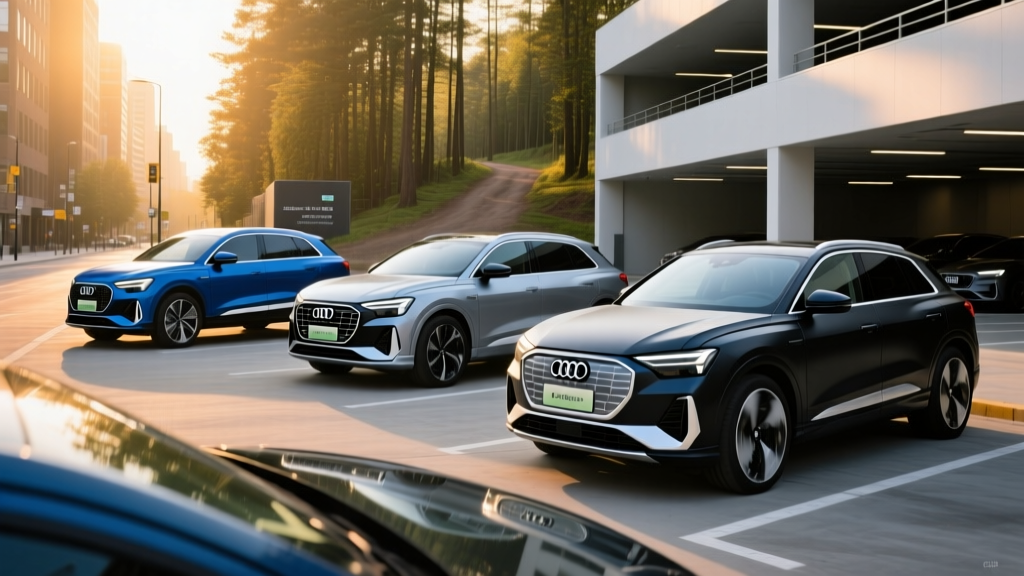
Quick Answer: Audi offers three all-electric SUVs for 2026: the compact Q4 e-tron (starting ~$49,800, EPA 265 mi), the midsize three-row Q6 e-tron (starting ~$63,800, EPA 321 mi), and the flagship Q8 e-tron (starting ~$74,400, EPA 285 mi). The Q4 e-tron delivers the best value and tax-credit eligibility, the Q6 e-tron offers the newest PPE platform with the fastest charging and longest range, and the Q8 e-tron provides luxury and air suspension at a premium. Your best pick depends on budget, passenger needs, and whether you qualify for the federal §30D credit.
Audi's Electric SUV Lineup at a Glance
Audi's electric SUV strategy spans three distinct vehicle classes, each built on different architecture. The Q4 e-tron rides on Volkswagen Group's MEB platform (shared with the VW ID.4), the Q6 e-tron debuts the new Premium Platform Electric (PPE) co-developed with Porsche, and the Q8 e-tron uses a modified MLB Evo platform adapted for full electrification. Understanding these platform differences matters — they directly affect charging speed, interior packaging, and long-term software capability.
| Spec | Q4 e-tron (Premium) | Q6 e-tron (Premium) | Q8 e-tron (Premium) |
|---|---|---|---|
| EPA Range | 265 mi | 321 mi | 285 mi |
| Battery (usable) | 77 kWh (NMC) | 94 kWh (NMC) | 106 kWh (NMC) |
| Peak DC Charge Rate | 175 kW | 270 kW | 170 kW |
| 10–80% DC Time | ~28 min | ~21 min | ~31 min |
| Level 2 Rate | 11.5 kW | 11.5 kW (9.6 kW std) | 19.2 kW |
| Horsepower | 282 hp (quattro) | 422 hp (quattro) | 402 hp (quattro) |
| 0–60 mph | 5.8 sec | 4.9 sec | 5.4 sec |
| MPGe (combined) | 95 MPGe | 101 MPGe | 87 MPGe |
| Cargo (rear seats up) | 24.8 cu ft | 30.1 cu ft | 28.0 cu ft |
| Base MSRP | $49,800 | $63,800 | $74,400 |
| Battery Warranty | 8 yr / 100,000 mi | 8 yr / 100,000 mi | 8 yr / 100,000 mi |
Real-World Range Reality: EPA estimates assume mixed driving at moderate temperatures. In our experience, expect ~220–240 highway miles from the Q4 e-tron at 70 mph, ~270–290 from the Q6, and ~240–260 from the Q8. In freezing weather (below 32°F), subtract 20–30% from all figures — the Q8 e-tron's standard heat pump helps, but physics still wins. Plan road trips around 180–200 miles between stops in winter conditions.
How Do Audi Electric SUVs Compare to Gas and Hybrid Alternatives?
Buyers cross-shopping an Audi all electric SUV often consider the gas-powered Audi Q5 or the Q5 PHEV (TFSI e). The financial case shifts dramatically depending on your mileage, electricity rate, and how long you keep the vehicle.
| Factor | Q6 e-tron quattro | Q5 45 TFSI (Gas) | Q5 TFSI e (PHEV) |
|---|---|---|---|
| MSRP (base) | $63,800 | $47,300 | $57,400 |
| Fuel/Energy Cost (15k mi/yr) | ~$660/yr* | ~$2,100/yr** | ~$1,200/yr*** |
| Annual Maintenance | ~$300 | ~$800 | ~$700 |
| 5-Year Energy + Maint. | ~$4,800 | ~$14,500 | ~$9,500 |
| Federal Tax Credit (§30D) | Up to $7,500**** | $0 | Up to $7,500**** |
| 5-Year Net Cost Delta | Baseline | + $1,150/yr more | +$500/yr more |
*Based on $0.14/kWh national average and 2.6 kWh/mi. **Based on $3.50/gal premium and 25 MPG combined. ***Assumes 60% electric / 40% gas driving. ****See tax credit section below — eligibility is not guaranteed.
The Q6 e-tron commands a $16,500 premium over the gas Q5, but saves roughly $1,150/year in combined fuel and maintenance. The break-even point lands around year 7–8 without incentives, or year 3–4 if you capture the full $7,500 federal credit plus state incentives. For buyers who lease, Audi frequently passes the credit through as lease cash, which can collapse the price gap immediately.
Real-World Ownership: What First-Time Audi EV Buyers Must Know
Owning an Audi electric SUV is a fundamentally different experience from owning a gas Audi. The advantages are real — instant torque, one-pedal driving, minimal maintenance, a quiet cabin — but the ownership model demands preparation.
Home Charging Is Non-Negotiable for Most Owners
Over 85% of EV charging happens at home, according to the Department of Energy. If you can install a Level 2 charger (240V, 40–48 amp circuit), every Audi e-tron SUV wakes up "full" each morning. The Q6 e-tron's 11.5 kW onboard charger adds roughly 32 miles of range per hour of Level 2 charging — enough to replenish a full day's driving in about 5 hours.
Without home charging, you'll rely on public DC fast charging and Level 2 destination chargers. This is viable if your commute is short and your area has robust infrastructure, but it adds 20–40 minutes per session and costs 2–3x more per kWh than residential rates. Audit your daily routine before committing.
| Item | Typical Cost | Notes |
|---|---|---|
| Level 2 Charger (Audi/ChargePoint) | $500–$700 | 48A hardwired recommended |
| Electrician (install + permit) | $800–$2,500 | Varies by panel proximity |
| Panel upgrade (if needed) | $1,500–$3,500 | 100A → 200A service |
| Total (typical install) | $1,300–$3,200 | Without panel upgrade |
| Total (with panel upgrade) | $2,800–$6,700 | Older homes most likely |
Climate and Driving Pattern Considerations
If you live in the northern tier (Minnesota, Maine, Colorado winters), cold weather will reduce your usable range by 20–30% in sub-freezing conditions. The Q8 e-tron includes a heat pump standard; the Q4 e-tron offers one as an option on higher trims; the Q6 e-tron includes it standard. A heat pump recovers waste heat from the drivetrain to warm the cabin, cutting HVAC energy draw by roughly 30–40% compared to resistive heating.
For road-trippers: the Q6 e-tron's 270 kW peak DC charge rate is a genuine advantage. On a Electrify America 350 kW station, you can add 150+ miles in 10 minutes. The Q4 and Q8 peak lower, meaning 10–80% sessions stretch 7–10 minutes longer on the same hardware.
Cost Breakdown: The True 5-Year Ownership Picture
| Cost Category | Q4 e-tron | Q6 e-tron | Q8 e-tron |
|---|---|---|---|
| Base MSRP | $49,800 | $63,800 | $74,400 |
| Est. Federal Credit (§30D) | Up to $7,500 | Up to $7,500 | $0 (MSRP cap) |
| Home Charger Install | $1,800 | $1,800 | $1,800 |
| 5-Year Electricity (home) | $3,300 | $3,600 | $4,100 |
| 5-Year Maintenance | $1,500 | $1,500 | $1,800 |
| 5-Year Insurance (est.) | $9,500 | $11,200 | $13,000 |
| Est. 5-Year Depreciation | $22,000 | $28,000 | $35,000 |
| 5-Year Total Cost | ~$38,400 | ~$49,100 | ~$55,100 |
Insurance estimates based on national averages for luxury EVs; actual quotes vary significantly by driver profile, ZIP code, and carrier. Depreciation estimates reflect current luxury EV market trends — EV depreciation has been steeper than gas counterparts in recent years, though this may stabilize.
The critical takeaway: the Q4 e-tron is meaningfully cheaper to own over five years, largely because it qualifies for the full federal credit (its MSRP falls under the §30D SUV cap of $80,000) and depreciates less in absolute dollars. The Q8 e-tron's MSRP exceeds the $80,000 SUV cap on most trims, eliminating the federal credit and widening the cost gap substantially.
Federal Tax Credit Eligibility: What Actually Applies to Audi e-trons
The IRS §30D Clean Vehicle Credit offers up to $7,500 for qualifying new EVs, but eligibility hinges on three filters that change frequently. As of the current tax year:
- MSRP Cap: SUVs must have an MSRP at or below $80,000. The Q4 e-tron and most Q6 e-tron trims qualify; the Q8 e-tron typically exceeds this cap.
- Buyer Income Limits: Modified AGI must not exceed $300,000 (joint), $225,000 (head of household), or $150,000 (single).
- Battery Sourcing: A percentage of critical minerals and battery components must be sourced from the U.S. or free-trade-agreement countries. These thresholds increase annually. Check the latest requirements at IRS.gov §30D page.
- Point-of-Sale Transfer: You can transfer the credit to the dealer at purchase, reducing your out-of-pocket cost immediately rather than waiting until tax filing.
The Q4 e-tron has consistently qualified for the full or partial credit, while the Q6 e-tron's eligibility depends on trim pricing and the current year's sourcing thresholds. Always verify the specific VIN on the fueleconomy.gov database before signing paperwork. If you lease rather than buy, the commercial clean vehicle credit (§45W) may allow the leasing company to claim the credit and pass savings through as reduced lease payments — a common Audi strategy.
Common Misconceptions About Audi Electric SUVs
| Myth | Fact |
|---|---|
| "The battery will need replacing in a few years." | Audi warranties the battery for 8 years/100,000 miles with a 70% capacity retention guarantee. Real-world data from MEB and PPE platforms shows 5–8% degradation over 100k miles under normal use. |
| "Charging takes too long for road trips." | The Q6 e-tron charges 10–80% in ~21 minutes at a 350 kW station. Combined with route planning via the myAudi app, most road-trip stops align with a rest break and meal. |
| "All Audi e-trons are the same underneath." | Three different platforms (MEB, PPE, MLB Evo) produce very different driving dynamics, charging profiles, and interior layouts. The Q6 e-tron's PPE architecture is a generational leap over the Q4's MEB. |
| "I need a Tesla to use Superchargers." | Audi e-trons use the CCS connector natively. Tesla has opened select Supercharger stations to non-Tesla EVs via the NACS adapter or built-in CCS-to-NACS compatibility — though availability varies by station. Audi offers a NACS adapter for newer models. |
| "Electric Audis cost more to insure." | Generally true — EV insurance premiums run 15–25% higher than equivalent gas models due to higher repair costs and parts pricing. Get quotes before purchasing. |
Decision Framework: Which Audi All Electric SUV Fits You?
Choose the Q4 e-tron if:
- Your budget is under $55,000 and you want to maximize the federal tax credit
- You need a compact SUV for commuting and city driving with occasional road trips
- You want the lowest total cost of ownership in Audi's EV lineup
- You don't regularly carry more than 4 passengers
Choose the Q6 e-tron if:
- You need three rows and the latest PPE platform technology
- Fast DC charging speed (270 kW) matters for frequent road trips
- You want the longest EPA range (321 mi) in the lineup
- Your budget allows $65,000–$75,000 and you still want §30D eligibility on mid trims
Choose the Q8 e-tron if:
- You prioritize ride comfort (standard adaptive air suspension) and flagship luxury
- You value the most powerful motor option (402 hp) and a premium interior
- You primarily drive locally and road-trip infrequently
- You accept the higher price and likely ineligibility for the federal tax credit
Frequently Asked Questions
Can I charge an Audi e-tron at a Tesla Supercharger?
Yes, with caveats. Tesla has opened a growing number of Supercharger stalls to non-Tesla EVs. Newer Audi models can use a NACS adapter to access these stations. However, not all Supercharger locations participate, and charging speeds may be limited compared to CCS-native Electrify America stations. Always check the Tesla app for station compatibility before relying on it for a road trip.
What happens if the battery degrades significantly?
Audi's high-voltage battery warranty covers 8 years or 100,000 miles, whichever comes first, guaranteeing at least 70% of original capacity. If your battery falls below that threshold within the warranty period, Audi will repair or replace it at no cost. Outside of warranty, a full battery replacement for these models currently ranges from $15,000 to $25,000 depending on the model — though individual module replacement can reduce this cost substantially.
Is the Q6 e-tron significantly better than the Q4 e-tron?
In measurable ways, yes. The Q6's PPE platform delivers 56 more miles of EPA range, a 95 kW higher peak charge rate (270 vs 175 kW), 140 more horsepower, and a more sophisticated 800-volt electrical architecture that enables faster charging and better thermal management. Whether that justifies the ~$14,000 price gap depends on your road-trip frequency and performance expectations.
Do Audi electric SUVs qualify for state incentives too?
Many states offer additional rebates, HOV lane access, or reduced registration fees for EVs. California's CVRP, Colorado's state credit, and New York's Charge Ready program are examples. These vary by jurisdiction, income level, and vehicle price — check your state energy office or AFDC state law database for current programs.
How does towing affect range on the Q8 e-tron?
The Q8 e-tron is rated for up to 4,000 lbs of towing capacity. Expect range to drop 35–50% when towing near maximum capacity at highway speeds. A 285-mile EPA range can shrink to 140–180 miles with a loaded trailer. Plan charging stops accordingly and precondition the battery before fast-charging sessions while towing.