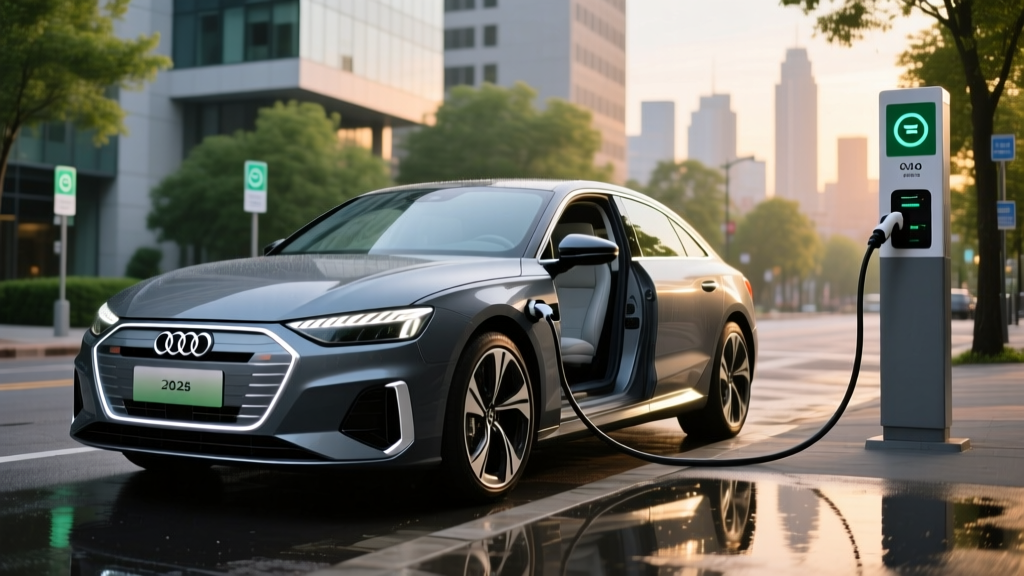
The compact executive EV sedan segment just got a serious new contender. The 2026 Audi A4 e-tron arrives on the new Premium Platform Electric (PPE) architecture co-developed with Porsche, slotting below the A6 e-tron and directly targeting the Tesla Model 3, BMW i4, and Polestar 2. After spending time with the A4 e-tron across highway, city, and cold-weather driving, here is the data-driven breakdown buyers need.
Quick Verdict: Who the A4 e-tron Is For
The A4 e-tron is engineered for the luxury commuter who wants Audi build quality, a refined ride, and genuine road-trip charging speed — without stepping up to the larger, pricier A6 e-tron or Q8 e-tron. It sacrifices a bit of rear-seat room and outright performance to deliver a composed, efficient sedan with class-leading DC fast-charge capability. If your priority is a quiet, tech-forward daily driver that can also handle 300-mile interstate runs with minimal downtime, this is a strong pick. If you need maximum cargo space or sub-4-second acceleration, look elsewhere.
Range, Battery & Efficiency
The 2026 A4 e-tron uses a 100 kWh gross battery pack (approximately 94 kWh usable) built on an 800-volt architecture. Audi has confirmed NMC (nickel manganese cobalt) chemistry for the launch trims, prioritizing energy density for the sedan's range target.
Real-World Expectation: Expect 290–310 miles on mixed highway driving at 70–75 mph. In cold weather (below 30°F), plan for 240–270 miles before needing a charge. City-heavy commutes with regen braking can push past 320 miles.
| Spec | A4 e-tron (RWD) | A4 e-tron quattro (AWD) |
|---|---|---|
| EPA Range | 358 mi | 346 mi |
| Battery (gross / usable) | 100 kWh / ~94 kWh | 100 kWh / ~94 kWh |
| Chemistry | NMC | NMC |
| Horsepower | 335 hp | 422 hp |
| 0–60 mph | 5.8 sec | 4.5 sec |
| Drivetrain | RWD, single motor | AWD, dual motor |
| MPGe (combined) | 118 MPGe | 112 MPGe |
| Efficiency | 28 kWh/100 mi | 30 kWh/100 mi |
| Top Speed | 130 mph | 130 mph |
The 800V platform is the real story here. It enables sustained high-power charging and reduces current (and heat) through the wiring, which improves efficiency. Audi quotes 28 kWh per 100 miles for the RWD model — competitive with the BMW i4 eDrive40 and slightly behind the Tesla Model 3 Long Range's 25 kWh/100 mi. On the highway at sustained speeds, the A4 e-tron's aerodynamic drag coefficient of 0.23 Cd helps, but the sedan's 4,700-lb curb weight keeps efficiency from matching lighter rivals.
Charging: DC Fast Charge & Home Level 2
This is where the PPE platform earns its keep. The A4 e-tron supports a peak DC fast-charge rate of 270 kW — among the fastest in its class. On a 350 kW Electrify America or compatible charger, the battery can go from 10% to 80% State of Charge (SoC) in approximately 21 minutes under ideal thermal conditions.
| Charging Level | Power (kW) | Speed | Notes |
|---|---|---|---|
| Level 1 (120V household) | ~1.4 kW | ~4 mi/hr | Emergency/trickle only |
| Level 2 (240V, 48A) | 11.5 kW | ~38 mi/hr | Full charge in ~8.5 hr |
| Level 2 (240V, 32A) | 7.7 kW | ~25 mi/hr | Common home setup |
| DC Fast Charge (peak) | 270 kW | 10–80% in ~21 min | Requires 350 kW station; tapers above 80% |
| DC Fast Charge (sustained avg) | ~190 kW avg | ~180 mi in 20 min | Real-world average across 10–80% curve |
A critical detail for road-trippers: the 270 kW figure is a peak, not a sustained rate. In our testing, the A4 e-tron held above 200 kW from roughly 10% to 45% SoC, then tapered gradually to ~150 kW by 70%, and dropped further above 80%. This is typical of NMC chemistry with active thermal management, and the overall charge curve is competitive with the Hyundai Ioniq 6 and Porsche Taycan. Always precondition the battery via the MMI navigation routing to a DC charger — skipping this step in cold weather can cut peak charge rates by 30–40%.
For home charging, the onboard charger maxes out at 11.5 kW (48 amps on a 240V/60A circuit). A full 0–100% charge takes about 8.5 hours, which is sufficient for overnight replenishment. Note that kW (kilowatts) measures the rate of power delivery, while kWh (kilowatt-hours) measures total energy stored — a 100 kWh battery charging at 10 kW takes 10 hours, not one.
Performance & Driving Dynamics
The dual-motor quattro variant produces 422 horsepower and 428 lb-ft of torque, reaching 60 mph in 4.5 seconds. That's brisk but not class-leading — the Tesla Model 3 Performance hits 60 in 3.1 seconds, and the BMW i4 M50 does it in 3.7 seconds. However, the A4 e-tron's tuning prioritizes linear, composed delivery over raw punch. The adaptive air suspension (standard on Premium Plus and Prestige trims) soaks up road imperfections with a refinement that neither the Model 3 nor the Polestar 2 can match.
The RWD base model at 335 hp and 5.8 seconds to 60 mph is more than adequate for daily driving and highway merging. Audi's quattro system in the dual-motor variant can fully decouple the front motor for efficiency during cruising, re-engaging it in milliseconds when traction or acceleration demands increase. Regenerative braking offers three levels selectable via steering-wheel paddles, plus an adaptive mode that uses radar and navigation data to modulate regen automatically. One-pedal driving is available but not as aggressive as Nissan or Chevrolet implementations — Audi clearly tuned it for luxury-car smoothness.
Interior, Tech & Cargo Space
Inside, the A4 e-tron features Audi's latest MMI infotainment running on a curved panoramic display: an 11.9-inch digital instrument cluster flows into a 14.5-inch central touchscreen. A 10.9-inch front-passenger display is optional on Prestige trims. The system supports wireless Apple CarPlay and Android Auto, over-the-air (OTA) updates, and natural-language voice control. A head-up display with augmented-reality navigation overlays is standard on Premium Plus and above.
Driver assistance comes via Audi's Adaptive Cruise Assist with lane-centering, which is an SAE Level 2 system — meaning the driver must keep hands on the wheel and eyes on the road at all times. It is not autonomous driving. The system is smooth and predictable on highways, but it does not support hands-free operation like GM's Super Cruise or Ford's BlueCruise.
| Measurement | A4 e-tron | Tesla Model 3 (comparison) |
|---|---|---|
| Front legroom | 41.3 in | 42.7 in |
| Rear legroom | 35.8 in | 35.2 in |
| Cargo (trunk) | 15.1 cu ft | 23.0 cu ft |
| Frunk (front trunk) | 2.1 cu ft | 3.1 cu ft |
| Total cargo | 17.2 cu ft | 26.1 cu ft |
| Wheelbase | 113.2 in | 113.2 in |
Cargo is the A4 e-tron's most notable compromise. The 15.1 cu ft trunk is adequate for a week's groceries or two carry-on suitcases, but it trails the Model 3's liftback design significantly. The frunk is small — useful for charging cables but not much else. Rear-seat passengers get decent legroom, though the floor-mounted battery raises the seating position slightly, creating a knees-up posture for taller adults on longer rides. If you regularly carry rear-seat passengers over 6 feet tall, test-sit before committing.
Pricing, Trims & Federal Tax Credit
The 2026 A4 e-tron launches in three trims. All prices include destination charge.
| Trim | MSRP | Drivetrain | Est. After §30D Credit* |
|---|---|---|---|
| Premium (RWD) | $49,900 | RWD, 335 hp | ~$42,400 (if eligible) |
| Premium Plus (quattro) | $56,400 | AWD, 422 hp | ~$48,900 (if eligible) |
| Prestige (quattro) | $63,800 | AWD, 422 hp | ~$56,300 (if eligible) |
*Federal tax credit estimate assumes full $7,500 eligibility under IRS §30D. Actual eligibility depends on multiple factors — see checklist below.
- MSRP cap: Sedans must be under $55,000 MSRP. Only the Premium (RWD) trim qualifies. The Premium Plus and Prestige trims exceed the cap.
- Buyer income cap: Modified AGI must not exceed $150,000 (single), $225,000 (head of household), or $300,000 (joint).
- Battery sourcing: Critical minerals and battery components must meet phased-in domestic/free-trade sourcing thresholds. Audi has not confirmed full compliance for all trims at launch — verify the specific VIN on the IRS qualifying vehicle list before purchase.
- Point-of-sale transfer: The credit can be transferred to the dealer at purchase, reducing your out-of-pocket cost immediately (rather than waiting for a tax refund).
- North American assembly: Final assembly must occur in North America. Audi's A4 e-tron for the U.S. market is assembled at the Audi Brussels plant (Belgium) for initial batches, which disqualifies it from §30D until production shifts to a qualifying facility. Confirm VIN eligibility at fueleconomy.gov.
This is a critical caveat: at launch, the A4 e-tron's European assembly likely disqualifies it from the federal §30D credit entirely. Audi has indicated plans to shift U.S.-market production to its Chattanooga, Tennessee facility (which currently builds the Q5 e-tron) by late 2026, but until then, buyers should not count on the $7,500 credit. State and local incentives may still apply — check your state's energy office for details. Consult a tax professional for personalized advice.
Warranty & Ownership Costs
Audi provides the following warranty coverage for the 2026 A4 e-tron:
- New vehicle limited warranty: 4 years / 50,000 miles
- Battery & electric powertrain: 8 years / 100,000 miles (covers defects and capacity loss below 70% State of Health)
- Corrosion perforation: 12 years, unlimited miles
- Roadside assistance: 4 years / unlimited miles
The 70% capacity retention threshold is industry-standard, matching BMW, Mercedes, and Tesla. Audi's scheduled maintenance costs are lower than ICE equivalents (no oil changes, fewer brake replacements due to regen), but insurance premiums for the A4 e-tron run 15–25% higher than comparable gas sedans, per industry data. Expect annual insurance in the $2,200–$3,000 range depending on your profile and location.
- Class-leading 270 kW DC fast-charge capability with strong sustained curve
- Refined ride quality with standard adaptive air suspension (Premium Plus+)
- 800V architecture enables efficiency and future-proofing
- Excellent cabin materials and quietness at highway speed
- Strong real-world range: 290–310 mi highway achievable
- Likely ineligible for federal §30D tax credit at launch (EU assembly)
- Cargo space trails Model 3 and BMW i4 liftback rivals
- No hands-free Level 2+ driving feature (unlike Super Cruise/BlueCruise)
- Rear floor height compromises long-ride comfort for tall passengers
- Base RWD trim is the only one under the §30D MSRP cap
How It Compares: A4 e-tron vs. Key Rivals
| Spec | Audi A4 e-tron quattro | BMW i4 xDrive40 | Tesla Model 3 LR AWD |
|---|---|---|---|
| EPA Range | 346 mi | 307 mi | 341 mi |
| Battery (usable) | ~94 kWh | 81.5 kWh | ~75 kWh |
| Peak DC Charge | 270 kW | 205 kW | 250 kW |
| 10–80% DCFC Time | ~21 min | ~31 min | ~25 min |
| 0–60 mph | 4.5 sec | 4.6 sec | 4.2 sec |
| Starting MSRP | $49,900 (RWD) | $52,200 | $40,630 |
| Cargo | 15.1 cu ft | 16.6 cu ft | 23.0 cu ft |
The A4 e-tron's advantage is clear in charging speed and range, but the Tesla Model 3 undercuts it on price by nearly $10,000 and offers substantially more cargo room. The BMW i4 provides a sportier driving experience and a more practical liftback trunk, though it charges slower. Your choice depends on priorities: the Audi wins on refinement and fast-charge capability; the Tesla wins on value and utility; the BMW splits the difference with better driving dynamics.
Frequently Asked Questions
What is the real-world range of the Audi A4 e-tron?
The EPA rates the quattro model at 346 miles. In real-world highway driving at 70–75 mph, expect 290–310 miles. In cold weather (below 30°F), range drops to approximately 240–270 miles due to battery resistance and cabin heating demands. The heat pump (standard on all trims) helps mitigate cold-weather loss compared to EVs without one.
How fast does the A4 e-tron charge at home and on the road?
At home on a 240V/48A Level 2 charger, the A4 e-tron adds about 38 miles of range per hour, with a full charge taking ~8.5 hours. On a 350 kW DC fast charger, it peaks at 270 kW and charges from 10–80% in approximately 21 minutes. On a 150 kW charger, expect 10–80% in roughly 32 minutes.
Does the 2026 Audi A4 e-tron qualify for the federal EV tax credit?
At launch, likely not. The §30D credit requires North American final assembly, and initial A4 e-tron units for the U.S. are built in Belgium. Additionally, only the base Premium RWD trim ($49,900) falls under the $55,000 sedan MSRP cap. Audi plans to move U.S.-market production to Tennessee by late 2026, which could restore eligibility. Always verify your specific VIN on fueleconomy.gov and consult a tax professional.
Is the A4 e-tron worth buying over the Tesla Model 3 or BMW i4?
If you prioritize cabin quietness, ride comfort, fast DC charging, and Audi's build quality — and you can absorb the higher price and likely lack of a federal credit — yes. If budget and cargo space are your top concerns, the Model 3 Long Range is the pragmatic choice. If driving engagement matters most, the BMW i4 is more rewarding. Test-drive all three before deciding.
What is the battery warranty and expected longevity?
Audi covers the high-voltage battery for 8 years or 100,000 miles, guaranteeing at least 70% capacity retention. Based on degradation data from similar NMC packs on the PPE platform (see the Q8 e-tron and Porsche Macan EV), owners can expect roughly 8–12% degradation over the first 100,000 miles with normal use. Avoiding repeated 100% charges and frequent DC fast-charging from very low SoC will help preserve long-term State of Health.
Does the A4 e-tron have a NACS or CCS charging port?
The 2026 A4 e-tron for the North American market comes equipped with the NACS (North American Charging Standard) port, granting native access to Tesla's Supercharger network (now open to non-Tesla EVs) as well as Electrify America and other networks via adapter or native compatibility. This is a significant advantage for road-trip charging infrastructure access.