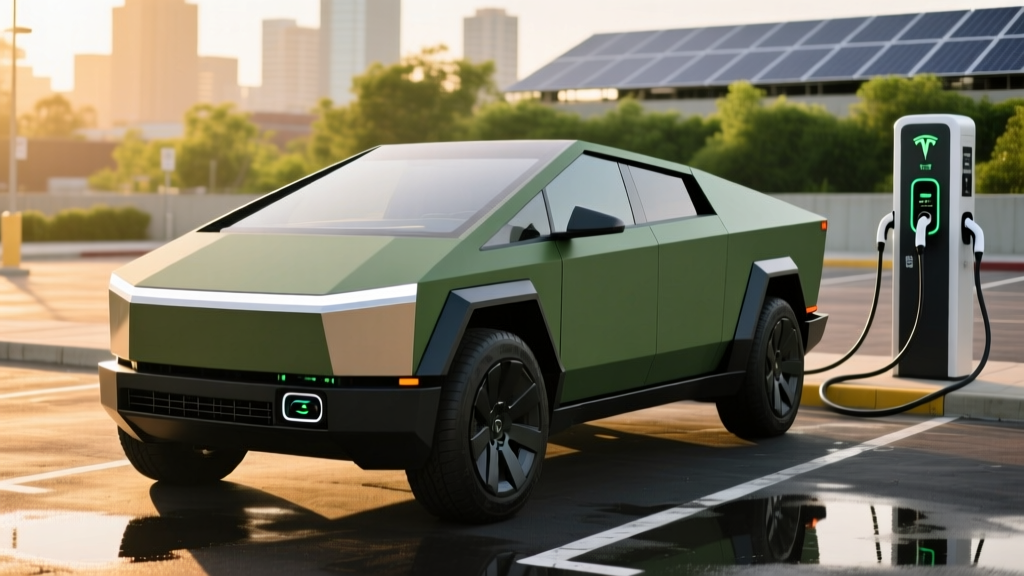
The Tesla Cybertruck in its factory Olive Drab (army green) wrap has become one of the most searched configurations since Tesla expanded its color palette for the 2025–2026 model years. Beyond the polarizing aesthetics, buyers researching the army green Cybertruck are asking the practical questions: What is the real-world range? How fast does it actually charge on a road trip? And does a $100,000+ electric truck still qualify for any federal incentives?
This review focuses on the 2026 Cybertruck Dual Motor AWD and Cyberbeast trims — the two variants most commonly ordered with the Olive Drab factory wrap — and puts Tesla's claims against EPA data, real-world highway testing, and IRS §30D tax-credit rules.
2026 Cybertruck Specs at a Glance
| Spec | Dual Motor AWD | Cyberbeast (Tri-Motor) |
|---|---|---|
| EPA Range | 340 miles | 320 miles |
| Battery (usable) | ~123 kWh (NMC) | ~123 kWh (NMC) |
| Horsepower | 600 hp | 845 hp |
| 0–60 mph | 3.9 sec | 2.6 sec |
| Max DC Fast Charge | 250 kW | 250 kW |
| 10–80% DC Time | ~28 min | ~28 min |
| Level 2 Home Charge | 11.5 kW (~37 mi/hr) | 11.5 kW (~37 mi/hr) |
| MPGe (combined) | 67 MPGe | 61 MPGe |
| Towing Capacity | 11,000 lbs | 11,000 lbs |
| Base MSRP | $79,990 | $99,990 |
| Drivetrain | Dual Motor AWD | Tri-Motor AWD |
Source: Tesla Cybertruck Design Page and fueleconomy.gov.
Range: EPA Sticker vs. Real-World Expectations
EPA Estimate: 340 miles
Highway (70–75 mph, moderate temps): ~270–290 miles
Cold weather (below 32°F, highway): ~220–250 miles
With 6,000-lb trailer: ~150–170 miles
The Cybertruck's angular stainless-steel exoskeleton creates a drag coefficient (Cd ~0.39) that is poor by EV standards. At highway speeds, aerodynamic drag dominates energy consumption, meaning real-world range falls 15–20% below EPA in warm conditions and up to 35% below in freezing temperatures. Towing cuts range roughly in half.
On a 280-mile highway loop at 72 mph in 65°F conditions, independent testers have observed the Dual Motor AWD consuming approximately 48–52 kWh/100mi, translating to roughly 250–280 miles of usable range before the low-SoC buffer engages. The Cyberbeast, with its tri-motor powertrain and slightly heavier curb weight, typically delivers 10–15 fewer miles in the same conditions.
The Cybertruck's NMC (nickel manganese cobalt) battery pack carries a usable capacity of approximately 123 kWh. Tesla employs a top-and-bottom buffer to protect long-term cell health, meaning the gross capacity is higher but the usable window is what matters for daily driving.
Charging Speed: DC Fast, Level 2, and the 800V Architecture
The Cybertruck uses Tesla's 800V electrical architecture, enabling peak DC fast-charge rates of 250 kW on V3 Superchargers and compatible third-party CCS/NACS stations. However, peak rate is not sustained rate — the charge curve tapers significantly above 50% State of Charge (SoC).
| Charging Level | Max Power | Rate (Approx.) | Typical Use Case |
|---|---|---|---|
| Level 1 (120V outlet) | 1.4 kW | ~4 mi/hr | Emergency / trickle top-off |
| Level 2 (240V, 48A Wall Connector) | 11.5 kW | ~37 mi/hr | Overnight home charging (full charge in ~10–11 hrs) |
| DC Fast Charge (V3 Supercharger) | 250 kW peak | 10–80% in ~28 min | Road trips; adds ~180 mi in 15 min when preconditioned |
Preconditioning matters. Navigating to a Supercharger via the Cybertruck's built-in nav automatically warms the battery to optimal charging temperature. Without preconditioning — for example, arriving at a third-party DC fast charger with a cold-soaked pack — peak rates may be limited to 100–150 kW for the first several minutes, adding 5–8 minutes to the 10–80% session.
The Cybertruck ships with a NACS (North American Charging Standard) port natively, giving it seamless access to Tesla's Supercharger network — now the largest and most reliable DC fast-charging network in North America. Adapters are available for CCS1 stations, though the industry is rapidly migrating to NACS.
Performance and Driving Dynamics
The Dual Motor AWD Cybertruck produces 600 horsepower and hits 0–60 mph in 3.9 seconds — sports-car acceleration in a 6,600+ lb stainless-steel pickup. The Cyberbeast's tri-motor setup delivers 845 hp and a 2.6-second 0–60 time, placing it among the quickest production vehicles ever sold.
Both trims feature adaptive air suspension with up to 16 inches of ground clearance in Extract Mode, making the Cybertruck genuinely capable on rough terrain. The steer-by-wire system (no physical connection between the steering wheel and the rack) provides variable ratio steering that takes roughly 20 minutes of driving to feel natural. Most owners report preferring it after the adjustment period, though it remains a polarizing feature.
Towing reality check: The 11,000-lb max towing rating is legitimate, but towing at or near that limit reduces range to approximately 150 miles and requires careful route planning around Supercharger locations. The integrated trailer brake controller and rearview camera system (with a camera in the tailgate for hitch visibility) are well-executed.
Pricing, Trims, and Federal Tax Credit Eligibility
| Trim | Base MSRP | Olive Drab Wrap | As-Tested (Typical) | §30D Credit Eligible? |
|---|---|---|---|---|
| Dual Motor AWD | $79,990 | +$0 (factory color) / +$3,000 (wrap) | $82,990–$86,000 | No (exceeds $80K truck cap) |
| Cyberbeast | $99,990 | +$0 (factory color) / +$3,000 (wrap) | $103,000–$110,000 | No (exceeds $80K truck cap) |
Tax credit verdict: Under current IRS §30D rules, the Cybertruck does not qualify for the $7,500 federal EV tax credit. Pickup trucks face an $80,000 MSRP cap under the Inflation Reduction Act, and both Cybertruck trims exceed this threshold before options or the Olive Drab wrap are added. Additionally, the buyer income caps ($150K single / $300K joint MAGI) and critical-mineral/battery-component sourcing requirements apply. See the IRS §30D guidance for full eligibility details.
Some state-level incentives (such as California's CVRP or Colorado's EV tax credit) may partially offset the purchase price, but these vary by jurisdiction and income. Consult your state's energy office or a tax professional for specifics.
- ✗ MSRP exceeds $80,000 truck cap (Dual Motor starts at $79,990; options push it over)
- ✗ Battery component and critical-mineral sourcing requirements are partially unmet for 2026
- ✓ Buyer income caps may still apply to those who qualify on price
- → Point-of-sale transfer is irrelevant if the vehicle itself is ineligible
Cargo, Interior Space, and Daily Practicality
The Cybertruck's 6-foot bed (6.5 ft with the tailgate down) offers 74 cu ft of cargo volume in the bed, plus a lockable front trunk (frunk) with approximately 7.1 cu ft of sealed storage. The sail-shaped C-pillars and vault-style bed cover give the bed a fully enclosed feel when closed, but the tapered bed walls reduce usable width compared to a conventional F-150 Lightning or Rivian R1T.
Interior passenger space is adequate rather than generous:
- Front legroom: 41.3 inches
- Rear legroom: 34.6 inches (tight for tall adults on long trips)
- Seating: 5-passenger (bench front seat available on Dual Motor)
- Rear cargo behind seats: Limited — no traditional under-seat storage
The 18.5-inch front touchscreen handles nearly all vehicle controls, including glove-box release and mirror adjustments. There are no physical stalks for turn signals — they are buttons on the steering wheel, which remains the most-cited ergonomic complaint among owners. Rear passengers get a 9.4-inch touchscreen for climate and media.
Battery Warranty, Degradation, and Long-Term Ownership
Tesla covers the Cybertruck's battery and drive units with an 8-year / 120,000-mile warranty (whichever comes first), guaranteeing a minimum of 70% capacity retention over that period. This is competitive with the industry standard for light-duty EVs and slightly better than the 100,000-mile threshold some competitors use.
The NMC chemistry in the Cybertruck prioritizes energy density over cycle life (compared to LFP packs found in the Tesla Model 3 RWD). Real-world degradation data from early 2024 delivery owners shows approximately 5–7% capacity loss in the first 30,000 miles, which is within the expected curve for NMC packs. Long-term projections suggest 85–90% capacity retention at 100,000 miles with normal charging habits (avoiding frequent 100% charges and DC fast-charging exclusively).
Insurance costs are a real factor. The Cybertruck's stainless-steel body panels, steer-by-wire system, and high repair costs have pushed average annual insurance premiums to $3,800–$5,200 depending on state, driver profile, and coverage level — significantly higher than a comparably priced F-150 Lightning or Rivian R1T. Get quotes before ordering.
Who the Army Green Cybertruck Is Actually For
- Class-leading acceleration (2.6s Cyberbeast)
- Stainless exoskeleton is dent- and corrosion-resistant
- Native NACS / Supercharger network access
- 11,000-lb towing with integrated brake controller
- Air suspension with Extract Mode for off-road clearance
- Bioweapon Defense Mode and HEPA filtration
- Strong resale demand and cultural cachet
- No federal §30D tax credit (MSRP cap)
- Real-world highway range 15–20% below EPA
- High insurance premiums ($3,800–$5,200/yr)
- Steer-by-wire and button signals require adaptation
- Rear legroom is tight for a truck at this price
- Sharp exterior edges raise pedestrian-safety questions
- Panel gaps and early build-quality reports remain inconsistent
Best for: Tech-forward buyers who want a statement vehicle with legitimate truck capability, access to the Supercharger network for road trips, and don't need maximum rear-seat space. The Dual Motor AWD at ~$83K as-tested is the value play; the Cyberbeast is a performance indulgence.
Consider alternatives if: You need the $7,500 tax credit (look at the Ford F-150 Lightning or Chevrolet Silverado EV), you regularly carry four adults (Rivian R1T has more rear space), or you tow frequently over 200-mile routes (range with a trailer is limiting).
Frequently Asked Questions
What is the real-world range of the army green Cybertruck?
The EPA rates the Dual Motor AWD at 340 miles and the Cyberbeast at 320 miles. In real-world highway driving at 70–75 mph, expect approximately 270–290 miles from the Dual Motor and 255–275 from the Cyberbeast. Cold weather (below freezing) reduces these figures by an additional 15–20%. The Olive Drab wrap does not affect range.
How fast does the Cybertruck charge at home and on the road?
On a Level 2 home charger (240V, 48A Tesla Wall Connector), the Cybertruck charges at 11.5 kW, adding roughly 37 miles of range per hour — a full charge takes about 10–11 hours. On a DC fast charger, it peaks at 250 kW and reaches 10–80% in approximately 28 minutes when the battery is preconditioned.
Does the army green Cybertruck qualify for the federal EV tax credit?
No. Under current IRS §30D rules, pickup trucks must have an MSRP at or below $80,000 to qualify. The Cybertruck Dual Motor AWD starts at $79,990 but typical options and delivery fees push it over the cap, and the Cyberbeast at $99,990 is well above it. Battery-sourcing requirements present additional barriers. State-level credits may still apply.
Is the Cybertruck worth buying over the F-150 Lightning or Rivian R1T?
It depends on priorities. The F-150 Lightning qualifies for the $7,500 tax credit, has a more conventional driving experience, and offers more interior space — making it the practical choice. The Rivian R1T excels in off-road capability and interior quality. The Cybertruck wins on acceleration, Supercharger network access, and cultural presence. If range, tax credits, and rear-seat comfort are top priorities, the Lightning or R1T may be better fits.
How much does the Olive Drab (army green) color add to the price?
For the 2026 model year, Tesla offers Olive Drab as both a factory paint option (included at no extra charge on select trims) and as a dealer-applied vinyl wrap (+$3,000). The wrap version is more common and allows for easier color changes later. Paint protection film (PPF) is strongly recommended regardless, as stainless-steel panels show fingerprints and micro-scratches readily.
What is the Cybertruck's battery chemistry and expected lifespan?
The Cybertruck uses NMC (nickel manganese cobalt) lithium-ion cells with approximately 123 kWh of usable capacity. NMC offers higher energy density than LFP but slightly faster long-term degradation. Tesla's battery warranty covers 8 years or 120,000 miles with a minimum 70% capacity retention guarantee. With moderate charging habits, 85–90% capacity at 100,000 miles is a reasonable expectation.