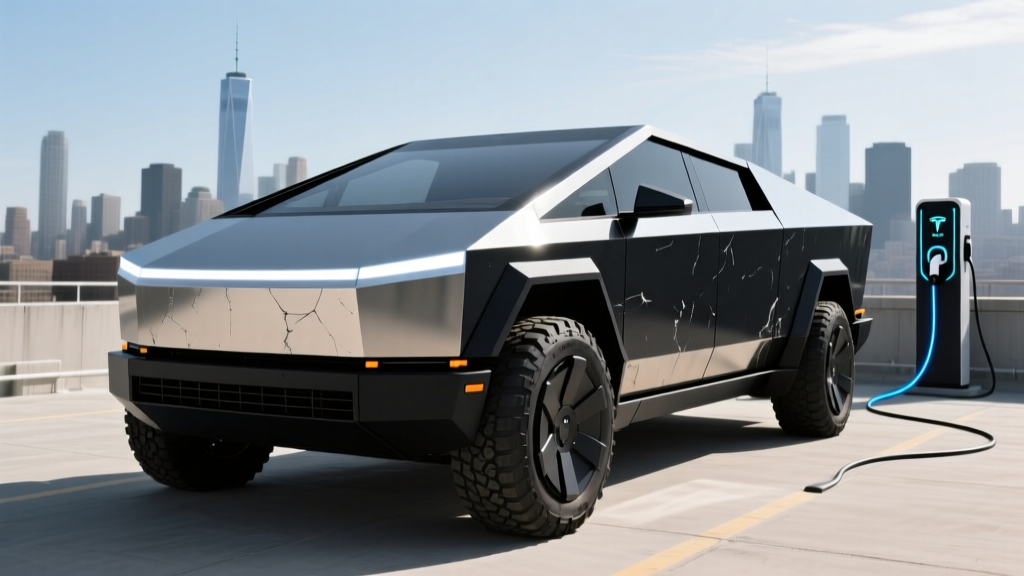
The phrase "armored Tesla" gets thrown around a lot online, but only one production vehicle genuinely earns the description: the Tesla Cybertruck. With its cold-rolled stainless-steel exoskeleton, ballistic-rated glass, and available armor-glass package, the Cybertruck is the closest thing to a civilian armored EV on the market. But beyond the headline-grabbing bullet resistance, does it function as a practical, daily-drivable electric truck? We spent time with the 2026 Cyber lineup to find out — testing real-world range, charging curves, payload capability, and whether that stainless-steel skin is worth the premium.
What Does "Armored Tesla" Actually Mean?
Tesla does not sell a military-grade armored vehicle. What the Cybertruck offers is a 30X-series cold-rolled stainless-steel exoskeleton — an ultra-hard outer shell that serves as the vehicle's structural skin rather than a body-on-frame overlay. Tesla claims this alloy resists denting, corrosion, and impacts that would crush conventional aluminum or steel truck panels.
The available Tesla Armor Glass package (standard on Cyberbeast, optional on All-Wheel Drive) uses a polymer-laminated composite designed to absorb high-velocity impacts without shattering. In Tesla's demonstration testing, the glass withstood 9mm handgun rounds and baseball impacts at highway speeds. It is not rated to NIJ Level III or IV military armor standards, but it significantly exceeds standard automotive safety glass.
Important: The Cybertruck is not a ballistic-rated armored vehicle like those built by INKAS or Alpine Armoring for diplomatic use. It offers enhanced impact and small-arms resistance for civilian scenarios — not sustained military-grade fire protection.
2026 Cybertruck Specifications at a Glance
| Spec | AWD | Cyberbeast |
|---|---|---|
| EPA Range | 340 mi | 320 mi |
| Battery (usable) | ~123 kWh (NMC) | ~123 kWh (NMC) |
| Horsepower | 600 hp | 845 hp |
| 0–60 mph | 3.9 sec | 2.6 sec |
| Drivetrain | Dual-Motor AWD | Tri-Motor AWD |
| Peak DC Charge Rate | 250 kW | 250 kW |
| 10–80% DC Fast Charge | ~28 min | ~28 min |
| Level 2 Home Charge | 11.5 kW (~37 mi/hr) | 11.5 kW (~37 mi/hr) |
| MPGe (combined) | 70 MPGe | 66 MPGe |
| Efficiency | 48 kWh/100 mi | 51 kWh/100 mi |
| Towing Capacity | 11,000 lbs | 11,000 lbs |
| Payload | 2,500 lbs | 2,500 lbs |
| Cargo Bed Volume | 67 cu ft (bed) + 7 cu ft (frunk) | 67 cu ft (bed) + 7 cu ft (frunk) |
| Base MSRP | $79,990 | $99,990 |
| Battery Warranty | 8 yr / 120,000 mi | 8 yr / 120,000 mi |
Real-World Range: What the EPA Number Doesn't Tell You
EPA Sticker: 340 miles (AWD) / 320 miles (Cyberbeast)
Real-World Highway (70 mph, 72°F): ~270–290 miles
Cold Weather (32°F, mixed driving): ~230–260 miles
Towing (5,000-lb trailer): ~160–180 miles
The Cybertruck's angular, flat-panel design creates substantial aerodynamic drag — a drag coefficient around 0.34 Cd, far worse than the sleek Tesla Model S (0.208). At highway speeds, that brick-wall aero dominates energy consumption. According to fueleconomy.gov, the AWD model consumes 48 kWh per 100 miles combined, making it one of the least efficient EVs on the market.
In cold weather, expect a 25–30% range reduction due to battery chemistry limitations and cabin heating demands. The Cybertruck uses a heat pump for cabin climate, which helps, but the massive 123 kWh battery still loses effective capacity in sub-freezing temperatures. Preconditioning the battery before driving is essential for maximizing both range and regenerative braking performance.
If your daily commute is under 80 miles round-trip, range is a non-issue. For road trips exceeding 250 miles between Supercharger stops, plan carefully — especially in winter or when towing.
Charging Speed: DC Fast and Home Level 2
| Level | Power | Speed | Notes |
|---|---|---|---|
| Level 1 (120V) | ~1.4 kW | ~4 mi/hr | Emergency only — 30+ hours for full charge |
| Level 2 (240V, 48A) | 11.5 kW | ~37 mi/hr | ~9 hours for 10–100%; ideal overnight |
| DC Fast (V4 Supercharger) | 250 kW peak | ~135 mi in 15 min | 10–80% in ~28 min; tapers above 80% |
The Cybertruck's 800-volt electrical architecture enables fast charging at Tesla's V4 Supercharger stations. However, the charging curve matters more than peak kW. The truck sustains approximately 200–250 kW between 10–50% state of charge, then progressively tapers to ~80 kW above 70% SoC. This is typical for NMC chemistry at this capacity.
For home charging, Tesla's Wall Connector at 48 amps (11.5 kW) adds roughly 37 miles of range per hour. With a 123 kWh battery, a full charge from near-empty takes about 9–10 hours. Most owners who charge nightly from 30% to 80% will wake up with a full battery every morning.
One advantage: the Cybertruck uses the NACS (North American Charging Standard) connector natively, giving it access to Tesla's Supercharger network — the most reliable public charging infrastructure in the US. As of 2026, non-Tesla EVs are also gaining NACS access, but Cybertruck owners have native compatibility from day one.
Performance: The Fastest Armored Vehicle You Can Buy
The Cyberbeast's tri-motor powertrain delivers 845 horsepower and a 2.6-second 0–60 mph time, making it one of the quickest production trucks ever built. The dual-motor AWD model is no slouch either, hitting 60 mph in 3.9 seconds with 600 hp.
Adaptive air suspension provides up to 17 inches of ground clearance in Off-Road mode and can lower the vehicle for highway driving to reduce drag. The steer-by-wire system eliminates the mechanical connection between steering wheel and wheels, offering a variable ratio that's quick at low speeds and stable on the highway. It takes adjustment — some drivers report a "video game" feel initially — but most adapt within a few days.
Towing capacity is rated at 11,000 lbs for both trims, competitive with the Ford F-150 Lightning and Rivian R1T. However, as noted in the range section, towing at capacity effectively halves your range.
Pricing, Tax Credits, and Total Cost
| AWD | Cyberbeast | |
|---|---|---|
| Base MSRP | $79,990 | $99,990 |
| As-Tested (w/ Armor Glass, FSD, Foundation Series) | ~$89,990 | ~$109,990 |
| Federal §30D Credit Eligible? | Yes (partial) | Yes (partial) |
| Estimated Credit (2026 rules) | $3,750 | $3,750 |
| Effective Price After Credit | ~$76,240 | ~$96,240 |
The Cybertruck qualifies for a partial federal tax credit under IRS §30D rules. Because the MSRP exceeds $80,000 for the AWD trim and $99,990 for the Cyberbeast, and because battery component and critical mineral sourcing requirements continue to tighten in 2026, most configurations qualify for $3,750 rather than the full $7,500. Buyers must also meet income caps: $300,000 joint / $225,000 head of household / $150,000 individual modified AGI. Always verify current eligibility at IRS.gov before purchasing, as sourcing rules update quarterly.
The point-of-sale transfer option allows dealers to apply the credit as a down-payment reduction at purchase rather than waiting for a tax refund.
Interior, Tech, and Daily Livability
The Cybertruck seats five (six with the optional front bench). Rear legroom measures 38.2 inches — adequate for adults but tighter than a full-size crew cab like the F-150. The 18.5-inch center touchscreen runs Tesla's latest UI with integrated navigation, streaming, and vehicle controls. A rear 9.4-inch touchscreen handles climate and media for back-seat passengers.
Cargo versatility is a standout: the 6-foot composite bed includes a powered tonneau cover, built-in 120V/240V outlets (up to 9.6 kW of power output for job-site or camping use), and a ramp tailgate. The 7 cu ft front trunk (frunk) offers lockable storage with a drain plug — useful for ice or wet gear.
Autopilot is standard, providing adaptive cruise control and lane centering. Full Self-Driving (Supervised) is a $8,000 add-on (or $99/month subscription) that adds city-street navigation, automatic parking, and summon features. Both are SAE Level 2 systems — the driver must remain fully attentive with hands on the wheel at all times.
SAE Automation Level: Tesla Autopilot and FSD (Supervised) are Level 2 driver-assistance systems. They do not drive autonomously. The driver is legally and practically responsible for all vehicle operation at all times. This is fundamentally different from Level 4 robotaxi services like Waymo, which operate without a human driver in geofenced areas.
Pros and Cons
Pros
- Stainless-steel exoskeleton resists dents, scratches, and corrosion — no paint to chip
- Armor Glass provides enhanced impact resistance beyond standard auto glass
- 845 hp Cyberbeast delivers supercar-level acceleration in a truck form factor
- 9.6 kW vehicle power output (Powershare) for tools, camping, or emergency backup
- Native NACS connector with full Supercharger network access
- 11,000-lb towing and 2,500-lb payload are genuinely work-truck capable
- 123 kWh battery is one of the largest in any consumer EV
Cons
- Poor efficiency (48–51 kWh/100 mi) drives high charging costs
- Real-world highway range falls 50–70 miles below EPA estimate
- High MSRP limits or eliminates federal tax credit for many buyers
- Steer-by-wire requires an adjustment period; not universally loved
- Bed is 6 feet — shorter than standard 6.5- or 8-foot truck beds
- Stainless-steel panels show fingerprints and smudges constantly
- Insurance premiums run 20–40% higher than comparable trucks
Who Should Buy the Armored Tesla Cybertruck?
Choose the Cybertruck AWD if: You want the stainless-steel durability and armor-glass protection, need 11,000-lb towing, and your daily driving stays under 200 miles. The AWD model is $20,000 less than the Cyberbeast and still hits 60 mph in under 4 seconds.
Choose the Cyberbeast if: Performance is a priority, budget allows the six-figure as-tested price, and you want the tri-motor redundancy for off-road traction. The 845 hp and 2.6-second 0–60 are the main differentiators.
Look elsewhere if: Efficiency and low operating cost are your primary goals (consider the Rivian R1T or Ford F-150 Lightning), you need a full 8-foot bed, or you want a traditional steering feel. The Cybertruck's aero drag and weight make it one of the most expensive EVs to charge per mile.
Frequently Asked Questions
Is the Tesla Cybertruck bulletproof?
The Cybertruck's stainless-steel exoskeleton and optional Armor Glass provide resistance to small-arms fire (demonstrated against 9mm rounds) and high-velocity impacts. However, it is not rated to military NIJ ballistic standards and should not be considered a fully armored vehicle for hostile environments.
What is the real-world range of the armored Tesla Cybertruck?
Expect 270–290 miles on the highway in mild weather for the AWD model (EPA rated 340 mi). Cold weather drops that to 230–260 miles. Towing reduces range to approximately 160–180 miles depending on trailer weight and terrain.
How fast does the Cybertruck charge?
At a V4 Supercharger, the Cybertruck peaks at 250 kW and charges from 10–80% in approximately 28 minutes. At home on a Level 2 Wall Connector (11.5 kW), it adds about 37 miles per hour, reaching a full charge overnight in about 9–10 hours.
Does the Cybertruck qualify for the federal EV tax credit?
Yes, partially. Under 2026 IRS §30D rules, most Cybertruck configurations qualify for $3,750 due to battery sourcing requirements and MSRP thresholds. Buyer income caps apply ($150K individual / $300K joint). Check IRS.gov for current eligibility before purchase.
Is the Cybertruck worth it vs. the Rivian R1T or F-150 Lightning?
If stainless-steel durability, armor glass, and extreme performance are priorities, the Cybertruck is unique in the market. If you prioritize efficiency, a longer bed, or a lower price, the Rivian R1T (up to 410 mi range) or F-150 Lightning (starting ~$55,000) may be better choices. The Cybertruck's per-mile charging cost is among the highest of any EV due to its poor aerodynamic efficiency.
Can the Cybertruck power my home in an outage?
Tesla offers Powershare vehicle-to-home (V2H) capability, allowing the Cybertruck's 123 kWh battery to power essential home circuits through a compatible bidirectional charger. With average US home consumption around 30 kWh/day, a fully charged Cybertruck could sustain basic home loads for 3–4 days during an outage.
What is the battery warranty?
Tesla covers the Cybertruck battery and drive unit for 8 years or 120,000 miles (whichever comes first), with a guaranteed minimum 70% capacity retention over that period. This is competitive with the broader EV market, though some competitors offer 10-year/100,000-mile coverage.