Where Are Teslas Actually Built in 2026?
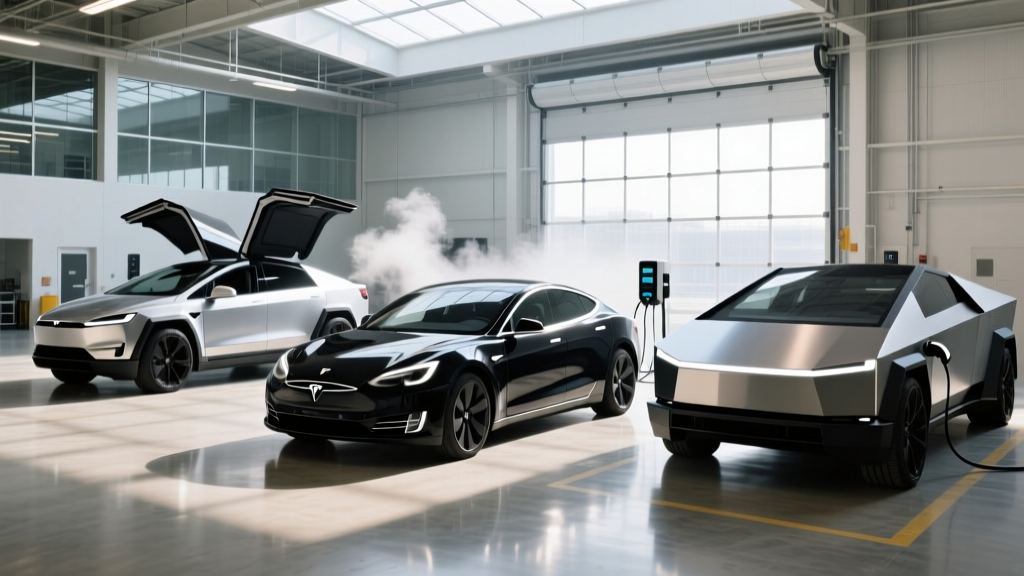
The short answer to "are Teslas made in the US" is: most of them, yes — but not all, and not every trim. Tesla operates four vehicle assembly plants worldwide, and the one that built your car matters for everything from delivery timelines to federal tax credit eligibility under IRS §30D. For US buyers in 2026, understanding which factory produced your Model 3, Model Y, Model S, Model X, or Cybertruck is no longer trivia — it's a purchase-decision variable.
| Factory | Location | Models Produced | Primary Market |
|---|---|---|---|
| Fremont Factory | Fremont, California | Model S, Model X, Model 3, Model Y | North America, select exports |
| Giga Texas | Austin, Texas | Model Y, Cybertruck | North America |
| Giga Shanghai | Shanghai, China | Model 3, Model Y | Asia-Pacific, Europe, Canada |
| Giga Berlin | Grünheide, Germany | Model Y | Europe |
If you buy a Tesla in the United States, it was almost certainly assembled at Fremont or Giga Texas. Giga Shanghai vehicles are occasionally redirected to North America during high-demand periods, but as of the 2026 model year, US-market inventory is overwhelmingly domestic. The bigger question for buyers is whether the battery cells and critical minerals inside that US-assembled car meet the increasingly strict sourcing requirements of the federal clean vehicle credit.
2026 Tesla Lineup: Range, Charging & Specs by Model
Below is the full 2026 Tesla passenger-vehicle lineup with the numbers that actually matter: EPA range, usable battery capacity, DC fast-charge peak and real-world 10-80% times, and efficiency. We've flagged the chemistry (LFP vs. NMC) because it affects longevity, cold-weather behavior, and charging habits.
| Model / Trim | EPA Range | Battery (usable kWh) | Chemistry | Peak DC kW | 10-80% Time | 0-60 mph | HP | MPGe (comb.) |
|---|---|---|---|---|---|---|---|---|
| Model 3 RWD | 272 mi | 57.5 | LFP | 170 kW | ~25 min | 5.8 s | 283 | 132 |
| Model 3 Long Range AWD | 341 mi | 75.0 | NMC | 250 kW | ~22 min | 4.2 s | 366 | 131 |
| Model 3 Performance | 315 mi | 75.0 | NMC | 250 kW | ~22 min | 2.9 s | 510 | 121 |
| Model Y Long Range AWD | 320 mi | 75.0 | NMC | 250 kW | ~23 min | 4.8 s | 384 | 122 |
| Model Y Performance | 293 mi | 75.0 | NMC | 250 kW | ~23 min | 3.5 s | 480 | 111 |
| Model S Long Range | 402 mi | 95.0 | NMC | 250 kW | ~27 min | 3.1 s | 670 | 120 |
| Model S Plaid | 359 mi | 95.0 | NMC | 250 kW | ~27 min | 1.99 s | 1,020 | 116 |
| Model X Long Range | 348 mi | 95.0 | NMC | 250 kW | ~28 min | 3.8 s | 670 | 109 |
| Cybertruck AWD | 340 mi | 123.0 | NMC | 250 kW | ~30 min | 4.1 s | 600 | 2.0 kWh/mi |
Real-World Range vs. the EPA Sticker
EPA range is measured on a controlled dynamometer cycle and then adjusted downward by a factor — it's a useful comparison tool, but it is not what you'll see on a Tuesday morning commute in January. Here's how Tesla's 2026 lineup translates once you leave the lab.
- Model 3 Long Range (EPA 341 mi): Expect 290-310 mi on a flat 70-mph highway run in mild weather. In sub-30°F conditions without preconditioning, drop that to 230-250 mi.
- Model Y Long Range (EPA 320 mi): Highway reality is ~270-290 mi. The taller, less aero crossover body costs you about 10% vs. the Model 3 at speed.
- Model S Long Range (EPA 402 mi): The 95 kWh pack and heat pump deliver ~340-360 mi highway in temperate weather — still the longest real-world range of any current Tesla.
- Cybertruck AWD (EPA 340 mi): Heavy, angular, and thirsty. Real-world highway range is closer to 280-300 mi. Towing a 5,000-lb trailer cuts that roughly in half.
- LFP note (Model 3 RWD): LFP chemistry loses slightly more capacity in extreme cold than NMC, but Tesla's battery thermal management mitigates most of this if you precondition via the app.
The single biggest range killer in any Tesla — or any EV — is sustained highway speed. Aerodynamic drag scales with the square of velocity, so the difference between 65 mph and 80 mph can cost you 15-20% of your range. Cold weather compounds this by increasing cabin heating demand and raising the battery's internal resistance. Always plan road trips using the in-car trip planner's estimate, not the EPA sticker.
Charging Speed: DC Fast, Level 2 & the Curve You Can't Ignore
Tesla's Supercharger network remains the most reliable public DC fast-charging ecosystem in North America, with over 6,500 V3 and V4 stalls across the US as of early 2026. But peak kW is not sustained kW, and understanding the charge curve is essential for trip planning.
| Charging Level | Power / Rate | Miles Added per Hour | Typical Use Case |
|---|---|---|---|
| Level 1 (120V household) | 1.2-1.4 kW | 3-5 mi/hr | Emergency / overnight trickle |
| Level 2 (240V home, 48A) | 11.5 kW | 37-44 mi/hr | Daily home charging |
| Level 2 (Tesla Wall Connector, 80A) | 19.2 kW | 55-65 mi/hr | Fast home / destination charging |
| DC Fast (V3 Supercharger) | Peak 250 kW | ~170 mi in 15 min (Model 3) | Road trips |
| DC Fast (V4 Supercharger) | Peak 250-350 kW* | Model-dependent | Next-gen corridor charging |
*V4 Supercharger cabinets can deliver up to 350 kW, but current Tesla vehicles are limited by their onboard charge architecture to ~250 kW peak. Future models or OTA updates may unlock higher rates.
The charge-curve reality: A Model 3 Long Range hitting a V3 Supercharger at 10% SoC will ramp quickly to ~250 kW, holding that peak until roughly 40-45% SoC. From 45-80%, the rate tapers progressively — from ~180 kW down to ~60 kW. That's why Tesla quotes 10-80% times (~22 min) rather than 0-100%. Charging from 80-100% at a DC fast charger is painfully slow and wastes your time and money. For road trips, the optimal strategy is to charge in the 10-80% window and hop to the next station.
At home, the Tesla Wall Connector on a 60A circuit (48A continuous) adds roughly 44 miles of range per hour of charging for a Model 3. Most owners who charge overnight never visit a public charger except on road trips. Home Level 2 installation typically costs $800-$2,000 depending on panel proximity and local permitting — a one-time investment that pays for itself within the first year of fuel savings for most drivers.
Pricing, Trims & the §30D Federal Tax Credit
Tesla's pricing has stabilized after several years of volatility. Here's the 2026 MSRP landscape and how the federal tax credit applies. The IRS §30D credit is now administered as a point-of-sale reduction, meaning the dealer (or Tesla directly) applies the credit at purchase and transfers it to the IRS on your behalf.
| Model / Trim | Base MSRP | As-Tested (typical config) | §30D Credit Eligible? | Effective Price (after max credit) |
|---|---|---|---|---|
| Model 3 RWD | $38,990 | $39,990 | Up to $7,500* | ~$31,490 |
| Model 3 Long Range AWD | $44,990 | $46,490 | Up to $7,500* | ~$37,490 |
| Model 3 Performance | $52,990 | $54,990 | Up to $7,500* | ~$45,490 |
| Model Y Long Range AWD | $44,990 | $46,990 | Up to $7,500* | ~$37,490 |
| Model Y Performance | $49,990 | $52,490 | Up to $7,500* | ~$42,490 |
| Model S Long Range | $79,990 | $84,990 | No (MSRP cap) | $79,990 |
| Model S Plaid | $94,990 | $99,990 | No (MSRP cap) | $94,990 |
| Model X Long Range | $79,990 | $85,990 | No (MSRP cap) | $79,990 |
| Cybertruck AWD | $79,990 | $84,990 | No (MSRP cap) | $79,990 |
*§30D eligibility is not automatic. To qualify for the full $7,500 credit on a Model 3 or Model Y, you must meet ALL of the following:
- MSRP cap: Sedans (Model 3) must be ≤$55,000; SUVs/trucks/vans (Model Y, Cybertruck) must be ≤$80,000.
- Buyer income cap: AGI ≤$150,000 (single), ≤$225,000 (head of household), ≤$300,000 (joint).
- Battery sourcing: A specified percentage of critical minerals must be sourced from the US or a free-trade-agreement country, and battery components must be manufactured or assembled in North America. These percentages increase annually. Tesla's US-built vehicles with domestic battery supply chains generally qualify, but verify on fueleconomy.gov before purchasing.
- Vehicle assembly: Final assembly must occur in North America. All US-market Teslas meet this requirement.
The Model S, Model X, and Cybertruck exceed the MSRP cap and are ineligible regardless of your income or the vehicle's sourcing. Always confirm eligibility with a tax professional and check the latest IRS guidance — these rules have shifted multiple times since 2023.
Technology, Driver Assists & the Autopilot Reality
Every 2026 Tesla ships with the same core tech stack: a 15.4-inch center touchscreen (17-inch in Model S/X), over-the-air updates, Tesla's app-based climate and charging controls, and the company's vision-only sensor suite (no radar or ultrasonic sensors on current production). The infotainment system remains one of the most responsive in the industry, with native navigation, streaming, and gaming — though the lack of Apple CarPlay and Android Auto is still a dealbreaker for some buyers.
Tesla's Autopilot and Full Self-Driving (Supervised) are SAE Level 2 driver-assistance systems. The driver must remain fully engaged, hands on or near the wheel, eyes on the road, and ready to take over instantly. These systems do NOT make the vehicle self-driving. Only Level 4 services like Waymo's robotaxi operate without a human driver. FSD (Supervised) can navigate intersections, handle highway lane changes, and follow navigation routes, but it makes errors — particularly in construction zones, unmapped areas, and adverse weather. Treat it as an advanced cruise control, not a chauffeur.
Autopilot (standard) includes Traffic-Aware Cruise Control and Autosteer. FSD (Supervised), available as a $8,000 one-time purchase or $99/month subscription, adds Navigate on Autopilot, Auto Lane Change, Autopark, Summon, and Smart Summon. In our testing, FSD performs well on well-marked highways but requires frequent interventions in urban environments. The camera-only approach means performance degrades more in heavy rain and fog than lidar-equipped competitors.
Notable tech features: Sentry Mode (360° parking surveillance), Dog Mode (climate-controlled pet safety), the Tesla app's granular remote controls, and the Supercharger network's seamless plug-and-charge experience. The Cybertruck adds steer-by-wire and 48-volt architecture — genuinely novel engineering, though long-term reliability data is still limited.
Warranty, Ownership Costs & Cargo Practicality
Tesla's warranty structure is straightforward but not class-leading:
- Basic vehicle: 4 years / 50,000 miles
- Battery & drive unit (Model 3 RWD, LFP): 8 years / 100,000 miles, minimum 70% capacity retention
- Battery & drive unit (Long Range / Performance / S / X): 8 years / 120,000 miles (150,000 mi for Model S/X), minimum 70% retention
Out-of-warranty battery replacement costs remain a concern: roughly $12,000-$16,000 for a Model 3 pack and $18,000-$22,000 for Model S/X, based on current service pricing. However, Tesla's NMC and LFP packs have demonstrated strong longevity in real-world data, with most vehicles showing 5-8% degradation at 100,000 miles when following recommended charging practices (daily limit of 80% for NMC, 100% acceptable for LFP).
Cargo and passenger space:
| Model | Cargo (rear seats up) | Cargo (rear seats folded) | Frunk | Rear Legroom |
|---|---|---|---|---|
| Model 3 | 23 cu ft | — | 3.1 cu ft | 35.2 in |
| Model Y | 30 cu ft | 72 cu ft | 4.1 cu ft | 37.4 in |
| Model S | 28 cu ft | 63 cu ft | 5.3 cu ft | 35.4 in |
| Model X | 15 cu ft (behind 3rd row) | 82 cu ft | 6.6 cu ft | 35.5 in (2nd row) |
| Cybertruck | 6.5 ft bed (67 cu ft vault) | — | 7.1 cu ft (frunk) | 38.0 in |
Pros, Cons & Who Should Buy a Tesla in 2026
- Supercharger network: 6,500+ US stalls with plug-and-charge simplicity — still the gold standard for road-trip charging
- Class-leading efficiency: Tesla's drivetrains extract more miles per kWh than nearly any competitor
- Over-the-air updates continuously add features — no dealer visits for software improvements
- LFP battery option (Model 3 RWD) allows daily 100% charging without degradation concern
- Strong resale value relative to most EV brands, though depreciation has normalized post-2023 price cuts
- No Apple CarPlay or Android Auto — a dealbreaker for some at this price point
- Vision-only Autopilot/FSD struggles more in adverse weather than lidar/radar-assisted competitors
- Service center capacity still lags the growing fleet — wait times for non-critical repairs can stretch weeks
- Model S/X/Cybertruck priced out of §30D tax credit eligibility
- Panel gaps, paint quality, and interior material quality have improved but still draw criticism vs. legacy luxury brands
- Model 3 RWD (~$31,500 after credit): The best-value EV sedan in America. Ideal for commuters who charge at home and want a no-fuss daily driver with 272 mi of range.
- Model 3 Long Range / Model Y Long Range: Families and road-trippers who need 320+ mi of range and dual-motor AWD for snow or mountain driving.
- Model 3 Performance: Enthusiasts who want 510 HP and a 2.9-second 0-60 in a practical sedan — just don't expect the §30D credit if your config crosses $55K.
- Model S/X: Luxury buyers who prioritize range (402 mi on the S) and don't need the tax credit to justify the price.
- Cybertruck: Early adopters and truck buyers willing to accept polarizing styling and limited long-term reliability data for genuinely innovative engineering.
Is a US-Made Tesla Worth It vs. the Competition?
The "made in the US" question matters most for the tax credit and supply-chain transparency. A Fremont- or Austin-built Tesla with a domestically sourced battery pack qualifies for the full §30D credit (assuming you meet income caps), giving it a pricing advantage over imported EVs that fail the sourcing requirements. Competitors like the Hyundai Ioniq 5 (built in Georgia since late 2024) and the Ford Mustang Mach-E (built in Mexico, which may or may not qualify depending on the current year's battery-sourcing rules) are strong alternatives — but none match Tesla's Supercharger ecosystem.
If your priority is the most reliable road-trip charging experience, the deepest OTA feature set, and the best efficiency per kWh, Tesla's US-built lineup still leads. If you want CarPlay, a more traditional interior layout, or a dealer service network, the Ioniq 5, BMW i4, or Ford Mach-E deserve a serious test drive.
Frequently Asked Questions
Are all Teslas sold in the US made in America?
Nearly all, yes. US-market Teslas are assembled at the Fremont, California factory or Giga Texas in Austin. Occasional Giga Shanghai vehicles have been redirected to North America during supply crunches, but this is rare as of 2026. You can verify your vehicle's assembly location on the window sticker (Monroney label) or via the VIN — VINs starting with "5YJ" indicate US assembly.
Does the Tesla Model Y qualify for the $7,500 federal tax credit?
The Model Y Long Range and Performance (both under the $80,000 SUV MSRP cap) can qualify for up to $7,500 under §30D, provided the buyer meets income limits and the vehicle's battery meets critical-mineral and component-sourcing thresholds. Tesla's US-built Model Y vehicles with North American battery supply chains have consistently qualified. Always verify on fueleconomy.gov before finalizing your order.
What's the real-world range of a Tesla Model 3 Long Range?
The EPA rates it at 341 miles. In real-world highway driving at 70 mph in mild weather, expect 290-310 miles. In cold weather (below 30°F) without preconditioning, plan for 230-250 miles. Use Tesla's in-car trip planner for route-specific estimates — it factors in elevation, temperature, and speed and is remarkably accurate.
How fast does a Tesla charge at home?
On a Tesla Wall Connector with a 60A circuit (48A continuous), a Model 3 adds roughly 44 miles of range per hour — enough to fully replenish overnight. On a standard 240V/32A setup (like a dryer outlet with the Mobile Connector), expect about 30 miles per hour. Level 1 (120V) adds only 3-5 miles per hour and is suitable only for emergencies or very low-mileage drivers.
Is Tesla's Full Self-Driving actually self-driving?
No. FSD (Supervised) is an SAE Level 2 driver-assistance system. You must remain fully engaged, monitor the road, and be prepared to take over at any moment. It handles highway driving and navigation-based lane changes well but requires frequent interventions in construction zones, complex intersections, and poor weather. It is not autonomous driving — that term applies only to Level 4 services like Waymo.
How long does a Tesla battery last?
Tesla warranties its NMC packs for 8 years / 120,000 miles (150,000 for Model S/X) with a minimum 70% capacity retention guarantee. Real-world data from high-mileage owners shows most packs retaining 85-92% capacity at 100,000 miles when following recommended charging practices. LFP packs (Model 3 RWD) tolerate daily 100% charging better than NMC and may offer longer cycle life, though long-term fleet data is still maturing.