The question "are Teslas dangerous" trends every time a viral crash video surfaces or an Autopilot incident makes headlines. But separating emotional reactions from engineering data is the only way to make an informed purchase decision. In this deep-dive, we examine every Tesla model currently on sale — the 2026 Model Y, Model 3, Model S, and Model X — through the lens of federal crash-test data, insurance loss records, battery-fire statistics, and the real capabilities (and limits) of Tesla's driver-assistance systems.
Spoiler: the data paints a more nuanced picture than either Tesla fans or critics typically admit. Teslas are among the safest vehicles ever tested in crashes. Their driver-assist features, however, demand more vigilance than most buyers realize.
Tesla Crash-Test Ratings: What NHTSA and IIHS Actually Say
When evaluating whether any vehicle is "dangerous," the most objective starting point is controlled crash testing. Tesla models consistently earn top marks from both the National Highway Traffic Safety Administration (NHTSA) and the Insurance Institute for Highway Safety (IIHS).
| Model | NHTSA Overall | IIHS Rating | Frontal Crash | Side Crash | Rollover Risk |
|---|---|---|---|---|---|
| Model Y (2026) | 5 Stars | Top Safety Pick+ | Good / 5★ | Good / 5★ | 7.9% (very low) |
| Model 3 (Highland) | 5 Stars | Top Safety Pick+ | Good / 5★ | Good / 5★ | 6.6% (very low) |
| Model S (2026) | 5 Stars | Good (most categories) | Good / 5★ | Good / 5★ | 5.2% |
| Model X (2026) | 5 Stars | Good (most categories) | Good / 5★ | Good / 5★ | 8.4% |
The low rollover risk across all Tesla models is a direct benefit of the skateboard-style battery pack mounted along the floor, which gives these vehicles an exceptionally low center of gravity. For comparison, the average SUV rollover risk sits around 15–20%.
IIHS has also praised Tesla's standard automatic emergency braking (AEB), noting it consistently avoids or mitigates collisions at both city and highway speeds. The Model 3 Highland refresh further improved headlight ratings — a historical weak point — to "Acceptable" and "Good" depending on trim.
Autopilot and FSD: Are Tesla's Driver-Assist Systems Dangerous?
Tesla Autopilot and Full Self-Driving (Supervised) are not self-driving systems. They are SAE Level 2 driver-assistance features. The driver must remain fully attentive, keep hands on the wheel (or demonstrate engagement), and be prepared to take over instantly. Only Level 4 systems like Waymo's robotaxi operate without a human driver.
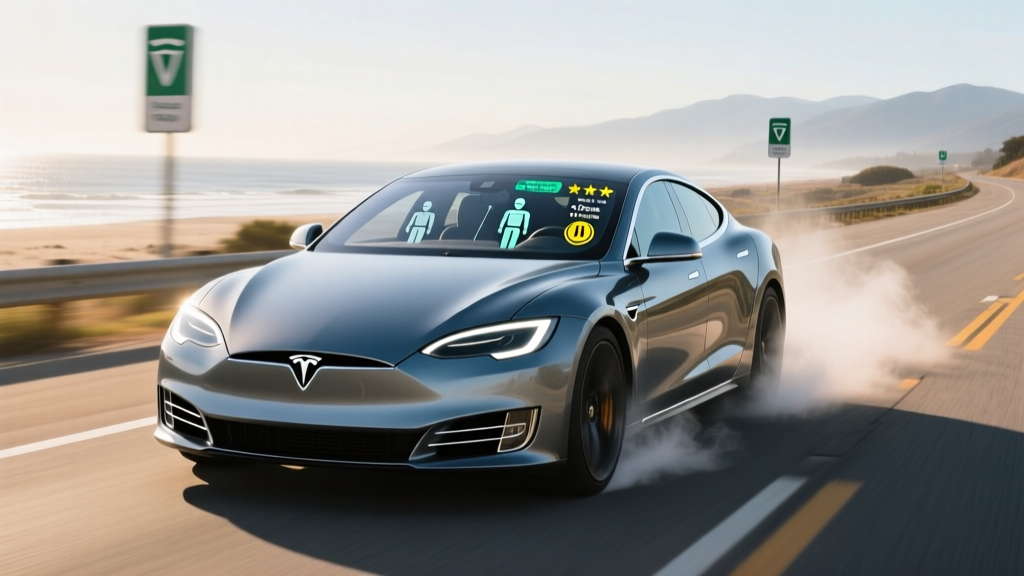
This is where the "are Teslas dangerous" debate gets heated. Tesla's Autopilot and optional FSD (Supervised) are sophisticated Level 2 systems that handle steering, acceleration, and braking on highways and some city streets. They are genuinely impressive — but their capability creates a dangerous psychological trap: overtrust.
What the NHTSA Data Shows
NHTSA's Standing General Order requires automakers to report crashes involving Level 2 and higher systems. Between 2021 and mid-2024, Tesla vehicles were involved in a significant share of reported Level 2 crashes — but context matters enormously:
- Tesla reports more data because it telemetrically logs every Autopilot engagement and crash event. Most other automakers underreport because they lack comparable telemetry.
- Miles driven on Autopilot: Tesla claims roughly 1 crash per 4–5 million Autopilot miles, versus the U.S. average of ~1 crash per 670,000 miles for all vehicles (NHTSA). This suggests Autopilot is safer than the average human driver when used correctly.
- Fatal incidents: Every confirmed Autopilot/FSD fatality has involved driver inattention — the human failed to intervene when the system encountered a scenario it couldn't handle (stationary emergency vehicles, cross-traffic, road debris).
- Reliably detect stationary objects at highway speed (overpass pillars, stopped fire trucks)
- Navigate construction zones with shifted lanes or missing lane markings
- Handle heavy rain, snow, or direct sun glare that blinds cameras
- Recognize pedestrians stepping out from behind obstacles in time to brake at speed
- Operate without a fully attentive, sober, licensed driver in the seat
The danger is not the system itself — it's the gap between what the marketing implies and what the engineering delivers. Tesla's steering-wheel torque monitoring and camera-based attention alerts have improved, but they remain easier to game than GM's Super Cruise eye-tracking or Ford's BlueCruise infrared driver monitoring.
Autopilot vs. Competing Level 2 Systems
| System | SAE Level | Hands-Free? | Driver Monitoring | Operational Domain |
|---|---|---|---|---|
| Tesla Autopilot / FSD (Supervised) | Level 2 | No (torque-based) | Camera + torque | All roads (FSD), highways (Autopilot) |
| GM Super Cruise | Level 2 | Yes (mapped roads) | Infrared eye-tracking | 400,000+ mi mapped highways |
| Ford BlueCruise | Level 2 | Yes (mapped roads) | Infrared eye-tracking | 130,000+ mi mapped highways |
| Hyundai/Kia HDA2 | Level 2 | No | Torque-based | Highways |
Battery Fire Risk: Do Teslas Catch Fire More Than Gas Cars?
Viral videos of burning Teslas create an outsized perception of fire risk. The data tells a different story.
According to a comprehensive analysis by AutoInsuranceEZ using NTSB and Bureau of Transportation Statistics data:
- Gasoline vehicles: ~1,530 fires per 100,000 vehicles
- Hybrid vehicles: ~3,475 fires per 100,000 vehicles (highest rate — due to dual powertrain complexity)
- Fully electric vehicles: ~25 fires per 100,000 vehicles
EV battery fires are exceedingly rare but harder to extinguish. Lithium-ion thermal runaway requires thousands of gallons of water and can reignite hours or days after the initial event. Fire departments are still adapting protocols for EV fires, which is why each incident generates outsized media coverage.
Tesla's structural battery pack design (especially the LFP chemistry in Standard Range models) is inherently more thermally stable than the NMC packs in Long Range and Performance variants. The 2026 Model Y uses a combination of firewalls between cell modules and a venting system designed to direct hot gases away from the cabin.
Tesla Model Lineup: Safety-Relevant Specs at a Glance
| Spec | Model 3 RWD | Model Y LR AWD | Model S LR | Model X LR |
|---|---|---|---|---|
| EPA Range | 363 mi | 337 mi | 402 mi | 335 mi |
| Battery (usable kWh) | ~60 kWh (LFP) | ~75 kWh (NMC) | ~95 kWh (NMC) | ~95 kWh (NMC) |
| 0-60 mph | 5.8 sec | 4.8 sec | 3.1 sec | 3.8 sec |
| Horsepower | 271 hp | 384 hp | 670 hp | 670 hp |
| Drivetrain | RWD | Dual-motor AWD | Dual-motor AWD | Dual-motor AWD |
| MPGe (combined) | 132 MPGe | 117 MPGe | 120 MPGe | 102 MPGe |
| Efficiency (kWh/100mi) | 25 | 29 | 28 | 33 |
| Base MSRP | $38,990 | $44,990 | $79,990 | $84,990 |
| Battery Warranty | 8 yr / 100,000 mi | 8 yr / 120,000 mi | 8 yr / 150,000 mi | 8 yr / 150,000 mi |
| Cargo Volume (cu ft) | 23 (trunk) + 3 (frunk) | 30 (rear) + 4 (frunk) | 28 (rear) + 3 (frunk) | 88 (max, seats folded) + 7 (frunk) |
| Rear Legroom (in) | 35.2 | 40.5 (updated) | 35.4 | 37.1 |
EPA estimates are laboratory-derived. In real-world driving, expect:
- Highway (70 mph, 75°F): ~85–90% of EPA — a Model Y LR delivers ~285–300 mi
- Cold weather (30°F, highway): ~65–75% of EPA — expect ~220–250 mi from a Model Y LR
- City/commute (stop-and-go, regen active): ~95–100% of EPA — you may match or exceed the sticker
Charging Speed and Infrastructure: Does It Affect Safety?
Charging infrastructure intersects with safety in two ways: stranding risk (running out of charge in an unsafe location) and the reliability of Supercharger stations, which remain the most dependable public DC fast-charging network in the U.S.
| Charging Level | Power (kW) | Model 3 / Y (10-80%) | Model S / X (10-80%) | Miles Added per Hour |
|---|---|---|---|---|
| Level 1 (120V household) | ~1.4 kW | N/A (trickle) | N/A (trickle) | 3–5 mi/hr |
| Level 2 (240V home, 48A) | 11.5 kW | ~8–9 hours (full) | ~10–11 hours (full) | 30–44 mi/hr |
| DC Fast Charge (V3 Supercharger) | Peak 250 kW | ~25–30 min | ~30–35 min | ~1,000+ mi/hr (peak) |
| DC Fast Charge (V4 Supercharger) | Peak 350 kW (cable) | ~20–25 min (LFP slower) | ~22–28 min | ~1,200+ mi/hr (peak) |
Charging-curve reality: Tesla's peak 250 kW rate only sustains between roughly 10–30% State of Charge (SoC). From 50–80%, the rate tapers to ~80–120 kW. This is normal lithium-ion behavior to protect battery health, but it means a "10–80% in 25 minutes" claim requires arriving at the charger with a very low battery and preconditioning the pack via the car's navigation routing.
With the 2025 opening of Tesla's Supercharger network to non-Tesla EVs (via the NACS standard), station congestion has increased at some popular corridors. Tesla has responded by adding stalls and deploying V4 cabinets, but peak-travel holiday waits of 15–30 minutes are now more common than in 2022.
Federal Tax Credit and Real Cost of Ownership
The IRS §30D Clean Vehicle Credit can reduce a Tesla's effective price by up to $7,500 — but eligibility is not guaranteed. Here's the 2026 framework:
- MSRP cap: Sedans (Model 3) must be ≤$55,000; SUVs/trucks (Model Y, Model X) must be ≤$80,000
- Buyer income cap: AGI ≤$150,000 (single), ≤$225,000 (head of household), ≤$300,000 (joint)
- Battery sourcing: ≥60% of battery critical minerals must be sourced from the U.S. or FTA partners; ≥60% of battery components must be manufactured/assembled in North America (2026 thresholds — these increase annually)
- Point-of-sale transfer: You can apply the credit as an instant dealer discount rather than waiting for tax filing
- One vehicle per VIN: The credit applies once per vehicle, and you cannot have claimed another §30D credit in the prior 3 years
| Model / Trim | Base MSRP | Est. Credit | Effective Price | Credit Eligible? |
|---|---|---|---|---|
| Model 3 RWD | $38,990 | $7,500 | ~$31,490 | Yes (if sourcing + income met) |
| Model 3 Long Range AWD | $45,490 | $7,500 | ~$37,990 | Yes (if sourcing + income met) |
| Model Y Long Range AWD | $44,990 | $7,500 | ~$37,490 | Yes (if sourcing + income met) |
| Model Y Performance | $48,990 | $7,500 | ~$41,490 | Yes (under $80K SUV cap) |
| Model S Long Range | $79,990 | $0 | $79,990 | No (exceeds $55K sedan cap) |
| Model X Long Range | $84,990 | $0 | $84,990 | No (exceeds $80K SUV cap) |
Important: Battery sourcing requirements tighten every year. A Model Y that qualified in 2024 may not qualify in 2026 if Tesla's supply chain shifts. Always verify current eligibility on the IRS Clean Vehicle Credit page or via the dealer's point-of-sale attestation before signing.
The Verdict: Are Teslas Dangerous?
- Crash safety: No — Teslas are among the safest vehicles on the road by every measurable metric.
- Fire risk: No — EVs have dramatically lower fire rates than gasoline vehicles.
- Autopilot/FSD: Potentially — if you treat a Level 2 system as self-driving. The technology is excellent but not autonomous.
- Pedestrian safety: Mixed — NHTSA has flagged Tesla's pedestrian detection in some scenarios, though AEB performance is generally strong.
- Stranding risk: Low — Tesla's Supercharger network remains the most reliable, though congestion is growing.
Pros
- Top-tier crash ratings (5★ NHTSA, TSP+ IIHS)
- Extremely low rollover risk from floor-mounted battery
- Best-in-class DC fast-charging network (Supercharger)
- Industry-leading efficiency (kWh/100mi)
- OTA updates continuously improve safety features
- LFP option (Model 3 RWD) offers superior thermal stability
Cons
- Autopilot/FSD marketing creates dangerous overtrust
- Camera-only vision (no LiDAR/radar) has blind-spot limitations
- Driver monitoring less robust than GM Super Cruise eye-tracking
- EV battery fires, while rare, are harder to extinguish
- Supercharger congestion increasing at peak travel times
- Model S/X exceed tax-credit MSRP caps
Who Should Buy a Tesla — and Who Should Look Elsewhere?
Choose a Tesla if: You want top crash-test ratings, access to the most reliable fast-charging network, and class-leading efficiency. The Model Y remains the default pick for families who road-trip, and the Model 3 RWD at ~$31,500 after the federal credit is arguably the best value in the EV market.
Look elsewhere if: You want hands-free highway driving with robust eye-tracking (consider GM Super Cruise vehicles), you need a truck for work (Rivian R1T, Ford F-150 Lightning), or you distrust camera-only driver-assist and want LiDAR redundancy (currently limited to Level 4 robotaxis like Waymo, not consumer vehicles).
Frequently Asked Questions
What is the real-world range of a Tesla Model Y?
The 2026 Model Y Long Range AWD carries an EPA rating of 337 miles. In real-world highway driving at 70 mph, expect approximately 285–300 miles. In cold weather (below 35°F), that drops to roughly 220–250 miles. Preconditioning the battery before departure helps recover some of that cold-weather loss.
How fast does a Tesla charge at home and on the road?
At home on a 240V Level 2 charger (48 amps / 11.5 kW), a Model Y adds roughly 30–44 miles of range per hour, fully charging overnight in 8–9 hours. On a V3 Supercharger (250 kW peak), expect a 10–80% charge in approximately 25–30 minutes, though the rate tapers significantly above 50% SoC.
Does the Tesla Model Y qualify for the federal EV tax credit?
Yes — the Model Y Long Range AWD at $44,990 is below the $80,000 SUV MSRP cap and is expected to qualify for the full $7,500 §30D credit in 2026, provided the buyer meets income thresholds and the battery sourcing requirements are satisfied at time of delivery. Always confirm with the dealer and the IRS Clean Vehicle Credit portal.
Is Tesla Autopilot safer than a human driver?
Tesla's own data suggests Autopilot achieves roughly 1 crash per 4–5 million miles, compared to the U.S. average of ~1 per 670,000 miles. However, this data is self-reported and primarily reflects highway driving, which is inherently safer. The critical caveat: every Autopilot fatality to date has involved a driver who was not paying attention. The system is a tool, not a replacement.
Are Tesla battery fires common?
No. Analysis of NTSB data shows EVs experience approximately 25 fires per 100,000 vehicles, compared to 1,530 per 100,000 for gasoline vehicles. Tesla battery fires are newsworthy precisely because they are rare — but they are more difficult for firefighters to extinguish due to lithium-ion thermal runaway characteristics.
Is the Model Y worth buying vs. the Hyundai Ioniq 5 or Ford Mustang Mach-E?
The Model Y wins on efficiency (117 MPGe vs. Ioniq 5's 114 MPGe), Supercharger network access, and cargo versatility. The Ioniq 5 offers faster 800V charging (~18 min 10–80% on 350 kW chargers) and a more comfortable ride. The Mach-E offers a more traditional driving feel. For road-trippers, the Supercharger advantage is decisive. For city commuters who prioritize comfort, the Ioniq 5 edges ahead.