The Short Answer
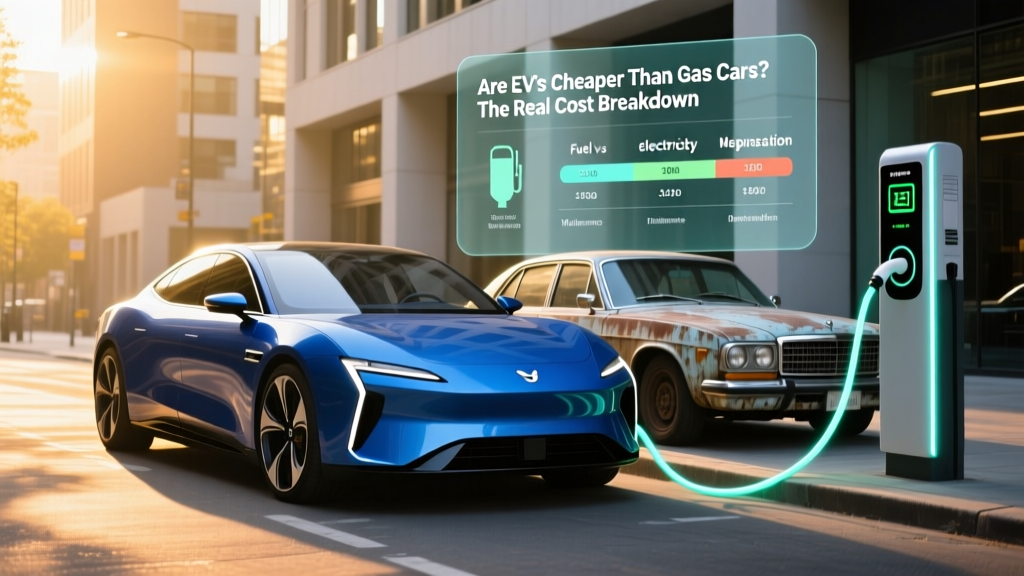
Yes, in most cases — but not for everyone. Over a 5-year ownership period, a typical EV saves $4,000–$9,000 compared to a comparable gas car when you factor in lower fuel and maintenance costs, plus available federal tax credits. However, the savings depend heavily on three variables: whether you can charge at home, your local electricity rates, and your annual mileage. If you rely exclusively on public DC fast charging in a high-rate state, an EV can actually cost more per mile than a fuel-efficient gas car.
Purchase Price: The Upfront Gap Is Narrowing
The sticker-price gap between EVs and gas cars has shrunk significantly. Battery pack prices have fallen below $100/kWh at the cell level, pushing mainstream EV pricing closer to internal combustion equivalents. Consider the current landscape:
| Vehicle (2026 MY) | Type | Base MSRP | After §30D Credit | EPA Range / MPG |
|---|---|---|---|---|
| Chevrolet Equinox EV LT | BEV | $33,600 | $26,100* | 315 mi |
| Toyota RAV4 LE (AWD) | Gas | $30,400 | — | 30 MPG combined |
| Hyundai Ioniq 5 SE | BEV | $42,600 | $35,100* | 303 mi |
| Honda CR-V EX (AWD) | Gas | $35,700 | — | 29 MPG combined |
| Tesla Model Y Long Range | BEV | $44,990 | $37,490* | 320 mi |
| Toyota RAV4 Hybrid XLE | HEV | $34,900 | — | 39 MPG combined |
*§30D credit eligibility requires meeting buyer income caps ($150K single / $300K joint), vehicle MSRP caps ($55K cars / $80K SUVs/trucks), and battery critical-mineral and component sourcing requirements. Verify current-year rules at IRS.gov. Point-of-sale transfer is available through registered dealers, reducing your out-of-pocket at purchase.
The Equinox EV at $26,100 (post-credit) undercuts the gas RAV4 by over $4,000 before you drive a single mile. But the Ioniq 5 and Model Y still carry a premium over their gas counterparts — one that fuel and maintenance savings must recoup over time.
Fuel vs. Charging: Where the Real Savings Live
This is where EVs typically win decisively — but the margin varies enormously based on how and where you charge. Let's break down the per-mile cost using national averages and real-world scenarios.
| Charging/Fueling Method | Cost per kWh or Gallon | Cost per Mile (250 Wh/mi EV / 30 MPG Gas) | Annual Cost (12,000 mi) |
|---|---|---|---|
| Home Level 2 (US avg $0.17/kWh) | $0.17/kWh | $0.043 | $510 |
| Home Level 2 (CA avg $0.30/kWh) | $0.30/kWh | $0.075 | $900 |
| Home solar ($0.06/kWh effective) | $0.06/kWh | $0.015 | $180 |
| Public DC fast (avg $0.48/kWh) | $0.48/kWh | $0.120 | $1,440 |
| Tesla Supercharger (avg $0.35/kWh) | $0.35/kWh | $0.088 | $1,050 |
| Gas car (US avg $3.40/gal, 30 MPG) | $3.40/gal | $0.113 | $1,360 |
| Hybrid (40 MPG, $3.40/gal) | $3.40/gal | $0.085 | $1,020 |
The data tells a clear story: home charging is the economic foundation of EV ownership. At the US average residential rate of $0.17/kWh, an EV costs roughly $0.04/mile to fuel — about one-third the cost of a 30 MPG gas car. Over 12,000 miles annually, that's $850/year in savings.
But notice the DC fast charging row. If you can't charge at home and rely on public chargers at $0.48/kWh (a realistic national average for Electrify America, EVgo, and ChargePoint DC stations in 2026), your per-mile cost actually exceeds that of a 30 MPG gas car. This is the single most important variable that EV critics correctly point to and that many buyers overlook.
A few nuances to factor in:
- Time-of-use rates: Many utilities offer off-peak overnight rates as low as $0.06–$0.10/kWh, which dramatically improves EV economics if you charge between 10 PM and 6 AM.
- Efficiency matters: A Hyundai Ioniq 6 (24 kWh/100 mi on the highway per fueleconomy.gov) will cost significantly less per mile than a Ford F-150 Lightning (47 kWh/100 mi) even at the same electricity rate.
- Cold-weather penalty: Expect 20–30% higher energy consumption in freezing temperatures due to battery heating and cabin climate demands. This erodes per-mile savings in northern climates during winter months.
Maintenance Costs: The Quiet Advantage
EVs have roughly 20 moving parts in their drivetrain versus 2,000+ in an internal combustion engine. That mechanical simplicity translates directly to your wallet. Here's what you can expect to spend — and save — on maintenance over 5 years and 60,000 miles:
EV Maintenance: Myth vs. Fact
| Claim | Reality |
|---|---|
| "EVs never need maintenance" | Myth. You still need tire rotations ($25–$50 each), cabin air filter replacements ($30–$60), brake fluid checks, wiper blades, and 12V battery replacement every 4–6 years. |
| "Brake pads last forever with regen" | Mostly fact. Regenerative braking handles 80–90% of deceleration. Many EV owners report original brake pads at 100,000+ miles. Budget $0 for brake pad replacement in the first 5 years. |
| "Battery replacement will bankrupt me" | Misleading. Modern LFP and NMC packs are lasting well beyond warranty periods. Federal law mandates at least 8 years/100,000 miles of battery warranty. Catastrophic failure within warranty is covered; out-of-warranty replacements run $8,000–$18,000 depending on pack size but are increasingly rare. |
| "EVs are more expensive to insure" | Partially true. Average EV insurance premiums run 15–25% higher than equivalent gas cars due to higher repair costs after collisions. A Model Y might cost $1,800–$2,400/year to insure vs. $1,400–$1,900 for a gas RAV4. Shop quotes before buying. |
Industry data from Consumer Reports and the Argonne National Laboratory estimates EV maintenance costs at roughly $0.061/mile versus $0.101/mile for gas vehicles — a savings of about $0.04/mile, or $2,400 over 60,000 miles. That's meaningful but not as dramatic as fuel savings.
Five-Year Total Cost of Ownership: The Full Picture
Let's model a realistic 5-year/60,000-mile ownership scenario comparing three popular vehicles: the Chevrolet Equinox EV (with full §30D credit), the Toyota RAV4 gas AWD, and the RAV4 Hybrid.
| Cost Category | Chevy Equinox EV 2LT ($33,600) | Toyota RAV4 AWD ($30,400) | RAV4 Hybrid ($34,900) |
|---|---|---|---|
| Purchase price (after credit) | $26,100 | $30,400 | $34,900 |
| Home Level 2 charger install | $1,200 | — | — |
| Fuel/energy (60K mi, home charging) | $2,550 | $6,800 | $5,220 |
| Maintenance (5 years) | $1,830 | $3,030 | $2,800 |
| Insurance (5 years, avg) | $10,500 | $8,250 | $8,750 |
| Estimated resale value (5 yr) | -$12,000 | -$16,500 | -$19,000 |
| Net 5-year cost | $30,180 | $31,980 | $32,670 |
In this scenario — a buyer who qualifies for the full §30D credit and charges primarily at home — the Equinox EV comes out roughly $1,800 ahead of the gas RAV4 and $2,490 ahead of the hybrid over five years. The EV wins primarily on fuel and maintenance savings, partially offset by higher insurance costs and the home charger installation.
But change the inputs and the picture shifts:
- No tax credit (income above cap or vehicle doesn't meet sourcing rules): The EV's net cost rises to $37,680, making it the most expensive option.
- 100% public DC fast charging at $0.48/kWh: Fuel cost jumps to $7,200 over 5 years, erasing most of the EV's advantage.
- 15,000 miles/year instead of 12,000: The EV's fuel savings grow proportionally, extending its lead.
- Cold climate (MN, ME): Add 25% to winter energy consumption and factor in 20–30% range loss. Savings shrink but don't disappear if you have a garage and home charging.
Real-World Ownership Factors That Change the Math
The spreadsheet calculations above assume idealized conditions. Real ownership introduces variables that can swing the economics significantly in either direction.
Home Charging Access
This is the single biggest determinant of whether an EV saves you money. If you own a home with a garage or dedicated parking spot near your electrical panel, a Level 2 (240V) charger installation typically costs $800–$2,000 including equipment and electrician labor. If your panel needs upgrading from 100A to 200A service, add $1,500–$3,500.
Apartment dwellers and street parkers face a harder equation. Workplace charging (if available) can substitute, and some municipalities are installing curbside Level 2 chargers, but relying on public infrastructure adds cost and inconvenience. If you cannot reliably access Level 1 or Level 2 charging at or near home, a hybrid (HEV or PHEV) is likely the more economical choice today.
Driving Patterns and Annual Mileage
Higher annual mileage amplifies EV savings because fuel savings scale linearly with miles driven. If you drive 20,000 miles/year on a long commute, an EV charged at home will save $1,400+/year on fuel alone. Conversely, if you drive under 8,000 miles/year, the fuel savings may not offset the higher insurance premiums within a typical ownership period.
Climate and Geography
Cold weather reduces EV range by 20–30% in sub-freezing conditions (verified by AAA and IIHS testing). A 300-mile EPA-rated EV might deliver 210–240 real-world miles at 20°F with the heater running. This doesn't eliminate savings but reduces efficiency. Heat pumps — now standard on most 2026 EVs including Hyundai, Tesla, and VW models — mitigate this loss by 10–15 percentage points compared to resistive heating.
In hot climates (AZ, TX), battery thermal management systems consume energy but modern liquid-cooled packs handle heat well. Expect minimal range loss in summer if your EV has active thermal management.
The Depreciation Wildcard
EV resale values have been volatile. Tesla's aggressive price cuts in 2023–2024 hammered used EV values industry-wide. By 2026, depreciation has stabilized somewhat, but EVs still tend to depreciate faster than Toyota/Honda gas vehicles, which hold value exceptionally well. Factor in a 55–65% depreciation over 5 years for mainstream EVs versus 45–55% for popular gas crossovers. This gap is narrowing as the used EV market matures and more buyers seek affordable electric options.
The Decision Framework: Is an EV Cheaper for You?
Choose an EV if:
- You can install a Level 2 charger at home (garage, driveway, or dedicated parking with outlet access)
- You qualify for the §30D federal tax credit (check income caps and vehicle eligibility at IRS.gov)
- You drive 10,000+ miles per year (more miles = more fuel savings)
- Your daily commute is under 80% of the EV's real-world range
- Your state offers additional EV incentives (check afdc.energy.gov for state-by-state programs)
- You have access to time-of-use electricity rates for cheap overnight charging
Choose a Hybrid (HEV/PHEV) if:
- You rent an apartment with no charging access and can't install a home charger
- You regularly drive 300+ miles between stops in areas with sparse DC fast charging
- You live in an extreme cold climate and frequently take long winter road trips
- You don't qualify for the federal tax credit and the EV's MSRP premium is more than $8,000
- You want the lowest-risk, most flexible ownership experience with no charging behavior changes
Stick with Gas (for now) if:
- You drive fewer than 6,000 miles/year (fuel savings won't offset EV premiums)
- You need to tow heavy loads regularly (EV range drops 40–50% under max tow)
- Your budget is strictly under $28,000 and no qualifying used EVs are available in your area
Common Misconceptions — Addressed with Data
"EVs are always cheaper to own." Not true for apartment dwellers without home charging, low-mileage drivers, or buyers who don't qualify for incentives. The math is favorable for most homeowners who drive average or above-average miles, but it's not universal.
"Electricity is always cheaper than gas." At home on average US rates, yes — roughly $0.04/mile vs. $0.11/mile. On public DC fast chargers at $0.48+/kWh, no — $0.12/mile actually exceeds the gas car cost. The charging method determines the economics.
"Battery replacement will cost $20,000 and strand the car." Battery packs in 2026 EVs are designed for 200,000+ mile lifespans with less than 10–15% degradation. The federal warranty mandate of 8 years/100,000 miles (with at least 70% capacity retention) provides a strong safety net. Catastrophic out-of-warranty failures remain rare, and module-level repairs are increasingly available at $2,000–$5,000 rather than full-pack replacements.
"EVs are worse for the environment because of battery mining." Lifecycle analyses from the ICCT and Argonne National Lab consistently show that EVs produce 50–70% fewer lifetime greenhouse gas emissions than gas cars in the US, even accounting for battery manufacturing and the current grid mix. The grid continues to decarbonize, making the gap wider over time.
Frequently Asked Questions
How much does it cost to charge an EV at home per month?
For a typical driver covering 1,000 miles/month in an EV averaging 3.5 miles/kWh, you'll use about 286 kWh/month. At the US average residential rate of $0.17/kWh, that's roughly $49/month. Compare that to $113/month for a 30 MPG gas car at $3.40/gallon. Your actual cost varies with your utility rate, driving efficiency, and climate.
Do EVs save money on maintenance?
Yes, typically $400–$600 per year. You eliminate oil changes ($150–$300/year), transmission fluid services, spark plugs, and most brake pad replacements. You still pay for tire rotations, cabin air filters, wiper fluid, and eventually the 12V auxiliary battery. Regenerative braking is the biggest maintenance saver — it drastically reduces wear on friction brake components.
Is a PHEV cheaper than a full EV?
It depends. PHEVs like the Toyota RAV4 Prime ($43,600 MSRP, 42 miles electric-only range) offer the flexibility of gas for long trips and electric for daily commuting. If your commute is under 40 miles and you charge nightly, you'll burn very little gasoline. But PHEVs have smaller batteries (typically 14–19 kWh), carry the maintenance burden of both an electric motor and a gas engine, and generally qualify for a smaller federal credit (up to $7,500, but many PHEVs receive $3,750 or less due to battery sourcing rules). For pure cost minimization with home charging, a BEV usually wins. For flexibility without charging anxiety, a PHEV is compelling.
What happens if I can't charge at home?
Public DC fast charging at current national average rates ($0.40–$0.55/kWh) costs $0.10–$0.14 per mile — comparable to or slightly more than a 30 MPG gas car. You also face time costs: even a 150 kW charger takes 25–35 minutes for a 10–80% session. If you can access workplace Level 2 charging (often free or subsidized) or find a reliable public Level 2 charger near your regular routine, the economics improve. Otherwise, a hybrid is the more cost-effective and convenient choice.
Will EV insurance costs keep going up?
Insurance premiums for EVs have moderated as collision repair networks gain experience with high-voltage systems and as EV market share grows. Expect EV insurance to remain 10–20% above comparable gas vehicles for the near term. The best strategy is to get quotes from multiple carriers before purchasing — some insurers now offer EV-specific discounts, and Tesla's own insurance product (available in many states) uses real-time driving data to price premiums competitively.