The Short Answer on Apple Electric Cars
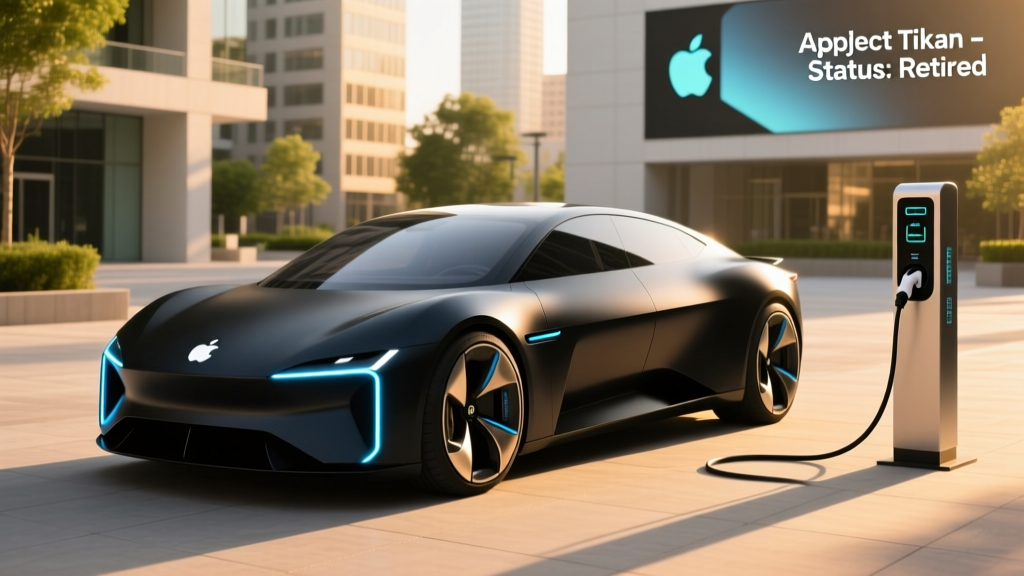
Apple does not manufacture or sell electric cars. In February 2024, Apple officially canceled Project Titan, its decade-long effort to build an autonomous electric vehicle, and reassigned roughly 2,000 employees to generative AI projects. As of 2026, there is no Apple car, no announced production timeline, and no indication Apple will re-enter the auto industry. Buyers searching for Apple electric cars will find concept renderings, rumors, and third-party speculation — but no vehicle you can purchase, order, or test-drive.
Project Titan: A Decade of Ambition, Canceled
Apple's automotive ambitions began around 2014 under the codename Project Titan. Early reports described plans for a fully autonomous, luxury-priced EV — sometimes rumored at $100,000+ MSRP — competing directly with Tesla, Mercedes, and Lucid. Over ten years, the project cycled through multiple leadership changes, strategic pivots (from full vehicle to EV platform to autonomous software), and partnerships explored with Hyundai, Kia, and several contract manufacturers.
By 2023, Apple had reportedly scaled the project back to a Level 2+ driver-assistance system rather than the Level 4 autonomy originally envisioned. The final cancellation in early 2024 came as Apple faced:
- Manufacturing complexity far beyond consumer electronics — auto supply chains involve thousands of Tier 1/2 suppliers, safety homologation, and dealer/service networks
- Margin reality: even premium automakers operate at 8-12% operating margins, versus Apple's ~30%+ on hardware
- Competitive moat erosion: Tesla, BYD, Hyundai, and Rivian had already shipped millions of EVs with proven platforms
- AI pivot urgency: generative AI demanded the engineering talent parked on Titan
Apple's automotive legacy lives on indirectly: CarPlay now integrates deeply with dozens of 2026 model-year vehicles, including next-gen CarPlay that controls climate, gauges, and vehicle settings on select Porsche, Aston Martin, and Mercedes models. But that's software — not a car.
What to Buy Instead: 2026 EVs That Actually Exist
If you were drawn to the idea of an Apple car — minimalist design, premium tech integration, strong software UX — several production EVs deliver on those promises today. Here's how the most relevant alternatives compare:
| Model | EPA Range | Battery (kWh) | Peak DC Charge | 10-80% Time | 0-60 mph | Base MSRP |
|---|---|---|---|---|---|---|
| 2026 Tesla Model Y Long Range | 320 mi | 78 kWh (NMC) | 250 kW | ~22 min | 5.0 sec | $46,630 |
| 2026 Hyundai Ioniq 5 N | 221 mi | 84 kWh (NMC) | 350 kW | ~18 min | 3.4 sec | $67,500 |
| 2026 Lucid Air Pure | 419 mi | 88 kWh (NMC) | 220 kW | ~25 min | 5.2 sec | $71,000 |
| 2026 Rivian R1S Dual-Motor | 330 mi | 106 kWh (NMC) | 220 kW | ~30 min | 4.5 sec | $79,900 |
| 2026 BMW i4 eDrive40 | 307 mi | 81.5 kWh (NMC) | 205 kW | ~26 min | 5.5 sec | $57,900 |
Source: EPA via fueleconomy.gov, manufacturer specifications. Real-world highway range typically 10-15% below EPA; cold-weather (below 30°F) can reduce range 20-30% without preconditioning.
EV Ownership Costs vs. Gas Cars: The Real Numbers
A common misconception is that EVs "cost more" full-stop. The reality depends on your driving volume, electricity rates, and how long you hold the vehicle. Here's a five-year total cost comparison using a 2026 Tesla Model Y Long Range versus a comparably equipped 2026 Toyota RAV4 gas AWD (both at ~$47,000 transaction price after federal credit):
| Category | Tesla Model Y LR (EV) | Toyota RAV4 AWD (Gas) |
|---|---|---|
| Purchase price (after incentives) | $39,130* | $38,500 |
| Fuel/Energy (5 yrs, 75k mi) | $4,875** | $9,375*** |
| Maintenance (5 yrs) | $1,200 | $3,500 |
| Insurance (5 yrs avg) | $10,500 | $7,500 |
| Estimated depreciation | $18,000 | $14,000 |
| 5-Year Total | $73,705 | $72,875 |
* Assumes $7,500 §30D federal EV tax credit applied at point of sale (buyer must meet income caps: $150K single / $300K joint; vehicle MSRP under $55K for sedans, $80K for SUVs; battery sourcing requirements apply). Consult a tax professional.
** Based on $0.13/kWh national average home charging, 3.5 mi/kWh efficiency.
*** Based on $3.50/gal, 28 MPG combined.
The EV edges ahead or breaks even over five years despite higher insurance premiums (a real, often-overlooked cost) and steeper early depreciation. At year 7+, the EV typically pulls further ahead as the gas car's maintenance costs accelerate (transmission service, timing components, exhaust). Your mileage — literally — will vary based on local electricity rates and annual driving distance.
Common Apple Car & EV Myths, Corrected
| Myth | Fact |
|---|---|
| "Apple is secretly still building a car" | Apple publicly confirmed Project Titan's cancellation in Feb 2024. No patent filings, spy shots, or supply-chain signals suggest a 2026 reversal. |
| "EVs need battery replacement every 5 years" | Modern NMC and LFP packs are warrantied for 8 years / 100,000 miles (10 years in CARB states) with ≤30% capacity loss. Real-world fleet data from Tesla and Hyundai shows ~10-15% degradation at 150,000 miles. |
| "You can't road-trip an EV" | The U.S. now has 5,500+ DC fast-charging stations with 30,000+ ports (per AFDC). A 2026 Model Y charges 10-80% in ~22 minutes at a V3/V4 Supercharger — less time than a meal stop. |
| "EVs are worse in winter" | Cold reduces range 20-30% below 30°F, but preconditioning (warming the battery while plugged in) recovers much of that loss. EVs start instantly in cold — no cranking, no cold-start emissions, and regenerative braking works immediately. |
| "Home charging requires a panel upgrade" | Most 200-amp residential panels support a 48-amp Level 2 charger (11.5 kW) without upgrade. A 100-amp panel may require a $1,500-$3,000 service upgrade. Always get a licensed electrician's load calculation first. |
| "Self-driving cars are here" | Consumer systems (Tesla Autopilot, GM Super Cruise, Ford BlueCruise) are SAE Level 2 — the driver must remain engaged and hands on or near the wheel. Only Waymo and Zoox operate Level 4 driverless service in limited geofenced areas. |
First-Time EV Buyer: What Actually Matters
Home charging access is the deciding factor
If you can install a Level 2 charger (240V, 32-48 amps) at home — garage, carport, or dedicated outdoor pad — EV ownership is dramatically easier. You'll wake up every morning with a "full tank" at $0.10-0.15/kWh, versus $3.50/gal at the pump. Expect $500-$1,500 for a quality Level 2 unit (ChargePoint Home Flex, Emporia V2, Wallbox Pulsar Plus) plus $800-$2,500 for electrician installation depending on panel proximity and local permit requirements.
If you cannot charge at home (apartment, street parking, landlord refusal), weigh:
- Workplace charging availability (many employers now offer Level 2 for free or subsidized)
- Public DC fast-charging density in your area (use PlugShare or A Better Routeplanner to map)
- Whether a PHEV (plug-in hybrid) like the 2026 Toyota RAV4 Prime (42 mi electric-only, 38 MPG hybrid) better fits your situation
Match the EV to your actual driving pattern
Most U.S. drivers travel 37 miles/day on average. A 250-mile EPA-range EV covers 95%+ of daily driving with massive buffer. But if you regularly drive 200+ mile highway trips, tow, or live in extreme cold, target 300+ EPA miles and preconditioning capability.
Which Electrified Vehicle Fits You?
- If you have home charging + drive <200 mi/day: BEV (full electric) — lowest operating cost, simplest maintenance. Target: Tesla Model Y, Hyundai Ioniq 5, Ford Mustang Mach-E.
- If you have home charging + frequent 300+ mi road trips: BEV with 300+ EPA miles and fast DC charging (250+ kW peak). Target: Lucid Air, Tesla Model 3 Long Range, Hyundai Ioniq 6.
- If you lack home charging but have workplace Level 2: BEV is still viable if your daily loop is under 100 miles. Target: Chevrolet Equinox EV (315 mi EPA, ~$33,000 after credit).
- If you have no reliable charging access at all: PHEV or HEV (hybrid). You'll still cut fuel use 30-60% without plug dependency. Target: Toyota RAV4 Prime, Honda CR-V Hybrid.
- If you tow >5,000 lbs regularly: Consider a heavy-duty PHEV or diesel — BEV towing cuts range 40-50%. Rivian R1T and F-150 Lightning work for light towing (<7,500 lbs) with route planning.
Federal Tax Credits in 2026: The Fine Print
The §30D clean vehicle credit offers up to $7,500 for new EVs and $4,000 for used EVs (max 30% of sale price), but eligibility is a three-part test:
- Buyer income cap: AGI ≤ $150,000 (single) / $225,000 (head of household) / $300,000 (joint)
- Vehicle MSRP cap: ≤ $55,000 for sedans/wagons; ≤ $80,000 for SUVs/pickups/vans
- Battery sourcing: Increasing percentages of critical minerals and battery components must be sourced from the U.S. or FTA partners — this disqualifies several models using Chinese-sourced minerals
As of 2026, the credit can be transferred to the dealer at point of sale, reducing your out-of-pocket cost immediately rather than waiting for tax filing. Always verify current eligibility on IRS.gov before signing a purchase agreement — sourcing rules tighten annually.
FAQ: Apple Cars and EV Buying Basics
Will Apple ever release a car?
No announced plans exist. Project Titan was canceled in February 2024 after ~10 years and an estimated $10B+ in R&D. Apple has pivoted those resources to AI. Unless Apple signals a reversal (which would require years of lead time for manufacturing, safety certification, and dealer networks), there is no Apple car coming.
Is CarPlay the same as an Apple car?
No. CarPlay is Apple's infotainment interface — it projects iPhone apps (Maps, Music, Messages) to your car's screen. Next-gen CarPlay (2025-2026 vehicles) controls climate and gauges but does not make Apple an automaker. You still buy a Porsche, Honda, or Ford — Apple just makes the screen experience better.
How much does home EV charging really cost?
At $0.13/kWh (national average) and 3.5 miles/kWh efficiency, you'll spend ~$3.70 per 100 miles — roughly one-third the cost of a 28-MPG gas car at $3.50/gal. Over 15,000 miles/year, that's ~$555 in electricity versus ~$1,875 in gas, saving ~$1,300 annually.
Do EV batteries degrade quickly?
No. LFP (lithium iron phosphate) chemistry, used in base Tesla Model 3/Y and Ford Mustang Mach-E Select, retains 90%+ capacity after 200,000 miles in fleet data. NMC chemistry degrades slightly faster (~12-15% loss at 150,000 miles) but is still warrantied for 8 years/100,000 miles at ≥70% capacity.
What if I live in an apartment and can't charge at home?
A PHEV (plug-in hybrid) is often the pragmatic choice — you get 30-45 miles of electric range for daily commuting (charge at any 120V outlet overnight) plus a gas engine for longer trips. Alternatively, check workplace charging, public Level 2 networks (ChargePoint, EVgo), and whether your building qualifies for utility-funded multi-unit dwelling charging programs.
Is Autopilot/FSD self-driving?
No. Tesla's Autopilot and Full Self-Driving (Supervised) are SAE Level 2 systems — they assist with steering and speed but require continuous driver supervision. You are legally and physically responsible for the vehicle at all times. Level 4 driverless operation (no human needed) is currently available only through Waymo's robotaxi service in Phoenix, San Francisco, Los Angeles, and Austin.