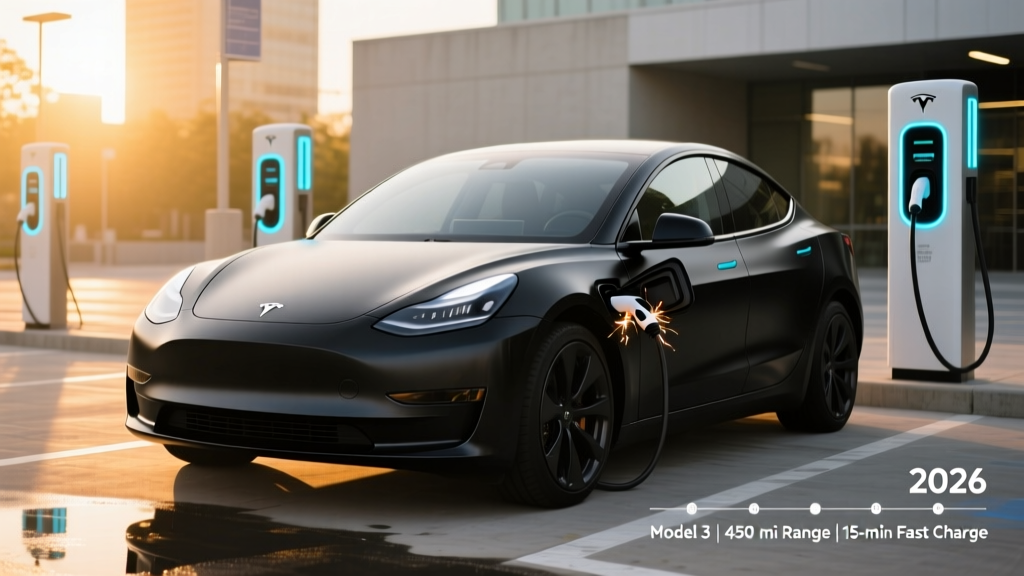
If you search forums and engineering communities for honest EV ownership takes, you'll eventually hit threads where an AP engineer Tesla owner breaks down the Model 3 with the kind of rigor most auto reviews skip. That's the lens we're adopting here: a data-first, spec-verified profile of the 2026 Tesla Model 3 Long Range AWD — the variant that remains the volume sweet spot for buyers who want max range without stepping into Performance pricing.
We'll walk through range, charging curves, real-world efficiency, tax-credit math, and the engineering trade-offs that matter once the honeymoon phase ends. No marketing copy, no "game-changer" fluff — just the numbers an engineer would want before signing a purchase agreement.
2026 Tesla Model 3 Long Range AWD: Spec Table
| Attribute | Value |
|---|---|
| EPA Range | 341 miles |
| Battery (usable) | ~79 kWh, NMC (nickel-manganese-cobalt) |
| Drivetrain | Dual-motor AWD |
| Horsepower | 346 hp (combined) |
| 0-60 mph | 4.2 seconds |
| Top Speed | 125 mph |
| MPGe (combined) | 117 MPGe |
| Efficiency | 26 kWh / 100 mi |
| Max DC Fast Charge | 250 kW (peak) |
| 10-80% DC Charge Time | ~27 minutes |
| Level 2 Home Charge (11.5 kW) | ~44 mi/hr |
| Cargo Volume | 23 cu ft (trunk + frunk) |
| Rear Legroom | 35.2 inches |
| Base MSRP | $47,490 (incl. destination) |
| Battery Warranty | 8 yr / 120,000 mi (min 70% retention) |
Source: fueleconomy.gov and Tesla's official 2026 spec sheet.
Range Reality: EPA Sticker vs. What You'll Actually See
Real-World Highway (70-75 mph, 65°F): ~280-300 miles
Real-World City / Mixed (moderate climate): ~310-330 miles
Cold-Weather (20°F, highway, heater on): ~220-250 miles
The EPA 341-mile figure is legitimate under the test cycle's mixed driving profile, but highway-heavy commutes consistently knock 12-18% off the sticker. That's physics, not a Tesla-specific flaw — aerodynamic drag scales with the square of velocity, and the Model 3's 0.219 Cd is excellent but can't eliminate the penalty of 75 mph sustained speeds.
Cold weather is the bigger variable. Lithium-ion cells lose efficiency below freezing, and cabin heating (even with the Model 3's heat pump) draws 3-5 kW continuously in deep cold. On a January road trip through the Rockies, expect 220-250 usable miles before you're hunting for a Supercharger. Preconditioning the battery while still plugged in at home recovers some of this loss — always enable scheduled departure if you have Level 2 at home.
Charging: DC Fast-Charge Curve and Home Setup
The 2026 Model 3 Long Range retains the 250 kW peak DC fast-charge capability on V3/V4 Superchargers. But peak is not sustained — here's what the curve actually looks like:
| State of Charge | Avg. Power (kW) | Approx. Miles Added in 10 Min |
|---|---|---|
| 10% → 30% | ~230-250 kW | ~120-130 mi |
| 30% → 50% | ~190-220 kW | ~100-110 mi |
| 50% → 70% | ~130-170 kW | ~70-85 mi |
| 70% → 80% | ~80-110 kW | ~40-55 mi |
| 80% → 100% | ~30-50 kW (taper) | Slow — avoid on road trips |
The 10-80% time of ~27 minutes assumes you arrive at the charger with a warm battery (preconditioned via navigation routing to the station). Show up cold-soaked and that first 10% may charge at 80-120 kW until the thermal management system catches up. This is the single biggest variable in real-world road-trip charging time.
Home Level 2: The onboard charger accepts up to 11.5 kW (48A on a 60A circuit). That translates to roughly 44 miles of range per hour of charging — enough to replenish a full day's driving overnight. A Level 2 installation on a 200A panel typically runs $800-$2,000 including the Tesla Wall Connector ($400), electrician labor, and permit. If your home has a 100A panel, budget an additional $2,000-$4,000 for a service upgrade.
Performance and Efficiency Numbers
The dual-motor AWD powertrain delivers 346 hp and a 4.2-second 0-60 mph time. That's quick enough for any merging scenario and genuinely fun on back roads, but the Model 3 Long Range is tuned more for efficiency than track work. Regen braking is aggressive enough for one-pedal driving in most conditions, and the heat pump standard on this trim keeps cabin energy draw reasonable in winter.
Efficiency lands at 117 MPGe combined (26 kWh/100 mi), which puts the Model 3 among the most efficient AWD sedans in its class. For context, at the US average electricity price of $0.17/kWh (EIA 2025 data), that's roughly $0.044 per mile — versus ~$0.13/mi for a 30 MPG gas car at $3.90/gallon. Over 15,000 miles/year, the energy-cost gap is approximately $1,290 in the Tesla's favor.
Pricing, Trims, and Federal Tax Credit Math
The 2026 Model 3 lineup breaks down as follows:
| Trim | MSRP (incl. dest.) | §30D Credit | Effective Price |
|---|---|---|---|
| RWD (LFP, ~60 kWh) | $38,990 | $3,750* | $35,240 |
| Long Range AWD (NMC) | $47,490 | $3,750* | $43,740 |
| Performance AWD | $54,990 | $3,750* | $51,240 |
*Federal credit amount reflects partial critical-mineral and battery-component sourcing compliance for 2026 as published by the IRS. Full $7,500 requires meeting both critical-mineral and battery-component thresholds. Credit can be transferred to the dealer at point of sale as a purchase-price reduction.
§30D eligibility checklist:
- Buyer AGI ≤ $150,000 (single) / $300,000 (joint) / $225,000 (head of household)
- Vehicle MSRP ≤ $55,000 (sedans — all Model 3 trims qualify)
- Battery components and critical minerals must meet annual threshold percentages (see IRS §30D guidance)
- Vehicle must be new, purchased for personal use in the US
Always verify your specific eligibility with a tax professional — sourcing requirements tighten annually, and Tesla's supply chain shifts can change a model's qualification status mid-year.
Tech, Interior, and Driver-Assistance Features
The refreshed Model 3 interior uses a 15.4-inch center touchscreen running Tesla's latest software, with ventilated front seats, ambient lighting, and rear-seat ventilation on Long Range and above. Build quality on the 2026 Highland-and-beyond refresh is markedly better than pre-2024 units — panel gaps are tighter and the cabin materials are more premium.
Autopilot comes standard and includes adaptive cruise, lane-keeping, and automatic emergency braking. Full Self-Driving (Supervised) is an $8,000 option (or $99/month subscription) that adds city-street navigation and traffic-light recognition. Important clarification:
The Model 3 earns a 5-star overall rating from NHTSA and Top Safety Pick+ from IIHS, which matters for insurance premiums and peace of mind.
Pros and Cons: The Honest Engineering Take
Pros
- Class-leading efficiency (117 MPGe combined) reduces long-term energy cost
- Supercharger network remains the most reliable DC fast-charging ecosystem in the US
- 341 mi EPA range covers most commutes with multi-day buffer
- Over-the-air updates continuously add features post-purchase
- Strong safety ratings (NHTSA 5-star, IIHS TSP+)
- 250 kW peak DC charging keeps road-trip stops under 30 min
Cons
- Rear legroom (35.2 in) is tight for taller passengers on longer trips
- No Apple CarPlay or Android Auto — Tesla-only ecosystem
- FSD (Supervised) remains Level 2; $8,000 is steep for what it delivers today
- NMC battery degrades faster than LFP if routinely charged to 100% (set daily limit to 80%)
- Insurance premiums run 15-30% higher than comparable gas sedans in most states
- Ride quality is firm — performance-tuned suspension transmits road imperfections
Who Should Buy the 2026 Model 3 Long Range?
- You commute 30-80 miles daily and have Level 2 access at home
- You take 2-4 road trips per year of 200-500 miles and value Supercharger reliability
- You want AWD traction for rain/snow without sacrificing efficiency
- You're an engineering-minded buyer who values OTA updates and software integration
- You regularly carry 3+ rear-seat passengers (consider Model Y or Ioniq 5 for space)
- You need Apple CarPlay or prefer a traditional dealership service experience
- Your budget is under $35,000 — the RWD trim or a used Model 3 may fit better
- You want maximum battery longevity with daily 100% charges — consider an LFP-equipped RWD model
How It Stacks Up Against Key Competitors
Against the Hyundai Ioniq 6 SE Long Range (EPA 361 mi, 351 kW peak DC charge, ~$42,000 base), the Model 3 gives up a small range edge and significantly slower peak charging. The Ioniq 6's 800V architecture enables a 10-80% charge in ~18 minutes versus the Model 3's ~27 minutes. However, Tesla's Supercharger network reliability and the Model 3's superior efficiency (117 vs. 111 MPGe) often balance the score in daily use.
Against the BMW i4 eDrive40 (EPA 301 mi, ~$57,000), the Model 3 wins on price, range, and charging infrastructure — but the i4 wins on interior luxury, ride refinement, and dealer service accessibility. It's a priorities call, not a spec-sheet slam dunk.
Frequently Asked Questions
What is the real-world range of the 2026 Tesla Model 3 Long Range?
EPA rates it at 341 miles. Expect 280-300 miles on highway road trips at 70-75 mph, 310-330 miles in mixed city/suburban driving, and 220-250 miles in sub-freezing winter conditions with cabin heating active.
How fast does the Model 3 charge at home and on DC fast chargers?
At home on Level 2 (11.5 kW / 48A), it adds ~44 miles of range per hour — a full charge takes about 8 hours. On a V3 Supercharger, it peaks at 250 kW and charges 10-80% in approximately 27 minutes when the battery is preconditioned.
Does the 2026 Tesla Model 3 qualify for the federal EV tax credit?
Yes, but the amount depends on battery-sourcing compliance at the time of purchase. As of early 2026, most Model 3 configurations qualify for $3,750 (meeting one of two sourcing thresholds). The full $7,500 requires both critical-mineral and battery-component compliance. Buyer income caps apply ($150K single / $300K joint). Verify current status at irs.gov.
Is the Model 3 Long Range worth buying over the RWD version?
If you need AWD for snow/rain or regularly take highway road trips, the Long Range's 341-mile EPA range and dual-motor traction justify the ~$8,500 premium. If your commute is short and climate is mild, the RWD model (with its LFP battery and ~$38,990 price) offers excellent value — and LFP chemistry tolerates daily 100% charges better than NMC.
What's the biggest drawback of owning a Tesla Model 3?
Beyond the firm ride and tight rear seat, the most common ownership friction points are: no CarPlay/Android Auto integration, insurance premiums that run 15-30% above segment average, and reliance on Tesla's mobile-app-and-touchscreen ecosystem for functions that other brands assign to physical buttons.
How long will the Model 3 battery last?
Tesla warranties the Long Range battery for 8 years / 120,000 miles with a minimum 70% capacity retention. Real-world data from high-mileage owners suggests NMC packs in the Model 3 lose roughly 8-12% capacity over the first 100,000 miles when charged responsibly (daily limit set to 80%, occasional 100% for trips). Replacement cost, if needed out of warranty, currently ranges from $12,000-$16,000 including labor.