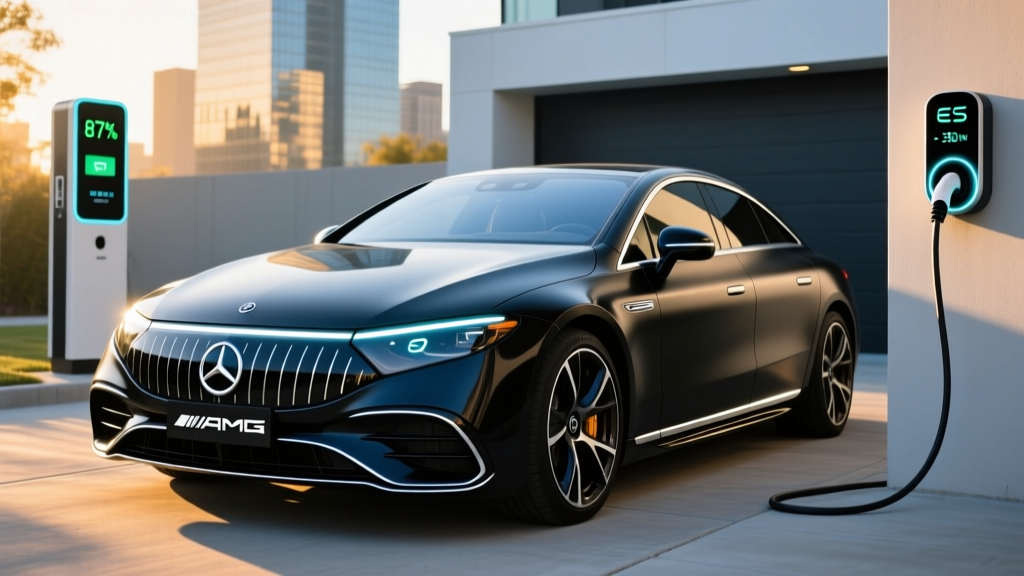
The Mercedes-AMG EQS occupies a narrow intersection of the EV market: a full-size luxury sedan with genuine performance credentials and the longest EPA-estimated range of any production sedan sold in the United States. For 2026, the AMG EQS line carries over with the EQS 53 4MATIC+ as the volume model and the limited EQS 54 (formerly the AMG EQS 53 with the AMG Performance Package) sitting at the top. Both share the same 118 kWh usable battery pack — one of the largest ever fitted to a passenger car — but diverge on power output, chassis tuning, and price by roughly $20,000.
This review covers everything a prospective buyer needs: real-world range expectations versus the EPA sticker, DC fast-charging behavior including the 80% taper, home charging logistics for a 118 kWh pack, federal tax credit ineligibility, and how the AMG EQS stacks against the BMW i7 M70, Porsche Taycan Turbo S, and Tesla Model S Plaid on the metrics that matter.
2026 AMG EQS Specifications at a Glance
| Specification | EQS 53 4MATIC+ | EQS 54 4MATIC+ |
|---|---|---|
| Base MSRP | $149,350 | $169,350 |
| EPA Range | ~330 miles | ~315 miles |
| Battery (usable) | 118 kWh, NMC | 118 kWh, NMC |
| Horsepower | 649 hp (boost: 751 hp) | 751 hp |
| Torque | 700 lb-ft | 752 lb-ft |
| 0-60 mph | 3.4 seconds | 3.2 seconds |
| Drivetrain | Dual-motor AWD | Dual-motor AWD |
| Max DC Fast Charge | 200 kW | 200 kW |
| 10-80% DC Charge | ~31 minutes | ~31 minutes |
| Level 2 Charge Rate | 9.6 kW (~30 mi/hr) | 9.6 kW (~30 mi/hr) |
| MPGe (combined) | ~81 MPGe | ~77 MPGe |
| Efficiency | ~42 kWh/100 mi | ~44 kWh/100 mi |
| Battery Warranty | 10 yr / 155,000 mi | 10 yr / 155,000 mi |
| Federal Tax Credit (§30D) | Not eligible (MSRP cap) | Not eligible (MSRP cap) |
Range and Efficiency: EPA vs. the Real World
The 2026 AMG EQS 53 carries an EPA-estimated range of approximately 330 miles on its 118 kWh usable battery (NMC chemistry). The EQS 54, with its more aggressive power delivery and standard 21-inch AMG wheels, drops to roughly 315 miles. For context, fueleconomy.gov lists the standard EQS 450+ (RWD, non-AMG) at 390 miles — the trade-off for AMG performance is measurable in range.
EPA estimate: 330 miles (EQS 53) / 315 miles (EQS 54). In mixed highway driving at 70-75 mph, expect 275-295 miles from the EQS 53 and 260-280 miles from the EQS 54. In cold weather (below 32°F), cabin heating and battery thermal management reduce usable range by 20-30%, dropping real-world highway range to approximately 210-240 miles. The AMG EQS's heat pump helps mitigate this compared to resistive heating systems, but the physics of a 5,700-lb sedan in winter remain unforgiving. City driving with heavy regenerative braking usage can push the EQS 53 closer to its EPA number or slightly above, as regen recovers energy that a gas car would waste as brake heat.
Efficiency lands at roughly 42 kWh per 100 miles for the EQS 53 and 44 kWh/100 mi for the EQS 54 — translating to about 81 and 77 MPGe combined, respectively. These figures are competitive with the BMW i7 M70 (roughly 78 MPGe combined) but trail the more efficiency-focused Lucid Air Grand Touring (131 MPGe). The AMG EQS prioritizes performance and luxury mass over aero optimization.
Charging Speed: DC Fast Charging and Home Setup
The AMG EQS supports a peak DC fast-charge rate of 200 kW via its CCS1 connector (NACS adapter included for Tesla Supercharger access starting with the 2025 model year). On a capable 350 kW charger — such as those at Electrify America or EVgo stations — the EQS can add approximately 186 miles of range in 15 minutes under ideal conditions (battery preconditioned, starting at low SoC, moderate ambient temperature).
| Charging Level | Power (kW) | Miles Added per Hour | Full Charge Time (10-100%) |
|---|---|---|---|
| Level 1 (120V household) | ~1.4 kW | ~4 mi/hr | ~85 hours |
| Level 2 (240V, 40A) | 9.6 kW | ~30 mi/hr | ~12.5 hours |
| DC Fast Charge (peak) | 200 kW | ~750 mi/hr (peak) | 10-80%: ~31 min |
A critical detail buyers miss: the 200 kW figure is a peak, not a sustained rate. The AMG EQS, like most large-battery EVs, follows a charging curve that tapers significantly above 80% State of Charge (SoC). The 10-80% charge takes roughly 31 minutes, but pushing from 80-100% can add another 25-30 minutes as the battery management system reduces current to protect the NMC cells. For road trips, plan your stops around the 10-80% window and skip topping off to 100% unless you're at your destination overnight.
At home on a Level 2 charger (240V, 40A circuit), the 9.6 kW onboard charger replenishes the pack at about 30 miles of range per hour. A full 0-100% charge takes roughly 12.5 hours — plan to plug in when you get home and wake up full. Given the 118 kWh battery, a dedicated 48A Level 2 circuit (Hardwired, 11.5 kW capable) would be ideal, but the EQS's onboard charger caps at 9.6 kW, so a 40A circuit is sufficient. Budget $1,200-$2,500 for a professional Level 2 installation depending on your panel capacity and conduit run — consult a licensed electrician for a site-specific quote.
Performance: Powertrain, Acceleration, and Driving Dynamics
Both AMG EQS variants use a dual-motor all-wheel-drive powertrain with one permanent-magnet synchronous motor on each axle. The EQS 53 produces 649 horsepower in standard mode, rising to 751 hp with the AMG Dynamic Plus package's RACE START function (launch control). The EQS 54 delivers 751 hp as standard. Torque figures are 700 lb-ft (EQS 53) and 752 lb-ft (EQS 54).
Acceleration is ferocious: the EQS 53 hits 0-60 mph in 3.4 seconds; the EQS 54 shaves that to 3.2 seconds. For reference, that puts the EQS 54 in the same bracket as a Porsche 911 Carrera S but in a 5,700-pound sedan with four doors and 22 cubic feet of cargo space. Top speed is electronically limited to 155 mph on both models.
The AMG-specific air suspension with adaptive damping, rear-axle steering (up to 10 degrees), and AMG-tuned torque vectoring give the EQS a dual personality: supple and quiet in Comfort mode, taut and responsive in Sport+. The rear-axle steering is the standout chassis feature — it shrinks the car's effective wheelbase at low speeds (tighter U-turns, easier parking) and extends it at highway speeds (stability during lane changes). This is a $5,600 option on some Mercedes models but standard on the AMG EQS.
Regenerative braking offers three levels selectable via steering-wheel paddles: D+ (coasting, no regen), D (mild regen), and D- (strong regen approaching one-pedal driving). Unlike some competitors, the AMG EQS does not offer a true one-pedal mode that brings the car to a complete stop — you still need the brake pedal for the final few mph. This is a deliberate Mercedes engineering choice favoring brake-blending feel over aggressive regen.
Interior, Cargo, and Technology
The AMG EQS cabin is dominated by the MBUX Hyperscreen — a 56-inch curved glass panel spanning the entire dashboard, combining a 17.7-inch central OLED touchscreen, a 12.3-inch driver instrument cluster, and a 12.3-inch front-passenger display. The system runs Mercedes' latest MBUX generation with over-the-air update capability, wireless Apple CarPlay and Android Auto, and an AI-driven "zero-layer" interface that surfaces frequently used functions without menu diving.
Interior space is generous, as expected from a 207.4-inch-long sedan:
- Front legroom: 41.7 inches
- Rear legroom: 40.1 inches
- Front headroom: 39.0 inches
- Rear headroom: 37.9 inches (panoramic roof reduces this slightly vs. the standard EQS)
- Trunk (cargo): 22.0 cubic feet (hatchback-style liftback opening)
- Frunk: None — the EQS platform uses the front space for HVAC and power electronics
The hatchback-style trunk is a practical advantage over traditional sedan trunks: the opening is wide enough for golf bags, luggage sets, or a folded stroller without maneuvering. However, the absence of a frunk means all cargo goes in the rear — something to note if you're comparing to the Tesla Model S (which offers a front trunk) or the Lucid Air.
Driver-assistance technology includes Mercedes' Drive Pilot system, which is SAE Level 3 certified in Germany and Nevada (on specific divided highways, under 40 mph, in daylight). In all other US states, the EQS operates with Distronic adaptive cruise and Active Steering Assist — both SAE Level 2 systems requiring continuous driver engagement. The distinction matters: Level 3 means the car accepts legal liability during approved operation; Level 2 means you are the driver at all times. NHTSA's automation framework clarifies these levels for consumers.
Pricing, Trims, and Federal Tax Credit Reality
The 2026 Mercedes-AMG EQS is offered in two trims:
| Trim | Base MSRP | Typical As-Tested Price | Federal §30D Credit |
|---|---|---|---|
| EQS 53 4MATIC+ | $149,350 | $160,000-$175,000 | Not eligible |
| EQS 54 4MATIC+ | $169,350 | $180,000-$195,000 | Not eligible |
Federal tax credit eligibility: Neither AMG EQS trim qualifies for the IRS §30D new clean vehicle credit. The reason is straightforward: the IRS enforces an MSRP cap of $55,000 for sedans (and $80,000 for SUVs/pickups/vans). At $149,350 base, the EQS 53 exceeds the sedan cap by nearly $95,000. Additionally, the battery's critical-mineral and component sourcing may not meet the domestic-content thresholds that have tightened annually since 2023. Buyers should not factor any federal credit into their purchase math for this vehicle.
Some states offer their own EV incentives that are not subject to the federal MSRP cap — California's Clean Fuel Reward and New York's Drive Clean Rebate have historically applied to higher-priced vehicles, though program rules change frequently. Check your state's energy or DMV website for current eligibility before purchase.
Pros, Cons, and Who Should Buy
- Class-leading EPA range among performance sedans (330 mi)
- 118 kWh battery provides genuine road-trip flexibility
- Sub-3.5-second 0-60 with four doors and adult rear seating
- MBUX Hyperscreen is the most advanced infotainment in the segment
- Rear-axle steering transforms low-speed maneuverability
- 10-year / 155,000-mile battery warranty (above industry standard)
- Drive Pilot Level 3 capability (Nevada, limited conditions)
- $149,350+ starting price with no federal tax credit offset
- No frunk — cargo limited to 22 cu ft rear hatchback
- 200 kW peak DC charge rate trails Hyundai/Kia's 800V systems (350 kW)
- 31-minute 10-80% charge is adequate, not class-leading
- Heavy at ~5,700 lbs — tire wear and efficiency reflect the mass
- True one-pedal driving not available (Mercedes design choice)
- Options and packages push as-tested price past $190,000 easily
- Executive commuters who want a silent, fast daily driver with back-seat space for clients or car seats
- Road-trip-capable EV buyers who need 300+ miles of range and don't want to plan around chargers every 180 miles
- Performance-sedan loyalists migrating from an AMG E63 or S63 who want electrification without sacrificing acceleration
- Tech-forward buyers who value the Hyperscreen, OTA updates, and Level 3 readiness
- Budget-conscious buyers (the Lucid Air Grand Touring offers 516 miles of range for ~$125,000)
- Track-day enthusiasts (the Porsche Taycan Turbo GT is lighter, sharper, and charges at 320 kW)
- Anyone who needs a frunk or maximum cargo versatility
How the AMG EQS Compares to Key Rivals
| Spec | AMG EQS 53 | BMW i7 M70 | Porsche Taycan Turbo S | Tesla Model S Plaid |
|---|---|---|---|---|
| Base MSRP | $149,350 | $169,295 | $197,400 | $89,990 |
| EPA Range | ~330 mi | ~295 mi | ~283 mi | ~396 mi |
| 0-60 mph | 3.4 sec | 3.5 sec | 2.4 sec | 1.99 sec |
| Battery (usable) | 118 kWh | 101.7 kWh | 83.7 kWh | ~95 kWh |
| Max DC Charge | 200 kW | 195 kW | 320 kW | 250 kW |
| Federal Tax Credit | No | No | No | No (MSRP cap for sedans) |
The AMG EQS wins on battery capacity and EPA range among German rivals. The Porsche Taycan Turbo S dominates on raw acceleration and charging speed (its 800V architecture enables 320 kW peak). The BMW i7 M70 is the closest direct competitor in philosophy — luxury-first with AMG/M-level performance — but trails on range. The Tesla Model S Plaid is the value and speed king but cannot match Mercedes' interior quality, ride refinement, or Drive Pilot technology.
Battery Longevity and Warranty
Mercedes backs the AMG EQS's NMC battery with a 10-year / 155,000-mile warranty (whichever comes first), guaranteeing a minimum of 70% state of health (SoH) over that period. This exceeds the federal minimum of 8 years / 100,000 miles and is one of the most generous battery warranties in the luxury segment. The standard vehicle warranty is 4 years / 50,000 miles with complimentary scheduled maintenance for the same duration.
NMC chemistry in the EQS benefits from Mercedes' liquid thermal management system, which actively heats and cools the pack to keep cells in their optimal temperature window. For maximum longevity, Mercedes recommends:
- Setting a daily charge limit of 80% for routine use (using the MBUX charge-limit setting)
- Charging to 100% only before long road trips
- Using preconditioning when navigating to a DC fast charger (the car warms the battery for faster, healthier charging)
- Avoiding prolonged parking at 100% SoC in hot weather
Battery replacement cost, should it be needed out of warranty, is estimated at $25,000-$35,000 based on current NMC pack pricing for the 118 kWh unit — a figure worth considering for second-ownership economics.
Frequently Asked Questions
What is the real-world highway range of the AMG EQS?
In 70-75 mph highway driving at moderate temperatures (55-75°F), the EQS 53 delivers approximately 275-295 miles. In cold weather (below 32°F), expect 210-240 miles. City driving with regen can push closer to or slightly above the 330-mile EPA figure.
How fast does the AMG EQS charge at home and on the road?
On DC fast chargers, it peaks at 200 kW with a 10-80% time of approximately 31 minutes. At home on a Level 2 (240V, 40A) charger, it adds about 30 miles of range per hour, taking roughly 12.5 hours for a full charge from empty.
Does the AMG EQS qualify for the $7,500 federal EV tax credit?
No. Under IRS §30D rules, sedans must have an MSRP at or below $55,000 to qualify. The EQS 53 starts at $149,350, nearly triple the cap. Battery sourcing requirements may also disqualify it independently. Check IRS.gov for the latest rules.
Is the AMG EQS worth buying over the Tesla Model S Plaid?
It depends on priorities. The Model S Plaid is faster (1.99s 0-60), has longer range (396 mi EPA), and costs $60,000 less. The AMG EQS delivers a superior interior, quieter ride, rear-axle steering, Level 3 Drive Pilot readiness, and a larger battery. If luxury refinement matters more than lap times and value, the EQS justifies its premium.
Does the AMG EQS have a front trunk (frunk)?
No. The EQS platform uses the front compartment for power electronics, HVAC, and the onboard charger. All 22 cubic feet of cargo space is in the rear hatchback.
What is the battery warranty on the AMG EQS?
Mercedes provides a 10-year / 155,000-mile battery warranty guaranteeing at least 70% state of health. This is above the industry-standard 8-year / 100,000-mile coverage.