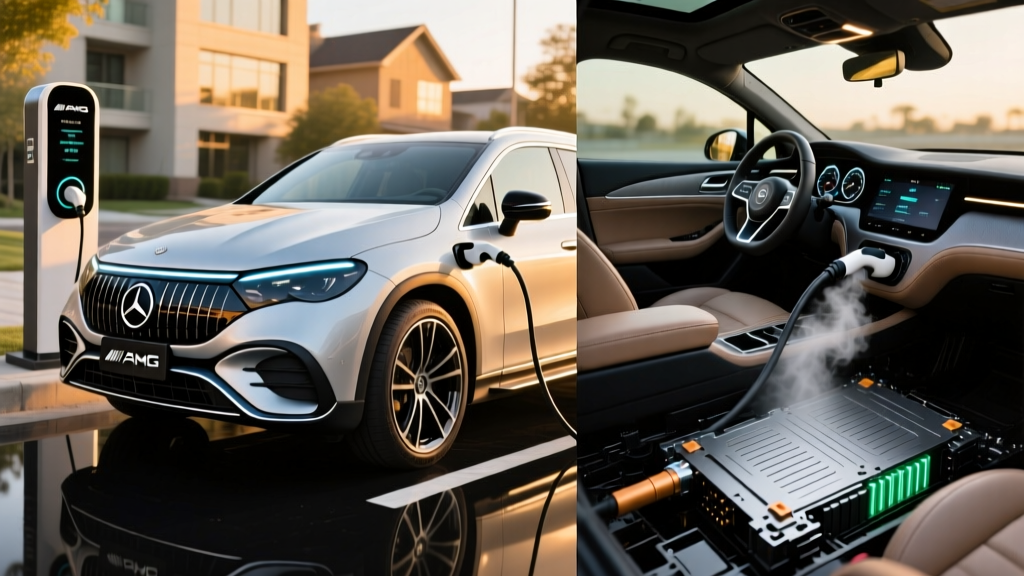
The Mercedes-AMG EQE 4MATIC SUV occupies a narrow but fascinating slice of the electric market: a luxury midsize crossover that tries to be a credible performance machine while still delivering the daily-drivable comfort Mercedes buyers expect. For 2026, the AMG treatment brings dual-motor all-wheel drive, adaptive air suspension, and the Hyperscreen dashboard — but it also brings a price tag that pushes well past six figures once options land. Is the AMG EQE SUV a serious EV performance contender, or a compliance halo wearing a three-pointed star? We break down the exact numbers that matter.
Quick Verdict: Who Should Consider the AMG EQE 4MATIC SUV?
This EV suits buyers who want a premium, tech-forward daily driver with genuine straight-line performance and don't need class-leading range or cargo space. It's a strong fit for:
- Executive commuters who prioritize cabin refinement, driver-assist tech, and badge prestige over maximum efficiency
- Performance-curious EV shoppers stepping up from an AMG GLC or GLE and wanting electric torque without sacrificing luxury
- Two-row family haulers who need decent rear-seat room but don't require third-row seating (that's the EQS SUV's territory)
It's not ideal for road-trippers who frequently exceed 250 miles between chargers, budget-conscious buyers, or anyone who prioritizes cargo volume over cabin ambiance.
Range, Battery, and Real-World Efficiency
| Spec | Value |
|---|---|
| EPA Estimated Range | 230 miles (AMG EQE 43); 220 miles (AMG EQE 53) |
| Battery Capacity (Usable) | 90.6 kWh |
| Battery Chemistry | NMC (Nickel Manganese Cobalt) |
| Drivetrain | Dual-motor AWD (4MATIC) |
| Horsepower | 469 hp (EQE 43); 617 hp (EQE 53) |
| 0–60 mph | 4.1 sec (EQE 43); 3.3 sec (EQE 53) |
| Efficiency | 74 MPGe combined / 45 kWh/100 mi (EQE 43 est.) |
| Cargo Volume (rear seats up/down) | 14.0 / 55.0 cu ft |
| Rear Legroom | 38.0 inches |
| Battery Warranty | 8 years / 100,000 miles |
| Base MSRP | $79,250 (EQE 43); $106,350 (EQE 53) |
According to fueleconomy.gov, the EQE SUV's efficiency hovers around 74 MPGe combined for the EQE 43 variant. That translates to roughly 45 kWh per 100 miles — noticeably thirstier than a Tesla Model X Long Range (about 102 MPGe) but comparable to the BMW iX xDrive50. The AMG tuning adds weight, wider tires, and more aggressive thermal management, all of which erode efficiency relative to the standard EQE sedan.
Charging Speed: DC Fast Charging and Home Level 2
| Charging Level | Power / Rate | Time or Miles Added |
|---|---|---|
| Level 1 (120V household) | ~1.4 kW | ~3–4 miles per hour |
| Level 2 (240V home / public AC) | 9.6 kW (onboard charger) | ~23 miles per hour; full charge in ~10.5 hours |
| DC Fast Charge (CCS peak) | 170 kW peak | 10–80% in ~32 minutes |
The AMG EQE SUV uses a CCS1 connector (standard for non-Tesla EVs in North America) and supports up to 170 kW peak DC fast charging. That peak rate holds roughly from 10% to 40% State of Charge before tapering. By 60% SoC, the rate typically drops to around 100–110 kW, and above 80% it slows further to protect the NMC cells. A 10–80% session takes approximately 32 minutes at a 350 kW-capable station like an Electrify America or EVgo charger.
At home on a Level 2 wallbox or ChargePoint Home Flex running at 48 amps (240V), the onboard 9.6 kW charger replenishes the 90.6 kWh battery from empty in roughly 10.5 hours. Most owners charging overnight from 20% to 80% will need about 6 hours — easily achievable with a standard evening plug-in routine.
Charging curve reality: The 170 kW peak figure can be misleading. Sustained average power from 10–80% is closer to 120–130 kW. This is competitive with the Audi Q8 e-tron but trails the Hyundai Ioniq 5 and Kia EV6, which sustain 220+ kW on 800V architectures.
Performance and Driving Dynamics
The AMG EQE 43 4MATIC delivers 469 horsepower and 633 lb-ft of torque from its dual permanent-magnet motors, reaching 60 mph in an estimated 4.1 seconds. Step up to the EQE 53 4MATIC+ and output rises to 617 hp (677 lb-ft) with the AMG Dynamic Plus package engaged, dropping the 0–60 sprint to approximately 3.3 seconds.
Both variants feature AMG-tuned adaptive air suspension with electronically controlled damping. The system lowers the ride height at speed for aerodynamic efficiency and can raise for rough roads. Rear-axle steering (up to 10 degrees) is standard, dramatically tightening the turning circle for a vehicle this size — you'll notice it in parking garages and U-turns.
The EQE 53 adds AMG-specific drive modes (Slippery, Comfort, Sport, Sport+, and Individual), a rear-biased torque distribution curve, and larger brakes. Regenerative braking offers three levels selectable via steering-wheel paddles, plus an intelligent auto-regen mode that uses radar and camera data to adjust deceleration based on traffic ahead. One-pedal driving is available but not as aggressive as Tesla or BMW implementations.
Interior, Tech, and Standout Features
The cabin is dominated by the available MBUX Hyperscreen — a 56-inch curved glass panel spanning the full dashboard width, combining a 12.3-inch instrument cluster, a 17.7-inch central touchscreen, and a 12.3-inch passenger display. The system runs Mercedes' latest MBUX generation with wireless Apple CarPlay and Android Auto, over-the-air updates, and a fingerprint reader for driver profiles.
Driver assistance includes Mercedes' Driver Assistance Package: adaptive cruise control with stop-and-go, active lane-keeping, evasive steering assist, and automatic lane-change on highways (activated via turn signal). This is an SAE Level 2 system — the driver must remain attentive with hands on or near the wheel at all times. Mercedes does not currently offer a Level 3 or Level 4 hands-off system in the US-market EQE.
Other notable features:
- Burmester 3D surround sound (15 speakers standard)
- Heated and ventilated front seats standard; massaging seats available
- Ambient lighting with 64 colors and active light animations
- Digital Light headlamps with projection capability
- HEPA filtration cabin air system
- Wireless phone charging (front and rear)
Drawbacks: The Hyperscreen, while visually stunning, attracts fingerprints and can produce glare in direct sunlight. The touch-capacitive steering wheel controls draw consistent criticism for being less intuitive than physical buttons. Rear visibility is compromised by the sloping roofline — the surround-view camera is essentially mandatory for confident parking. And at 14.0 cu ft behind the rear seats, cargo space trails the BMW iX (35.5 cu ft) and even the smaller Genesis Electrified GV70 (28.7 cu ft) significantly.
Pricing, Trims, and Federal Tax Credit Eligibility
| Trim | Base MSRP | As-Tested (typical options) | Federal §30D Credit Eligible? |
|---|---|---|---|
| AMG EQE 43 4MATIC SUV | $79,250 | $88,000–$95,000 | No — exceeds MSRP and buyer income caps |
| AMG EQE 53 4MATIC+ SUV | $106,350 | $115,000–$130,000 | No — exceeds MSRP cap |
Under current IRS §30D rules, the federal EV tax credit of up to $7,500 is subject to three key limitations that disqualify most AMG EQE SUV buyers:
- MSRP cap: SUVs must have a base MSRP of $80,000 or less. The EQE 43 at $79,250 technically clears this threshold, but adding common option packages (AMG Night Package, Pinnacle Trim, Hyperscreen) pushes the sticker above $80,000.
- Buyer income cap: Modified adjusted gross income must not exceed $300,000 (joint filers), $225,000 (head of household), or $150,000 (single). Most AMG buyers exceed these thresholds.
- Battery sourcing requirements: A percentage of critical minerals and battery components must be sourced from the US or free-trade-agreement countries. Mercedes has not confirmed full compliance for the 2026 AMG EQE SUV's battery supply chain.
Bottom line: Do not count on the $7,500 federal credit when budgeting for this vehicle. Some buyers may qualify for state or local incentives — check your state's energy office or AFDC incentive database for details. A tax professional should verify your individual eligibility before purchase.
Competitor Comparison: Is It Worth Buying?
| Spec | AMG EQE 43 SUV | BMW iX M60 | Tesla Model X Plaid | Porsche Cayenne EV (Turbo) |
|---|---|---|---|---|
| EPA Range | ~230 mi | ~296 mi | ~326 mi | ~270 mi (est.) |
| 0–60 mph | 4.1 sec | 3.6 sec | 2.5 sec | 3.3 sec (est.) |
| Horsepower | 469 hp | 610 hp | 1,020 hp | ~670 hp (est.) |
| Peak DC Charge | 170 kW | 195 kW | 250 kW | ~270 kW (est.) |
| Cargo (rear up) | 14.0 cu ft | 35.5 cu ft | 37.1 cu ft | ~22.0 cu ft (est.) |
| Base MSRP | $79,250 | $111,500 | $94,990 | ~$105,000 (est.) |
- Choose the AMG EQE 43 SUV if: You want the most luxurious cabin in the segment, value Mercedes brand cachet, prioritize ride comfort over outright performance, and accept shorter range as a trade-off.
- Choose the BMW iX M60 if: You need more cargo space, better range (296 mi EPA), and a more engaging driving experience at a similar price point.
- Choose the Tesla Model X Plaid if: Maximum performance (2.5 sec 0–60), Supercharger network access, and longest range are your top priorities — and you can tolerate Tesla's minimalist interior.
- Choose the Porsche Cayenne EV if: You want the sharpest handling dynamics and Porsche build quality, though availability is limited and pricing often exceeds MSRP.
Warranty and Long-Term Ownership
Mercedes-Benz covers the AMG EQE SUV's high-voltage battery with an 8-year / 100,000-mile warranty, guaranteeing a minimum of 70% capacity retention over that period. The basic vehicle warranty runs 4 years / 50,000 miles, which is industry-standard but trails Hyundai/Genesis (5 yr / 60,000 mi) and Kia (7 yr / 100,000 mi).
NMC battery chemistry in the 90.6 kWh pack is proven in Mercedes' EVA2 platform (shared with the EQS and standard EQE sedan). Early data from European EQE fleets suggests degradation of approximately 5–8% over the first 60,000 miles — well within the warranty threshold. However, NMC cells are more sensitive to sustained 100% charging than LFP chemistry; Mercedes recommends setting the daily charge limit to 80% for routine use and only charging to 100% before long trips.
Maintenance costs are lower than a comparable AMG GLE (no oil changes, fewer brake pad replacements thanks to regen), but insurance premiums for the AMG EQE SUV run 15–25% higher than the non-AMG EQE due to the vehicle's repair costs and performance classification.
Pros and Cons
Pros
- Exceptionally refined cabin with class-leading material quality
- MBUX Hyperscreen is visually impressive and feature-rich
- Rear-axle steering makes it surprisingly maneuverable in the city
- Adaptive air suspension delivers a plush ride in Comfort mode
- Strong straight-line performance, especially the EQE 53
- Comprehensive driver-assist suite standard
Cons
- EPA range of 220–230 miles trails most competitors in this price range
- Cargo volume (14.0 cu ft) is surprisingly small for a midsize SUV
- 170 kW peak DC charging is outpaced by rivals with 800V systems
- Hyperscreen glare and fingerprint issues in bright sunlight
- Touch-capacitive steering controls are frustrating to use while driving
- Likely ineligible for the $7,500 federal tax credit for most buyers
- High insurance costs relative to non-AMG EQE variants
Frequently Asked Questions
What is the real-world range of the AMG EQE 4MATIC SUV?
The EPA rates it at 220–230 miles depending on trim. In real-world highway driving at 70 mph, expect about 195–210 miles. In cold weather below freezing, that can drop to 160–180 miles due to battery chemistry limitations and cabin heating demands.
How fast does the AMG EQE SUV charge?
On a DC fast charger, it peaks at 170 kW and charges from 10–80% in approximately 32 minutes. At home on a Level 2 (240V, 48A) charger, the 9.6 kW onboard rate adds about 23 miles per hour, fully recharging overnight in roughly 10.5 hours.
Does the AMG EQE 4MATIC SUV qualify for the federal EV tax credit?
Most likely not. While the EQE 43's base MSRP of $79,250 technically falls under the $80,000 SUV cap, most optioned examples exceed it. Additionally, the buyer income caps ($300K joint, $150K single) and battery-sourcing requirements disqualify the majority of potential buyers. Consult a tax professional and verify current IRS §30D rules before purchasing.
Is the AMG EQE SUV worth buying over the BMW iX or Tesla Model X?
It depends on priorities. If cabin luxury, brand prestige, and ride comfort matter most, the AMG EQE excels. If you need more range, cargo space, or charging speed, the BMW iX M60 or Tesla Model X are stronger choices. The EQE's 14.0 cu ft of cargo space is a significant practical weakness for a vehicle at this price.
What is the battery warranty on the AMG EQE SUV?
Mercedes covers the 90.6 kWh NMC battery for 8 years or 100,000 miles, whichever comes first, with a minimum 70% capacity retention guarantee over that period.
Can the AMG EQE SUV tow?
Yes. When properly equipped, the AMG EQE 4MATIC SUV is rated to tow up to 4,000 pounds — adequate for a small boat trailer or light utility trailer, though towing will reduce range by roughly 30–40%.