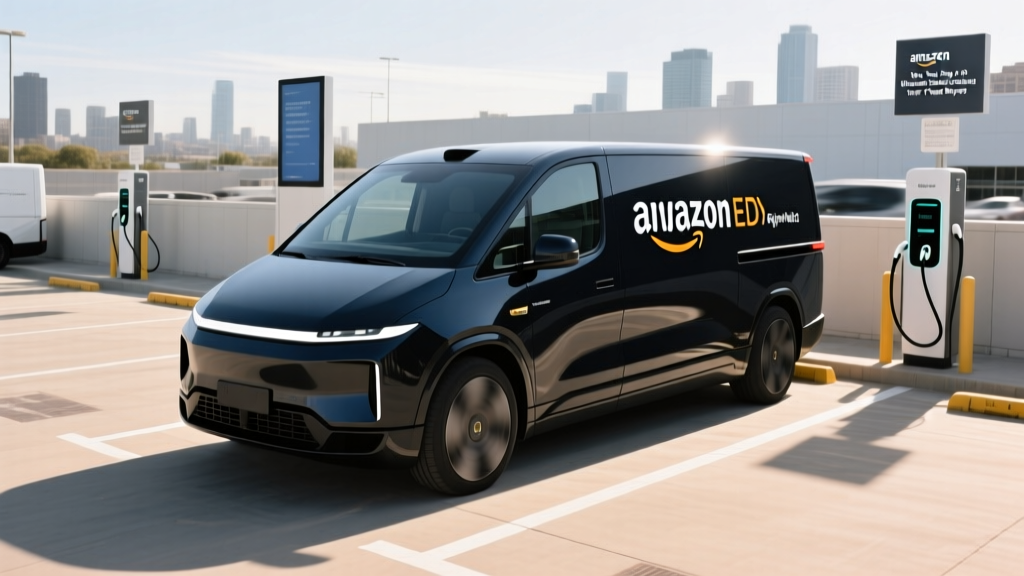
The Short Answer: Can You Buy an Amazon Electric Van?
Bottom line: You cannot buy the exact Amazon-branded Rivian EDV (Electric Delivery Van) as a private consumer or small fleet operator in 2026. Amazon holds an exclusivity agreement with Rivian that runs through 2030, restricting EDV sales to Amazon's own delivery network. However, the commercial electric van market has expanded significantly, and several alternatives are available for purchase right now — including Rivian's own commercial fleet program that opened to non-Amazon buyers in limited capacity starting in 2025.
If you're a fleet manager or small business owner searching for an "amazon electric van for sale," what you're really looking for is a Class 2b/3 electric cargo van with 150–200+ miles of range, fast depot charging, and low operating costs. That market now includes vehicles from Ford, GM/BrightDrop, Mercedes-Benz, and others — and we'll break down exactly what's available and what it costs.
Why the Amazon Rivian EDV Isn't Available to the Public
Amazon ordered 100,000 custom electric delivery vans from Rivian in 2019, with deliveries running through 2030. The EDV comes in two sizes — the EDV-500 (500 cubic feet of cargo space) and the EDV-700 (700 cubic feet) — and was designed from the ground up for last-mile delivery routes. Key specs include:
- Battery: ~135 kWh usable capacity (NMC chemistry)
- EPA-estimated range: Approximately 120–150 miles depending on payload and configuration
- DC fast charging: Up to 150 kW peak, 10–80% in roughly 40 minutes
- Cargo volume: 500 or 700 cu ft
- GVWR: Class 2b (under 10,000 lbs for the EDV-500)
Amazon's exclusivity clause means Rivian cannot sell the EDV to other fleets until at least 2030, though Rivian has begun offering a modified commercial variant to select non-Amazon buyers under its Rivian Commercial program. Even then, availability is extremely limited and prioritized for large fleet contracts.
This is why your search for an "amazon electric van for sale" won't yield direct results — but the good news is that the commercial EV van segment has matured considerably, and several comparable or superior alternatives are on the market now.
Commercial Electric Vans You Can Actually Buy in 2026
| Vehicle | Battery (kWh) | EPA Range (mi) | Cargo (cu ft) | Peak DC Charge (kW) | 10–80% Time | Starting MSRP |
|---|---|---|---|---|---|---|
| Ford E-Transit (2026) | 89 kWh (NMC) | 126 (low-roof) / 108 (high-roof) | 246.7–487.3 | 115 kW | ~45 min | $55,995 |
| BrightDrop Zevo 400 (GM) | 165 kWh (NMC) | ~250 | 412 | 120 kW | ~55 min | ~$74,000 |
| Mercedes-Benz eSprinter (2026) | 113 kWh (NMC) | ~200 | 338–533 | 115 kW | ~42 min | $72,500 |
| Rivian EDV-500 (select fleets) | ~135 kWh (NMC) | ~150 | 500 | 150 kW | ~40 min | Not publicly listed |
| RAM ProMaster EV (2026) | 110 kWh (NMC) | ~162 | 463 | 150 kW | ~35 min | $62,000 |
Real-world range note: These EPA figures assume moderate payloads and mixed driving. In practice, expect 15–25% range reduction with maximum payload, stop-and-go urban delivery routes, and cold-weather operation (below 40°F). A Ford E-Transit rated at 126 miles EPA may deliver 95–105 miles in winter delivery conditions. Always spec your battery for your worst-case route, not your average.
Electric Van vs. Gas Van: The Real Cost Breakdown
The strongest argument for going electric in commercial delivery isn't environmental — it's operational economics. Here's a five-year total cost of ownership (TCO) comparison between the Ford E-Transit and the gasoline Ford Transit 250, based on 20,000 miles/year and national average energy costs:
| Cost Category | Ford E-Transit (EV) | Ford Transit 250 (Gas) |
|---|---|---|
| Purchase Price (base) | $55,995 | $47,500 |
| Federal Commercial Clean Vehicle Credit (§45W) | −$7,500 | $0 |
| Net Purchase Cost | $48,495 | $47,500 |
| Fuel/Energy (5 years, 100k miles) | $6,250 (depot L2 @ $0.13/kWh) | $18,750 (gas @ $3.50/gal, 15 MPG) |
| Maintenance (5 years) | $2,800 | $6,500 |
| Insurance (5 years) | $12,500 | $10,000 |
| Estimated Resale Value (Year 5) | $18,000 | $20,000 |
| Net 5-Year TCO | $52,045 | $62,750 |
Key takeaway: The E-Transit saves roughly $10,700 over five years despite a higher sticker price, driven almost entirely by fuel and maintenance savings. The gap widens if your fleet charges at depot rates below $0.13/kWh or if gas prices rise. Electric vans eliminate oil changes, transmission fluid, spark plugs, and exhaust system maintenance — the powertrain has dramatically fewer moving parts.
Note on tax credits: The §45W Commercial Clean Vehicle Credit provides up to $7,500 for vehicles under 14,000 lbs GVWR and up to $40,000 for heavier vehicles. Eligibility depends on battery sourcing requirements and your business tax liability. Consult a tax professional for your specific situation.
Real-World Ownership: What Fleet Buyers Must Plan For
Depot Charging Infrastructure
Unlike consumer EVs that rely on public charging networks, commercial vans live and die by depot charging. Here's what a typical Level 2 depot installation looks like for a 5-van fleet:
- Equipment: 5× Level 2 wall connectors (19.2 kW each) — $3,000–$5,000 total
- Electrical panel upgrade: Most depots need a 200–400A service upgrade — $5,000–$15,000
- Electrician labor and permits: $8,000–$20,000 depending on trenching, conduit runs, and local code
- Networked charging software: $20–$50/port/month for load management
- Total depot install (5 ports): $18,000–$42,000
At 19.2 kW per port, an E-Transit with an 89 kWh battery charges from 10% to 80% in about 4 hours on Level 2 — ideal for overnight depot charging. You do not need DC fast chargers at the depot unless your vans run multi-shift routes.
Route Planning and Range Reality
Electric vans are best suited for predictable, urban/suburban routes under 100 miles per day. If your routes regularly exceed 120 miles with heavy payloads, you need to either spec a larger-battery vehicle (BrightDrop Zevo 400 or eSprinter) or plan for mid-day opportunity charging on a DC fast charger.
Cold-weather impact: In northern climates (sustained temps below 30°F), expect 20–30% range loss due to battery chemistry limitations and cabin/cargo heating demands. A van rated at 150 miles EPA may deliver only 105–120 miles in a Minnesota winter. Fleets in cold regions should oversize their battery spec by at least 25% relative to their longest route.
Charging Curve Reality
When using public DC fast chargers for mid-day top-ups, understand that peak charge rates are not sustained. A van advertising "150 kW peak" may hold that rate from 10–40% State of Charge, then taper to 80 kW through 60%, and drop to 40 kW above 80%. This is normal lithium-ion battery management — the Battery Management System (BMS) slows charging to protect cell health. Plan your fast-charge stops for the 10–80% window only; charging from 80–100% can take as long as the 10–80% segment.
Common Misconceptions About Commercial Electric Vans
| Myth | Fact |
|---|---|
| "EV vans don't have enough range for real delivery routes." | The average USPS delivery route is 69 miles/day. Most urban courier routes are under 80 miles. Even the lowest-range E-Transit (108 mi EPA) covers these with margin — but always spec for your worst-case day, not your average. |
| "Electric vans are too expensive." | Upfront cost is $5,000–$15,000 higher than gas equivalents, but the §45W credit and fuel/maintenance savings typically close the gap within 2–3 years. Five-year TCO favors EVs in most delivery applications. |
| "Batteries will need expensive replacement." | Commercial van batteries carry 8-year/100,000-mile warranties minimum. The Ford E-Transit battery warranty covers capacity below 70% for 8 years/100,000 miles. Real-world degradation data from early fleet deployments shows 8–12% capacity loss over 100k miles — well within warranty thresholds. |
| "You can buy an Amazon van if you find one used." | Amazon EDVs are not titled for resale to the general public under the exclusivity agreement. Any listing claiming to sell an "Amazon electric van" is either a scam or a non-EDV commercial van being misrepresented. |
| "Charging takes too long for commercial use." | Overnight depot charging on Level 2 (7–8 hours) fully replenishes any van on this list. For multi-shift operations, a 30-minute DC fast-charge session adds 60–80 miles — enough for a second urban route. |
Decision Framework: Which Electric Van Is Right for Your Fleet?
Choose the Ford E-Transit if:
- Your daily routes are under 100 miles with moderate payloads
- You want the lowest entry price and the widest dealer service network
- You already operate Ford Transits and want parts/driver familiarity
- Your cargo needs fit within 487 cu ft maximum
Choose the BrightDrop Zevo 400 if:
- You need maximum range (~250 mi EPA) for longer suburban/rural routes
- You're willing to pay a premium ($74k+) for that range advantage
- Your fleet is large enough to negotiate direct-from-manufacturer pricing
Choose the Mercedes-Benz eSprinter if:
- You need maximum cargo volume (up to 533 cu ft) with a 200-mile range
- Your fleet already operates Sprinters and has existing service relationships
- Premium cabin tech and driver comfort are priorities for driver retention
Choose the RAM ProMaster EV if:
- You want a balance of range (162 mi), cargo space (463 cu ft), and fast charging (150 kW)
- You value the lowest 10–80% charge time (~35 min) for mid-day opportunity charging
- Your budget is mid-range at ~$62,000
Wait for broader Rivian EDV access if:
- Your fleet is very large (500+ vehicles) and can negotiate direct with Rivian Commercial
- You need the unique 500 cu ft step-van configuration that no competitor matches
- You can wait for exclusivity terms to loosen post-2026
What First-Time Commercial EV Buyers Must Know
If this is your fleet's first electric vehicle, here are the non-obvious realities that no brochure will tell you:
- Get your electrical site assessment done before ordering vehicles. A 5-van depot charging setup can require a utility transformer upgrade that takes 3–6 months to schedule. Start this process 6 months before your vehicle delivery date.
- Train drivers on regenerative braking. Commercial EV vans use aggressive regen to recover energy during deceleration. Drivers accustomed to gas vans need 1–2 weeks to adapt to one-pedal-style driving, which also reduces brake wear dramatically (expect 100,000+ miles on original brake pads).
- Insurance costs 15–25% more for EVs. Higher repair costs for battery-adjacent damage and specialized technician requirements drive premiums up. Get quotes before purchasing and factor this into your TCO model.
- Telematics is essential. Fleet management software that monitors State of Charge, route efficiency, and charging patterns is not optional — it's how you prevent range-anxiety dispatch errors. Ford Pro, GM Fleet, and third-party platforms like Geotab all offer EV-specific fleet modules.
- The §45W credit is non-refundable. Your business must have sufficient federal tax liability to use the credit. If your tax burden is lower than the credit amount, you cannot receive the difference as a refund (though you may be able to carry it forward — consult your CPA). The IRS §45W guidelines detail eligibility.
Frequently Asked Questions
Can I buy a used Amazon Rivian EDV?
No. Amazon's EDVs are not available on the used market. The exclusivity agreement with Rivian prohibits resale to non-Amazon entities. Amazon retains ownership and control of all EDVs in its fleet. Any online listing advertising an "amazon electric van for sale" should be treated with extreme skepticism.
What is the cheapest commercial electric van available in 2026?
The Ford E-Transit starts at $55,995 before incentives. After the $7,500 §45W Commercial Clean Vehicle Credit, the effective price drops to approximately $48,495 — making it competitive with a loaded gas Transit 250.
How long do commercial electric van batteries last?
Most manufacturers warrant their batteries for 8 years or 100,000 miles, covering capacity retention above 70%. Real-world fleet data suggests 8–15% degradation over 100,000 miles depending on charging habits and climate. A well-managed fleet battery should remain operational for 150,000–200,000 miles before capacity loss impacts route viability.
Do I need DC fast chargers at my depot?
For single-shift operations (vans return to depot overnight), Level 2 chargers (11.5–19.2 kW) are sufficient and cost 80% less to install. DC fast chargers ($40,000–$100,000+ installed) are only necessary for multi-shift operations or if your vans need mid-day top-ups exceeding what public infrastructure can provide.
How does payload affect electric van range?
Every additional 1,000 lbs of payload reduces range by approximately 5–8%. A Ford E-Transit rated at 126 miles EPA with a light load may deliver 105–112 miles at maximum payload (3,800 lbs). Factor your typical payload into route planning — not just the sticker range.
Are there state incentives for commercial electric vans beyond the federal credit?
Yes, but they vary significantly by jurisdiction. California's HVIP (Hybrid and Zero-Emission Truck and Bus Voucher Incentive Project), New York's NYTVIP, and Colorado's commercial fleet credits can stack with the federal §45W credit. Check your state's energy office or DOE Alternative Fuels Data Center for current programs in your area.