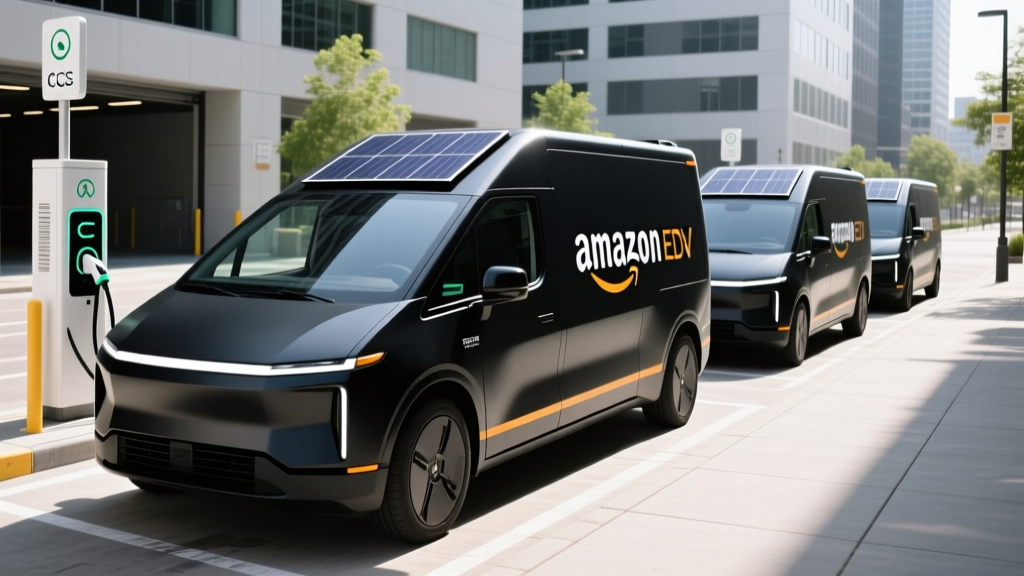
Quick Answer: The Amazon Electric Delivery Van is the Rivian EDV (Electric Delivery Van), a purpose-built commercial BEV produced exclusively for Amazon under a 100,000-unit agreement. As of 2026, Amazon has deployed over 20,000 EDVs across U.S. and European metro delivery routes. The EDV-700 (150 cu ft cargo) offers approximately 150 miles of real-world range from a ~140 kWh NMC battery, charges at up to 150 kW DC, and eliminates diesel fuel and transmission maintenance costs — saving Amazon an estimated $0.15–$0.25 per mile versus the Sprinter-class diesel vans it replaced.
Why Amazon Bet on a Custom Electric Delivery Van
Amazon's last-mile delivery network covers over 100,000 daily routes across North America, most under 120 miles with frequent stop-and-go patterns. That duty cycle — low average speed, heavy regenerative braking opportunity, return-to-depot overnight charging — is the ideal use case for battery-electric commercial vehicles. Rather than adapting an existing van, Amazon signed a landmark deal with Rivian in 2019 to co-develop a ground-up electric delivery van, eventually ordering 100,000 units with delivery through 2030.
The result is the EDV, available in two cargo volumes: the EDV-700 (~150 cubic feet, comparable to a Mercedes-Benz Sprinter 2500) and the larger EDV-900 (~190 cubic feet). A smaller EDV-500 variant has been tested in dense European city centers. Unlike consumer EVs you can purchase at a dealership, the EDV is a fleet-exclusive vehicle — not available for individual sale. But its specs, economics, and real-world performance data offer valuable insight for commercial fleet operators and EV-curious buyers evaluating the electrification of delivery logistics.
EDV Specifications: Battery, Range, and Powertrain
| Specification | EDV-700 | EDV-900 |
|---|---|---|
| Cargo Volume | ~150 cu ft | ~190 cu ft |
| Battery Capacity (estimated usable) | ~140 kWh (NMC) | ~140 kWh (NMC) |
| EPA-Estimated Range | ~150 mi | ~120–140 mi |
| Real-World Range (loaded, mixed route) | 110–145 mi | 100–130 mi |
| Peak DC Fast Charge Rate | 150 kW | 150 kW |
| 10–80% DC Charge Time | ~45–55 min | ~45–55 min |
| Level 2 AC Charging | ~19.2 kW | ~19.2 kW |
| Motor Output | ~300 hp / 400 lb-ft | ~300 hp / 400 lb-ft |
| Drivetrain | RWD (single motor) | RWD (single motor) |
| Payload Capacity | ~2,500 lbs | ~2,800 lbs |
| GVWR | ~9,990 lbs | ~9,990 lbs |
Real-World Range Reality: The EDV-700's ~150-mile EPA-equivalent range is adequate for most last-mile routes (averaging 70–110 miles per day), but heavily loaded vans in cold climates (below 32°F) can see 20–30% range reduction, dropping usable range to 100–115 miles. Amazon mitigates this with route-optimization software that factors battery state-of-charge, weather, and payload weight before dispatching vans.
The EDV uses a single rear-mounted electric motor rather than Rivian's quad-motor R1T/R1S architecture — a cost and efficiency decision appropriate for a vehicle that rarely exceeds 65 mph and doesn't need off-road capability. The ~140 kWh NMC (nickel manganese cobalt) battery pack is mounted low in the chassis, providing a stable center of gravity despite the van's tall profile.
Charging Infrastructure: Depot-Based, Not Public
Unlike consumer EVs that rely on a mix of home and public charging, the EDV charges almost exclusively at Amazon delivery stations — purpose-built depots equipped with dozens of DC fast chargers and Level 2 units. This is a critical distinction in understanding fleet EV economics.
| Charging Level | Power | Typical Use Case | Miles Added per Hour |
|---|---|---|---|
| Level 2 (Depot AC) | ~19.2 kW | Overnight top-off at delivery station | ~40–50 mi/hr |
| DC Fast Charging | Up to 150 kW | Mid-day opportunity charging | ~200–250 mi/hr (peak) |
Most EDVs return to depot with 20–40% state-of-charge remaining and plug into Level 2 chargers overnight, reaching full charge by morning. The 150 kW DC capability exists for mid-shift top-ups but is rarely needed on standard routes. Amazon has invested heavily in depot electrical infrastructure, including transformer upgrades and utility demand-management agreements, to support simultaneous overnight charging of hundreds of vans at high-volume stations.
The charge curve on the EDV's NMC pack peaks near 150 kW up to approximately 40% SoC, then tapers progressively — typical of large NMC packs prioritizing longevity over peak speed. A 10–80% session takes roughly 45–55 minutes, acceptable for depot operations but not comparable to consumer EVs like the Hyundai Ioniq 5 that hit 80% in 18 minutes on 350 kW chargers.
EDV vs Diesel Delivery Van: Cost and Emissions Comparison
The business case for the EDV hinges on total cost of ownership (TCO) over the vehicle's 10-year, ~200,000-mile projected lifespan. Here's how it stacks up against the diesel vans it replaces:
| Cost Factor | Rivian EDV-700 | Diesel Sprinter-Class Van |
|---|---|---|
| Estimated Acquisition Cost | ~$80,000–$90,000 (fleet pricing) | ~$48,000–$55,000 |
| Energy Cost per Mile | $0.06–$0.10 (depot electricity) | $0.22–$0.30 (diesel fuel) |
| Annual Energy Cost (25,000 mi/yr) | $1,500–$2,500 | $5,500–$7,500 |
| Maintenance per Mile | $0.04–$0.07 | $0.12–$0.18 |
| Annual Maintenance (25,000 mi/yr) | $1,000–$1,750 | $3,000–$4,500 |
| Transmission/Exhaust Service | None (no multi-speed trans, no DEF, no DPF) | $1,500–$3,000/yr avg |
| Estimated 10-Year TCO | $150,000–$190,000 | $200,000–$260,000 |
| Tailpipe CO₂ per Mile | 0 lbs (upstream grid varies) | ~1.0–1.3 lbs |
The higher upfront cost of the EDV (roughly 1.5–1.8× a comparable diesel) is offset within 3–5 years through fuel and maintenance savings. Amazon's scale — ordering tens of thousands of units and controlling depot electricity rates through utility contracts — accelerates the payback period. For smaller fleets, the economics depend heavily on local electricity rates, route distances, and available commercial EV incentives like the IRS §45W Commercial Clean Vehicle Credit, which offers up to $40,000 for qualifying commercial EVs over 14,000 lbs GVWR.
What Fleet Operators and EV Buyers Can Learn From the EDV
Even though you can't buy an Amazon EDV at a dealership, the program reveals several principles applicable to any commercial or consumer EV decision:
Common Misconceptions About Electric Delivery Vans
| Myth | Fact |
|---|---|
| "EVs can't handle full-day delivery routes" | Most last-mile routes average 70–110 miles — well within the EDV's 110–145 real-world miles. Route optimization ensures vans aren't dispatched beyond their SoC budget. |
| "Battery replacement makes EVs uneconomical" | The EDV's NMC pack is designed for 200,000+ miles with projected 70–80% capacity retention at end of first life. Amazon has not reported widespread battery replacements. Rivian provides a commercial powertrain warranty covering the pack. |
| "Electric vans are slower and less productive" | Instant torque (400 lb-ft from 0 RPM) gives the EDV strong acceleration from stops — the most common driving event in delivery. Drivers report the EDV is easier and less fatiguing to drive than diesel equivalents. |
| "Cold weather makes electric delivery impossible" | Range drops 20–30% in sub-freezing temps, but Amazon's dispatch software adjusts route length accordingly. Depot preconditioning warms the battery before departure, reducing cold-weather energy loss. |
For first-time EV buyers evaluating passenger vehicles, the EDV program underscores three transferable lessons:
- Match the battery to the duty cycle. The EDV doesn't need 350 miles of range because its routes don't require it. Overspecifying range means paying for battery weight you'll never use — a principle that applies equally to choosing between a 250-mile and 350-mile consumer EV.
- Charging access determines viability. Amazon invested in depot chargers before deploying vans. For consumer buyers, confirming home Level 2 charging feasibility (including panel capacity and electrician costs of $500–$2,000+) should happen before purchase.
- Maintenance savings are real but gradual. No oil changes, no transmission fluid, no DEF fluid, no DPF regeneration. But tire wear on EVs is typically 15–25% higher due to instant torque and heavier curb weight — a cost often overlooked in EV-vs-gas comparisons.
Rivian Beyond Amazon: The EDV's Impact on the Brand
Rivian's Amazon EDV contract has been both a lifeline and a constraint. The company's Normal, Illinois factory has produced EDVs alongside the consumer R1T pickup and R1S SUV, with Amazon's order providing steady revenue during Rivian's cash-intensive ramp-up phase. However, the exclusivity agreement initially prevented Rivian from selling the EDV platform to other fleets — a restriction that began loosening in 2025 when Rivian announced it would offer a commercial van variant (the Rivian Commercial Van, or RCV) to non-Amazon fleet customers starting in 2026–2027.
This matters for the broader EV market: companies like FedEx, UPS, and regional delivery services now have a proven, high-volume electric van option beyond the Ford E-Transit (126-mile EPA range) and the BrightDrop Zevo 600 (250-mile range). Competition in the commercial EV van segment is expected to drive down acquisition costs and accelerate fleet electrification through 2030.
Decision Framework: Is Fleet Electrification Right for Your Operation?
Choose Electric Delivery Vans If:
- Your average daily route is under 130 miles with predictable return-to-depot patterns
- You have depot space with electrical infrastructure (or budget for utility upgrades, typically $50,000–$200,000 for a 20-van depot)
- Your operation is in a state or municipality with commercial EV incentives, clean-air mandates, or low-emission zones
- You plan to hold vehicles 7+ years to capture full TCO savings
- Your local electricity rates are below $0.12/kWh commercial (or you can negotiate off-peak depot charging rates)
Stick With Diesel or Consider PHEV If:
- Your routes regularly exceed 180 miles without mid-day charging opportunity
- You operate in extreme cold climates (sustained below 0°F) without heated depot facilities
- Your fleet turns over vehicles every 3–4 years (insufficient time to recoup higher upfront EV cost)
- Your depot electrical service is constrained and utility upgrades would take 2+ years
- You need towing capability beyond what current electric vans provide
Frequently Asked Questions
Can I buy an Amazon Electric Delivery Van for personal use?
No. The Rivian EDV is built exclusively for Amazon under a long-term supply agreement and is not available for retail purchase. However, Rivian is developing a commercial van variant (RCV) for other fleet customers, expected to begin deliveries in 2026–2027. For personal use, consider the Ford E-Transit (starting ~$47,000, 126-mile EPA range) or the consumer Rivian R1T/R1S.
How many Amazon Electric Delivery Vans are on the road?
As of early 2026, Amazon has deployed over 20,000 EDVs across the U.S. and Europe, with deliveries ongoing toward the 100,000-unit commitment through 2030. The EDV operates in most major U.S. metro areas and is a common sight in Amazon's DSP (Delivery Service Partner) fleet.
What is the real-world range of the Amazon EDV?
The EDV-700 delivers approximately 110–145 miles in real-world delivery use, depending on payload, terrain, climate, and driving style. The EPA-equivalent rating is ~150 miles. Cold weather (below 32°F) can reduce range by 20–30%, bringing usable range to roughly 100–115 miles. Amazon's routing software accounts for these variables when assigning daily routes.
How long does it take to charge the Amazon Electric Delivery Van?
On a 150 kW DC fast charger, the EDV charges from 10–80% in approximately 45–55 minutes. Most vans charge overnight on Level 2 depot chargers (~19.2 kW), reaching a full charge in 7–9 hours. The charge curve tapers above 80% to protect battery longevity, which is standard practice for fleet vehicles designed for 200,000+ mile lifespans.
Does Amazon use Rivian for all its delivery vans?
No. While the Rivian EDV is Amazon's primary electric van, the company still operates gasoline and diesel vehicles (including Ram ProMaster and Mercedes-Benz Sprinter vans) on longer routes and in areas where EV charging infrastructure is not yet available. Amazon's goal is to have 100,000 EDVs deployed by 2030, but its total global delivery fleet numbers well over 100,000 vehicles across all powertrains.
What tax credits apply to commercial electric delivery vans?
The IRS §45W Commercial Clean Vehicle Credit provides up to $40,000 for qualified commercial EVs with GVWR above 14,000 lbs (the EDV is under this threshold at ~9,990 lbs, qualifying for up to $7,500). Eligibility depends on battery sourcing requirements, MSRP limits, and business tax liability. Consult a tax professional and review current IRS guidance, as rules are subject to legislative changes.