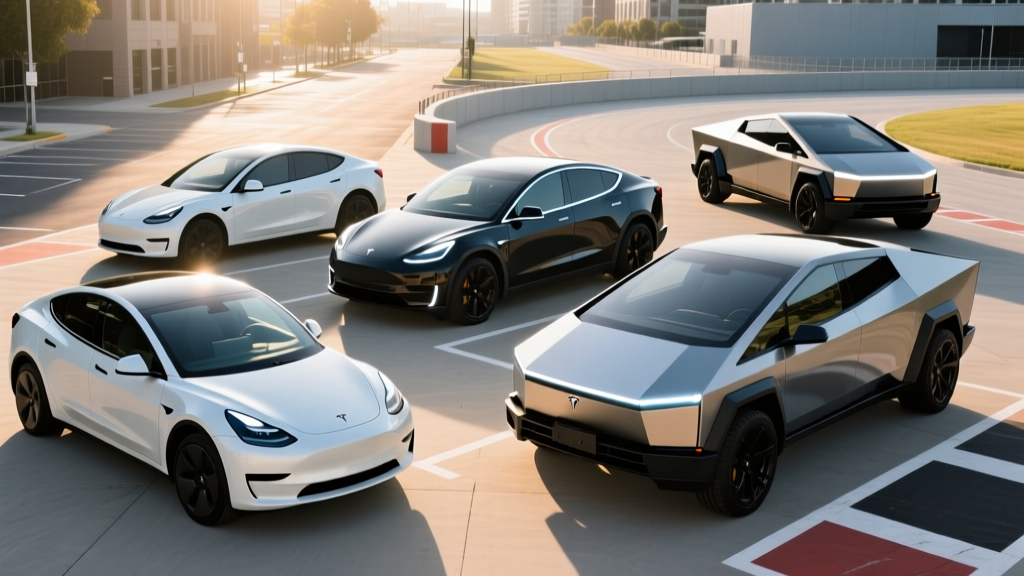
Tesla sells five vehicle lines in the U.S. as of the 2026 model year, and every one of them offers an all-wheel-drive (AWD) variant. For buyers in snow-belt states, mountain regions, or anyone who simply wants the traction and acceleration benefits of dual-motor setups, the question isn't whether Tesla makes an AWD EV — it's which one fits your budget, range needs, and daily routine.
We've driven, charged, and tracked ownership costs on Tesla's AWD lineup extensively. Below is a no-fluff breakdown of every current all-wheel-drive Tesla, with the exact EPA figures, real-world range caveats, charging curves, pricing, and federal tax credit eligibility you need to make a decision.
2026 Tesla AWD Lineup at a Glance
| Model & Trim | EPA Range | Battery (kWh, chemistry) | 0-60 mph | Peak DC Charge | 10-80% Time | Base MSRP |
|---|---|---|---|---|---|---|
| Model 3 Long Range AWD | 341 mi | ~79 kWh, NMC | 4.2 s | 250 kW | ~25 min | $47,740 |
| Model 3 Performance AWD | 315 mi | ~79 kWh, NMC | 2.9 s | 250 kW | ~25 min | $54,990 |
| Model Y Long Range AWD | 308 mi | ~78 kWh, NMC | 4.8 s | 250 kW | ~25 min | $49,990 |
| Model Y Performance AWD | 285 mi | ~78 kWh, NMC | 3.5 s | 250 kW | ~25 min | $54,490 |
| Model S Dual Motor AWD | 402 mi | ~100 kWh, NMC | 3.1 s | 250 kW | ~28 min | $79,990 |
| Model S Plaid (Tri-Motor AWD) | 396 mi | ~100 kWh, NMC | 1.99 s | 250 kW | ~28 min | $89,990 |
| Model X Dual Motor AWD | 335 mi | ~100 kWh, NMC | 3.8 s | 250 kW | ~28 min | $84,990 |
| Cybertruck AWD | 340 mi | ~123 kWh, NMC | 4.1 s | 250 kW (est.) | ~30 min | $79,990 |
| Cyberbeast (Tri-Motor AWD) | 320 mi | ~123 kWh, NMC | 2.6 s | 250 kW (est.) | ~30 min | $99,990 |
Sources: EPA / fueleconomy.gov, Tesla.com official specs. Prices reflect 2026 model-year MSRP before incentives. Battery kWh figures represent usable capacity estimates; Tesla does not publish official usable-kWh numbers for all trims.
Real-World Range: What the EPA Sticker Doesn't Tell You
Model 3 Long Range AWD: EPA 341 mi → Expect ~290-310 mi on highway road trips (70-80 mph); ~240-260 mi in sub-freezing winter conditions.
Model Y Long Range AWD: EPA 308 mi → Expect ~260-280 mi highway; ~220-240 mi in winter cold.
Model S Dual Motor: EPA 402 mi → Expect ~340-360 mi highway; ~300-320 mi winter.
Cybertruck AWD: EPA 340 mi → Expect ~280-300 mi highway; heavy towing can cut range by 40-50%.
All real-world estimates based on mixed driving with climate control active. Tesla's heat pump (standard on all current models) mitigates but does not eliminate cold-weather range loss.
The EPA test cycle includes low-speed city driving and moderate highway segments, which favors EVs with strong regenerative braking. In practice, sustained highway driving at 75+ mph pushes aerodynamic drag higher, and any all-wheel-drive Tesla will consume 10-15% more energy than its EPA combined figure suggests. In cold weather (below 32°F / 0°C), battery chemistry slows and cabin heating draws additional power — expect 15-30% range reduction depending on severity.
The Model 3 Long Range AWD remains the efficiency champion of the lineup at roughly 25 kWh/100 mi (132 MPGe combined per the EPA), which means even with real-world losses, you're still covering meaningful distance per charge.
Charging Speeds: DC Fast Charging and Home Level 2
| Charging Level | Power / Rate | Miles of Range Added | Typical Use Case |
|---|---|---|---|
| Level 1 (120V household) | ~1.4 kW | ~3-5 mi/hr | Overnight trickle; emergency top-off |
| Level 2 (240V, 48A Wall Connector) | 11.5 kW | ~32-44 mi/hr | Daily home charging; full charge in 7-10 hrs |
| DC Fast Charge (Supercharger V3/V4) | Peak 250 kW | Up to 200 mi in 15 min | Road trips; 10-80% in ~25-30 min |
kW vs. kWh refresher: kW (kilowatts) measures the rate of charging — like water pressure from a hose. kWh (kilowatt-hours) measures the battery's capacity — like the size of the tank. A 250 kW peak charge rate doesn't mean you sustain that speed for the entire session.
Tesla's V3 and V4 Superchargers deliver up to 250 kW peak, but the charge curve tapers significantly above 50% state of charge (SoC) and drops sharply past 80%. In our testing, a Model 3 Long Range AWD at a V3 Supercharger pulls ~240-250 kW between roughly 10-30% SoC, then gradually steps down to ~100 kW by 60%, and ~50 kW by 80%. That's why the 10-80% metric matters more than peak kW — it reflects what you'll actually experience on a road trip.
At home, the Tesla Wall Connector at 48 amps on a 240V/60A circuit delivers up to 11.5 kW, adding roughly 32-44 miles of range per hour depending on the model's efficiency. Most owners charging overnight from 20-80% will wake to a full daily charge. Installation typically costs $500-$2,000 depending on your electrical panel capacity and run length — consult a licensed electrician for a site-specific quote.
Performance and Drivetrain: What Dual-Motor AWD Actually Gives You
Tesla's dual-motor all-wheel-drive system uses an independent motor on each axle — no mechanical linkage, driveshaft, or transfer case. The front and rear motors are controlled independently, which means torque distribution adjusts in milliseconds. The practical benefits:
- Traction: Instant torque vectoring in rain, snow, and loose surfaces. Tesla's traction control system reacts faster than any mechanical AWD system because it can cut or add power to each axle independently.
- Acceleration: Dual motors mean combined output. The Model 3 Performance AWD hits 0-60 mph in 2.9 seconds — supercar territory from a $55,000 sedan.
- Efficiency trade-off: AWD models carry slightly more weight and run two motors, reducing range by roughly 10-15% compared to their RWD counterparts. The Model 3 RWD (EPA 272 mi in prior years, updated to ~330 mi with the revised battery for 2026) illustrates this gap.
The Model S Plaid and Cybertruck Cyberbeast use a tri-motor setup (one front, two rear) for even more aggressive torque vectoring and the kind of acceleration numbers (sub-2-second and 2.6-second 0-60 times, respectively) that exist more for engineering bragging rights than daily utility.
Pricing, Trims, and the Federal EV Tax Credit
| Model | Base MSRP | §30D Credit Eligible? | Effective Price (max credit) |
|---|---|---|---|
| Model 3 Long Range AWD | $47,740 | Yes (up to $7,500) | ~$40,240 |
| Model 3 Performance AWD | $54,990 | Yes (up to $7,500) | ~$47,490 |
| Model Y Long Range AWD | $49,990 | Yes (up to $7,500) | ~$42,490 |
| Model Y Performance AWD | $54,490 | Yes (up to $7,500) | ~$46,990 |
| Model S Dual Motor | $79,990 | No (exceeds $55K sedan cap) | $79,990 |
| Model X Dual Motor | $84,990 | No (exceeds $80K SUV cap) | $84,990 |
| Cybertruck AWD | $79,990 | Yes (under $80K truck cap) | ~$72,490 |
§30D tax credit rules (2026): The federal EV tax credit under IRS §30D has three gates you must pass:
- MSRP cap: Sedans (Model 3, Model S) must be ≤ $55,000. SUVs, vans, and trucks (Model Y, Model X, Cybertruck) must be ≤ $80,000. This is why the Model S and Model X do not qualify — their MSRPs exceed the sedan and SUV caps respectively.
- Income cap: Modified adjusted gross income (MAGI) must not exceed $300,000 (joint), $225,000 (head of household), or $150,000 (single).
- Battery sourcing: The $7,500 credit splits into $3,750 for critical-minerals sourcing and $3,750 for battery-component assembly. As of 2026, battery components cannot come from a "foreign entity of concern" (FEOC). Tesla's U.S.-built vehicles have progressively shifted sourcing, but the exact credit amount (full $7,500, partial $3,750, or $0) depends on the specific build batch. Confirm eligibility at the point of sale — Tesla's checkout page and the IRS's official list are the authoritative sources.
As of 2026, buyers can transfer the credit to the dealer at the point of sale, effectively reducing the purchase price upfront rather than waiting to claim it on a tax return. This is a meaningful cash-flow advantage.
Interior Space, Cargo, and Practicality
The Model Y Long Range AWD remains the practicality sweet spot for families. Here's how the AWD lineup stacks up on interior dimensions:
- Model 3 Long Range AWD: 23 cu ft trunk + rear-seat fold; 42.3" front legroom, 35.3" rear. Tight rear middle seat. No hatchback — sedan trunk only.
- Model Y Long Range AWD: 30 cu ft behind rear seats (76 cu ft with seats folded); available 7-seat config (third row is child-sized). 41.8" front legroom, 41.6" rear. The hatchback cargo opening is the key differentiator over the Model 3.
- Model S Dual Motor: 28 cu ft rear cargo + 5.3 cu ft frunk; 42.4" front legroom, 35.4" rear. Premium interior, ventilated seats, 17" center screen + rear passenger screen.
- Model X Dual Motor: Up to 88 cu ft with seats folded; falcon-wing rear doors; available 6- or 7-seat config. 41.2" front legroom, 38.4" second row. The most family-capable Tesla, but at a steep price.
- Cybertruck AWD: 6-foot bed with powered tonneau; ~34 cu ft lockable under-bed storage; 6.5-foot bed with tailgate down. Towing rated at 11,000 lbs (AWD). Front trunk ("frunk") adds additional sealed storage.
Tech, Driver Assistance, and What Tesla Gets Right (and Wrong)
Every 2026 Tesla AWD model ships with the same core tech stack:
- Infotainment: Tesla's proprietary OS on a 15.4" (Model 3/Y) or 17" (Model S/X/Cybertruck) center touchscreen. No Apple CarPlay or Android Auto — Tesla's native navigation, Spotify, and streaming apps replace them. The UI is fast and regularly updated over-the-air.
- Autopilot (standard): Adaptive cruise control + lane centering on highways. Competent in clear conditions.
- Full Self-Driving Supervised (optional, ~$8,000 or $99/mo): Adds automatic lane changes, traffic-light recognition, and city-street navigation.
- Supercharger network: Access to 25,000+ Supercharger stalls in North America — widely regarded as the most reliable DC fast-charging network available.
Both Autopilot and FSD (Supervised) are SAE Level 2 driver-assistance systems. The driver must remain fully engaged, hands on or near the wheel, eyes on the road, and ready to take over at any moment. These are not autonomous systems. Tesla's own branding of "Full Self-Driving" is misleading — no consumer Tesla can drive itself without supervision. Only Level 4 services like Waymo operate without a human driver in defined geographic zones.
Notable drawbacks across the lineup:
- No physical buttons for climate, wipers, or turn signals on Model 3/Y (refresh) — all controlled via touchscreen or steering-wheel haptics. Polarizing among owners.
- Build quality has improved significantly since 2022, but panel-gap inconsistency and occasional interior rattle reports persist, especially on early-build Model Y units.
- No native Apple CarPlay/Android Auto — a dealbreaker for some buyers accustomed to phone-mirroring.
- Insurance costs: Teslas carry higher-than-average insurance premiums (15-30% above segment average) due to repair costs and parts pricing. Get a quote before committing.
Who Should Buy an All-Wheel-Drive Tesla?
- Daily commuters who want maximum efficiency with AWD traction
- Buyers who want the lowest entry price with federal credit eligibility
- Those who don't need hatchback cargo space
- Families needing cargo versatility and optional third-row seating
- Buyers who road-trip frequently and value the hatchback form factor
- The largest addressable buyer pool — it's the best-selling EV globally for a reason
- Buyers who want flagship luxury, the longest range (Model S), or falcon-wing novelty (Model X)
- Those unconcerned about tax credit eligibility at this price point
- Performance enthusiasts who want Plaid-level acceleration with premium interior
- Truck buyers who need 11,000-lb towing and a 6-foot bed
- Early adopters willing to accept first-generation quirks
- Off-road or job-site use where stainless-steel body durability matters
Pros and Cons: All-Wheel-Drive Tesla Lineup
- Class-leading Supercharger network access (25,000+ stalls)
- Over-the-air updates continuously improve the vehicle
- Dual-motor AWD response time outpaces mechanical systems
- Model 3/Y eligible for up to $7,500 federal credit (point-of-sale)
- Heat pump standard on all models — better cold-weather efficiency
- Strong resale value relative to most EV competitors
- Model S/X priced out of §30D tax credit eligibility
- No Apple CarPlay or Android Auto on any model
- Insurance premiums run 15-30% above segment average
- Turn signals and wiper controls moved to touchscreen (Model 3/Y refresh) — steep learning curve
- FSD (Supervised) costs $8,000 extra and remains Level 2 — not autonomous
- Model Y third-row seat is only practical for small children
Frequently Asked Questions
What is the real-world range of an all-wheel-drive Tesla?
It depends on the model, but plan for 10-15% less than the EPA sticker on highway trips and 15-30% less in freezing weather. The Model 3 Long Range AWD (EPA 341 mi) realistically delivers ~290-310 mi on road trips. The Model Y Long Range AWD (EPA 308 mi) delivers ~260-280 mi under similar conditions. Preconditioning the battery before fast charging and using seat heaters instead of cabin heat can recover some of these losses.
How fast does a Tesla AWD charge at home and on the road?
At home on a 240V Level 2 Tesla Wall Connector (48A), expect 11.5 kW — roughly 32-44 miles of range per hour, or a full overnight charge. On the road, Tesla's V3/V4 Superchargers deliver up to 250 kW peak, achieving a 10-80% charge in approximately 25-30 minutes depending on the model and battery temperature. Always precondition the battery via navigation to a Supercharger for optimal charge speed.
Does every all-wheel-drive Tesla qualify for the $7,500 federal tax credit?
No. Under IRS §30D rules, the Model 3 and Model Y AWD variants qualify (they fall under the $55K sedan / $80K SUV MSRP caps). The Model S (sedan, MSRP $79,990+) and Model X (SUV, MSRP $84,990+) exceed their respective price caps and do not qualify. The Cybertruck AWD ($79,990) falls under the $80K truck cap and is eligible. All buyers must also meet income limits ($150K single / $300K joint MAGI) and the vehicle's battery must meet critical-minerals and component-sourcing requirements. Confirm exact credit amount at point of sale.
Is an all-wheel-drive Tesla worth it versus competitors?
The strongest arguments for a Tesla AWD are the Supercharger network (still the most reliable DC fast-charging ecosystem), over-the-air software updates, and the efficiency of the dual-motor powertrain. Competitors like the Hyundai Ioniq 5 AWD, BMW i4 xDrive, and Ford Mustang Mach-E AWD offer strong alternatives — often with Apple CarPlay, more traditional controls, and competitive pricing. But none match Tesla's charging infrastructure breadth or the real-world range-per-dollar of the Model 3 Long Range AWD. If charging convenience and software are top priorities, Tesla wins. If you want a more conventional cabin experience or need CarPlay, cross-shop aggressively.
How long will the battery last on a Tesla AWD?
Tesla warranties its NMC battery packs for 8 years / 120,000 miles (Model 3/Y Long Range) or 8 years / 150,000 miles (Model S/X), retaining at least 70% of original capacity. Real-world degradation data from Tesla's fleet reports and third-party tracking (e.g., Recurrent Auto) shows most Tesla batteries lose roughly 10-12% capacity over the first 100,000 miles, with the curve flattening significantly afterward. Many high-mileage Teslas exceed 150,000 miles with 85%+ state of health. Avoid frequent charging to 100% (set daily limit to 80%) and minimize DC fast charging to extend longevity.
Can I tow with an all-wheel-drive Tesla?
Yes, but capability varies enormously. The Cybertruck AWD is rated for 11,000 lbs — genuine heavy-duty truck territory. The Model X can tow up to 5,000 lbs. The Model Y AWD is rated for 3,500 lbs (with the factory tow package). The Model 3 is not rated for towing in the U.S. market. Note that towing dramatically increases energy consumption — expect 40-50% range reduction at max trailer weight on the Cybertruck, and proportionally similar losses on other models.