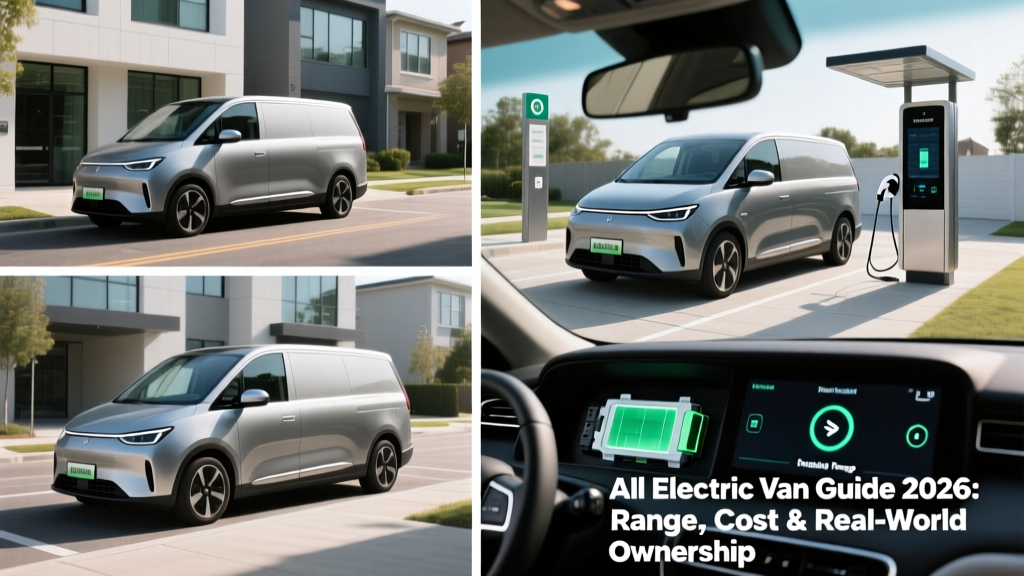
The Real Story on Buying an All Electric Van in 2026
Quick Answer: If you're shopping for an all electric van today, the Ford E-Transit leads for commercial cargo use (126 miles EPA range, ~$51,000 base), while the Mercedes-Benz eSprinter offers the longest range at 211 miles EPA (~$72,000). For passenger/family use, the Chrysler Pacifica Hybrid (PHEV, 32 miles electric-only) remains the only electrified minivan. Expect real-world range 15–25% below EPA in mixed driving, and commercial buyers should verify IRS §30D or §45W commercial credit eligibility before purchase.
The all electric van segment has matured past early-adopter territory into a calculated business and lifestyle decision. Fleet operators, tradespeople, and large families now face a legitimate question: does electrifying a van platform save money and reduce downtime, or does the upfront premium and charging logistics outweigh the benefits? This guide breaks down the current market with real numbers — not marketing promises.
Current All Electric Van Models: Spec Comparison
Here's what's actually available for the 2026 model year. Note that payload and cargo volume vary by wheelbase and roof height configuration.
| Model | EPA Range | Battery (kWh usable) | Peak DC Charge (kW) | 10–80% Time | Cargo Volume | Base MSRP |
|---|---|---|---|---|---|---|
| Ford E-Transit (2026) | 126 mi | 68 kWh (NMC) | 115 kW | ~45 min | 487 cu ft (high roof) | $51,000 |
| Mercedes-Benz eSprinter (2026) | 211 mi | 113 kWh (NMC) | 115 kW | ~42 min | 533 cu ft (high roof) | $72,000 |
| BrightDrop Zevo 600 (2026) | ~250 mi (est.) | 165 kWh (NMC) | 120 kW | ~55 min | 615 cu ft | $78,000 (fleet) |
| Chrysler Pacifica Hybrid (PHEV) | 32 mi electric-only / 520 mi total | 16 kWh (NMC) | N/A (Level 2 only) | ~2 hr (L2) | 140.5 cu ft (seats folded) | $49,000 |
Real-world range caveat: Cargo vans rarely achieve their EPA sticker. The E-Transit's 126-mile rating assumes light payload and moderate temperatures. Expect 95–110 miles with a 2,000-lb load in 70°F weather, and potentially 75–90 miles in sub-30°F conditions. The eSprinter's larger battery provides more buffer, but highway driving at 70+ mph still cuts range by roughly 20%.
Total Cost of Ownership: Electric Van vs. Gas Van
The purchase price of an all electric van is substantially higher than its gas equivalent. The Ford E-Transit starts at $51,000; a comparable gas Transit cargo van starts around $44,000. But total cost of ownership tells a different story for high-mileage commercial users.
| Cost Factor | Ford E-Transit (Electric) | Ford Transit 3.5L V6 (Gas) |
|---|---|---|
| Purchase Price | $51,000 | $44,000 |
| Federal Tax Credit (§45W commercial) | Up to $7,500 | $0 |
| Fuel/Energy Cost (15,000 mi/yr, 5 yr) | $4,500 ($0.13/kWh avg) | $11,250 ($3.75/gal, 15 MPG) |
| Maintenance (5 yr) | $1,800 (tires, cabin filter, brake inspection) | $4,200 (oil, filters, brakes, transmission) |
| Insurance (5 yr avg) | $9,500 | $8,000 |
| 5-Year Total | $62,300 | $67,450 |
The electric van wins on 5-year TCO by roughly $5,000 for a fleet vehicle driven 15,000 miles annually — but only if you can charge at depot overnight. Without home or depot charging, public DC fast charging at $0.35–$0.50/kWh erases the fuel savings entirely. Commercial buyers should also investigate the §45W commercial clean vehicle credit, which operates under different rules than the consumer §30D credit (no MSRP cap, different sourcing requirements).
Charging Infrastructure: The Make-or-Break Factor
Every all electric van buyer must answer one question before signing: where will this vehicle charge every night? Depot-based Level 2 charging is the ideal scenario. Here's what that looks like in practice:
| Charging Level | Power (kW) | Miles Added/Hour | Use Case |
|---|---|---|---|
| Level 1 (120V) | 1.4 kW | ~3–4 mi/hr | Emergency/top-up only — unusable for daily van ops |
| Level 2 (240V, 48A) | 11.5 kW | ~28–32 mi/hr | Overnight depot charging — full charge in 6–8 hours |
| DC Fast Charge | 50–115 kW | ~120–200 mi/hr (peak) | Midday top-up; not for daily use (degradation) |
Level 2 installation cost for commercial depot: Expect $3,500–$8,000 per charger including a 48A hardwired unit ($600–$1,200), electrical panel work, conduit runs, and permitting. Multi-charger depots may require a service upgrade from 200A to 400A three-phase, pushing costs to $15,000–$25,000. Factor this into year-one budgeting.
For residential buyers eyeing the Pacifica Hybrid or considering an E-Transit as a conversion camper, a standard 240V/48A home charger ($500–$800 equipment, $800–$2,000 installation) handles overnight needs. The Pacifica Hybrid's small 16 kWh battery charges fully in roughly 2 hours on Level 2.
Electric Van vs. Gas vs. Hybrid: Which Fits Your Route?
| Factor | All Electric Van | Gas Van | PHEV Minivan |
|---|---|---|---|
| Best For | Predictable routes under 100 mi/day, depot charging | Long-haul, rural, variable routes | Family use with short commutes + road trips |
| Daily Range Needed | <100 mi (with buffer) | 300+ mi | 32 mi electric, then gas |
| Cold Weather Impact | 20–30% range loss | Minimal | Reduced EV range, gas engine compensates |
| Refuel/Recharge Time | 6–8 hr (L2) or 45 min (DC) | 5 minutes | 5 min (gas) or 2 hr (L2) |
| Maintenance Complexity | Low (no oil, fewer brake replacements) | High (transmission, exhaust, oil changes) | Moderate (two powertrains to service) |
| Upfront Premium | +$7,000–$28,000 vs gas | Baseline | +$5,000–$8,000 vs gas minivan |
The data is clear: an all electric van pays off when routes are predictable, daily mileage stays within 70–80% of rated range (leaving cold-weather buffer), and overnight charging is guaranteed. If your routes regularly exceed 120 miles or you operate in northern climates without garage parking, a gas Transit or Sprinter remains the pragmatic choice in 2026.
Common Misconceptions About Electric Vans
| Myth | Fact |
|---|---|
| "Electric vans can't handle heavy payloads" | The E-Transit has a 3,880-lb max payload rating (low roof) — competitive with the gas Transit's 4,290 lbs. The weight penalty is real but manageable for most trades. |
| "Batteries will need replacing at $20,000+" | Both Ford and Mercedes warranty their van batteries for 8 years/100,000 miles at 70% capacity retention. EPA data shows modern NMC packs typically retain 85–90% at 100k miles. Full replacement is rare before 200k+ miles. |
| "You'll always qualify for the $7,500 tax credit" | Commercial vehicles use the §45W credit, which has different battery-sourcing and assembly requirements. Consumer purchases of vans over 14,000 lbs GVWR aren't eligible for §30D at all. Always verify with a tax professional. |
| "Fast charging daily is fine" | Exclusive DC fast charging accelerates battery degradation. Fleet data shows packs charged primarily on Level 2 retain 5–8% more capacity at 100k miles vs. daily DC charging. |
Decision Framework: Should You Buy an All Electric Van?
Choose an all electric van (E-Transit or eSprinter) if:
- Your daily route is under 100 miles round-trip and predictable
- You have depot or home Level 2 charging available every night
- You drive 12,000+ miles annually (fuel savings offset the premium faster)
- You operate in mild-to-moderate climates, or have indoor/garage parking
- You qualify for the §45W commercial credit or applicable state fleet incentives
Stick with a gas van if:
- Your routes regularly exceed 150 miles or are highly variable
- You lack access to reliable overnight Level 2 charging
- You operate in sub-zero climates without battery preconditioning infrastructure
- Your annual mileage is under 8,000 (the TCO payback extends past 7+ years)
- You need maximum towing (the gas Transit tows up to 6,900 lbs; the E-Transit is not rated for significant towing)
Choose the Pacifica Hybrid (PHEV) if:
- You need a passenger minivan for family use, not cargo
- Your daily school/commute loop is under 30 miles (run on electric)
- You still need 520+ miles of total range for road trips without charging stops
Frequently Asked Questions
What is the longest-range all electric van available in 2026?
The Mercedes-Benz eSprinter at 211 miles EPA with the 113 kWh battery pack. Real-world range with moderate payload and mixed driving is approximately 170–185 miles. In cold weather (below 30°F), expect 145–160 miles.
Can I tow with an electric van?
Towing capacity is a significant limitation. The Ford E-Transit is not recommended for heavy towing — Ford rates it only for light trailer use. The gas Transit tows up to 6,900 lbs. If your business requires regular towing, a gas or diesel van remains the better tool in 2026.
Do electric vans qualify for the $7,500 federal tax credit?
It depends on how you buy and what you buy. Vans purchased for commercial/business use may qualify for the §45W commercial clean vehicle credit (up to $7,500 for vehicles under 14,000 lbs GVWR, up to $40,000 for heavier vehicles). This credit has different battery-sourcing and domestic-assembly rules than the consumer §30D credit. Income caps and MSRP caps do not apply to §45W, but the vehicle must be used predominantly in a trade or business. Consult a tax professional for your specific situation.
How long do electric van batteries last?
Ford warranties the E-Transit battery for 8 years or 100,000 miles (whichever comes first) with a 70% capacity retention threshold. Mercedes-Benz offers the same terms for the eSprinter. Real-world fleet data from early E-Transit deployments suggests 85–92% capacity retention at 100,000 miles when primarily Level 2 charged. A full battery replacement, if needed out of warranty, runs $15,000–$25,000 depending on the model.
Is an electric van practical for a camper conversion?
It can be, with caveats. The E-Transit's 126-mile EPA range becomes roughly 90–105 miles once you add conversion weight (insulation, furniture, water tanks). This limits you to campground-to-campground hops with charging access. The eSprinter's 211-mile range is more viable for van-life, but the $72,000+ starting price makes it a premium conversion platform. Most camper converters still prefer gas Sprinter or Transit chassis for range flexibility in remote areas.
What charging connector do electric vans use?
The Ford E-Transit uses the CCS1 connector for DC fast charging and J1772 for Level 2. The Mercedes-Benz eSprinter also uses CCS1/J1772. As of 2026, neither has adopted the NACS (Tesla) connector, though adapters are available for Supercharger access where permitted. BrightDrop uses CCS1 as well.