The Quick Answer: Is an All-Electric Toyota Right for You?
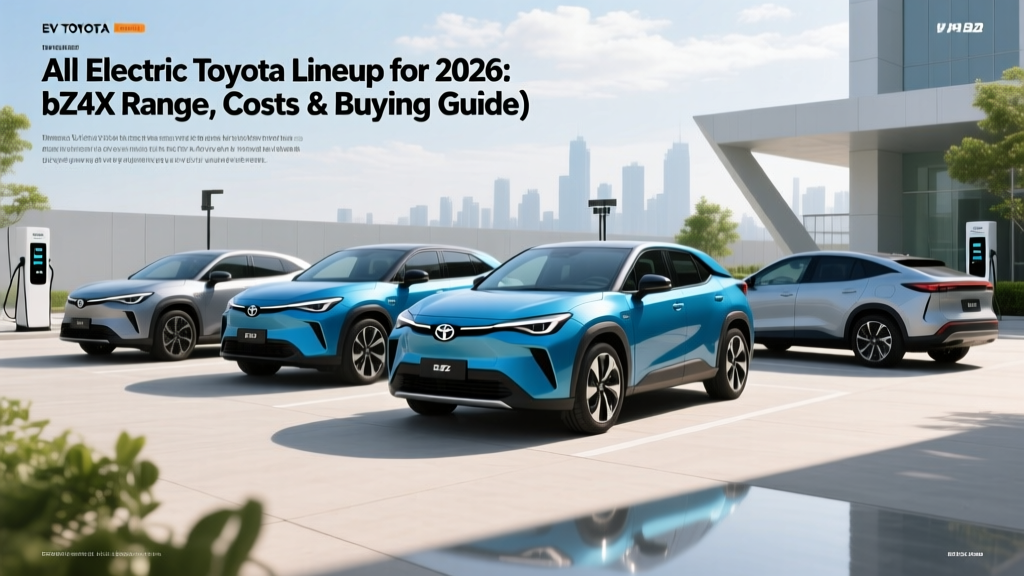
If you're searching for an all electric Toyota, your current option is the 2026 Toyota bZ4X, a compact electric crossover with an EPA-estimated range of up to 252 miles, starting at approximately $38,465. It's a solid entry point into battery-electric ownership from a brand known for hybrid dominance, but it comes with important caveats: DC fast charging peaks at around 150 kW (slower than rivals like the Hyundai Ioniq 5), real-world highway range drops closer to 210–220 miles, and federal tax credit eligibility depends on your income, the vehicle's MSRP, and battery-sourcing requirements under current IRS §30D rules.
Bottom line: The bZ4X works well for daily commuters with home Level 2 charging and moderate road-trip needs. If you regularly drive 300+ miles between stops or live in extreme cold climates, Toyota's hybrid lineup (like the RAV4 Hybrid or Prius) may serve you better for now.
2026 Toyota bZ4X: Specs, Range, and Real-World Expectations
Toyota introduced the bZ4X as its first mass-market battery electric vehicle, and the 2026 model year carries forward with incremental updates. Here are the exact numbers buyers need:
| Specification | bZ4X FWD (XLE) | bZ4X AWD (XLE) |
|---|---|---|
| EPA Range | 252 miles | 228 miles |
| Battery Capacity | 71.4 kWh (usable) | 71.4 kWh (usable) |
| Battery Chemistry | NMC (Nickel Manganese Cobalt) | NMC |
| Horsepower | 201 hp | 214 hp |
| 0–60 mph | ~7.1 seconds | ~6.5 seconds |
| Peak DC Fast Charge | ~150 kW | ~150 kW |
| 10–80% DC Charge Time | ~33 minutes | ~33 minutes |
| Level 2 Charge Rate | 7.2 kW (onboard charger) | 7.2 kW |
| MPGe (Combined) | 119 MPGe | 112 MPGe |
| Starting MSRP | ~$38,465 | ~$40,880 |
| Battery/Powertrain Warranty | 8 yr / 100,000 mi | 8 yr / 100,000 mi |
EPA vs. Real-World Range: The FWD bZ4X carries an EPA estimate of 252 miles, but expect approximately 210–225 miles at sustained highway speeds (70–75 mph) in mild conditions. In freezing temperatures (below 32°F), range can drop an additional 15–25%, potentially bringing usable range to 170–190 miles. The AWD variant, rated at 228 miles EPA, will deliver roughly 190–205 miles in mixed real-world driving. If your typical weekly driving stays under 200 miles and you charge at home nightly, the bZ4X's range is more than adequate.
Charging the bZ4X: What You Need to Know
Charging speed is one area where the bZ4X faces criticism compared to competitors. Here's the practical breakdown:
| Charging Level | Power | Miles Added per Hour | Typical Use Case |
|---|---|---|---|
| Level 1 (120V household) | ~1.4 kW | ~4–5 mi/hr | Overnight trickle; emergency top-ups |
| Level 2 (240V home/public) | 7.2 kW (max onboard) | ~24–28 mi/hr | Daily home charging; full charge in ~10 hrs |
| DC Fast Charging | ~150 kW peak | ~130+ mi in 30 min | Road trips; 10–80% in ~33 min |
Charging curve reality: The bZ4X peaks at roughly 150 kW only at low state-of-charge (around 10–20% SoC). As the battery fills, charging power tapers significantly — above 60% SoC, expect rates closer to 60–80 kW. This means the full 10–80% session averages closer to 90–100 kW sustained, which is why the 33-minute time is longer than rivals like the Ioniq 5 or EV6 (which sustain 200+ kW longer and complete 10–80% in roughly 18 minutes).
Connector note: The 2026 bZ4X uses the NACS (North American Charging Standard) connector, giving it native access to Tesla Supercharger stations — a significant advantage over CCS-only vehicles now that Toyota has adopted the Tesla-standard plug. For Level 2 home charging, you'll use a J1772-to-NACS adapter or a native NACS wall connector.
Cost Breakdown: bZ4X vs. Gas and Hybrid Alternatives
The financial case for an all electric Toyota depends heavily on your driving habits, electricity rate, and whether you qualify for incentives. Here's a concrete comparison:
| Cost Factor | bZ4X FWD (EV) | RAV4 Hybrid AWD | RAV4 Gas AWD |
|---|---|---|---|
| Starting MSRP | ~$38,465 | ~$33,800 | ~$31,200 |
| Est. Federal Tax Credit (§30D) | Up to $7,500* | Not eligible | Not eligible |
| Effective Price (after credit) | ~$30,965* | $33,800 | $31,200 |
| Fuel/Energy Cost per Year (15k mi) | ~$550 (at $0.14/kWh) | ~$1,200 (at 39 MPG, $3.10/gal) | ~$1,575 (at 29 MPG, $3.10/gal) |
| Annual Maintenance | ~$200–300 | ~$450–600 | ~$500–700 |
| 5-Year Fuel/Energy Cost | ~$2,750 | ~$6,000 | ~$7,875 |
| 5-Year Maintenance Cost | ~$1,250 | ~$2,500 | ~$3,000 |
*Federal EV tax credit eligibility under IRS §30D depends on buyer income caps ($150K single / $300K joint), vehicle MSRP caps ($55K for SUVs), battery critical-mineral sourcing, and North American assembly rules. The bZ4X is assembled in Japan, which may affect credit eligibility depending on current-year sourcing requirements. Always verify at irs.gov or consult a tax professional before purchasing.
Insurance: EV insurance premiums run 10–20% higher than comparable gas vehicles on average. Expect bZ4X insurance to cost approximately $1,800–$2,200 per year depending on your state, driving record, and coverage level — compared to roughly $1,500–$1,800 for a RAV4 Hybrid. Get quotes before committing.
Home charging installation: If you need a 240V Level 2 home charger installed, budget $800–$2,000 for the charger unit plus $500–$2,500 for electrician labor and permits. If your home's electrical panel needs an upgrade (common in older homes with 100-amp service), add $1,500–$3,500. Total home-charging setup: $1,300–$8,000 depending on your situation.
EV vs. Hybrid: Which Toyota Fits Your Life?
Toyota's hybrid lineup is extensive, and for many buyers, a hybrid may be the more practical electrified choice. Here's a decision framework:
Choose the all-electric bZ4X if:
- You have reliable home Level 2 charging (garage or driveway with 240V access)
- Your daily round-trip commute is under 80 miles
- You take road trips fewer than 5–6 times per year (or are comfortable planning DC fast-charge stops)
- You live in a moderate climate (extreme cold significantly reduces range)
- You want the lowest possible per-mile energy cost and minimal maintenance
- You qualify for federal/state EV incentives that narrow the price gap
Choose a Toyota Hybrid (RAV4 Hybrid, Prius, Camry Hybrid) if:
- You lack home charging access (apartment, street parking, no garage)
- You regularly drive 300+ miles in a single day without time for charging stops
- You live in an area with sparse public DC fast-charging infrastructure
- You experience prolonged sub-freezing winters (hybrids don't suffer range loss from cold)
- You want a lower purchase price without depending on tax-credit eligibility
- You tow or carry heavy loads frequently (the bZ4X is not rated for towing)
| Factor | bZ4X (All-Electric) | RAV4 Hybrid |
|---|---|---|
| Powertrain Complexity | Simple — 1 motor, no transmission, no oil changes | Moderate — ICE + electric motor, eCVT, oil changes required |
| Refueling/Flexibility | Requires planning on long trips; 30+ min charge stops | Fill up in 5 min anywhere; no range anxiety |
| Cold-Weather Performance | 15–25% range loss below 32°F | Negligible MPG impact; cabin heat from engine waste heat |
| Regenerative Braking | Strong regen; reduces brake wear significantly | Mild regen; standard brake wear |
| Long-Term Battery Risk | Replacement cost: $8,000–$15,000 out of warranty | Hybrid battery: $3,000–$5,000; lasts 150K+ mi typically |
Common Misconceptions About the All-Electric Toyota bZ4X
| Myth | Fact |
|---|---|
| "The bZ4X gets 252 miles of range no matter how you drive." | The 252-mile figure is an EPA combined-cycle estimate. Sustained highway driving at 75 mph yields roughly 210–225 miles. Cold weather drops it further to 170–190 miles. Always plan trips around 75–80% of the EPA number for safety. |
| "It charges as fast as other modern EVs." | At ~150 kW peak, the bZ4X charges slower than competitors like the Hyundai Ioniq 5 (~240 kW peak), Kia EV6 (~240 kW), or Tesla Model Y (~250 kW). A 10–80% charge takes ~33 minutes vs. ~18 minutes for the fastest rivals. |
| "Every buyer gets the $7,500 federal tax credit." | Eligibility under IRS §30D requires meeting income caps, MSRP limits, battery-sourcing rules, and North American final assembly requirements. The bZ4X's Japanese assembly may disqualify it from the full new-vehicle credit depending on current-year rules. Verify at irs.gov. |
| "EVs need no maintenance at all." | EVs still require tire rotations (EVs wear tires faster due to instant torque and heavier weight), cabin air filter replacement, brake fluid checks, wiper fluid, and software updates. Expect $200–$300/year — low, but not zero. |
| "The battery will need replacing in a few years." | NMC batteries in modern EVs typically degrade 10–15% over 8–10 years. Toyota warranties the bZ4X battery for 8 years/100,000 miles with a minimum 70% capacity retention threshold. Data from fueleconomy.gov and long-term fleet studies show most EV batteries outlast their vehicles. |
First-Time EV Buyer Checklist: What to Know Before You Buy
If the bZ4X would be your first electric vehicle, here are the practical realities to prepare for:
- Home charging is essential for convenience. Relying solely on public charging is expensive ($0.30–$0.50/kWh at DC fast chargers vs. $0.10–$0.18/kWh at home) and time-consuming. Confirm you can install a Level 2 charger before buying.
- Understand kW vs. kWh. kWh (kilowatt-hours) measures battery capacity — like gallons in a gas tank. The bZ4X has 71.4 kWh usable. kW (kilowatts) measures charging power — like the flow rate of a gas pump. A 150 kW charger fills the battery faster than a 7.2 kW Level 2 charger.
- Preconditioning matters. The bZ4X can precondition its battery before fast charging (warming it to optimal temperature). Use the navigation to route to a DC fast charger, and the car will automatically precondition — this can shave 5–10 minutes off your charge time, especially in cold weather.
- Plan for road trips. With NACS access, you can use Tesla Superchargers, which have the most reliable DC fast-charging network in the US. Apps like PlugShare and A Better Routeplanner help you map charging stops.
- Tire costs are higher. EV-specific tires for the bZ4X run $200–$300 per tire, and the vehicle's weight and instant torque accelerate wear. Budget for tire replacement every 30,000–40,000 miles.
- Check your electrical panel. A Level 2 charger typically requires a 40-amp or 50-amp circuit. If your home has a 100-amp panel that's already near capacity, you may need a panel upgrade ($1,500–$3,500) before installation. Consult a licensed electrician for a site assessment.
What's Next for Toyota's Electric Lineup
Toyota has announced plans to expand its BEV offerings significantly, including a next-generation electric SUV and sedan built on a revised platform with improved battery technology. However, as of early 2026, the bZ4X remains Toyota's only all-electric vehicle available for purchase in the US market. Any additional models (such as a potential three-row electric SUV or a compact EV) are still in the announced/preliminary stage with no confirmed US pricing or on-sale dates.
Toyota is also investing in solid-state battery technology, which promises faster charging and greater energy density. But solid-state batteries are not yet in production vehicles, and Toyota's timeline for commercialization remains 2027–2028 at the earliest. For buyers shopping now, the bZ4X is the all-electric Toyota option — and it's a competent, if not class-leading, electric crossover.
Frequently Asked Questions
Is the Toyota bZ4X eligible for the $7,500 federal tax credit in 2026?
Possibly, but not guaranteed. The IRS §30D new clean vehicle credit has multiple requirements: buyer income must be under $150,000 (single) or $300,000 (joint filing), the vehicle MSRP must be under $55,000 for SUVs, and the battery must meet critical-mineral and component sourcing thresholds. Because the bZ4X is assembled in Japan, it may not qualify for the full credit under current North American assembly rules. Check the latest eligible vehicle list at irs.gov or ask your dealer for the point-of-sale credit status before purchasing.
How does the bZ4X range compare to competitors?
The bZ4X FWD at 252 miles EPA trails several rivals: the Hyundai Ioniq 5 (303 mi), Kia EV6 (310 mi), Tesla Model Y Long Range (330 mi), and Ford Mustang Mach-E Extended Range (320 mi). The bZ4X's range is competitive with the Volkswagen ID.4 (275 mi) and Subaru Solterra (227 mi, which shares the bZ4X's platform). For most daily commutes under 60 miles round-trip, 252 miles is more than sufficient — but for road-trip-heavy buyers, the gap matters.
Can I charge the bZ4X at Tesla Superchargers?
Yes. The 2026 bZ4X comes equipped with the NACS (North American Charging Standard) connector, which is the same plug used by Tesla. This gives you access to the Supercharger network — widely considered the most reliable and extensive DC fast-charging network in North America. No adapter is needed for Tesla Superchargers.
What happens if the bZ4X battery degrades significantly?
Toyota warranties the high-voltage battery for 8 years or 100,000 miles (whichever comes first) with a minimum 70% state-of-health threshold. If the battery falls below 70% capacity within that period, Toyota will repair or replace it at no cost. Out of warranty, a full battery replacement could cost $8,000–$15,000 depending on labor and parts pricing at the time. Real-world degradation data for NMC batteries suggests most lose only 10–15% capacity over the first 8–10 years of typical use.
Does the bZ4X qualify for HOV lane access?
This varies by state. In California, for example, zero-emission vehicles can apply for Clean Air Vehicle decals for HOV lane access, but the program has income caps and application deadlines. Check your state's DMV or DOT website for current rules, as these programs change frequently.