The Short Answer on All Electric Semi Trucks
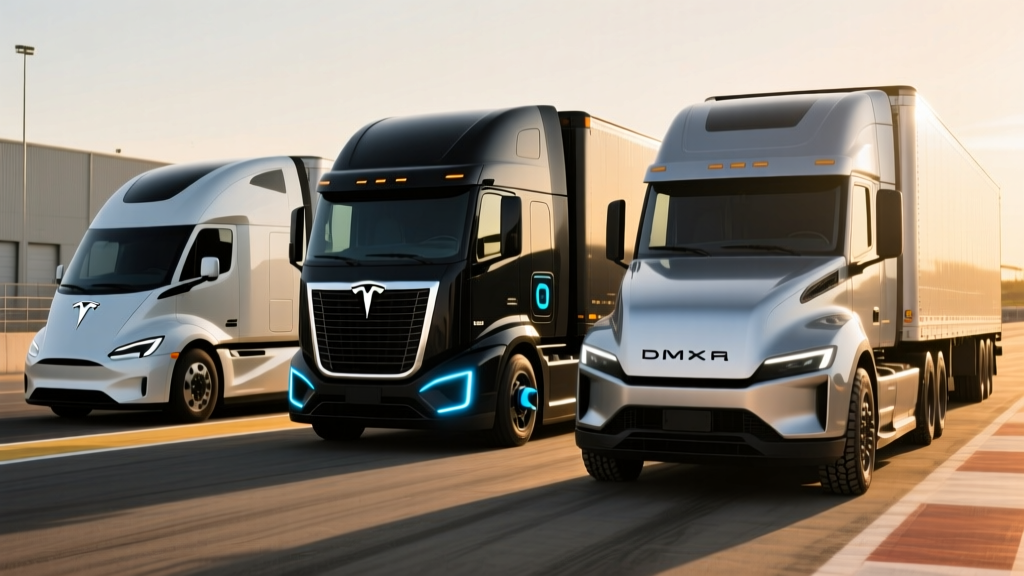
As of 2026, three production all electric semi trucks dominate the Class 8 market: the Tesla Semi (up to 500 miles EPA range, ~$250,000 base), the Freightliner eCascadia (up to 230 miles range, ~$300,000+), and the Volvo VNR Electric (up to 275 miles range, ~$270,000+). These trucks cost 2–3× more upfront than a diesel Class 8 rig (~$120,000–$150,000), but fleet operators report fuel and maintenance savings of $0.40–$0.60 per mile that can close the gap within 3–5 years on high-utilization regional routes. The catch: megawatt charging infrastructure is still sparse, and cold-weather range loss of 20–35% remains a real operational constraint. Federal incentives under the IRA's Commercial Clean Vehicle Credit (§45W) can offset up to $40,000 of the purchase price, and state programs (notably California's HVIP) can stack on top.
Why Fleets Are Looking at All Electric Semi Trucks Now
The commercial trucking sector accounts for roughly 23% of U.S. transportation greenhouse gas emissions despite representing only 4% of vehicles on the road, per EPA data. Regulatory pressure — from California's Advanced Clean Fleets rule to corporate ESG commitments — is pushing fleet operators to evaluate electrification. But this isn't purely compliance-driven. The economics of electric semis have shifted meaningfully since 2023, when battery costs were above $130/kWh and megawatt chargers barely existed outside pilot programs.
By 2026, lithium iron phosphate (LFP) battery packs for commercial applications have dropped below $90/kWh at the cell level, and the Megawatt Charging System (MCS) standard — capable of delivering up to 1.2 MW (1,200 kW) — has been deployed at key freight corridors in California, Texas, and the Northeast. That combination makes regional-haul electric trucking genuinely viable for the first time.
Production All Electric Semi Trucks: Side-by-Side Specs
Here's what's actually available to order in 2026, with manufacturer-published specifications. Note that real-world range depends heavily on payload, terrain, ambient temperature, and driving speed.
| Spec | Tesla Semi (Long Range) | Freightliner eCascadia | Volvo VNR Electric (6-battery) |
|---|---|---|---|
| EPA Range | 500 mi (82,000 lb GCW) | 230 mi (82,000 lb GCW) | 275 mi (66,000 lb GCW) |
| Real-World Range (highway, loaded) | ~375–425 mi | ~170–200 mi | ~210–240 mi |
| Battery Capacity (usable) | ~900 kWh (est., NMC) | ~438 kWh (NMC) | ~565 kWh (NMC) |
| Peak DC Charge Rate | ~1 MW (MCS) | ~350 kW (CCS2/MCS) | ~250 kW (CCS2) |
| 10–80% Charge Time | ~60 min (at 1 MW+) | ~90 min (at 350 kW) | ~90–120 min (at 250 kW) |
| Motor Output | ~1,000+ hp (tri-motor) | ~470 hp (eAxle) | ~455 hp (dual e-motor) |
| 0–60 mph (loaded) | ~20 sec | ~30+ sec | ~30+ sec |
| Base MSRP (est.) | $250,000 | $300,000+ | $270,000+ |
| Warranty (battery) | 8 yr / 1,000,000 mi | 5 yr / 600,000 mi (est.) | 5 yr / 600,000 mi |
| Production Status | Limited production, backlog | In production | In production |
Key takeaway: The Tesla Semi leads on range and charging speed, but its production volume remains constrained and it lacks the dealer/service network that Daimler Truck (Freightliner) and Volvo Trucks provide. For fleets prioritizing service uptime over spec-sheet dominance, the eCascadia and VNR Electric are the pragmatic choices today.
Total Cost of Ownership: Electric Semi vs. Diesel
The purchase price of an all electric semi is the headline shock — $250,000 to $300,000+ versus $120,000–$150,000 for a new diesel Class 8 tractor. But fleets don't buy trucks on sticker price alone. Total cost of ownership (TCO) over a 5-year or 500,000-mile operational window tells a different story.
| Cost Category (5 yr / 500,000 mi) | Diesel Class 8 | All Electric Semi (Regional) |
|---|---|---|
| Purchase Price | $135,000 | $275,000 |
| Federal Tax Credit (§45W) | $0 | –$40,000 |
| State Incentive (CA HVIP example) | $0 | –$45,000 to –$120,000 |
| Net Effective Purchase | $135,000 | $110,000–$190,000 |
| Fuel/Energy (500k mi) | $225,000 ($0.45/mi diesel) | $100,000 ($0.20/mi electricity, avg.) |
| Maintenance (500k mi) | $60,000 | $25,000 |
| DEF / Fluids | $7,500 | $0 |
| Insurance (est.) | $45,000 | $55,000 (higher replacement cost) |
| Total 5-Year Cost | $472,500 | $290,000–$370,000 |
| Cost Per Mile | $0.945/mi | $0.58–$0.74/mi |
The math works when: the truck runs 80,000–120,000+ miles per year on predictable regional routes (under 250 miles round-trip), the fleet has depot charging installed, and state incentives are available. For long-haul, irregular-route operations, diesel still wins on flexibility and infrastructure availability.
Charging Infrastructure: The Biggest Bottleneck
Charging a 900 kWh battery pack is not like plugging in a passenger EV. Even at 1 MW (1,000 kW), filling the Tesla Semi from 10% to 80% takes roughly an hour. For context, a typical Level 2 home charger delivers 7.2–19.2 kW — you could never charge a semi at home, and even most public DC fast chargers max out at 350 kW, far below what these trucks need.
| Charging Method | Power (kW) | Approx. Miles Added Per Hour | Practical Use Case |
|---|---|---|---|
| Depot AC (Level 2, 80A) | 19.2 kW | ~12–15 mi/hr | Overnight top-off only |
| Depot DC (150 kW) | 150 kW | ~100–120 mi/hr | Opportunity charging, smaller packs |
| Public DC (350 kW CCS) | 350 kW | ~230–280 mi/hr | Mid-route top-off (eCascadia, VNR) |
| MCS Megawatt Charger | 600–1,200 kW | ~400–700+ mi/hr | Primary fast-charge for Tesla Semi |
Depot charging is mandatory. Fleets deploying electric semis install 150–350 kW DC chargers at their yards, typically charging overnight at off-peak electricity rates ($0.08–$0.14/kWh in many markets). The installation cost for a single 350 kW depot charger with transformer upgrade, conduit, and commissioning runs $150,000–$300,000 per stall, and a fleet of 10 trucks may need 5–8 stalls plus a potential utility service upgrade to 1–2 MW of site capacity.
Real-World Range vs. EPA: What Dispatchers Actually See
EPA range figures assume specific test cycles that don't fully capture the demands of loaded highway driving at 65–70 mph in varied conditions. Based on fleet operator reports and third-party testing:
- Loaded at 80,000 lb GCW, 65 mph, 75°F: Expect 75–85% of EPA range
- Cold weather (20°F), loaded, highway: Expect 60–70% of EPA range (battery heating + cabin HVAC draw)
- Mountainous terrain (e.g., I-70 through Colorado): Expect 55–65% of EPA range on sustained grades, though regenerative braking recovers some energy on descents
- Empty/bobtail, moderate conditions: Can exceed EPA range by 10–15%
For route planning, conservative dispatchers should use 70% of EPA range as the safe operational window in mixed conditions. A Tesla Semi with 500 miles EPA becomes a 350-mile truck in real-world winter highway operation.
Common Misconceptions About Electric Semis
| Myth | Fact |
|---|---|
| "Electric semis can't pull full loads." | All three production models are rated for 82,000 lb GCW (Tesla Semi, eCascadia) or 66,000 lb (VNR Electric). Torque delivery is instant and actually superior to diesel at low RPM for launch and grade-climbing. |
| "Batteries won't last the life of the truck." | Tesla warrants its Semi battery for 1 million miles. LFP and NMC chemistries in commercial use are designed for 3,000–5,000+ full cycles before reaching 80% state of health. At 100,000 mi/yr with a 300-mile daily cycle, that's 10–15+ years of service. |
| "You can charge an electric semi anywhere." | MCS megawatt chargers are available at fewer than 50 public locations nationwide as of early 2026. Depot charging is the backbone — public MCS is for opportunity top-offs, not primary fueling. |
| "Electric trucks are slower and less productive." | The Tesla Semi hits 60 mph loaded in ~20 seconds (faster than most diesel semis). However, 60–90 minute mid-route charging stops on longer runs do reduce daily range versus a 15-minute diesel fill. Route optimization is essential. |
| "The federal tax credit covers $40,000 for everyone." | The §45W Commercial Clean Vehicle Credit provides up to $40,000 for vehicles over 14,000 lb GVWR, but the truck must meet domestic content and battery sourcing requirements. Eligibility depends on the specific VIN and manufacturer certification. Consult a tax professional and check IRS guidance on §45W. |
Decision Framework: Should Your Fleet Go Electric?
Choose an All Electric Semi If:
- Your routes are regional and predictable — under 250 miles round-trip with a return to depot nightly
- You operate in a state with strong incentive programs (CA, NY, NJ, CO, OR) that stack with federal credits
- Your fleet runs 80,000+ miles per truck per year, maximizing fuel/maintenance savings to offset higher purchase price
- You have depot space and utility capacity (or can secure it) for overnight DC charging at 150–350 kW per stall
- Your customers or corporate mandates require emissions reporting or zero-emission freight
- You operate in urban or port-adjacent areas where diesel idling restrictions and clean-air-zone rules are tightening
Stick With Diesel (or Evaluate Hydrogen FCEV) If:
- Your routes are long-haul, irregular, or cross-country — over 500 miles without predictable stops
- You operate in extreme cold climates (Northern Plains, Alaska) where range loss compounds with limited charging infrastructure
- Your fleet averages under 50,000 miles per truck per year, making the TCO payback window impractically long
- Your depot lacks utility capacity for MW-scale charging and a service upgrade would cost $500,000+ and take 2+ years
- You need immediate truck availability — Tesla Semi backlog extends 12–18 months; eCascadia and VNR Electric lead times are 6–10 months
What First-Time Electric Semi Buyers Must Know
Transitioning from diesel to electric Class 8 trucks is not a simple powertrain swap — it's an operational redesign. Here's what fleet managers consistently report as the biggest surprises:
1. Utility engagement must start 12–18 months before truck delivery. Most depots need a new transformer, switchgear, and potentially a medium-voltage service drop. Utilities in high-demand areas (Southern California, parts of Texas) are quoting 12–24 month lead times for service upgrades exceeding 1 MW.
2. Driver training is non-negotiable. Regenerative braking behavior, range management, preconditioning protocols, and charge-stop procedures are fundamentally different from diesel operation. Fleets report a 2–4 week adaptation period for drivers, with efficiency improving 10–15% after training.
3. Route planning software must be EV-aware. Standard dispatch tools don't account for charge-curve taper (charging slows significantly above 80% state of charge), cold-weather derating, or elevation-based energy consumption. Purpose-built EV fleet routing tools (e.g., from Geotab, Samsara, or OEM-specific platforms) are essential.
4. Insurance premiums run 15–25% higher. The higher replacement cost of battery packs and specialized drivetrain components drives up physical-damage premiums. Some insurers are still building actuarial models for electric Class 8 vehicles. Budget accordingly.
5. Maintenance shifts from mechanical to electrical. You'll eliminate oil changes, DPF filter replacements, DEF refills, and transmission service. But you'll add battery thermal management system maintenance, high-voltage system inspections (requiring certified technicians), and software update management. Plan for technician retraining or OEM service contracts.
Frequently Asked Questions
Can an all electric semi do long-haul routes over 500 miles?
Not practically in 2026. Even the Tesla Semi's 500-mile EPA range drops to ~350–425 miles in real-world loaded highway operation. A 600-mile route would require at least one mid-route charge stop of 45–90 minutes at a megawatt charger, and public MCS infrastructure is too sparse to rely on for daily long-haul scheduling. Long-haul electric trucking becomes viable when MCS corridors are dense and battery energy density improves — likely in the 2028–2030 timeframe.
How long do electric semi batteries last, and what does replacement cost?
Current NMC and LFP battery packs in commercial semis are designed for 3,000–5,000 full charge cycles before degrading to 80% state of health. At one cycle per day, that's 8–14 years. Tesla warrants its Semi battery for 1 million miles. A full battery replacement for a 400–900 kWh pack would cost approximately $100,000–$200,000 at current cell prices, though this cost is projected to decline. Most fleets plan to retire or repurpose trucks before a full pack replacement is needed.
Do electric semis qualify for the $7,500 consumer EV tax credit?
No. The §30D Clean Vehicle Credit applies to light-duty vehicles under 14,000 lb GVWR. Electric semis qualify under a different provision: the §45W Commercial Clean Vehicle Credit, which provides up to $40,000 for qualifying heavy commercial vehicles. The vehicle must meet battery component and critical mineral sourcing requirements. See the IRS §45W page for current eligibility rules and consult a tax professional for your specific situation.
What is the payback period for an electric semi vs. diesel?
For a fleet running 100,000 miles/year on a regional route with access to state incentives (e.g., California HVIP + federal §45W), the payback period is typically 3–5 years. Without state incentives, the payback extends to 5–7 years. At low annual mileage (under 50,000 mi/yr), payback may exceed the truck's useful life, making diesel the better economic choice.
Which all electric semi is best for drayage and port operations?
The Volvo VNR Electric and Freightliner eCascadia are the most deployed in drayage today, thanks to established dealer networks, shorter routes (typically under 100 miles round-trip), and overnight depot charging that eliminates range concerns. The Tesla Semi's superior range is less relevant in drayage, and its limited service footprint is a disadvantage for uptime-critical port operations.