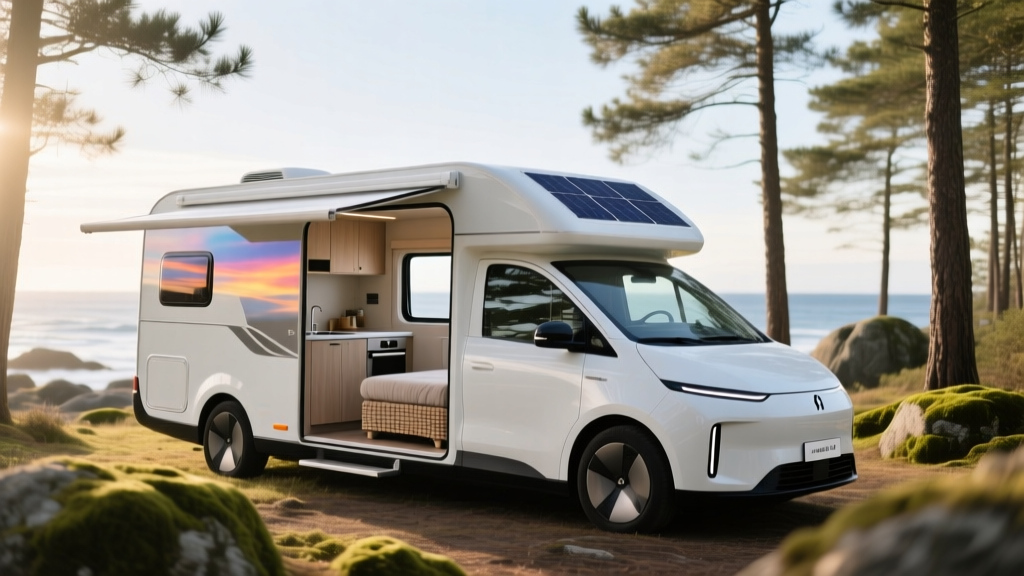
The Short Answer: Can You Buy an All Electric Camper Van in 2026?
Yes, but options are limited and require compromises. The only production-ready all electric camper vans available to U.S. buyers in 2026 are conversions built on commercial electric van platforms — primarily the Ford E-Transit (EPA range ~126 miles, 68 kWh usable battery) and the Mercedes-Benz eSprinter (EPA range ~150 miles, 113 kWh usable battery). Dedicated EV camper platforms like the Volkswagen ID. Buzz (long-wheelbase, 91 kWh battery, ~230-mile EPA range) offer a more consumer-friendly entry but with less interior build-out space. Expect to spend $85,000–$160,000+ for a professionally converted all electric camper van. Real-world highway range with a full camper build (added 1,500–3,000 lbs of weight) drops 15–25% below EPA estimates, making 100–180 miles the practical daily driving radius before needing a DC fast charge.
The Current All Electric Camper Van Landscape
The all electric camper van market in 2026 is split into three categories: OEM-produced electric passenger vans that owners convert themselves, commercial electric cargo vans outfitted by specialty upfitters, and a small number of turnkey conversions from niche builders. Unlike the gas van market — where you can walk into a dealership and drive home a fully built-out camper — the EV side requires more legwork.
Platform options available now:
- Ford E-Transit (cargo/passenger): 68 kWh usable LFP battery, 266 hp, EPA range 108–126 miles depending on body length and roof height. DC fast charging peaks at 115 kW (10–80% in ~45 minutes). MSRP starts ~$47,000 for the cargo van.
- Mercedes-Benz eSprinter: 113 kWh usable NMC battery, 201 hp, EPA range up to ~150 miles (150 kW DC peak, 10–80% in ~42 minutes). MSRP starts ~$74,000 for the cargo van.
- Volkswagen ID. Buzz (3-row, LWB): 91 kWh usable NMC battery, 282 hp (rear motor), EPA range ~234 miles. DC fast charging at 200 kW peak (10–80% in ~26 minutes). MSRP starts ~$61,000. Best range but smallest cargo volume for builds.
- BrightDrop Zevo 600 (commercial fleet only): 250+ mile range, 200 kWh battery — but GM sells primarily to fleet operators, not individual consumers.
Specialty converters like Lightship (a dedicated EV travel trailer company) and a handful of custom van-life shops have begun offering turnkey electric camper builds, typically adding $40,000–$80,000 on top of the base vehicle cost. These builds include insulation, solar integration, house batteries, kitchens, and sleeping platforms.
Range Reality: What EPA Numbers Don't Tell You
The single biggest challenge with an all electric camper van is range degradation under real-world camping conditions. EPA range estimates are generated under controlled conditions that don't account for the weight, aerodynamics, and terrain that define van life.
Real-World Range Expectations for Electric Camper Vans
| Platform | EPA Range | Highway (70 mph) | Camping Load (+2,000 lbs) | Cold Weather (30°F) |
|---|---|---|---|---|
| Ford E-Transit (148" WB, high roof) | 126 mi | ~95 mi | ~80–95 mi | ~65–80 mi |
| Mercedes-Benz eSprinter (170" WB, high roof) | 150 mi | ~115 mi | ~100–120 mi | ~80–100 mi |
| VW ID. Buzz LWB | 234 mi | ~185 mi | ~155–170 mi | ~130–150 mi |
Sources: fueleconomy.gov, manufacturer data, real-world testing estimates. Cold-weather figures assume no preconditioning.
The physics are straightforward: every 100 pounds of added weight reduces efficiency by roughly 1–2%. A full camper buildout — kitchen galley, water tanks (fresh, grey, black), insulation panels, house battery bank, bed platform, and gear — adds 1,500 to 3,000 pounds to a vehicle already pushing a boxy, aerodynamically hostile shape. Highway driving at 70+ mph compounds the problem; electric vehicles lose efficiency at speed far more dramatically than at city speeds because regenerative braking can't recover energy on open roads.
For context, a gas-powered Ford Transit with a 25-gallon tank and 16 MPG combined gets roughly 400 miles per fill-up — a number no current all electric camper van can approach. This isn't a dealbreaker for every use case, but it fundamentally shapes how you travel.
Charging Logistics: The Make-or-Break Factor
Charging an electric camper van is where the rubber meets the road — or rather, where the trip either flows or stalls. Your charging strategy determines whether an all electric camper van is practical for your travel style.
| Charging Level | Power (kW) | Miles Added/Hour (eSprinter) | Where You'll Find It |
|---|---|---|---|
| Level 1 (120V outlet) | 1.0–1.4 kW | ~3–4 mi/hr | Any standard outlet; campground pedestal |
| Level 2 (240V, 32A) | 7.7 kW | ~22 mi/hr | Home wall charger; some RV parks (NEMA 14-50) |
| Level 2 (240V, 48A) | 11.5 kW | ~33 mi/hr | Hardwired home charger; commercial locations |
| DC Fast Charge | 115–200 kW | ~150–250 mi in 30 min | Electrify America, Tesla Supercharger (NACS adapter required) |
Home charging is nearly mandatory. If you have access to a Level 2 charger at home (a 240V circuit, typically 40–60 amps), you can fully replenish any electric van overnight. A professional Level 2 installation runs $1,200–$3,500 including the charger ($500–$800) and electrical work, potentially more if your panel needs an upgrade to 200 amps. Without home charging, you're relying on public infrastructure — and the economics shift dramatically.
Campground charging is the weak link. Most RV parks and campgrounds offer 30-amp or 50-amp shore power designed for RV house systems, not EV traction batteries. A 50-amp/240V RV pedestal can deliver roughly 12 kW — enough for Level 2 charging, but you'll need the correct adapter (typically a NEMA 14-50 plug). Many national parks and BLM land have no electrical hookups at all. DC fast chargers are increasingly common along interstate corridors but are virtually nonexistent inside campgrounds or on remote scenic routes.
The charging curve also matters: peak kW rates only hold between roughly 10–50% state of charge. Above 80%, charging speed drops significantly to protect the battery. A "45-minute charge" realistically means 45 minutes from 10% to 80%, with the final 20% taking an additional 30–60 minutes on Level 2.
Cost Breakdown: Electric Camper Van vs. Gas Camper Van
The upfront cost of an all electric camper van is substantially higher than a comparable gas build, but operating costs can be lower — depending heavily on your electricity source and driving volume.
| Cost Category | All Electric (eSprinter Build) | Gas (Sprinter Build) | Difference |
|---|---|---|---|
| Base Vehicle MSRP | $74,000 | $52,000 | +$22,000 EV |
| Professional Camper Conversion | $55,000 | $55,000 | — |
| Total Build Cost | $129,000 | $107,000 | +$22,000 EV |
| Federal Tax Credit (§30D, if eligible) | Up to –$7,500 | $0 | –$7,500 EV |
| Effective Total | ~$121,500 | $107,000 | +$14,500 EV |
| Fuel/Energy (annual, 10,000 mi) | $1,200 (home) / $2,800 (public DC) | $3,750 (gas @ $3.75/gal, 15 MPG) | –$950 to –$2,550 EV/yr |
| Annual Maintenance | ~$400 | ~$1,200 | –$800 EV/yr |
| 5-Year Operating Cost | $8,000–$16,000 | $24,750 | –$8,750 to –$16,750 EV |
Gas cost assumes 15 MPG combined at $3.75/gallon. EV home charging at $0.14/kWh; public DC at $0.40/kWh. Maintenance estimates from industry averages. Federal tax credit eligibility depends on MSRP caps, buyer income limits, and battery sourcing per IRS §30D rules — consult a tax professional.
The math shows that even with a $22,000 upfront premium (partially offset by the tax credit), an all electric camper van can break even on operating costs within 5–8 years — but only if you charge primarily at home. If you rely on public DC fast charging, the per-mile energy cost rises to roughly $0.28/mile, narrowing the advantage significantly.
Insurance for electric vans runs 10–20% higher than gas equivalents due to higher repair costs and parts pricing. Factor in ~$2,400–$3,600/year for comprehensive coverage on a $130,000 build.
Who Should (and Shouldn't) Buy an All Electric Camper Van
An electric camper van isn't for everyone. The decision depends on your travel patterns, charging access, and tolerance for route planning.
Decision Framework: Is an Electric Camper Van Right for You?
Choose an all electric camper van if:
- You take weekend trips within 100–150 miles of home and can charge at home between trips
- You primarily camp at RV parks with 50-amp electrical hookups
- You travel in moderate climates (extreme cold or heat crushes range)
- You value silent, zero-tailpipe-emission camping in sensitive natural areas
- You drive less than 10,000 miles/year in the van and want lower per-mile operating costs
- You have a 5+ year ownership horizon to recoup the upfront premium
Stick with a gas or diesel camper van if:
- You plan cross-country or remote boondocking trips where DC chargers are scarce
- You regularly travel in sub-freezing temperatures (30%+ range loss is common)
- You tow a trailer (electric vans already sacrifice range; towing compounds it severely)
- You need 300+ miles of daily driving range without extended charging stops
- You don't have reliable home charging access
- You want maximum resale market liquidity — the used electric van market is thin
There's also a plug-in hybrid middle ground worth considering. The Chrysler Pacifica Hybrid (32 miles electric-only, 30 MPG combined on gas) offers limited EV range for quiet campground arrivals but unlimited gas range for highway travel. It's a minivan, not a high-roof camper, but conversion companies do outfit them. For larger builds, a diesel Sprinter remains the dominant platform for a reason: 18–22 MPG, 500+ mile range, and fuel available everywhere.
Common Misconceptions About Electric Camper Vans
| Myth | Fact |
|---|---|
| "You can camp off-grid indefinitely with solar panels on the roof." | Van roof solar (typically 400–800W) generates enough to run house systems (lights, fridge, devices) but adds only 5–15 miles of driving range per day. You cannot meaningfully recharge the traction battery from roof solar. |
| "Electric vans are cheaper overall." | Lower operating costs are real, but the $15,000–$25,000 upfront premium takes 5–10 years to recoup. If you sell before then, you're net negative. |
| "DC fast chargers are everywhere now." | Interstate corridors are well-covered, but national parks, forest roads, and rural campgrounds have almost zero DC charging infrastructure. Plan routes around chargers, not destinations. |
| "The battery will need expensive replacement." | Modern EV batteries are warranted for 8 years/100,000 miles (10 years/150,000 miles in CARB states) with capacity retention thresholds of 70%. Most LFP and NMC packs last well beyond warranty. Full replacement costs $15,000–$30,000 but is rarely needed within the first decade. |
| "You'll get the full $7,500 federal tax credit." | The §30D credit has buyer income caps ($150K single / $300K joint), vehicle MSRP caps ($80K for vans/trucks), and battery component/critical mineral sourcing requirements that change annually. Many commercial van conversions exceed the MSRP cap. Verify current eligibility at irs.gov. |
What First-Time Electric Camper Van Buyers Must Know
If you're seriously considering an all electric camper van, here are the practical realities that don't appear in marketing brochures:
- Preconditioning is non-negotiable for fast charging. Use the vehicle's navigation to route to a DC charger — this triggers battery preconditioning, warming the pack to optimal temperature. Without it, cold batteries charge at a fraction of peak kW, turning a 45-minute stop into a 90-minute stop.
- Weight distribution matters more than in gas vans. Electric vans carry heavy battery packs low in the chassis. Your camper build must account for this — overloading the rear axle affects handling and can void warranty coverage.
- kW vs. kWh — know the difference. kW (kilowatts) measures power — how fast you can charge. kWh (kilowatt-hours) measures energy — how much the battery holds. A 113 kWh battery charged at 150 kW is like filling a 30-gallon tank through a high-flow hose. Confusing these leads to bad planning.
- Plan trips around charging, not destinations. Use apps like PlugShare and A Better Routeplanner (ABRP) to map routes with DC chargers spaced within your van's real-world range. Always budget a 20% range buffer for detours, headwinds, and elevation changes.
- Verify the connector. Ford and VW now use the NACS (Tesla) connector for 2026 models. Mercedes-Benz still uses CCS1 on the eSprinter. Public charging networks are transitioning, but adapter compatibility matters — especially at Tesla Superchargers.
Bottom Line: The Electric Camper Van Is a Niche That's Growing
An all electric camper van works beautifully for a specific owner: someone who camps regionally, charges at home, travels light, and values quiet, clean operation. For long-distance overlanding, remote boondocking, or cold-climate touring, gas and diesel platforms remain the pragmatic choice in 2026. The technology is improving rapidly — expect 250+ mile electric vans with 200 kW charging to become mainstream by 2028–2029 — but today's buyers are early adopters paying a premium for the privilege. If that trade-off works for your lifestyle, the driving experience, operating savings, and campground silence make it worthwhile.
What is the longest-range all electric camper van available in 2026?
The Volkswagen ID. Buzz LWB offers the longest EPA range at ~234 miles from its 91 kWh battery, but its smaller cargo area limits camper build potential. For full-size van conversions, the Mercedes-Benz eSprinter (150 miles EPA) offers the most range with a high-roof, 170-inch wheelbase layout suitable for a full camper build.
Can I charge an electric camper van at a campground?
Yes, if the campground has a 50-amp/240V RV pedestal (NEMA 14-50 outlet). This provides Level 2 charging at roughly 12 kW, adding about 30–35 miles of range per hour for a large van. Overnight (8–10 hours) can restore 250–350 miles worth of range — enough to fully recharge most electric vans. Campgrounds without electrical hookups offer no practical charging option for the traction battery.
How much does it cost to build an all electric camper van?
Expect $85,000–$160,000+ for a professionally converted electric camper van. The base electric van platform costs $47,000–$74,000, and professional camper conversions add $40,000–$80,000 depending on build complexity. DIY conversions on a used E-Transit can reduce costs to $55,000–$75,000 total.
Do electric camper vans qualify for the $7,500 federal tax credit?
Possibly, but eligibility is restrictive. The §30D credit applies to new vehicles under the $80,000 MSRP cap for vans/trucks, with buyer income limits ($150K single / $300K joint) and battery sourcing requirements. Many professionally converted electric vans exceed the MSRP cap when the conversion cost is included. Check current rules at irs.gov and consult a tax professional before purchasing.
How long do electric van batteries last?
EV batteries in the eSprinter, E-Transit, and ID. Buzz are warranted for 8 years/100,000 miles (10/150,000 in CARB states) against degradation below 70% capacity. Real-world data from commercial fleets suggests most packs retain 85–90% capacity at 100,000 miles. Full replacement, if ever needed, costs $15,000–$30,000 depending on the platform.