The All Black Cybertruck in 2026: More Than Just Looks
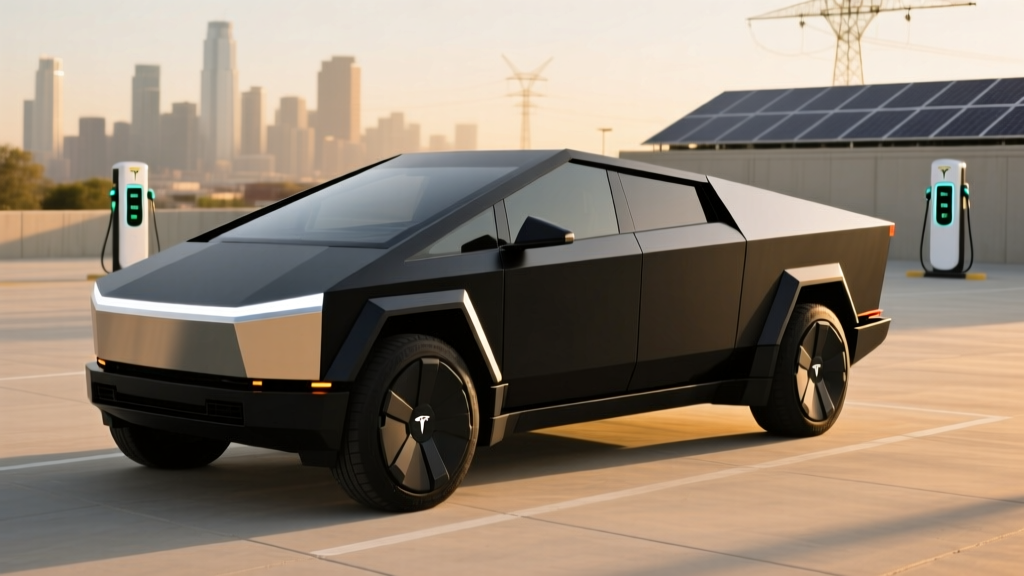
Tesla's stainless-steel exoskeleton was designed to be left bare — that raw, brushed-metal finish is the Cybertruck's signature. But the all black Cybertruck has become one of the most requested custom configurations in the EV truck segment. Whether achieved through Tesla's factory Stealth Matte PPF (Paint Protection Film), a third-party vinyl wrap, or aftermarket stealth packages, the monochrome-black Cybertruck commands attention and raises practical questions about range, thermal management, and ownership cost.
This review covers the 2026 Tesla Cybertruck AWD (dual-motor) and Cyberbeast (tri-motor) as the platforms behind the all-black build, with exact EPA data, charging curves, real-world range expectations, and a detailed look at how a black wrap or PPF affects efficiency and battery thermals. If you're considering going full stealth, here's every number you need.
Spec Table: 2026 Cybertruck AWD and Cyberbeast at a Glance
| Specification | Cybertruck AWD | Cyberbeast (Tri-Motor) |
|---|---|---|
| EPA Range | 340 miles | 320 miles |
| Battery Capacity (usable) | ~123 kWh (NMC) | ~123 kWh (NMC) |
| Battery Chemistry | NMC (Nickel Manganese Cobalt) | NMC (Nickel Manganese Cobalt) |
| Drivetrain | Dual-Motor AWD | Tri-Motor AWD |
| Horsepower | 600 hp | 845 hp |
| 0-60 mph | 4.1 seconds | 2.6 seconds |
| Max DC Fast Charge | 250 kW (V3 Supercharger) | 250 kW (V3 Supercharger) |
| 10-80% DC Charge Time | ~28 minutes | ~28 minutes |
| Level 2 Home Charging | 11.5 kW (~37 mi/hr) | 11.5 kW (~37 mi/hr) |
| MPGe (combined) | 72 MPGe | 68 MPGe |
| Efficiency | 47 kWh/100 mi | 50 kWh/100 mi |
| Towing Capacity | 11,000 lbs | 11,000 lbs |
| Payload | 2,500 lbs | 2,500 lbs |
| Cargo Volume (bed) | ~67 cu ft (vault) | ~67 cu ft (vault) |
| Frunk Volume | ~7 cu ft | ~7 cu ft |
| Rear Legroom | ~38.2 inches | ~38.2 inches |
| Battery/Drive Unit Warranty | 8 yr / 120,000 mi | 8 yr / 120,000 mi |
| Base MSRP (2026) | $79,990 | $99,990 |
Sources: fueleconomy.gov, Tesla Cybertruck specs.
Real-World Range: What to Expect Beyond the EPA Sticker
The Cybertruck AWD carries a 340-mile EPA estimate. In real-world highway driving at 70-75 mph, expect ~260-290 miles of usable range. In cold weather (below 30°F), that drops to roughly 220-250 miles due to battery resistance and cabin heating demands. The Cyberbeast's more aggressive powertrain calibration and wider tires shave another 10-15 miles off these figures.
The Cybertruck's angular, flat-panel stainless-steel body is an aerodynamic challenge. Its drag coefficient is estimated at ~0.38-0.42 Cd — significantly higher than a Tesla Model Y (~0.23 Cd). That means highway efficiency degrades faster with speed than in Tesla's car lineup. At 65 mph you'll see closer to the EPA sticker; at 80 mph the range loss becomes pronounced.
For the all black Cybertruck specifically, a dark wrap or PPF does have a minor thermal impact. Black surfaces absorb more solar radiation, which can raise cabin and battery-pack temperatures slightly in hot climates. In practice, Tesla's thermal management system handles this without meaningful range loss, but expect the HVAC system to work marginally harder in summer desert conditions — roughly a 1-2% efficiency penalty in extreme heat versus the bare stainless finish, which reflects more sunlight.
Charging: DC Fast, Level 2, and the Curve You Need to Know
| Charging Level | Power | Speed (approx.) | Use Case |
|---|---|---|---|
| Level 1 (120V) | ~1.4 kW | ~4 mi/hr | Emergency / trickle only |
| Level 2 (240V, 48A) | 11.5 kW | ~37 mi/hr | Home daily charging |
| DC Fast (V3 Supercharger) | Peak 250 kW | 10-80% in ~28 min | Road trips |
| DC Fast (V4 Supercharger) | Peak 250-350 kW* | 10-80% in ~22-25 min* | Newer stations (2025+) |
*V4 Supercharger speeds depend on station configuration and vehicle firmware. As of early 2026, most V4 cabinets deliver up to 250 kW to current Cybertruck hardware; future OTA updates may unlock higher rates.
The Cybertruck's 123 kWh (usable) NMC battery pack charges at a peak of 250 kW on Tesla V3 and V4 Superchargers. However, as with all large packs, the charge curve tapers significantly above 80% state of charge (SoC). The 10-80% sprint takes roughly 28 minutes, but pushing from 80-100% can add another 20-25 minutes. For road-trip efficiency, plan stops around the 80% mark.
At home, an 11.5 kW Level 2 wall connector (Tesla's Gen 3 Wall Connector on a 60A circuit) replenishes about 37 miles of range per hour, meaning a full 10-100% charge takes roughly 10-11 hours overnight. For most owners, plugging in nightly and charging to 80-90% is sufficient and better for long-term NMC battery health.
Preconditioning matters. The Cybertruck's navigation system will precondition the battery for optimal fast-charging speed when you route to a Supercharger. Skipping this — for example, arriving at a charger with a cold-soaked battery in winter — can reduce peak charge rates to 100-150 kW until the pack warms up.
Performance, Drivetrain, and Daily-Drive Practicality
The dual-motor AWD Cybertruck delivers 600 horsepower and a 4.1-second 0-60 mph time — quick enough to surprise sports-car drivers at stoplights while hauling a full bed load. The Cyberbeast's tri-motor setup pushes 845 hp and a 2.6-second 0-60, placing it in hypercar territory despite its 6,600+ lb curb weight.
Both configurations feature adaptive air suspension with up to 12 inches of ground clearance in Off-Road mode, a rear-wheel steering system (up to 10 degrees) that tightens the turning radius to roughly 37 feet, and a steer-by-wire system that eliminates the mechanical connection between the yoke and the front wheels. Steer-by-wire takes adjustment — there's no traditional steering feel — but enables variable ratios that make parking-lot maneuvers surprisingly easy for a 223-inch-long truck.
Cargo and space: The 6-foot vault (bed) offers approximately 67 cu ft of lockable storage with the motorized tonneau cover closed. The powered frunk adds ~7 cu ft. Rear-seat legroom at 38.2 inches is adequate for adults on shorter trips but tighter than a Ford F-150 Lightning's rear cabin. The cabin seats five, though the rear bench is best suited for two adults plus a child.
Pricing, Trims, and Federal Tax Credit Eligibility
| Trim | Base MSRP (2026) | Stealth PPF Add-On | Est. As-Tested (Black) | §30D Credit Eligible? |
|---|---|---|---|---|
| Cybertruck AWD | $79,990 | ~$5,000-$7,000 | $85,000-$87,000 | No (exceeds $80K MSRP cap for trucks) |
| Cyberbeast | $99,990 | ~$5,000-$7,000 | $105,000-$107,000 | No (exceeds $80K MSRP cap for trucks) |
Federal tax credit reality: Under IRS §30D rules, the Cybertruck is classified as a pickup truck, which carries an $80,000 MSRP cap for credit eligibility. The AWD trim's $79,990 base price technically sits under that threshold — but once you add any options (FSD, Stealth PPF, accessories), the MSRP exceeds $80,000 and the vehicle becomes ineligible. The Cyberbeast at $99,990 is well above the cap regardless of configuration.
Even at the base AWD price with zero options, buyers must still meet §30D income caps ($150,000 single / $300,000 joint AGI) and the vehicle must satisfy critical-mineral and battery-component sourcing requirements that shift annually. As of 2026, Tesla's domestic sourcing for the Cybertruck's 4680 cells has improved, but confirming eligibility requires checking the latest IRS qualified vehicles list before purchase. The credit can be transferred to the dealer at point of sale for an immediate price reduction if eligible.
Bottom line: Most all black Cybertruck builds — especially those with the factory Stealth Matte PPF or any option packages — will not qualify for the federal $7,500 tax credit. Budget accordingly.
Going All Black: PPF, Wraps, and What It Means for Ownership
Tesla offers a factory Stealth Matte PPF option that transforms the Cybertruck's brushed stainless into a satin-black finish. This is not paint — the Cybertruck has no painted body panels. The PPF (paint protection film) is a thick, matte urethane layer applied over the raw steel. At $5,000-$7,000 depending on coverage, it's a significant upcharge, but it offers protection against rock chips, fingerprints, and the micro-scratches that stainless steel inevitably accumulates.
Third-party vinyl wraps from shops like Metro Wrap, AutoBahn, or local specialists typically run $4,000-$6,500 for a full-body stealth or gloss-black wrap. Vinyl wraps are removable and can be changed, but they don't offer the same impact protection as PPF. Some owners opt for a gloss-black wrap over PPF for a dual-layer approach.
Maintenance note: Black surfaces — especially matte and satin finishes — show dust, pollen, water spots, and swirl marks more than the raw stainless. Budget for regular hand washes and avoid automated brush car washes entirely. Matte PPF requires specific pH-neutral cleaning products; harsh chemicals can degrade the finish.
Pros, Cons, and the Competition
- 340-mile EPA range is best-in-class for electric pickups
- 250 kW Supercharger access with a mature, reliable network
- 11,000-lb towing capacity with integrated trailer brake controller
- Stainless exoskeleton is dent- and corrosion-resistant
- Stealth black PPF adds protection and a unique aesthetic
- Rear-wheel steering makes a large truck surprisingly maneuverable
- Over-the-air updates continue to add features post-purchase
- Likely ineligible for §30D tax credit once options are added
- Real-world highway range drops to ~260-290 miles
- Rear-seat comfort lags behind F-150 Lightning and Rivian R1T
- Steer-by-wire and yoke steering polarizing for some drivers
- Black wrap/PPF requires more maintenance than bare steel
- No CCS adapter included — Supercharger-only without optional adapter
- Insurance premiums run 15-25% higher than comparable trucks
Versus the competition: The Ford F-150 Lightning offers a more conventional truck experience, better rear-seat space, and a lower starting price (~$55,000), but tops out around 320 miles EPA. The Rivian R1T (dual-motor, ~342 miles EPA on the Max Pack) is more refined on-road and has superior build quality, but starts above $75,000 and also generally misses the tax credit on higher trims. The all black Cybertruck wins on raw range, charging infrastructure, and visual impact — but loses on rear-seat comfort and traditional truck ergonomics.
Who the All Black Cybertruck Suits Best
Choose the all black Cybertruck if: You prioritize range and Supercharger network access above all else, want a truck that stands out visually, don't regularly carry rear-seat passengers on long trips, and are comfortable with the steer-by-wire driving experience.
Look elsewhere if: You need maximum rear-seat comfort (F-150 Lightning), want a more traditional driving feel (Rivian R1T), need to stay under the §30D tax credit MSRP cap with options, or prefer CCS-compatible public charging without an adapter.
Frequently Asked Questions
What is the real-world range of the all black Cybertruck?
The 2026 Cybertruck AWD has a 340-mile EPA estimate. Real-world highway driving at 70-75 mph yields approximately 260-290 miles. Cold weather (below 30°F) reduces this to roughly 220-250 miles. The black PPF or wrap has a negligible 1-2% effect in extreme heat but no meaningful range impact in temperate conditions.
How fast does the Cybertruck charge at home and on the road?
On a V3 Supercharger at peak 250 kW, the Cybertruck charges from 10-80% in approximately 28 minutes. At home on an 11.5 kW Level 2 charger, you get about 37 miles of range per hour, meaning a full overnight charge is practical. Level 1 (120V) trickle charging adds only about 4 miles per hour and is not viable as a primary charging method for a 123 kWh pack.
Does the Cybertruck qualify for the $7,500 federal EV tax credit?
Technically, the base AWD at $79,990 sits under the $80,000 truck MSRP cap. However, adding any factory options — including the Stealth PPF for the all-black look — pushes the MSRP above $80,000, making it ineligible. The Cyberbeast at $99,990 never qualifies. Additionally, buyers must meet IRS income limits ($150K single / $300K joint) and the vehicle must meet 2026 battery-sourcing requirements. Always verify on the IRS qualified vehicles list before purchasing.
Is the all black Cybertruck worth it versus the F-150 Lightning or Rivian R1T?
If range, Supercharger access, and head-turning design are your top priorities, yes. The Cybertruck's 340-mile EPA range and 250 kW charging on the most reliable DC network in North America are genuine advantages. If you prioritize rear-seat comfort, traditional steering feel, or lower pricing, the F-150 Lightning or Rivian R1T may be better fits. The black aesthetic is subjective but undeniably distinctive.
What are the biggest drawbacks of a black Cybertruck wrap or PPF?
Black finishes — particularly matte and satin — show dust, water spots, and fingerprints more than bare stainless steel. Maintenance requires more frequent hand washing with pH-neutral products. Automatic brush car washes will damage matte PPF. The factory Stealth PPF option costs $5,000-$7,000 and may push the vehicle over the §30D tax credit MSRP cap. Third-party wraps are cheaper ($4,000-$6,500) but offer less physical protection.
How long will the Cybertruck battery last?
Tesla warranties the Cybertruck's battery and drive units for 8 years or 120,000 miles (whichever comes first), with a minimum 70% capacity retention threshold. Based on Tesla's NMC 4680 cell data from Model S/X fleets, real-world degradation typically follows a curve of ~5-8% loss in the first year, then 1-2% annually thereafter. Most owners report 85-90% State of Health (SoH) at 100,000 miles with normal charging habits (avoiding frequent 100% charges and DC fast-charging exclusively).