The Quick Answer: Alfa Romeo's Electric SUV in 2026
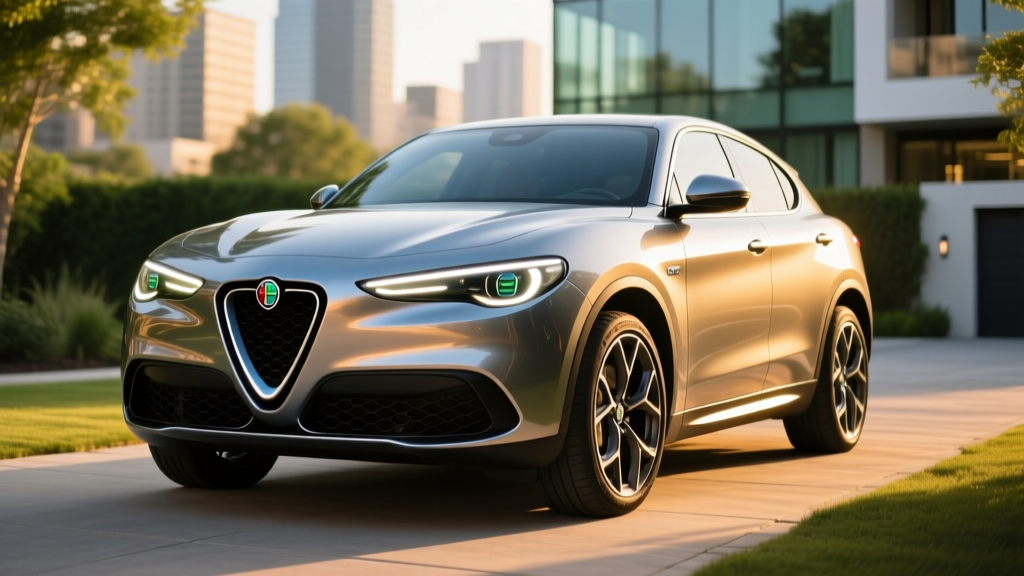
Alfa Romeo's first battery-electric SUV sold in the U.S. is the 2026 Junior Elettrica (badged Milano in Europe). It is a subcompact luxury crossover built on Stellantis' e-CMP2 platform with a 54 kWh (usable) NMC battery, a single front motor producing 156 hp (210 hp in the Veloce trim), and an EPA-estimated range of approximately 215 miles (Veloce: ~205 miles). Base pricing starts at $45,900 before destination, with the performance-oriented Veloce at $51,400. DC fast charging peaks at 100 kW (10–80% in ~27 minutes). It is best suited for urban commuters and style-focused buyers who prioritize design and handling dynamics over maximum range or class-leading cargo space. If you need 300+ miles of range or frequent long road trips, competitors like the Tesla Model Y or Hyundai IONIQ 5 are better fits.
Range, Battery, and Efficiency: The Real Numbers
The Junior Elettrica uses a 54 kWh usable battery pack with NMC (nickel-manganese-cobalt) chemistry — the same cell supplier and module architecture found in the Peugeot e-2008 and Jeep Avenger EV. NMC offers higher energy density than LFP, which matters here because Alfa needed to package the cells within a compact crossover footprint while preserving ground clearance and interior volume.
| Spec | Junior Elettrica (Base) | Junior Elettrica Veloce |
|---|---|---|
| Battery (usable) | 54 kWh NMC | 54 kWh NMC |
| EPA Range (est.) | 215 miles | 205 miles |
| Motor | Single FWD, 156 hp / 192 lb-ft | Single FWD, 210 hp / 192 lb-ft |
| 0–60 mph | ~8.5 sec | ~7.0 sec |
| Top Speed | 93 mph | 100 mph |
| DC Fast Charge (peak) | 100 kW | 100 kW |
| 10–80% DC Time | ~27 min | ~27 min |
| Level 2 Charge (7.4 kW) | ~7.5 hours (0–100%) | ~7.5 hours (0–100%) |
| MPGe (combined, est.) | 110 MPGe | 105 MPGe |
| Base MSRP | $45,900 | $51,400 |
| Battery Warranty | 8 yr / 100,000 mi (≥70% SoH) | 8 yr / 100,000 mi (≥70% SoH) |
Real-World Range Expectations
EPA sticker: 215 miles (base) / 205 miles (Veloce).
Real-world highway (70 mph, 65°F): Expect ~175–190 miles. The Junior's relatively upright crossover profile and 2,900+ lb curb weight work against highway efficiency.
Cold weather (30°F, cabin heat on): Expect ~145–165 miles. NMC batteries lose 20–30% of range in freezing temperatures without a heat pump — and the Junior Elettrica uses a resistive PTC heater in base trims, which draws significant energy from the pack. The Veloce trim includes a heat pump, partially mitigating this loss.
Practical daily range budget: Plan around 170 miles of usable range for mixed driving to maintain a comfort buffer.
Charging Speed and Infrastructure: What Owners Need to Know
The Junior Elettrica charges via a CCS1 connector (U.S. market) at a peak DC rate of 100 kW. This is a critical number to understand: 100 kW is the peak, not the sustained rate. In real-world DC fast charging, the battery management system tapers current as the state of charge climbs, protecting cell longevity. Here's what the charge curve actually looks like:
- 10–40% SoC: Near peak ~95–100 kW (fastest segment)
- 40–60% SoC: Tapers to ~75–85 kW
- 60–80% SoC: Drops to ~50–60 kW
- Above 80%: Slows dramatically to ~25 kW (typical for NMC)
This is why the 10–80% time of ~27 minutes is the standard benchmark. A 10–100% session would take closer to 50 minutes.
| Level | Power | Connector | Miles Added per Hour | Best For |
|---|---|---|---|---|
| Level 1 (120V) | ~1.4 kW | J1772 (adapter) | ~5 mi/hr | Emergency / overnight trickle |
| Level 2 (240V) | 7.4 kW | J1772 / CCS1 | ~28 mi/hr | Home daily charging |
| DC Fast Charge | Up to 100 kW | CCS1 | ~180 mi/hr (peak) | Road trips, quick top-ups |
Home charging reality: Most Junior Elettrica owners will install a Level 2 home charger (240V, 32A circuit) to fully replenish the 54 kWh pack overnight. A full 0–100% charge takes about 7.5 hours at 7.4 kW. Expect a home charger installation cost of $800–$2,000 depending on your electrical panel's capacity and the run distance from panel to garage. If your home has a 100A panel and you're already running heavy loads (HVAC, dryer, range), you may need a $1,500–$3,000 panel upgrade to 200A — factor this into your purchase budget.
Public charging note: The CCS1 connector is compatible with Electrify America, EVgo, and ChargePoint DC fast networks. However, as Tesla opens its Supercharger network to non-Tesla vehicles via NACS adapters, CCS-equipped vehicles like the Junior may face a shrinking public charging ecosystem over the next several years. Stellantis has not announced a NACS retrofit adapter for the Junior as of early 2026.
EV vs. Gas: Alfa Romeo Junior Elettrica vs. Tonale
For buyers cross-shopping within Alfa Romeo's own lineup, the natural comparison is the gas-powered Tonale (and its PHEV variant). Here's how the Junior Elettrica stacks up against the conventional Tonale on the metrics that matter:
| Metric | Junior Elettrica (Base) | Tonale 2.0T AWD (Gas) |
|---|---|---|
| Base MSRP | $45,900 | $42,595 |
| EPA Range / Total Range | 215 mi (electric) | ~380 mi (13.5 gal tank, 28 MPG combined) |
| Fuel/Energy Cost per Mile | ~$0.045/mi (home L2, $0.14/kWh) | ~$0.125/mi ($3.50/gal gas) |
| Annual Fuel Cost (12,000 mi) | ~$540 | ~$1,500 |
| Annual Maintenance (est.) | ~$200 | ~$650 |
| 0–60 mph | ~8.5 sec | ~7.5 sec |
| Cargo Volume | ~12.5 cu ft (rear seats up) | ~18.0 cu ft (rear seats up) |
| Federal Tax Credit (§30D) | Potentially up to $3,750* | $0 |
*The Junior Elettrica's §30D eligibility is limited. Because Stellantis sources battery cells and critical minerals primarily from European and Asian supply chains that may not meet the 2026 domestic-content thresholds, the full $7,500 credit is unlikely. Expect $3,750 (half credit for meeting one of two sourcing requirements) or $0 depending on final IRS sourcing determinations. Always verify current-year eligibility on IRS.gov and consult a tax professional before purchasing.
Total Cost of Ownership: 5-Year Breakdown
The Junior Elettrica carries a ~$3,300 premium over the gas Tonale at purchase, but lower operating costs narrow that gap over time. Here's a realistic 5-year / 60,000-mile ownership projection:
| Cost Category | Junior Elettrica | Tonale Gas AWD |
|---|---|---|
| Purchase Price (MSRP) | $45,900 | $42,595 |
| Federal Tax Credit (est.) | -$3,750 | $0 |
| Home Charger Install | $1,500 | $0 |
| Effective Purchase Cost | $43,650 | $42,595 |
| Fuel/Energy (5 yr) | $2,700 | $7,500 |
| Maintenance (5 yr) | $1,000 | $3,250 |
| Insurance (5 yr, est.) | $9,500 | $7,800 |
| Estimated Depreciation (5 yr) | $22,000 | $17,500 |
| Total 5-Year Cost | $78,850 | $78,645 |
The numbers are essentially a wash over five years. The EV saves roughly $7,050 on fuel and maintenance but gives it back in higher insurance premiums (EVs cost 15–25% more to insure on average due to repair complexity and battery replacement risk) and steeper depreciation (luxury EVs from non-Tesla brands have historically depreciated faster than their gas counterparts). The real financial win for the Junior Elettrica comes if you have access to cheap home electricity (under $0.12/kWh), drive more than 12,000 miles annually, or live in a state with additional EV rebates.
Common Misconceptions About the Alfa Romeo Electric SUV
| Myth | Fact |
|---|---|
| "It has the same range as a Tesla Model Y." | The Model Y Long Range offers 320+ EPA miles. The Junior Elettrica's 215 miles is nearly 100 miles shorter — a significant gap for road-trip use. |
| "100 kW charging means it charges at 100 kW the whole time." | 100 kW is the peak rate, sustained only from roughly 10–40% SoC. Average charge rate across a 10–80% session is closer to 65–70 kW. |
| "I'll get the full $7,500 federal tax credit." | Due to battery-sourcing requirements under §30D, Stellantis EVs in 2026 may qualify for only $3,750 or $0. Check fueleconomy.gov for the latest eligible-vehicle list. |
| "It qualifies for HOV lane access everywhere." | HOV lane stickers are state-specific. California's Clean Air Vehicle decal program has income caps and application requirements. Check your state's DMV. |
| "The battery will need replacing in 5 years." | NMC batteries in modern thermal-managed packs typically retain 85–90% capacity after 100,000 miles. Alfa's warranty guarantees ≥70% State of Health at 8 years / 100,000 miles. |
Who Should Buy the Alfa Romeo Junior Elettrica?
Decision Framework: Is This Your EV?
Choose the Junior Elettrica if:
- You prioritize Italian design, brand cachet, and engaging steering dynamics over maximum range
- Your daily commute is under 80 miles round-trip and you have Level 2 home charging
- You live in a mild climate (limited cold-weather range loss) or opt for the Veloce trim's heat pump
- You rarely take road trips over 200 miles, or you're comfortable planning DC fast-charge stops
- You want a luxury-badged EV under $52,000 and don't need class-leading cargo space
Look elsewhere if:
- You need 300+ miles of range (consider Tesla Model Y, Hyundai IONIQ 5, or Kia EV6)
- You frequently drive in sub-freezing climates and can't install a heat pump-equipped trim
- You rely exclusively on public charging and want NACS/Supercharger access
- Cargo capacity is a priority (the Junior's ~12.5 cu ft is tight for a crossover — the Model Y offers 30+ cu ft)
- You want the fastest DC charging in the segment (the IONIQ 5's 800V architecture peaks at 240 kW, 10–80% in ~18 min)
What First-Time EV Buyers Should Know Before Purchasing
If the Junior Elettrica is your first electric vehicle, here are the practical ownership realities that don't appear on the window sticker:
1. Home charging is non-negotiable for convenience. Without a Level 2 home charger, you'll rely on public infrastructure or painfully slow Level 1 (120V) charging that adds only ~5 miles per hour. Before signing a purchase agreement, get a quote from a licensed electrician for a 240V/40A circuit installation. Budget $800–$2,000 for a straightforward install; $2,500–$4,000 if you need a panel upgrade.
2. Preconditioning matters. The Junior Elettrica allows you to precondition the battery and cabin while plugged in — warming or cooling the pack to optimal temperature before driving or charging. Use this feature via the Alfa Connect app. Preconditioning before a DC fast-charge stop can shave 5–8 minutes off your session by bringing cells to ideal charging temperature.
3. Regenerative braking takes adjustment. The Junior offers multiple regen levels but does not provide true one-pedal driving (the vehicle won't come to a complete stop via regen alone). Expect a brief adaptation period if you're coming from a gas car.
4. Insurance will likely cost more. Get an insurance quote before purchasing. EV insurance premiums run 15–25% higher than comparable gas vehicles due to specialized repair requirements, battery replacement costs, and limited collision-repair networks trained on high-voltage systems.
5. Tire wear accelerates on EVs. The instant torque and heavier curb weight (battery mass) wear tires 15–30% faster than on equivalent gas cars. Budget for a tire replacement every 25,000–35,000 miles rather than the 40,000–50,000 you might expect from a gas crossover.
Frequently Asked Questions
Does the Alfa Romeo Junior Elettrica qualify for the $7,500 federal tax credit?
Likely not the full amount. Under 2026 IRS §30D rules, the full $7,500 credit requires meeting both critical-minerals and battery-component sourcing thresholds. Stellantis' European battery supply chain may satisfy one but not both criteria, resulting in a $3,750 partial credit — or $0 if neither threshold is met. The Junior Elettrica's MSRP is under the $80,000 SUV cap, and buyer income limits ($300K joint / $150K single) still apply. Verify on IRS.gov before purchasing, and consider the point-of-sale transfer option if eligible.
How does the Junior Elettrica compare to the Alfa Romeo Tonale PHEV?
The Tonale PHEV offers ~30 miles of electric-only range and 77 MPGe combined, with a total range exceeding 350 miles thanks to its gas engine. It starts around $46,095 — similar to the Junior Elettrica base price. The PHEV is the pragmatic choice if you can't install home charging, frequently drive long distances, or live in an area with sparse DC fast-charging infrastructure. The Junior Elettrica wins on per-mile operating cost and zero tailpipe emissions but demands more lifestyle adaptation.
What is the battery replacement cost for the Junior Elettrica?
Full NMC pack replacement for e-CMP2-based Stellantis vehicles currently runs approximately $12,000–$16,000 out of warranty. However, module-level repairs (replacing individual degraded cell modules rather than the entire pack) can reduce this to $3,000–$6,000. Under the 8-year/100,000-mile warranty, Alfa Romeo covers any pack that drops below 70% State of Health — a threshold most packs won't reach under normal use based on current NMC degradation data.
Can I use Tesla Superchargers with the Junior Elettrica?
Not directly. The Junior Elettrica uses a CCS1 connector, while Tesla Superchargers use the NACS connector. As of early 2026, Tesla's Supercharger network is opening to non-Tesla CCS vehicles at select locations via built-in CCS cables (Magic Dock), but coverage is limited. Stellantis has not announced a NACS adapter or retrofit for the Junior. For reliable road-trip charging, plan around Electrify America, EVgo, and ChargePoint CCS stations.
Is the Alfa Romeo Junior Elettrica good in snow and cold weather?
The base trim's lack of a heat pump means cabin heating draws directly from the traction battery, reducing winter range by 20–30%. The Veloce trim includes a heat pump that recovers waste heat and cuts cold-weather range loss to ~15%. Front-wheel drive (no AWD option is available) limits traction in deep snow compared to AWD competitors like the Model Y or IONIQ 5 AWD. Winter tires are strongly recommended for snow-belt owners regardless of trim.