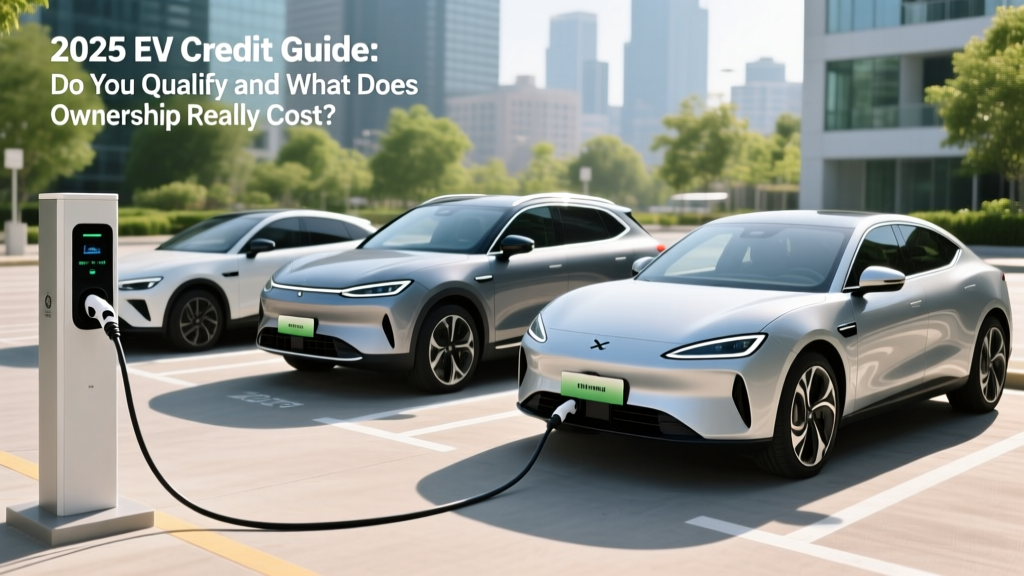
The federal EV tax credit can knock up to $7,500 off your next electric vehicle purchase — but only if you clear a gauntlet of income caps, MSRP ceilings, battery-sourcing mandates, and model-year eligibility changes. Pair that with higher insurance premiums and volatile resale values, and the math gets complicated fast.
This guide dissects the 2025 EV credit rules under IRS §30D and pairs them with a full five-year total cost of ownership analysis. We use real numbers: EPA efficiency data, national-average electricity rates, insurance industry figures, and depreciation tracking. No cherry-picked savings, no glossed-over costs.
The 2025 EV Credit: Eligibility Rules That Actually Matter
The §30D Clean Vehicle Credit offers up to $7,500 for qualifying new EVs and up to $4,000 for qualifying used EVs (under §25E). But "up to" is doing heavy lifting. As of 2025, the credit splits into two $3,750 halves — one tied to critical minerals sourcing, the other to battery component manufacturing — and the thresholds tighten each year. For 2025 model-year vehicles, the critical-minerals threshold requires that at least 80% of applicable critical minerals be extracted or processed in the U.S. or a free-trade-agreement country, or recycled in North America. Battery components must be at least 100% manufactured or assembled in North America for 2025.
On top of sourcing rules, you must clear these gates:
- Adjusted Gross Income (AGI) caps: $300,000 joint filers / $225,000 head of household / $150,000 all other filers. Uses the lesser of current-year or prior-year AGI.
- MSRP caps: $80,000 for vans, SUVs, and trucks; $55,000 for sedans and other body styles. The manufacturer's suggested retail price — not your negotiated out-the-door price — determines eligibility.
- Final assembly: Vehicle must undergo final assembly in North America. Check your VIN at the NHTSA VIN decoder.
- Battery sourcing (§30D(e)): Critical minerals and battery components must meet escalating percentage thresholds. The DOE/FuelEconomy.gov eligible vehicle list tracks which trims qualify.
- Point-of-sale transfer: Beginning in 2024, you can transfer the credit to the dealer at purchase, receiving the benefit as a down-payment reduction or cash equivalent rather than waiting to claim it on your tax return. You still must meet all eligibility requirements, and if your actual tax liability is lower than the credit, the transferred amount does not need to be repaid.
- Vehicle must be new (for §30D): Original use must commence with you. For the used-EV credit (§25E), the vehicle must be at least two model years old, priced at $25,000 or below, purchased from a licensed dealer, and you must not have claimed a used-EV credit in the prior three years.
Key caveat: The list of qualifying vehicles shifts as automakers adjust supply chains. A trim that qualified in January may lose eligibility by June if battery sourcing changes. Always verify on fueleconomy.gov at the time of purchase, and confirm with your tax professional — this is not tax advice.
Five-Year Total Cost of Ownership: EV vs. Gas Baseline
To ground the numbers, we compare a representative 2025 EV — the Hyundai Ioniq 6 SE Long Range (RWD, 77.4 kWh usable battery, EPA 361 miles, 140 MPGe combined, ~$42,600 MSRP) — against a comparable midsize gas sedan averaging 30 MPG combined (e.g., Toyota Camry LE at ~$28,500 MSRP).
| Cost Category | 2025 Ioniq 6 SE (EV) | Gas Sedan (30 MPG) | 5-Year Delta |
|---|---|---|---|
| Purchase Price (MSRP) | $42,600 | $28,500 | +$14,100 EV |
| Federal Tax Credit | −$7,500 (if eligible) | $0 | −$7,500 EV |
| Net Purchase After Credit | $35,100 | $28,500 | +$6,600 EV |
| Fuel/Energy (75,000 mi) | $4,635 | $8,929 | −$4,294 EV savings |
| Maintenance (5 yr) | $1,800 | $3,750 | −$1,950 EV savings |
| Insurance (5 yr) | $11,250 | $8,500 | +$2,750 EV |
| Depreciation (est.) | $18,900 | $11,400 | +$7,500 EV |
| Total 5-Year Cost | $71,685 | $61,079 | +$10,606 EV |
Assumptions: 15,000 miles/year; electricity at $0.165/kWh national average with the Ioniq 6 consuming ~25 kWh/100 mi (home charging dominant); gas at $3.50/gallon; insurance based on national averages from industry data showing EV premiums 20-30% higher; depreciation based on iSeeCars and Kelley Blue Book tracking showing EVs averaging ~44% five-year depreciation vs. ~40% for gas equivalents.
The EV costs more over five years in this scenario primarily because of higher upfront price (even after the credit) and steeper depreciation. But shift the variables — cheaper electricity, more miles driven, a state rebate, or a lower-priced EV — and the math can flip. Let's break each line item down.
Charging vs. Gas: The Per-Mile Math
This is where EVs consistently win, and the advantage widens the more you drive. The critical metric is cost per mile, which depends on your energy source and the vehicle's efficiency.
| Scenario | Energy Cost | Vehicle Efficiency | Cost Per Mile |
|---|---|---|---|
| Home charging (national avg) | $0.165/kWh | 25 kWh/100 mi (Ioniq 6) | $0.041 |
| Home charging (cheap utility, e.g., WA, LA) | $0.10/kWh | 25 kWh/100 mi | $0.025 |
| DC fast charging (public, avg) | $0.40/kWh | 25 kWh/100 mi | $0.100 |
| Gas sedan (30 MPG) | $3.50/gallon | 30 MPG | $0.117 |
| Gas truck (20 MPG) | $3.50/gallon | 20 MPG | $0.175 |
At home on the national average, the Ioniq 6 costs $0.041/mile — roughly one-third the cost of fueling a 30 MPG sedan. Over 15,000 miles, that's $615/year for electricity versus $1,750/year for gas, a $1,135 annual savings.
The caveat: if you rely heavily on DC fast charging at $0.40/kWh, your per-mile cost rises to $0.10 — approaching gas parity. EV ownership economics depend heavily on home or workplace charging access. If you can't charge at home (apartment dwellers, street parkers), run the numbers with your local public charging rates before buying.
Also factor in time-of-use rates. Many utilities offer off-peak EV rates as low as $0.06-0.08/kWh for overnight charging, which can drop your cost per mile below $0.02.
Maintenance Savings: Where EVs Quietly Win
EVs eliminate entire maintenance categories. No engine oil, no transmission fluid, no spark plugs, no timing belts, no exhaust system. Regenerative braking dramatically extends brake pad life — many EV owners report original brake pads lasting 80,000-100,000+ miles.
| Maintenance Item | EV (Typical) | Gas Vehicle (Typical) |
|---|---|---|
| Oil changes | Not required | 2x/year, ~$50-80 each ($500-800/5yr) |
| Brake pads | Replace every 80-100k+ mi | Replace every 30-50k mi ($300-600/axle) |
| Transmission fluid | Not required (single-speed) | Every 30-60k mi ($150-300) |
| Coolant | Battery thermal mgmt system, ~every 5 yr | Every 30-50k mi ($100-200) |
| Cabin air filter | Every 15-20k mi ($30-60) | Every 15-20k mi ($30-60) |
| Tire rotation | Every 7,500 mi (EVs wear tires faster due to weight/torque) | Every 7,500 mi |
| Tire replacement | May need sooner — EVs are 500-1,000 lbs heavier | Standard intervals |
| Estimated 5-year total | ~$1,500-2,100 | ~$3,500-4,200 |
The realistic 5-year maintenance savings for an EV is $1,500-$2,100. Significant, but not enough alone to overcome the higher purchase price. One underappreciated EV cost: tire wear. The instant torque and extra weight from the battery pack accelerate tire wear — budget for a set of EV-rated tires (e.g., Michelin Pilot Sport EV, Hankook iON) around year 3-4, typically $800-$1,400 for a set of four mounted and balanced.
Insurance: The Uncomfortable EV Premium
EV insurance costs 20-30% more on average than insuring an equivalent gas vehicle. The reasons are structural, not arbitrary:
- Higher repair costs: Battery packs are expensive to replace if damaged ($5,000-$20,000+), and many body shops lack EV-certified technicians, driving up labor rates.
- Higher vehicle values: Insurers base premiums partly on replacement cost, and EVs carry higher MSRPs.
- Specialized parts: Proprietary components and limited aftermarket parts mean longer repair times and higher claims.
- Crash repair complexity: High-voltage systems require de-energizing protocols and specialized training.
For our Ioniq 6 example, expect annual premiums around $2,100-$2,400 versus $1,600-$1,800 for the Camry equivalent — an extra $400-$600/year, or $2,000-$3,000 over five years. Some insurers (Geico, Progressive, State Farm) now offer EV-specific discounts that can narrow the gap by 5-10%. Always get quotes for the specific VIN before purchasing.
Depreciation and Resale Value: The Moving Target
EV depreciation has been volatile. In 2023-2024, aggressive Tesla price cuts triggered a cascade through the used-EV market, with some models losing 50%+ of value in two years. The market has stabilized somewhat by 2025, but EVs still depreciate faster than gas equivalents on average.
According to iSeeCars analysis, the average 5-year depreciation for EVs hovers around 44-49%, compared to roughly 38-42% for gas vehicles. Key factors:
- Battery health uncertainty: Used buyers worry about replacement costs ($5,000-$20,000), depressing resale even though most modern batteries outlast their warranties with minimal degradation.
- Rapid tech obsolescence: Newer EVs offer more range and faster charging, making 3-4 year-old models feel dated.
- Price wars: When new-EV prices drop (as Tesla and others have done), used values follow.
- Brand matters: Tesla, Porsche, and Hyundai/Kia EVs have held value better than some luxury marques (Mercedes EQS, Jaguar I-PACE have seen steep drops).
For the Ioniq 6 at $42,600 MSRP, expect a 5-year resale value of roughly $21,500-$24,000 (approximately 44-50% depreciation). That's $18,600-$21,100 in depreciation cost. The gas sedan at $28,500 might retain $16,500-$17,500, or $11,000-$12,000 in depreciation. The EV loses roughly $6,500-$9,000 more to depreciation.
One offset: if you claim the $7,500 credit at purchase, your effective cost basis drops, partially cushioning the depreciation hit in absolute dollars.
State, Local, and Utility Incentives: The Variable Stack
Important: State and local incentives vary dramatically by jurisdiction and change frequently. The examples below are illustrative — always verify current availability through your state energy office, utility provider, and the Alternative Fuels Data Center.
Beyond the federal §30D credit, many buyers can stack additional incentives:
- State rebates: Colorado offers up to $5,000 in state tax credits for new EVs (income-dependent). California's Clean Fuel Reward was discontinued but some air-district incentives remain. Massachusetts offers $2,500 through MOR-EV for income-qualified buyers.
- Utility rebates: Many utilities offer $500-$1,500 rebates for purchasing an EV and/or installing a Level 2 home charger. Examples include Xcel Energy (CO/MN), PG&E (CA), and Con Edison (NY).
- HOV lane access: States including California, Colorado, Florida, and Virginia offer single-occupant HOV lane access for EVs — a significant commute-time benefit with real economic value.
- Home charging installation: The §30C Alternative Fuel Infrastructure Tax Credit covers 30% of home charger installation costs (up to $1,000) if you live in an eligible census tract. Combined with utility rebates, this can reduce a typical $1,200-$2,500 Level 2 installation to near zero.
- Registration fees: Some states charge EVs higher annual registration fees ($50-$200+) to offset lost gas tax revenue. Factor this into your state-specific math.
In a best-case stacking scenario — federal $7,500 + state $5,000 + utility $1,000 + §30C charger credit $300 — you could reduce your effective purchase cost by $13,800, which dramatically improves the 5-year TCO picture.
Frequently Asked Questions
How much does it really cost to own an EV over 5 years?
For a midrange EV like the 2025 Hyundai Ioniq 6 SE at ~$42,600 MSRP, expect a 5-year total cost of roughly $68,000-$75,000 including purchase (net of federal credit), energy, insurance, maintenance, and depreciation. A comparable gas sedan runs $58,000-$64,000. The EV costs approximately $7,000-$14,000 more over five years, depending on your electricity rates, mileage, insurance market, and state incentives. Higher mileage and cheaper electricity narrow the gap.
Do I qualify for the 2025 EV federal tax credit?
You likely qualify if: your AGI is under $150,000 (single) or $300,000 (joint), the EV's MSRP is under $55,000 (sedans) or $80,000 (SUVs/trucks/vans), the vehicle was assembled in North America, and its battery meets 2025 critical-mineral (80%) and component-manufacturing (100%) thresholds. The eligible vehicle list changes — verify at fueleconomy.gov before purchasing and consult a tax professional for your specific situation.
How much do I save on fuel and maintenance with an EV?
On home charging at the national average ($0.165/kWh), expect to save roughly $1,000-$1,200/year on fuel versus a 30 MPG gas car. Maintenance savings add another $300-$500/year. Combined, that's approximately $1,300-$1,700 in annual savings, or $6,500-$8,500 over five years. These savings alone rarely offset the EV's higher purchase price and depreciation, but they improve with higher mileage and lower electricity rates.
Are EVs more expensive to insure?
Yes — typically 20-30% more than a comparable gas vehicle. For a $40,000-$45,000 EV, expect annual premiums of $2,000-$2,500 versus $1,500-$1,900 for a gas equivalent. The premium reflects higher repair costs, battery replacement risk, and specialized labor requirements. Shop quotes from multiple insurers; some now offer EV-specific discounts.
How well do EVs hold their value?
Average 5-year EV depreciation is approximately 44-49%, versus 38-42% for gas vehicles. Battery health concerns, rapid technology advancement, and new-EV price competition drive faster depreciation. Brands like Tesla and Hyundai/Kia have fared better than some luxury marques. The federal tax credit partially offsets this by lowering your effective purchase price, but resale value remains a genuine EV ownership disadvantage as of 2025.
Can I transfer the tax credit to the dealer at the point of sale?
Yes. Since 2024, §30D allows you to transfer the credit to a registered dealer, receiving the benefit as a reduction in your purchase price or down payment at the time of sale. You must still meet all eligibility requirements (income, MSRP, sourcing), and you'll need to attest to your income on the IRS Energy Credits Online portal. If your actual tax liability turns out to be less than the credit amount, you do not need to repay the difference — the transferred credit is not recaptured from the buyer.
The Bottom Line: Run Your Own Numbers
The 2025 EV credit meaningfully improves the ownership equation — but it doesn't guarantee that an EV is cheaper overall. The honest math depends on your specific variables: how many miles you drive, your electricity rate, your insurance market, your state incentives, and which EV you choose.
If you drive 20,000+ miles/year, have cheap home electricity, qualify for the full $7,500 credit plus state incentives, and plan to keep the vehicle 7-10 years (riding out the depreciation curve), an EV can break even or come out ahead. If you drive under 10,000 miles/year, rely on expensive public charging, and trade vehicles every 3-4 years, the gas option likely costs less.
Use the framework above with your own numbers. Get insurance quotes for the exact VIN. Check your utility's EV rate plan. Verify credit eligibility on the day you buy. The spreadsheet isn't glamorous, but it's the only way to know if going electric saves you money — or costs you more.