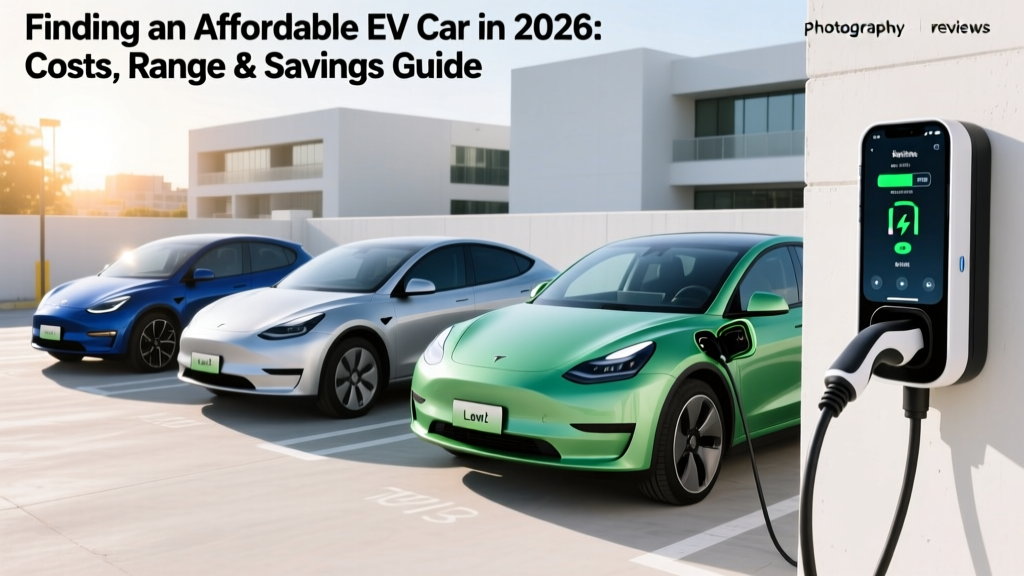
The Quick Answer: What Makes an EV Truly Affordable?
An affordable EV car in 2026 means a base MSRP under $38,000 before incentives, with real-world range above 230 miles, Level 2 home charging capability, and eligibility for at least a partial §30D federal tax credit (up to $7,500) applied at the point of sale. The Chevrolet Equinox EV, Nissan Leaf, and Hyundai Kona Electric currently anchor this segment. But true affordability isn't just sticker price — it's total cost of ownership over five years, factoring in electricity vs. gasoline, maintenance savings, insurance premiums, and battery warranty coverage.
Budget-conscious EV shoppers face a maze of conflicting information: inflated range claims, shifting tax-credit eligibility, and charging infrastructure that varies wildly by zip code. This guide cuts through the noise with exact numbers — EPA range, battery capacity in kWh, peak charge rates in kW, and real ownership costs — so you can decide whether an affordable EV car actually saves you money compared to a gas or hybrid alternative.
2026's Most Affordable EV Cars: Spec-by-Spec Breakdown
The sub-$40,000 EV market has matured significantly. Here's how the leading budget electric vehicles stack up on the metrics that matter most:
| Model | Base MSRP | EPA Range | Battery (kWh) | Peak DC Charge (kW) | 10-80% Time | 0-60 mph | HP |
|---|---|---|---|---|---|---|---|
| Chevrolet Equinox EV 2LT | $33,600 | 319 mi | 85 kWh (NMC) | 150 kW | ~30 min | 7.8 sec | 213 |
| Hyundai Kona Electric SEL | $32,975 | 261 mi | 65 kWh (NMC) | 100 kW | ~43 min | 7.6 sec | 201 |
| Nissan Leaf SV Plus | $36,190 | 212 mi | 60 kWh (NMC) | 100 kW | ~45 min | 6.9 sec | 214 |
| Kia Niro EV Wind | $39,600 | 239 mi | 64.8 kWh (NMC) | 85 kW | ~45 min | 7.8 sec | 201 |
| Volkswagen ID.4 Standard | $38,995 | 206 mi | 62 kWh (NMC) | 140 kW | ~32 min | 8.5 sec | 201 |
Real-world range caveat: EPA estimates assume mixed driving at moderate temperatures. Expect highway-only range to drop 10-15% below the EPA sticker, and cold-weather range (below 32°F) to drop 20-30% depending on whether the vehicle has a heat pump. The Equinox EV's 319-mile EPA figure translates to roughly 250-270 miles on a highway road trip in fair weather, and potentially 200-220 miles in freezing conditions without preconditioning.
EV vs. Gas vs. Hybrid: The Real Cost Comparison
The most common question from first-time EV buyers: does an affordable EV car actually save me money compared to a gas car or hybrid? The answer depends heavily on your driving patterns, local electricity rates, and whether you can charge at home.
| Cost Factor | Chevy Equinox EV ($33,600) | Toyota Corolla Gas ($22,050) | Toyota Prius Hybrid ($28,550) |
|---|---|---|---|
| Purchase Price (MSRP) | $33,600 | $22,050 | $28,550 |
| Est. §30D Tax Credit | $7,500* | $0 | $0 |
| Effective Purchase Price | $26,100 | $22,050 | $28,550 |
| Fuel/Energy Cost (5 yr / 75,000 mi) | $3,750** | $7,500*** | $4,690*** |
| Maintenance (5 yr) | ~$1,500 | ~$3,200 | ~$3,000 |
| Insurance (5 yr avg) | ~$9,500 | ~$7,200 | ~$7,800 |
| 5-Year Total Cost | $40,850 | $39,950 | $44,040 |
*Tax credit eligibility depends on buyer income (≤$150K single / ≤$300K joint), MSRP caps, and battery critical-mineral sourcing per IRS §30D rules. Always verify with a tax professional.
**Based on $0.15/kWh national average, 3.5 mi/kWh efficiency.
***Based on $3.50/gal, Corolla 33 MPG combined, Prius 57 MPG combined per fueleconomy.gov.
The Equinox EV achieves near-parity with the Corolla on total cost over five years despite a higher starting price, primarily through fuel and maintenance savings. Against the Prius hybrid, the EV wins on energy costs but loses on insurance premiums, which run 15-25% higher for electric vehicles due to battery replacement risk in collision claims.
The Full Cost Breakdown: What First-Time EV Buyers Miss
| Cost Category | Details | Typical Range |
|---|---|---|
| Home Level 2 Charger (hardware) | ChargePoint Home Flex, Emporia Vue, Tesla Wall Connector | $350 – $700 |
| Home Installation (electrician) | 240V/60A circuit, conduit run, permit | $500 – $2,500 |
| Electrical Panel Upgrade | If existing panel is 100A or maxed out | $1,500 – $3,500 |
| Electricity Cost (per mile) | At $0.15/kWh, ~3.5 mi/kWh | $0.04 – $0.05/mi |
| Public DC Fast Charging (per mile) | At $0.40/kWh average | $0.11 – $0.14/mi |
| Tire Replacement | EVs wear tires 20-30% faster (weight + torque) | $800 – $1,400/set |
| Battery Warranty | Federally mandated minimum | 8 yr / 100,000 mi |
| Battery Replacement (out of warranty) | Full pack swap | $8,000 – $18,000 |
Charging Infrastructure Reality Check
The most affordable EV car becomes frustratingly expensive in time and money if you live in a charging desert. Before buying, map your daily routine:
- Home charging available (garage/driveway with 240V access): Ideal scenario. A Level 2 charger at 7.2-11.5 kW adds 25-44 miles of range per hour — more than enough to replenish a daily commute overnight.
- Apartment/workplace Level 2 charging: Workable if consistently available. Confirm reliability and whether your workplace chargers are complimentary or paid.
- Public DC fast charging only: Budget 30-45 minutes per session, 2-3 times weekly. Costs 3-4x more than home charging. This scenario negates most of the EV's cost advantage and adds significant time overhead.
Federal Tax Credits: How They Actually Work in 2026
The §30D Clean Vehicle Credit can reduce an affordable EV car's effective price by up to $7,500, but eligibility is far from universal. The credit has three gating requirements that trip up many buyers:
- Income Caps: Modified adjusted gross income ≤$150,000 (single), ≤$225,000 (head of household), ≤$300,000 (joint filers)
- MSRP Caps: Vehicle base MSRP must be ≤$55,000 for sedans, ≤$80,000 for SUVs/pickups
- Battery Sourcing: Critical minerals and battery components must meet phased-in domestic/free-trade-agreement sourcing thresholds that tighten annually through 2029
- Point-of-Sale Transfer: As of 2024, buyers can transfer the credit to the dealer as an immediate down-payment reduction rather than waiting to claim it on their tax return
- Final Assembly: Vehicle must undergo final assembly in North America
The battery sourcing requirement is the most volatile factor. A model that qualifies in January may lose eligibility mid-year if the manufacturer's supply chain shifts. Always check the fueleconomy.gov tax credit lookup tool for the specific vehicle and delivery date before signing paperwork.
Common Misconceptions About Budget EVs
| Myth | Fact |
|---|---|
| "Affordable EVs have terrible range" | The Equinox EV delivers 319 mi EPA at $33,600 — competitive with many premium EVs from 2022. Budget range now exceeds 250 mi for most models. |
| "The battery will die and cost $20,000 to replace" | NMC batteries in current models show 8-12% degradation over 100,000 miles based on fleet data. Federal warranty mandates 8 yr/100,000 mi coverage at ≥70% capacity retention. |
| "EVs don't work in cold weather" | Range drops 20-30% in freezing temps, but preconditioning (warming the battery while plugged in) recovers much of this loss. Modern EVs with heat pumps handle winter driving — with adjusted expectations. |
| "Charging takes too long for road trips" | A 150 kW-capable EV like the Equinox adds ~150 miles in 20 minutes at a DC fast charger. With route planning (A Better Routeplanner, PlugShare), road trips add 30-45 min per 250-300 mi. |
| "All EVs qualify for the $7,500 tax credit" | Only vehicles meeting all §30D criteria qualify. Several popular models lost partial or full credit eligibility due to battery sourcing changes. Always verify before purchase. |
Decision Framework: Is an Affordable EV Car Right for You?
Choose an affordable EV if:
- You have reliable access to Level 2 home or workplace charging
- Your daily driving is under 80 miles (round trip) with occasional 250+ mile trips
- You qualify for the §30D tax credit based on income and the specific model's sourcing status
- You plan to keep the vehicle 5+ years to recoup the upfront cost premium through fuel/maintenance savings
- You live in a moderate climate, or your EV pick includes a heat pump for cold-weather efficiency
Choose a hybrid (HEV/PHEV) instead if:
- You lack home charging and public infrastructure in your area is sparse
- You regularly drive 300+ miles between charging opportunities (rural routes, frequent road trips)
- Your budget is strictly under $25,000 and you cannot wait for used-EV market depreciation
- You live in extreme cold (consistently below 0°F) where range loss exceeds 35%
Wait or reconsider if:
- Your apartment building has no EV charging and installation isn't feasible
- You need to tow more than 2,500 lbs (budget EVs have limited towing capacity)
- Your household income exceeds §30D caps and the EV's MSRP premium over a hybrid isn't offset by fuel savings alone
Frequently Asked Questions
What is the cheapest EV with over 250 miles of range in 2026?
The Chevrolet Equinox EV 2LT at $33,600 MSRP offers 319 miles of EPA-estimated range, making it the value leader in the 250+ mile category. The Hyundai Kona Electric at $32,975 delivers 261 miles EPA — slightly less range at a marginally lower price.
Do affordable EVs charge fast enough for road trips?
Budget EVs typically peak between 85-150 kW on DC fast chargers. The Equinox EV peaks at 150 kW, achieving a 10-80% charge in approximately 30 minutes. The Kona Electric peaks at 100 kW (~43 minutes 10-80%). These speeds are adequate for road trips with planned stops, but noticeably slower than premium EVs charging at 250-350 kW.
How much does home EV charger installation cost?
A Level 2 home charger installation typically costs $850-$3,200 total (hardware + electrician labor + permit), assuming your electrical panel has sufficient capacity. If a panel upgrade from 100A to 200A is needed, add $1,500-$3,500. Always get a quote from a licensed electrician before committing to an EV purchase.
Will an affordable EV's battery last?
Current NMC battery chemistry shows approximately 8-12% capacity loss over 100,000 miles based on real-world fleet data. All new EVs carry a federally mandated battery warranty of 8 years/100,000 miles (10 years/150,000 miles in CARB states) guaranteeing at least 70% capacity retention. Out-of-warranty replacement runs $8,000-$18,000 depending on the pack size.
Are EVs more expensive to insure than gas cars?
Yes, typically 15-25% higher premiums due to elevated repair costs (specialized body shops, battery protection requirements) and higher total-loss write-off rates from battery damage. Shop quotes from multiple carriers — some insurers now offer dedicated EV policies with competitive rates.