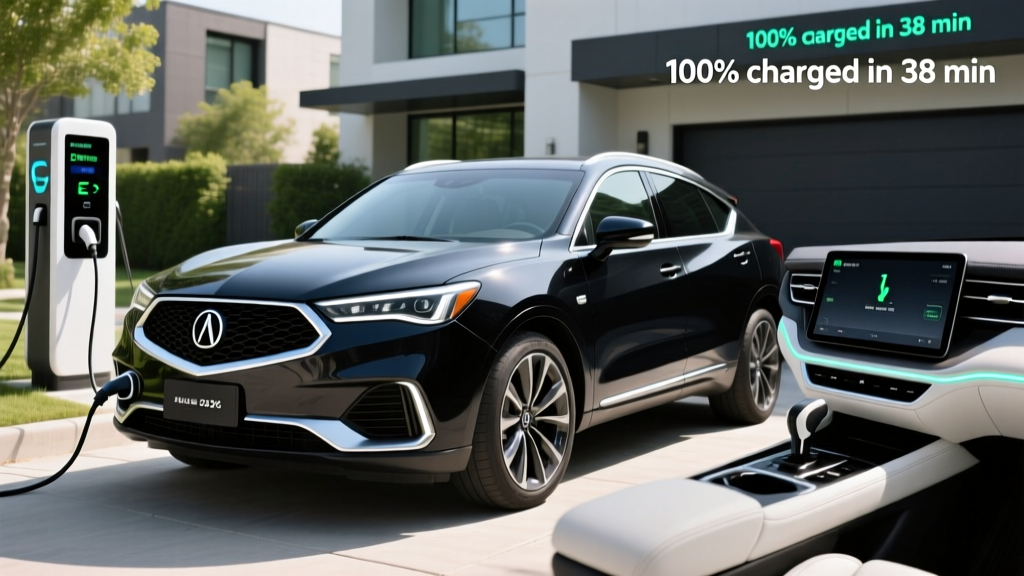
The Acura ZDX occupies a strange space in the luxury electric SUV segment: it shares its Ultium platform and battery hardware with the Cadillac Lyriq, but wears Acura styling, tunes its suspension differently, and prices itself against the BMW iX and Audi Q8 e-tron. For buyers researching Acura ZDX reliability, the answer hinges less on Acura's historical reputation and more on how the shared GM Ultium architecture has performed since its 2023 rollout — and how Acura's dealer network supports it long-term.
This review breaks down the 2026 Acura ZDX with the exact numbers buyers need: EPA range versus real-world expectations, DC fast-charge curves (not just peak kW), battery chemistry and warranty terms, and whether the federal EV tax credit actually applies at your income level.
2026 Acura ZDX at a Glance: Core EV Specs
| Spec | ZDX A-Spec (RWD) | ZDX A-Spec (AWD) | ZDX Type S |
|---|---|---|---|
| EPA Range | 321 miles | 304 miles | 278 miles |
| Battery (usable) | 102 kWh, NMC | 102 kWh, NMC | 102 kWh, NMC |
| Horsepower | 358 hp | 490 hp | 500 hp |
| 0-60 mph | 6.4 sec (est.) | 5.0 sec | 4.5 sec |
| Peak DC Fast Charge | 190 kW | 190 kW | 190 kW |
| 10-80% DC Time | ~37 min | ~37 min | ~37 min |
| Level 2 Home Charge | 11.5 kW (~31 mi/hr) | 11.5 kW (~31 mi/hr) | 11.5 kW (~31 mi/hr) |
| MPGe (combined) | 94 MPGe | 88 MPGe | 82 MPGe |
| Base MSRP | $65,850 | $69,850 | $74,850 |
A few things jump out from this table. First, the ZDX's 102 kWh usable NMC (nickel manganese cobalt) battery is one of the largest in its class — larger than the BMW iX xDrive50's 105.2 kWh gross pack and significantly larger than the Audi Q8 e-tron's 106 kWh gross / ~95 kWh usable. That capacity is what gives the RWD A-Spec its 321-mile EPA figure. Second, 190 kW peak DC charging is acceptable for 2026 but trails Hyundai/Kia's 800V architecture (which peaks above 230 kW) and Porsche/Audi's 270 kW capability.
Real-World Range: What the EPA Sticker Doesn't Tell You
EPA estimated: 304 miles
Highway (70-75 mph, moderate temps): ~255-275 miles
Cold weather (below 32°F, mixed driving): ~215-245 miles
City/regenerative driving (mild temps): ~290-310 miles
The ZDX A-Spec AWD's 304-mile EPA rating is a blended figure. In practice, large, heavy EVs (the ZDX weighs approximately 5,700 lbs in AWD form) lose efficiency disproportionately at highway speeds because aerodynamic drag scales with the square of velocity. Expect 255-275 miles on a 70-75 mph interstate run in 60-75°F weather. Below freezing, lithium-ion internal resistance rises and cabin heating draws from the pack — plan for 215-245 miles unless you precondition the battery while plugged in.
The RWD A-Spec's 321-mile EPA figure is more achievable in mixed driving because it sheds roughly 150 lbs of front-axle hardware and eliminates front-motor parasitic losses. If your commute is predominantly suburban and you use one-pedal regenerative driving, 290-310 real-world miles is realistic in mild weather.
The Type S, with its stickier 22-inch summer tires, sportier alignment, and higher power output, sacrifices range for grip. 278 miles EPA means roughly 230-245 miles on a highway road trip — fine for daily use but tight for Los Angeles-to-Las Vegas runs without a charge stop.
Charging Speed and Curve: The 190 kW Reality
| Charging Level | Power / Rate | Miles Added per Hour | Notes |
|---|---|---|---|
| Level 1 (120V household) | ~1.4 kW | ~3-4 mi/hr | Emergency/top-up only |
| Level 2 (240V home, 48A) | 11.5 kW | ~31 mi/hr | Full charge in ~9.5 hours |
| DC Fast Charge (peak) | 190 kW | ~210 mi/hr (at peak) | Peak held from ~10-40% SoC |
| DC Fast Charge (10-80%) | Avg ~130 kW | — | ~37 minutes typical |
The ZDX's Ultium platform uses a 400V architecture, which caps peak DC charging at 190 kW. The charge curve matters more than the peak number: the ZDX sustains close to 190 kW from roughly 10% to 40% state of charge (SoC), then tapers progressively. By 60% SoC, expect roughly 120-130 kW; by 80%, it drops below 80 kW. This taper is normal for NMC chemistry at 400V but means the 10-80% time of approximately 37 minutes is average for the class — not class-leading.
For context, a Hyundai Ioniq 5 on an 800V charger completes 10-80% in roughly 18 minutes. If your road trips frequently involve 300+ mile stretches between reliable DC chargers, the ZDX's charge speed is workable but not a differentiator.
At home on a Level 2 hardwired charger (48-amp circuit, 60-amp breaker), the ZDX's 11.5 kW onboard charger adds roughly 31 miles per hour of charging. A depleted 102 kWh pack reaches full in about 9.5 hours — plug in at 9 PM, leave at 7 AM with a full battery. Home charging installation typically runs $800-$2,500 depending on panel capacity and conduit distance; budget for a potential $1,500-$3,000 panel upgrade if your home has a 100-amp service.
Acura ZDX Reliability: What We Know So Far
The 2026 ZDX enters its third model year on the Ultium platform, which is relevant for reliability assessment. First-year Ultium vehicles (2023 Cadillac Lyriq, 2024 ZDX) experienced documented issues including:
- Software glitches: Infotainment freezes, phantom battery-drain reports, and delayed over-the-air (OTA) update rollouts were common in 2023-2024 models. Acura and GM have issued multiple OTA patches through 2025 addressing these.
- 12V battery drain: Like many modern EVs, the ZDX uses a conventional 12V battery to run ancillary systems. Owners reported 12V failures within the first 18 months, sometimes stranding vehicles. GM revised the 12V charging logic via software update in late 2024.
- Build quality variance: Panel gap inconsistencies and occasional rattles from the panoramic roof assembly appeared in owner forums. These are assembly-line issues rather than systemic design flaws.
The powertrain itself — the Ultium battery pack and drive motors — has held up well. There have been no widespread reports of battery cell failures, thermal runaway events, or motor recalls specific to the ZDX or Lyriq. GM's battery modules use a pouch-cell NMC design with active liquid thermal management, which historically ages better than passively cooled packs.
Acura's 4-year/50,000-mile basic warranty and 8-year/100,000-mile battery and powertrain warranty are industry-standard. The battery warranty guarantees the pack will retain at least 60% of its original capacity during the coverage period — though real-world Ultium degradation data from 2023 Lyriqs suggests roughly 4-6% loss at 30,000 miles, which is normal for NMC chemistry.
For long-term reliability confidence, the ZDX benefits from parts commonality with the Lyriq, Blazer EV, and Equinox EV — meaning GM has strong incentive to maintain the Ultium supply chain. Acura's dealer network, while smaller than Honda's, has been generally well-reviewed for EV service competency since the 2024 ZDX launch.
Pricing, Trims, and Federal Tax Credit Eligibility
| Trim | Base MSRP | As-Tested (typical) | §30D Credit Eligible? |
|---|---|---|---|
| A-Spec RWD | $65,850 | $67,500 | Yes, if buyer meets income caps |
| A-Spec AWD | $69,850 | $71,200 | Yes, if buyer meets income caps |
| Type S | $74,850 | $77,500 | Yes, if buyer meets income caps |
The 2026 Acura ZDX qualifies under the IRS §30D clean vehicle credit rules, but eligibility depends on three buyer-specific criteria:
- MSRP cap: SUVs must have a base MSRP at or below $80,000. All ZDX trims clear this threshold.
- Buyer income cap: Modified adjusted gross income (MAGI) must not exceed $150,000 (single), $225,000 (head of household), or $300,000 (married filing jointly).
- Battery sourcing: A percentage of critical minerals and battery components must be sourced from the U.S. or free-trade-agreement countries. As of the 2026 model year, the ZDX's Ultium pack — manufactured in the U.S. with globally sourced minerals — meets the phased-in thresholds. Verify current compliance at IRS.gov's eligible vehicle list before purchasing.
If you qualify, the credit is up to $7,500 and can be applied as a point-of-sale rebate through a registered dealer, effectively reducing your out-of-pocket cost at purchase. This brings the A-Spec RWD to approximately $58,350 net — competitive with a well-equipped BMW iX xDrive50 ($75,000+ MSRP, ineligible for §30D due to MSRP cap) and undercutting the Audi Q8 e-tron ($74,400 MSRP).
Consult a tax professional to confirm your MAGI eligibility and to understand how the point-of-sale transfer interacts with your tax liability. Full rules are published at IRS.gov §30D.
Interior, Tech, and Daily Livability
The ZDX's cabin borrows heavily from the Honda Prologue (its platform sibling) but upgrades materials with Acura-specific leather, aluminum trim, and a standard 18-speaker Bang & Olufsen audio system. Key dimensions:
- Cargo volume: 28.4 cu ft behind rear seats, 56.5 cu ft with rear seats folded
- Rear legroom: 38.2 inches
- Front headroom: 40.1 inches (panoramic glass roof reduces headroom by ~0.5 in vs. solid roof)
- Towing capacity: 1,500 lbs (all trims)
The 11.3-inch touchscreen runs Google Built-In (Google Maps, Google Assistant, Play Store), which is responsive and well-integrated but means you're locked into Google's ecosystem. Wireless Apple CarPlay and Android Auto are standard.
Acura's AcuraWatch driver-assistance suite includes adaptive cruise control with stop-and-go, lane-centering assist, blind-spot monitoring, and rear cross-traffic braking. This is an SAE Level 2 system — you must remain engaged with hands on the wheel and eyes on the road at all times. It is not autonomous driving. The system is competent for highway commuting but less assertive than GM's Super Cruise (available on the Cadillac Lyriq but not offered on the ZDX as of 2026).
Notable drawbacks: the ZDX lacks a front trunk (frunk), which competitors like the Ford Mustang Mach-E and Rivian R1S offer. The 1,500-lb tow rating is low for a vehicle of this size — the Rivian R1S tows 7,700 lbs, and even the BMW iX manages 3,500 lbs. If you need to tow a small camper or boat, the ZDX is not the right tool.
Who Should Buy the Acura ZDX — and Who Shouldn't
- You want a 300+ mile luxury EV SUV under $70,000 (after credit) with a proven, U.S.-built battery platform
- You value Acura's dealer network and service infrastructure over cutting-edge charge speed
- Your daily driving is under 80 miles and you can charge at home overnight
- You prefer physical controls and Google-native infotainment over minimalist touchscreen-only interfaces
- You frequently road-trip 400+ miles and want 18-minute DC charge stops (consider Hyundai Ioniq 5, Kia EV6, or Porsche Macan EV)
- You need hands-off highway driving assist (Cadillac Lyriq with Super Cruise)
- You tow more than 1,500 lbs (Rivian R1S, Ford F-150 Lightning)
- You want a third row or maximum cargo capacity (Kia EV9, Tesla Model X)
Pros and Cons: Honest Ownership Assessment
- 321-mile EPA range (RWD) is genuinely usable for road trips
- 102 kWh battery provides range buffer in cold weather
- Comfortable, well-insulated ride quality
- Google Built-In infotainment is fast and familiar
- Federal §30D credit eligible at all trims
- U.S.-built (Spring Hill, TN) with strong parts commonality
- 190 kW peak DC charge is average; 37-min 10-80% lags 800V rivals
- No frunk; cargo space is modest for the vehicle's footprint
- 1,500-lb tow rating is low for a luxury midsize SUV
- Type S range penalty (278 mi EPA) limits road-trip appeal
- No Super Cruise or equivalent hands-free driving option
- Early-model software issues may persist in used examples
Frequently Asked Questions
What is the real-world range of the 2026 Acura ZDX?
The A-Spec AWD delivers roughly 255-275 miles on the highway in mild weather, and 215-245 miles in freezing temperatures. The RWD version gains 15-20 miles in equivalent conditions. City driving with regenerative braking can approach or slightly exceed the EPA estimate.
How fast does the Acura ZDX charge at home and on the road?
At home on a 48-amp Level 2 charger, the ZDX charges at 11.5 kW, adding about 31 miles per hour (full charge in ~9.5 hours). On DC fast chargers, it peaks at 190 kW and completes 10-80% in approximately 37 minutes — adequate but not class-leading.
Does the 2026 Acura ZDX qualify for the $7,500 federal EV tax credit?
Yes, all trims fall under the $80,000 SUV MSRP cap. However, you must also meet IRS income limits ($150K single / $300K married filing jointly) and the vehicle must meet battery-sourcing requirements. Confirm eligibility at IRS.gov and with a tax professional before purchase.
Is the Acura ZDX more reliable than the Cadillac Lyriq?
Both share the Ultium platform, battery, and motors. Reliability is expected to be nearly identical. The ZDX's advantage is Acura's dealer service network, which some owners prefer for luxury-brand experience. Early software issues affected both brands similarly.
How does the ZDX compare to the BMW iX and Audi Q8 e-tron?
The ZDX offers more EPA range (304-321 mi vs. the iX xDrive50's ~309 mi and Q8 e-tron's ~285 mi) at a lower price point, especially after the $7,500 credit. The iX charges faster (up to 200 kW) and offers a more premium interior; the Q8 e-tron tows more (4,000 lbs). The ZDX's value proposition is range-per-dollar with U.S. manufacturing and credit eligibility.
What is the battery replacement cost for the Acura ZDX?
Out-of-warranty Ultium battery replacement is estimated at $15,000-$22,000 based on current GM pricing for Lyriq packs. However, the 8-year/100,000-mile warranty covers capacity loss below 60%, and real-world degradation data suggests most owners will not need replacement within typical ownership periods.