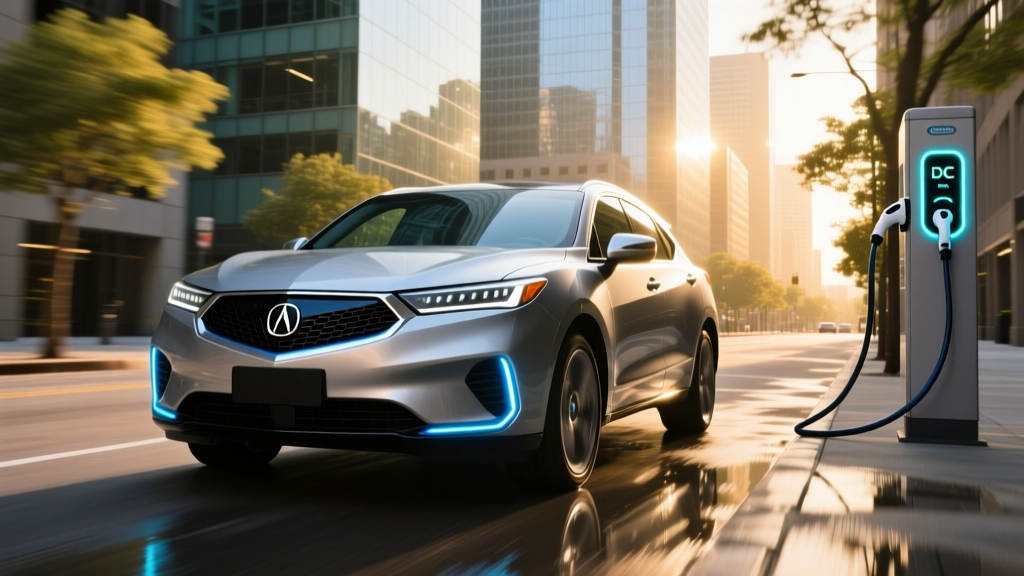
Acura's first all-electric vehicle carries a lot of expectations. The ZDX, built on General Motors' Ultium platform and wearing Honda's luxury badge, targets the premium midsize electric SUV segment occupied by the BMW iX, Genesis Electrified GV70, and Tesla Model X. After spending time with the specs, the charging curves, and the competitive landscape, here's what the data actually tells us about whether the ZDX earns its premium positioning.
Quick Verdict: Who Should Consider the Acura ZDX?
The ZDX fits buyers who want a luxury electric SUV with strong fast-charging capability, a spacious cabin, and access to Tesla's Supercharger network via the NACS connector — without the Tesla ecosystem lock-in. It's best suited for suburban commuters and families who can install a Level 2 home charger and take occasional road trips within well-covered charging corridors. If you prioritize cutting-edge autonomous driving features or need a third row, look elsewhere.
Range, Battery, and Real-World Efficiency
Real-World Expectation: ~240–265 miles at sustained highway speeds (70–80 mph); ~190–220 miles in cold weather (below 30°F) with cabin heating active.
The ZDX lineup uses GM's Ultium battery platform with a 102 kWh usable lithium-ion battery pack employing NMC (nickel-manganese-cobalt) chemistry. This is the same foundational architecture underpinning the Cadillac Lyriq and Chevrolet Blazer EV, though Acura tunes it for its own performance and efficiency targets.
The rear-wheel-drive A-Spec trim achieves the highest EPA rating at 313 miles. Stepping up to the dual-motor AWD A-Spec drops that to approximately 288 miles, while the performance-oriented Type S (dual-motor, higher output) lands around 278 miles. These are competitive numbers for the segment, though the Hyundai Ioniq 5 (311 miles) and Tesla Model Y Long Range (330+ miles) edge ahead in efficiency per kWh.
Efficiency ratings hover around 88 MPGe combined for the AWD variants, translating to roughly 34–36 kWh per 100 miles driven. That's adequate but not class-leading — the ZDX's 5,000+ lb curb weight works against it in stop-and-go efficiency compared to lighter competitors.
Charging Speed: DC Fast, Level 2, and NACS Access
| Charging Level | Power / Rate | Time / Miles Added |
|---|---|---|
| DC Fast Charge (Peak) | 190 kW | 10–80% in ~27 minutes |
| DC Fast Charge (Sustained Avg.) | ~130–150 kW to 80% | Expect taper above 60% SoC |
| Level 2 (Home, 240V / 48A) | 11.5 kW | ~31 miles of range per hour |
| Level 2 (Standard 240V / 32A) | 7.7 kW | ~21 miles of range per hour |
| Level 1 (120V) | 1.4 kW | ~4 miles of range per hour |
The ZDX's 190 kW peak DC fast-charge rate is respectable, though it trails the Hyundai/Kia E-GMP platform's 240–250 kW capability and the Lucid Air's 300 kW+ architecture. More importantly, peak rate is not sustained rate. In practice, the ZDX holds strong charge speeds from 10–40% SoC, then begins a gradual taper. Expect an average of roughly 130–150 kW through the 10–80% window, which translates to about 27 minutes at a 350 kW-capable station.
A significant advantage for 2026: the ZDX uses the NACS (North American Charging Standard) connector, granting native access to Tesla Supercharger stalls (now open to non-Tesla EVs via the Open Supercharger initiative). This dramatically expands reliable fast-charging options on road trips compared to CCS-only vehicles still dependent on Electrify America and third-party networks.
For home charging, the onboard 11.5 kW AC charger is competitive. A full charge from 10–100% on a 48-amp Level 2 circuit takes roughly 9–10 hours — easily overnight for most owners. Budget $600–$1,200 for a quality Level 2 home charger (ChargePoint Home Flex, Emporia V2, or Wallbox Pulsar Plus) and $800–$2,500 for professional installation by a licensed electrician, depending on your panel capacity and conduit run distance.
Performance: 0–60, Horsepower, and Drivetrain Options
| Trim | Drivetrain | Horsepower | Torque (lb-ft) | 0–60 mph |
|---|---|---|---|---|
| A-Spec (RWD) | Rear-Wheel Drive | 340 hp | 325 | ~5.7 sec |
| A-Spec (AWD) | Dual-Motor AWD | 490 hp | 425 | ~4.6 sec |
| Type S (AWD) | Dual-Motor AWD | 500 hp | 500+ | ~4.2 sec |
The ZDX A-Spec RWD provides adequate thrust for daily driving and highway merging. The dual-motor AWD variant is where the ZDX feels genuinely quick — 490 hp in a luxury SUV delivers confident passing power and satisfying off-the-line acceleration. The Type S pushes output to 500 hp with a sport-tuned suspension, larger brakes, and a more aggressive torque curve, though the 0–60 improvement over the standard AWD is modest (roughly 0.4 seconds).
Ride quality in the A-Spec is composed and comfortable, with well-damped responses to road imperfections. The Type S firms things up noticeably — sporty enough for canyon carving but potentially too stiff for buyers who prioritize plushness. Steering is precise but light, which aids city maneuverability at the expense of sporty feedback.
Interior, Cargo, and Technology
The ZDX's cabin seats five passengers with generous dimensions:
- Front legroom: 41.3 inches
- Rear legroom: 38.7 inches
- Cargo volume (rear seats up): 28.4 cu ft
- Cargo volume (rear seats folded): 56.9 cu ft
- Front trunk (frunk): Not available — Ultium platform packaging allocates this space to HVAC and electronics
The infotainment system runs on an 11.3-inch touchscreen with Google Built-In (Google Maps, Google Assistant, Google Play Store). Wireless Apple CarPlay and Android Auto are standard. The 11-inch digital driver display is configurable but not as visually rich as Audi's Virtual Cockpit or Mercedes' MBUX Hyperscreen.
Acura's driver-assistance suite, branded AcuraWatch, includes adaptive cruise control with stop-and-go, lane-keeping assist, blind-spot monitoring, and rear cross-traffic alert. This is an SAE Level 2 system — it assists with steering and speed but requires the driver to remain fully engaged at all times. It does not offer hands-free highway driving like GM's Super Cruise or Ford's BlueCruise, which is a notable gap at this price point.
Pricing, Trims, and Federal Tax Credit Eligibility
| Trim | Base MSRP | As-Tested (Typical Options) | Est. After §30D Credit* |
|---|---|---|---|
| A-Spec RWD | $64,500 | $66,000–$68,000 | ~$57,000–$59,500 |
| A-Spec AWD | $69,500 | $72,000–$75,000 | ~$62,000–$67,500 |
| Type S AWD | $74,500 | $78,000–$82,000 | ~$67,000–$74,500 |
*Federal tax credit estimates assume buyer eligibility. Actual credit depends on IRS §30D requirements.
- MSRP cap: SUVs/vans/pickups must be ≤$80,000 — all ZDX trims qualify
- Buyer income cap: AGI ≤$300,000 (married filing jointly), ≤$225,000 (head of household), ≤$150,000 (single)
- Battery sourcing: Critical minerals and battery components must meet phased percentage thresholds from US/FTA partners — verify current-year compliance on IRS.gov
- Point-of-sale transfer: Eligible buyers can transfer the credit to the dealer at purchase, reducing the out-of-pocket price directly (up to $7,500)
- Consult a tax professional to confirm your individual eligibility before purchase
All ZDX trims fall under the $80,000 SUV MSRP cap, making them potentially eligible for the full $7,500 federal credit. However, battery-sourcing and critical-mineral requirements tighten annually — always confirm current-year compliance on the IRS clean vehicle credit page before finalizing a purchase. Many states also offer additional incentives (California's CVRP, Colorado's innovative motor vehicle credit, New York's Drive Clean rebate) that can stack with the federal credit, but these vary by jurisdiction and have their own income and price caps.
Warranty and Long-Term Ownership
| Coverage Type | Duration |
|---|---|
| Basic / Bumper-to-Bumper | 4 years / 50,000 miles |
| Powertrain | 6 years / 70,000 miles |
| Battery Pack | 8 years / 100,000 miles (minimum 70% capacity retention) |
| Corrosion Perforation | 5 years / unlimited miles |
| Roadside Assistance | 4 years / 50,000 miles |
The 8-year/100,000-mile battery warranty is standard for the segment and meets the federal mandate for EV battery coverage. The 70% capacity retention threshold means Acura will replace or repair the battery if it degrades below 70% of original capacity within the warranty period. Based on NMC degradation curves observed across GM's Ultium fleet, most owners should expect roughly 5–8% degradation in the first 50,000 miles, with the rate slowing significantly thereafter. Reaching the 70% threshold within 8 years would be unusual under normal use.
Insurance costs for the ZDX tend to run 15–25% higher than comparable gasoline Acura models (RDX, MDX) due to the higher repair costs associated with EV battery systems and aluminum body panels. Expect annual premiums in the $2,200–$3,200 range depending on your driving record, location, and coverage levels.
Pros and Cons
- NACS connector provides native Tesla Supercharger access
- Spacious cabin with 38.7" rear legroom and nearly 57 cu ft max cargo
- Strong dual-motor performance (490–500 hp)
- Google Built-In infotainment with wireless CarPlay/Android Auto
- Competitive EPA range (up to 313 miles RWD)
- All trims under $80K MSRP cap for §30D tax credit
- 190 kW peak charge rate trails Hyundai/Kia 800V competitors
- No hands-free highway driving feature (no Super Cruise equivalent)
- No front trunk (frunk) for additional storage
- Type S ride quality may be too firm for comfort-focused buyers
- Efficiency (kWh/100mi) lags lighter competitors
- Insurance premiums higher than gas Acura counterparts
How the ZDX Stacks Up Against Key Competitors
In the premium electric SUV segment, the ZDX faces stiff competition:
- BMW iX xDrive50: More luxurious interior, available hands-free driving (Highway Assistant), but starts above $87K and exceeds the §30D MSRP cap.
- Genesis Electrified GV70: Comparable pricing, 800V fast-charging architecture (240 kW peak), but shorter EPA range (~236 miles) and smaller cargo area.
- Tesla Model Y Long Range: Lower price (~$48K), more range (~330 mi), better efficiency, and Supercharger native — but less premium interior, no Apple CarPlay, and polarizing brand perception.
- Cadillac Lyriq: Same Ultium platform, similar range, lower starting price (~$58K), but less sporty tuning and no Type S variant.
The ZDX occupies a middle ground: more premium than the Model Y and Lyriq, more affordable than the iX, with the NACS charging advantage over the GV70. If hands-free driving assistance is a priority, the BMW iX or a GM vehicle with Super Cruise (Cadillac Lyriq, Chevrolet Blazer EV) may be more compelling.
Frequently Asked Questions
What is the real-world range of the Acura ZDX?
The EPA rates the RWD A-Spec at 313 miles, but real-world highway driving at 70–80 mph typically yields 240–265 miles. In cold weather (below 30°F) with cabin heating, expect 190–220 miles. City driving with regenerative braking can match or slightly exceed the EPA estimate.
How fast does the ZDX charge at home and on the road?
On a DC fast charger, the ZDX peaks at 190 kW and reaches 10–80% in approximately 27 minutes. At home on a 48-amp Level 2 charger (11.5 kW), you'll add about 31 miles of range per hour, with a full 10–100% charge taking roughly 9–10 hours.
Does the Acura ZDX qualify for the federal EV tax credit?
All ZDX trims fall under the $80,000 SUV MSRP cap, making them potentially eligible for the full $7,500 §30D credit. However, eligibility also depends on buyer income limits, battery-sourcing compliance, and tax liability. Always verify current-year rules on IRS.gov and consult a tax professional.
Is the Acura ZDX worth buying over a Tesla Model Y?
If you prioritize a premium interior, traditional luxury dealership service, and Google-based infotainment with Apple CarPlay, the ZDX is the stronger choice. If you want the lowest price, longest range, best efficiency, and don't mind Tesla's minimalist approach, the Model Y Long Range is hard to beat on value.
Does the ZDX have hands-free or self-driving capability?
No. The ZDX's AcuraWatch suite is an SAE Level 2 driver-assistance system that requires active driver engagement at all times. It does not offer hands-free highway driving. No production consumer vehicle sold in the US offers true self-driving (Level 4/5) capability — only geofenced robotaxi services like Waymo operate at that level in select cities.
What connector does the Acura ZDX use?
The ZDX uses the NACS (North American Charging Standard) connector, the same plug used by Tesla vehicles. This provides native access to Tesla Supercharger stations that have opened to non-Tesla EVs, as well as other NACS-equipped public chargers. No adapter is needed for NACS stations.