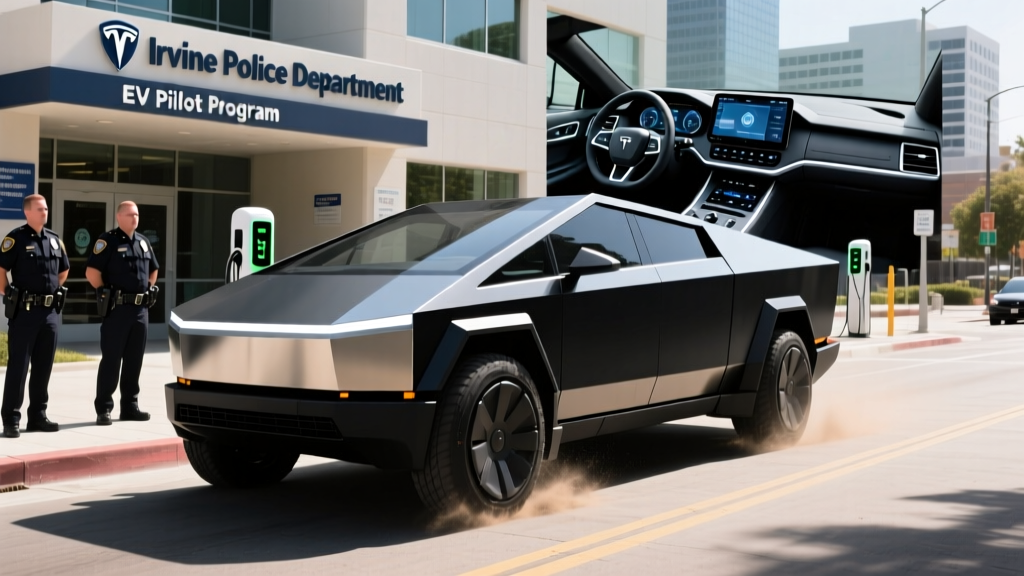
When the Irvine Police Department (IPD) in Orange County, California, began evaluating the Tesla Cybertruck for fleet duty, it sparked national headlines and polarized opinions. The Irvine Police Department Cybertruck pilot program represents one of the most high-profile experiments in electric-vehicle adoption by a U.S. law enforcement agency. But beyond the viral photos and social media debate, what does the Cybertruck actually offer as a patrol-adjacent vehicle — and what does its real-world performance mean for everyday EV buyers watching closely?
In this review, we break down the 2025/2026 Tesla Cybertruck's specs, range, charging behavior, pricing, and ownership economics with the rigor we apply to every EV we evaluate. Whether you're tracking the IPD experiment or simply considering a Cybertruck for your own garage, here's the data you need.
Why the Irvine Police Department Tested the Cybertruck
The Irvine Police Department serves a city of roughly 310,000 residents across 66 square miles of suburban Orange County. IPD's interest in the Cybertruck centered on several potential fleet advantages: the vehicle's stainless-steel exoskeleton (reducing body-repair costs), its electric powertrain (eliminating idle fuel burn during stakeouts and community events), and its onboard power capability for running equipment and lighting at scenes.
It's important to clarify what the program is and isn't. IPD has explored the Cybertruck primarily for community engagement, special events, and supplemental patrol support — not as a wholesale replacement for its existing fleet of pursuit-rated sedans and SUVs. Police departments require upfitting that the Cybertruck's unconventional geometry makes challenging: cage installations, prisoner transport partitions, light-bar mounting, and equipment rack compatibility all present hurdles that traditional fleet vehicles like the Ford Explorer Interceptor or Dodge Charger Pursuit handle natively.
For civilian buyers, the IPD's evaluation is useful because it stress-tests the Cybertruck in stop-and-go, high-idle, urban-duty cycles that mirror severe commuter use — exactly the kind of real-world data that supplements EPA estimates.
Cybertruck Range: EPA Estimates vs. Real-World Expectations
EPA estimated range: 340 miles (AWD dual-motor)
Real-world highway (70-75 mph, moderate climate): ~270-290 miles
Real-world cold weather (below 40°F, cabin heat): ~220-250 miles
Real-world urban stop-and-go (police/commuter duty cycle): ~290-310 miles
The Tesla Cybertruck AWD, which is the variant most relevant to fleet evaluation, carries an EPA-estimated 340 miles of range on its dual-motor configuration. The tri-motor Cyberbeast variant drops to roughly 320 miles EPA due to its performance-oriented tuning and added weight.
Real-world range tells a different story, as it does for every EV. The Cybertruck's angular stainless-steel body creates a drag coefficient significantly higher than a sedan like the Model S or even the Model Y. At sustained highway speeds of 70-75 mph, expect to lose roughly 15-20% from the EPA sticker. In cold weather, where battery chemistry becomes less efficient and cabin heating draws additional power, range can dip to 65-75% of the EPA figure — a pattern consistent across most NMC-based battery packs.
For police duty cycles characterized by low-speed patrol, extended idle periods, and regenerative braking opportunities in stop-and-go traffic, range actually performs closer to EPA estimates. Regenerative braking recaptures energy that internal-combustion patrol vehicles waste as heat, making EVs particularly efficient in urban environments. This is precisely why the Irvine Police Department Cybertruck evaluation has generated interest from other municipalities.
Battery Specs, Chemistry, and Efficiency
| Specification | AWD (Dual Motor) | Cyberbeast (Tri Motor) |
|---|---|---|
| Battery Capacity (usable) | ~123 kWh | ~123 kWh |
| Battery Chemistry | NMC (Nickel Manganese Cobalt) | NMC |
| EPA Range | 340 miles | 320 miles |
| MPGe (combined) | ~79 MPGe (est.) | ~74 MPGe (est.) |
| Energy Consumption | ~42 kWh/100 mi | ~45 kWh/100 mi |
| 0-60 mph | 4.1 seconds | 2.6 seconds |
| Horsepower | 600 hp | 845 hp |
| Drivetrain | Dual-motor AWD | Tri-motor AWD |
| Towing Capacity | 11,000 lbs | 11,000 lbs |
| Payload Capacity | 2,500 lbs | 2,500 lbs |
The Cybertruck uses a roughly 123 kWh usable NMC (nickel manganese cobalt) battery pack. Tesla has not published LFP (lithium iron phosphate) variants for the Cybertruck as of the current model year, which means the pack offers higher energy density but requires the typical NMC care regimen: daily charging to 80-90% with 100% reserved for trips, and avoidance of prolonged storage at full charge.
Efficiency is the Cybertruck's weakest metric relative to other Tesla products. At roughly 42 kWh per 100 miles (AWD), it consumes significantly more energy per mile than a Model Y (~28 kWh/100 mi) or Model 3 (~25 kWh/100 mi). The truck's 6,600+ pound curb weight and brick-like aerodynamics are the primary culprits. For fleet operators calculating fuel-cost savings, this higher consumption narrows the gap between electricity cost and gasoline — though electricity still wins in most markets.
For authoritative efficiency data, the EPA's fueleconomy.gov listings provide official MPGe and kWh/100mi figures once finalized for each model year.
Charging Speed: DC Fast Charging and Home Level 2
| Charging Level | Power (kW) | Speed (miles added/hr) | Notes |
|---|---|---|---|
| Level 1 (120V household) | ~1.4 kW | ~3-4 mi/hr | Emergency/trickle only |
| Level 2 (240V home, 48A) | 11.5 kW | ~29-33 mi/hr | Full overnight charge in ~11 hrs |
| Level 2 (240V, 80A Wall Connector) | 19.2 kW | ~48-52 mi/hr | Requires 100A circuit; ~7 hrs 0-100% |
| DC Fast Charge (V4 Supercharger) | Peak ~250 kW | ~130+ mi in 15 min | 10-80% in ~25-30 min |
The Cybertruck supports DC fast charging at up to approximately 250 kW on Tesla's V3 and V4 Supercharger network. In practice, the large 123 kWh pack means the 10-80% charging session takes roughly 25-30 minutes — longer than smaller-pack EVs like the Model 3 or Hyundai Ioniq 5, but competitive with other large-battery trucks like the Rivian R1T or Ford F-150 Lightning.
The charging curve matters more than peak kW. The Cybertruck sustains strong charge rates through the 20-60% state-of-charge window, then tapers progressively above 80%. This is standard NMC behavior — charging speed drops to protect battery health as cells approach full voltage. For police fleet operators, this means planning fast-charge sessions around the 10-80% sweet spot rather than topping to 100% on DC, which is both slower and harder on the pack long-term.
At home, the Cybertruck accepts up to 19.2 kW on Level 2 using Tesla's Gen 2 Wall Connector at 80 amps — but this requires a 100-amp dedicated circuit and a panel that can support it. Most homes with 200-amp service will need a panel evaluation from a licensed electrician before committing to this setup. A more common 48-amp installation (60A circuit) delivers 11.5 kW, adding roughly 30 miles per hour of charging — enough for most daily needs including patrol-style duty cycles that return to base nightly.
Pricing, Trims, and Federal Tax Credit Eligibility
| Trim | Base MSRP | §30D Federal Credit | Effective Price (est.) |
|---|---|---|---|
| AWD (Dual Motor) | $79,990 | $0 (MSRP cap exceeded) | $79,990 |
| Cyberbeast (Tri Motor) | $99,990 | $0 (MSRP cap exceeded) | $99,990 |
Here's where the Cybertruck hits a wall for most buyers — and for fleet procurement officers. Under current IRS §30D rules, the federal EV tax credit caps eligibility at an MSRP of $80,000 for trucks, vans, and SUVs. The Cybertruck AWD at $79,990 technically sits at the threshold, but destination fees and any dealer-installed options push the transaction price above the cap. The Cyberbeast at $99,990 is well beyond it. Additionally, buyer income caps ($300,000 joint / $150,000 single for new vehicles) and critical-mineral/battery-sourcing requirements further restrict eligibility.
For the Irvine Police Department and other government fleets, the §30D credit is largely irrelevant — municipalities are tax-exempt entities and do not benefit from income tax credits. However, the Commercial Clean Vehicle Credit (§45W) may apply to fleet purchases, offering up to $7,500 for vehicles under 14,000 lbs GVWR. Fleet buyers should consult IRS guidance and a tax professional for eligibility specifics.
Civilian buyers should verify current-year rules directly at IRS.gov's clean vehicle credit page, as battery-sourcing requirements have tightened progressively and exclude vehicles with certain foreign-sourced battery components.
Performance, Cargo, and Standout Technology
The Cybertruck AWD delivers a 4.1-second 0-60 mph time — brisk for a 6,600-pound truck and faster than most gas-powered midsize pickups in its class. The Cyberbeast's 2.6-second run is supercar territory, though its practical utility for police work or daily driving is marginal. Both variants feature adaptive air suspension with up to 16 inches of ground clearance in Off-Road mode and a self-leveling rear that compensates for payload.
Cargo capacity includes a 6.5-foot bed with a powered retractable tonneau cover (the "sail" architecture) and a front trunk (frunk) large enough for a standard carry-on. The bed offers 67 cubic feet of volume, though the angular wheel-well intrusions and sloped bed walls limit the practical rectangular footprint compared to a conventional F-150 or Silverado. Rear-seat legroom measures approximately 41 inches — adequate for two adults but tighter than a full-size crew cab.
Standout technology includes:
- Steer-by-wire: No mechanical connection between steering wheel and rack; enables variable ratio and rear-wheel steering for a tighter turning circle.
- 48-volt electrical architecture: Reduces wiring harness weight and enables higher-power accessories — relevant for police upfitting.
- Powershare (V2L/V2H): Up to 11.5 kW of bidirectional power export, enough to run scene lighting, power tools, or partially back up a home during outages.
- 18.5-inch front touchscreen + 9.4-inch rear screen: Tesla's latest infotainment with integrated navigation, Supercharger routing, and over-the-air updates.
- Autopilot / FSD (Supervised): SAE Level 2 driver-assist — requires active driver supervision at all times. This is not autonomous driving.
Notable drawbacks include the Cybertruck's polarizing angular design (love it or not, it draws attention — a potential liability for unmarked police work), its large turning radius despite rear-wheel steering, limited aftermarket upfitting options for law enforcement cages and partitions, and panel-gap consistency issues that Tesla has been progressively improving but that still surface on early-build vehicles.
Warranty and Long-Term Battery Outlook
Tesla provides a 4-year/50,000-mile basic limited warranty and an 8-year/120,000-mile battery and drive-unit warranty for the Cybertruck. The battery warranty guarantees retention of at least 70% of original capacity over the coverage period. For fleet operators running vehicles 20,000-30,000 miles annually, the powertrain warranty provides roughly 4-6 years of coverage before potential out-of-pocket risk.
NMC battery packs in Tesla vehicles have demonstrated degradation curves averaging roughly 10-15% capacity loss over the first 100,000 miles based on fleet and owner data aggregated by third-party analysts. The Cybertruck's large 123 kWh pack provides a buffer — even at 85% state of health, you're still working with roughly 104 usable kWh and an estimated 290 miles of range. For police departments planning 7-10 year vehicle lifecycles, battery replacement cost (estimated $15,000-$22,000 out of warranty) is a line item that must enter the total-cost-of-ownership calculation.
Who Should Consider the Cybertruck — and Who Shouldn't
- 11,000-lb towing and 2,500-lb payload — genuine truck capability
- Powershare V2L/V2H up to 11.5 kW — best-in-class power export
- Stainless-steel body eliminates paint repair costs and resists dents
- Strong real-world efficiency in urban/stop-and-go duty cycles
- Access to Tesla Supercharger network (17,000+ stalls in North America)
- Over-the-air updates continuously add features post-purchase
- $79,990+ MSRP — exceeds §30D credit cap for most buyers
- High energy consumption (~42 kWh/100 mi) raises charging costs vs. sedans
- Real-world highway range drops to ~270-290 mi — plan road trips carefully
- Limited upfitting/aftermarket ecosystem for fleet and commercial use
- Steer-by-wire learning curve and no mechanical backup steering feel
- Panel quality and build consistency improving but still uneven
The Cybertruck suits: Tech-forward truck buyers who need genuine towing/payload, want bidirectional power capability, have home Level 2 charging access, and value Supercharger network reliability for road trips. For fleet operators like the Irvine Police Department, it makes sense as a supplemental vehicle for community engagement, events, and urban patrol — not as a primary pursuit unit.
The Cybertruck does not suit: Budget-conscious buyers (the Rivian R1S or Ford F-150 Lightning offer lower entry points), those who need proven fleet upfitting infrastructure, buyers without reliable home charging, or anyone expecting the §30D tax credit to meaningfully offset the purchase price.
How the Cybertruck Compares to Key Competitors
Against the Ford F-150 Lightning (starting ~$55,000, EPA range up to 320 mi with extended-range battery), the Cybertruck offers more power, better power-export capability, and Supercharger access — but at a $25,000+ price premium and with no federal credit. The Lightning also has a far more mature fleet-upfitting ecosystem, making it the pragmatic police-fleet choice today.
Against the Rivian R1T (starting ~$69,900, EPA range up to 352 mi with Max Pack), the Cybertruck wins on towing (11,000 vs. 7,700 lbs) and V2L power, while the R1T offers a more refined interior, a quad-motor option, and better real-world build quality consistency. Both exceed the §30D MSRP cap in most configurations.
For the Irvine Police Department specifically, the Cybertruck serves as a visibility and engagement tool that sparks community conversation about electrification — a role it plays better than any alternative on the market. As a pure patrol vehicle, established platforms still hold the edge.
Frequently Asked Questions
What is the real-world range of the Cybertruck?
The EPA rates the Cybertruck AWD at 340 miles. In real-world highway driving at 70-75 mph, expect roughly 270-290 miles. In cold weather below 40°F, plan for 220-250 miles. Urban stop-and-go driving with regenerative braking can return 290-310 miles — relevant for police and commuter duty cycles.
How fast does the Cybertruck charge?
On a Tesla V3/V4 Supercharger, the Cybertruck peaks at approximately 250 kW DC, achieving a 10-80% charge in roughly 25-30 minutes. At home on a 48-amp Level 2 charger (11.5 kW), a full charge takes about 11 hours. An 80-amp Wall Connector (19.2 kW, requiring a 100A circuit) reduces this to approximately 7 hours.
Does the Cybertruck qualify for the federal EV tax credit?
Under current IRS §30D rules, the $7,500 credit for new clean vehicles requires the truck MSRP to be at or below $80,000. The Cybertruck AWD at $79,990 sits at the cap, but destination charges and options typically push it over. The Cyberbeast at $99,990 does not qualify. Income caps ($300K joint / $150K single) and battery-sourcing requirements further restrict eligibility. Verify current rules at IRS.gov.
Is the Irvine Police Department Cybertruck a real patrol vehicle?
IPD has explored the Cybertruck primarily for community engagement, special events, and supplemental patrol support. It is not a replacement for pursuit-rated vehicles. The unconventional body shape complicates traditional police upfitting (cages, partitions, light bars), making it better suited to visibility and outreach roles.
How much does the Cybertruck cost to charge vs. gas?
At the national average electricity rate of ~$0.16/kWh and the Cybertruck's ~42 kWh/100 mi consumption, fueling costs roughly $6.72 per 100 miles. A comparable gas truck at 18 MPG and $3.50/gallon costs about $19.44 per 100 miles — nearly 3x more. DC fast charging at $0.35-$0.48/kWh raises the EV cost to $14.70-$20.16 per 100 miles, narrowing the gap on road trips.
What is the Cybertruck's warranty coverage?
Tesla covers the Cybertruck with a 4-year/50,000-mile basic warranty and an 8-year/120,000-mile battery and drive-unit warranty, guaranteeing at least 70% capacity retention. Out-of-warranty battery replacement is estimated at $15,000-$22,000 based on current Tesla service pricing for large packs.
Is the Cybertruck worth buying vs. the F-150 Lightning or Rivian R1T?
Choose the Cybertruck if you prioritize Supercharger network access, class-leading V2L power export (11.5 kW), stainless-steel durability, and Tesla's software ecosystem. Choose the F-150 Lightning if you need a lower entry price, established fleet upfitting, and a conventional truck form factor. Choose the Rivian R1T if you want a more refined interior, quad-motor performance options, and stronger build-quality consistency — and can accept the lack of Supercharger access (though NACS adapter support is expanding).