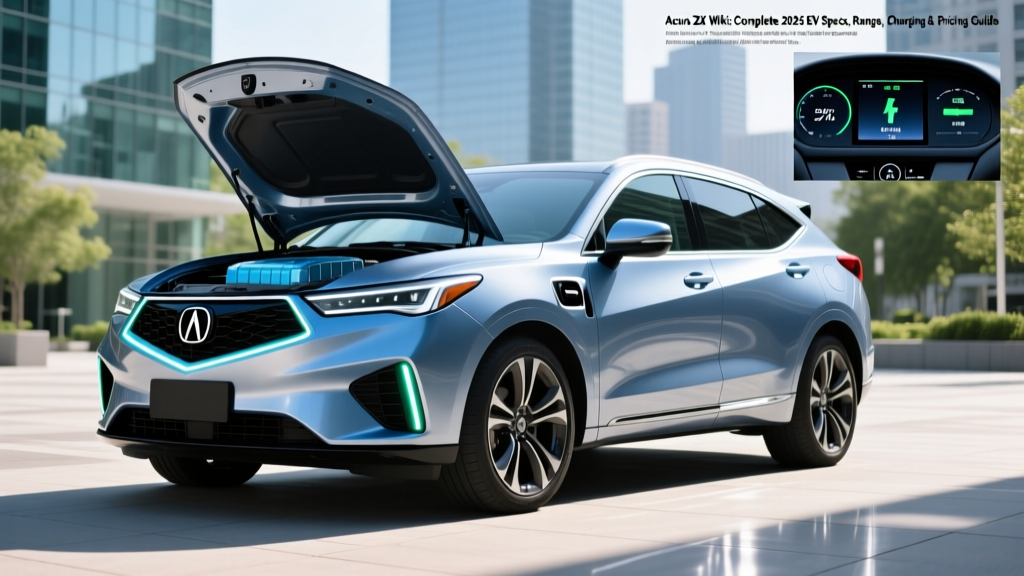
Searches for an Acura ZDX wiki spike every time a new model year drops, and for good reason: Acura's all-electric flagship sits at the intersection of luxury SUV practicality and GM's Ultium platform engineering. But official spec sheets only tell half the story. This guide compiles everything a prospective buyer or current owner needs — EPA range versus real-world expectations, DC fast-charging behavior, home charging setup, federal tax credit eligibility under current IRS §30D rules, and how the ZDX stacks up against the BMW iX, Genesis Electrified GV70, and Tesla Model X.
All specifications below reflect the 2026 model year as published by Acura and verified against fueleconomy.gov. Pricing and incentive data reflect rules in effect as of early 2026 and are subject to change — always confirm with your dealer and a tax professional before purchasing.
2026 Acura ZDX: Full Specification Table
| Specification | ZDX A-Spec (RWD) | ZDX A-Spec (AWD) | ZDX Type S |
|---|---|---|---|
| EPA Range | 313 mi | 304 mi | 278 mi |
| Battery (usable) | 102 kWh, NMC | 102 kWh, NMC | 102 kWh, NMC |
| Horsepower | 358 hp | 490 hp | 500 hp |
| 0-60 mph | ~6.0 sec | ~4.7 sec | ~4.5 sec |
| Drivetrain | Single-motor RWD | Dual-motor AWD | Dual-motor AWD (perf-tuned) |
| Max DC Fast Charge | 190 kW | 190 kW | 190 kW |
| 10-80% DC Time | ~42 min | ~42 min | ~42 min |
| Level 2 Home Rate | 11.5 kW (~31 mi/hr) | 11.5 kW (~31 mi/hr) | 11.5 kW (~31 mi/hr) |
| MPGe (combined) | 94 MPGe | 90 MPGe | 84 MPGe |
| Efficiency | 36 kWh/100 mi | 38 kWh/100 mi | 41 kWh/100 mi |
| Cargo (rear seats up) | 27.0 cu ft | 27.0 cu ft | 27.0 cu ft |
| Cargo (rear seats folded) | 56.0 cu ft | 56.0 cu ft | 56.0 cu ft |
| Rear Legroom | 38.4 in | 38.4 in | 38.4 in |
| Base MSRP | $64,500 | $67,500 | $74,500 |
| Battery/Powertrain Warranty | 8 yr / 100,000 mi | 8 yr / 100,000 mi | 8 yr / 100,000 mi |
Range Reality Check: EPA Sticker vs. What You'll Actually Get
EPA sticker: 313 mi (RWD A-Spec) / 304 mi (AWD A-Spec) / 278 mi (Type S)
Highway driving (70-75 mph, 75°F): Expect ~255-275 mi (RWD), ~245-265 mi (AWD). The ZDX's bluff-front SUV profile creates meaningful aero drag above 65 mph.
Cold weather (20-30°F, highway): Plan for ~200-230 mi. NMC chemistry loses 15-25% range in freezing temps without consistent preconditioning. The ZDX does include a battery heat pump, which mitigates this somewhat compared to vehicles without active thermal management.
City/commuter driving (moderate climate): You may exceed the EPA number — regenerative braking in stop-and-go traffic pushes real-world city range to 320-340 mi on the RWD model.
The 102 kWh usable NMC (nickel manganese cobalt) battery pack is shared with the Chevrolet Blazer EV and Cadillac Lyriq, all riding on GM's Ultium platform. NMC chemistry delivers higher energy density than LFP (lithium iron phosphate), enabling the ZDX's 313-mile range in a package that doesn't sacrifice interior volume. The trade-off: NMC cells degrade slightly faster over thousands of cycles than LFP, and they prefer not to sit at 100% state of charge for extended periods. Daily charging to 80-90% is the longevity sweet spot.
Acura's battery warranty covers capacity retention below 70% for 8 years or 100,000 miles, whichever comes first. Industry data from Recurrent Auto shows that most liquid-cooled NMC packs in this class retain 90-93% capacity after 100,000 miles, so the warranty threshold is conservative. Full battery replacement, should it ever be needed out of warranty, is estimated at $14,000-$18,000 based on current Ultium pack pricing.
Charging Speeds: DC Fast, Level 2, and the Charge Curve Truth
| Charging Level | Power | Speed | Use Case |
|---|---|---|---|
| Level 1 (120V household) | ~1.4 kW | ~4 mi/hr | Overnight trickle; emergency only |
| Level 2 (240V home) | 11.5 kW max | ~31 mi/hr (full in ~10 hr) | Daily home charging; wake up full every morning |
| DC Fast Charge (CCS) | 190 kW peak | 10-80% in ~42 min | Road trips; Electrify America, EVgo networks |
The ZDX's 190 kW peak DC fast-charge rate is where buyer expectations need recalibration. That peak number is achieved only between roughly 10-30% state of charge under ideal thermal conditions (battery preconditioned, ambient temps 65-85°F). Above 50% SoC, the charge curve tapers significantly — you'll see ~120 kW in the 50-70% range, and it drops below 60 kW past 80%. This is normal behavior for NMC packs with conservative charge management, but it means a 10-80% session genuinely takes the full ~42 minutes, not a "20-minute top-up" as some marketing implies.
One important connector note: the 2026 ZDX uses the CCS1 connector for DC fast charging and the J1772 inlet for Level 2. Acura has not yet transitioned to the NACS (Tesla) connector as of this model year. If you rely on Tesla Superchargers, you'll need a CCS-to-NACS adapter (sold separately, ~$200-$250) — and even then, Supercharger stalls cap CCS vehicles at ~150 kW, so you won't reach the ZDX's full 190 kW peak on Tesla's network.
For home charging, the onboard 11.5 kW charger is competitive. A full charge from 10% to 100% takes roughly 9-10 hours on a 48-amp Level 2 wall connector. Most owners will arrive home at 30-40% SoC and wake up at 80-90% — well within the battery health sweet spot. Installation of a 240V/48A Level 2 circuit typically runs $800-$2,000 depending on panel proximity and local permit fees; if your home's electrical panel needs a 200A upgrade, add $1,500-$3,000.
Performance and Drivetrain Breakdown
The A-Spec RWD model's 358 hp and ~6.0-second 0-60 time deliver confident highway merging and effortless city acceleration — adequate for a luxury cruiser, though not thrilling. Step up to the A-Spec AWD with its 490 hp dual-motor setup and the 0-60 drops to approximately 4.7 seconds, which feels properly quick in a 5,400-lb SUV.
The Type S pushes to 500 hp with a performance-tuned air suspension, Brembo brakes, and a sportier torque distribution map. Its 0-60 of ~4.5 seconds is only marginally quicker than the AWD A-Spec, but the Type S is about chassis dynamics, not straight-line bragging rights. Adaptive dampers and the lower, stiffer calibration make it genuinely engaging on canyon roads — rare for a two-row electric SUV.
All trims feature Acura's version of one-pedal driving with adjustable regenerative braking levels via steering-wheel paddles. Maximum regen is strong enough for most city driving without touching the friction brakes, though it won't bring the ZDX to a complete stop-and-hold like some competitors. Expect to use the brake pedal at stoplights.
Interior, Tech, and Daily Livability
The ZDX's cabin borrows heavily from the Honda Prologue (its platform sibling) but elevates with Acura-specific materials: open-pore wood, perforated Milano leather on Type S, and a 17.8-inch center touchscreen running a Google built-in infotainment system. Wireless Apple CarPlay and Android Auto are standard across all trims. The 11-inch digital driver display is clear and configurable, though not as graphically rich as BMW's iDrive or Mercedes MBUX.
Driver assistance comes via AcuraWatch 2.0, a comprehensive Level 2 (SAE) suite including adaptive cruise control with stop-and-go, lane centering, blind-spot monitoring, and rear cross-traffic braking. This is not a hands-free system — Acura does not currently offer anything equivalent to GM's Super Cruise or Ford's BlueCruise. You must keep your hands on the wheel. The system is competent for highway cruising but requires active driver engagement at all times.
AcuraWatch 2.0 is a SAE Level 2 driver-assistance system. It does not make the ZDX self-driving. The driver must remain fully attentive, hands on wheel, eyes on road. No Level 3 or Level 4 autonomy is available on any consumer Acura model.
Practical livability scores well. Rear legroom of 38.4 inches accommodates tall adults comfortably, and the flat floor (no transmission tunnel) makes the middle seat usable for short trips. Cargo space at 27.0 cu ft behind the second row is modest for a vehicle this size — the BMW iX offers 35.5 cu ft — but folding the 60/40 split rear seats opens up 56.0 cu ft, enough for a weekend's worth of gear for a family of four.
Notable drawbacks: there is no frunk (front trunk), as the Ultium platform's front subframe houses HVAC and power electronics. Towing capacity is rated at 1,500 lbs across all trims — sufficient for a small utility trailer or a couple of dirt bikes, but not a camper or boat. If you need serious towing, look to the Rivian R1S (7,700 lbs) or the Tesla Model X (5,000 lbs).
Pricing, Trim Levels, and Federal Tax Credit Eligibility
| Trim | Base MSRP | As-Tested (typical options) | §30D Credit Eligibility |
|---|---|---|---|
| ZDX A-Spec RWD | $64,500 | $67,000-$69,000 | Potentially eligible (see rules below) |
| ZDX A-Spec AWD | $67,500 | $70,000-$73,000 | Potentially eligible (see rules below) |
| ZDX Type S | $74,500 | $78,000-$82,000 | Exceeds MSRP cap — NOT eligible |
Federal tax credit eligibility for the Acura ZDX is nuanced and depends on several factors that change periodically. Under current IRS §30D rules:
- MSRP cap: SUVs must have a base MSRP at or below $80,000. The A-Spec trims clear this bar; the Type S at $74,500 base also qualifies on MSRP alone.
- Buyer income cap: Modified adjusted gross income (MAGI) must not exceed $150,000 (single), $225,000 (head of household), or $300,000 (joint filing).
- Battery sourcing requirements: The credit is split into two halves ($3,750 each) based on critical-mineral sourcing and battery-component manufacturing requirements. Because the ZDX is built on GM's Ultium platform with battery cells manufactured in the U.S. (Ultium Cells LLC, a GM-LG joint venture), it has historically qualified for the component half. Critical-mineral sourcing rules tighten annually — verify current-year compliance on fueleconomy.gov before purchasing.
- Point-of-sale transfer: As of 2024, buyers can transfer the credit to the dealer at purchase, reducing the out-of-pocket price immediately rather than waiting to claim it on their tax return. This requires the dealer to be registered with the IRS Energy Credits Online portal.
Bottom line: the A-Spec RWD at $64,500 is the credit-friendly sweet spot. If you qualify for the full $7,500, your effective price drops to ~$57,000 — genuinely competitive with a well-equipped BMW iX xDrive50 that starts over $87,000. The Type S, despite its $74,500 MSRP being under the $80,000 SUV cap, may lose one or both credit halves depending on the model year's specific sourcing compliance. Always confirm with your dealer's F&I department and cross-reference the VIN on fueleconomy.gov before signing.
Acura ZDX vs. Key Competitors
| Attribute | 2026 Acura ZDX AWD | 2026 BMW iX xDrive50 | 2026 Genesis Electrified GV70 | 2026 Tesla Model X LR |
|---|---|---|---|---|
| EPA Range | 304 mi | 324 mi | 236 mi | 335 mi |
| Base MSRP | $67,500 | $87,250 | $68,150 | $79,990 |
| Max DC Charge | 190 kW | 200 kW | 240 kW | 250 kW |
| 0-60 mph | 4.7 sec | 4.4 sec | 4.2 sec | 3.8 sec |
| Cargo (seats up) | 27.0 cu ft | 35.5 cu ft | 28.7 cu ft | 37.1 cu ft (+ frunk) |
| §30D Credit | Potential $7,500 | Potential $7,500 | Likely ineligible | Potential $7,500 |
The ZDX's strongest competitive argument is value. At $67,500 for a 304-mile AWD luxury SUV with a potential $7,500 credit, it undercuts the BMW iX by over $20,000 and the Model X by $12,000 (pre-credit). The Genesis Electrified GV70 is similarly priced but hobbled by its 236-mile range — a significant disadvantage for road trips.
Where the ZDX falls short: cargo volume is the smallest in this comparison, charging speed is slower than the Tesla and Genesis, and Acura's dealer network is less EV-experienced than Tesla's direct-sales model. If you prioritize charging speed above all else, the Model X at 250 kW is the benchmark. If interior space matters most, the iX wins on cargo by a wide margin.
Choose the Acura ZDX if: You want a luxury-badge AWD EV SUV under $70K (pre-credit), prioritize ride comfort over sporty handling, and do most of your charging at home. The A-Spec AWD at an effective ~$60K after credit is one of the best value propositions in the segment.
Look elsewhere if: You need maximum cargo space (BMW iX), fastest DC charging (Tesla Model X), hands-free highway driving (Cadillac Lyriq with Super Cruise), or a frunk for gear storage.
Pros, Cons, and Who Should Buy the ZDX
✅ Pros
- Strong value at $64,500-$67,500 MSRP with potential $7,500 federal credit
- 313-mile EPA range (RWD) is competitive in the luxury EV SUV class
- Comfortable, quiet ride with well-tuned suspension
- Large 17.8-inch Google built-in touchscreen with wireless CarPlay/AA
- U.S.-built battery supports domestic supply chain and credit eligibility
- 8-year/100,000-mile battery and powertrain warranty
- Heat pump for improved cold-weather efficiency
❌ Cons
- 190 kW peak DC charging is slower than key rivals (Tesla 250 kW, Genesis 240 kW)
- CCS1 connector requires adapter for Tesla Supercharger access
- No frunk — lost cargo opportunity
- 1,500-lb towing capacity is the lowest in its class
- No hands-free driving system (AcuraWatch 2.0 requires hands on wheel)
- Cargo space (27.0 cu ft) trails BMW iX and Tesla Model X
- Real-world highway range drops meaningfully below EPA estimate
Who the ZDX is best for: The Acura ZDX A-Spec AWD is ideal for luxury-minded commuters and small families who charge primarily at home, take road trips a few times per year (not weekly), and value a smooth, quiet ride over performance bragging rights. If your daily commute is under 60 miles round-trip and you have Level 2 access at home, the ZDX will serve you exceptionally well while keeping your effective purchase price in the high-$50K range after the federal credit.
Who should look elsewhere: Frequent long-distance travelers who need 250 kW+ charging speeds, families needing maximum cargo room, boat/camper owners who need serious towing, and tech-forward buyers who want hands-free highway driving should cross-shop the Tesla Model X, BMW iX, or Cadillac Lyriq respectively.
Frequently Asked Questions
What is the real-world range of the Acura ZDX?
The EPA rates the RWD A-Spec at 313 miles, AWD A-Spec at 304 miles, and Type S at 278 miles. In real-world highway driving at 70-75 mph in moderate temperatures, expect approximately 255-275 miles (RWD) and 245-265 miles (AWD). Cold weather (below 30°F) can reduce range by 15-25%, bringing highway range down to 200-230 miles. City driving with regenerative braking may exceed EPA estimates.
How fast does the Acura ZDX charge at home and on DC fast chargers?
On a Level 2 home charger (240V, 48A), the ZDX charges at up to 11.5 kW, adding roughly 31 miles of range per hour — a full charge takes about 10 hours. On DC fast chargers, it peaks at 190 kW, achieving a 10-80% charge in approximately 42 minutes. Peak rate is only sustained between roughly 10-30% SoC; the charge curve tapers significantly above 50%.
Does the Acura ZDX qualify for the $7,500 federal EV tax credit?
The A-Spec trims (MSRP $64,500-$67,500) are potentially eligible for up to $7,500 under IRS §30D, subject to buyer income limits ($150K single / $300K joint), battery critical-mineral sourcing compliance, and point-of-sale dealer registration. The Type S at $74,500 MSRP clears the $80,000 SUV cap but sourcing eligibility varies by production batch. Always verify your specific VIN on fueleconomy.gov and consult a tax professional before purchasing.
Is the Acura ZDX worth buying versus the BMW iX or Tesla Model X?
If value is your priority, yes. The ZDX AWD at ~$60,000 effective (after $7,500 credit) undercuts the BMW iX by $20,000+ and the Model X by $12,000+. You sacrifice some cargo space, ~20 miles of range, and 50-60 kW of peak charging speed — but gain a comfortable, well-built luxury SUV at a compelling price. If you need maximum range, fastest charging, or hands-free driving, the competitors justify their premiums.
Does the Acura ZDX use the Tesla (NACS) charging connector?
No. The 2026 ZDX uses the CCS1 connector for DC fast charging and J1772 for Level 2. To use Tesla Superchargers, you'll need a CCS-to-NACS adapter (~$200-$250). Note that Supercharger stalls typically cap CCS vehicles at ~150 kW, below the ZDX's 190 kW peak capability.
What is the battery warranty on the Acura ZDX?
Acura covers the high-voltage battery and electric powertrain for 8 years or 100,000 miles, whichever comes first. The warranty guarantees the battery will retain at least 70% of its original capacity during that period. Industry data suggests most liquid-cooled NMC packs retain 90%+ capacity at 100,000 miles under normal use.