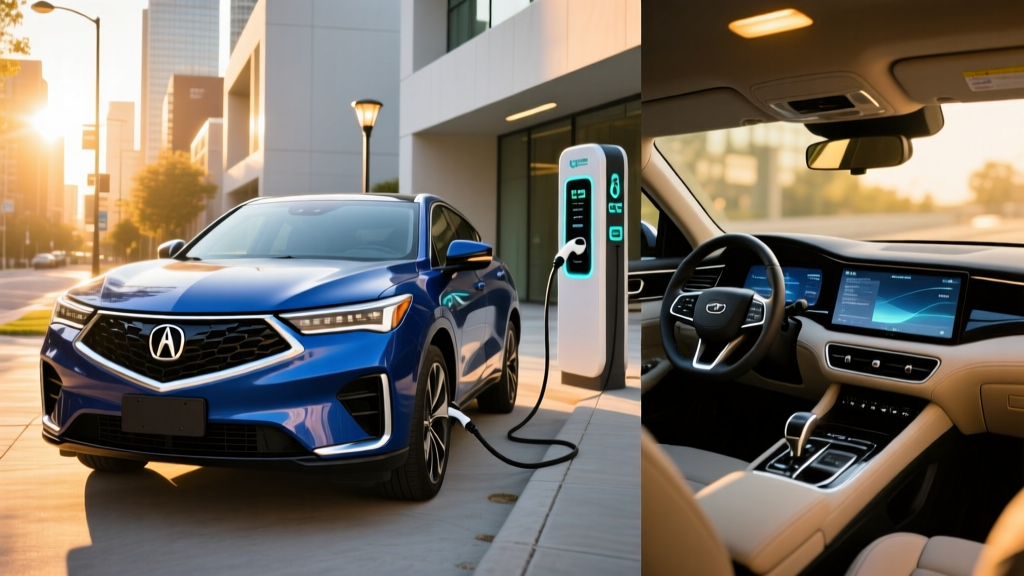
The 2025 Acura ZDX marks Honda's luxury division's first all-electric vehicle, built on General Motors' Ultium platform in Spring Hill, Tennessee. As a midsize luxury electric SUV competing against the BMW iX, Audi Q8 e-tron, and Tesla Model X, the ZDX brings Acura's design language and dealership network to the EV space — but does the execution match the badge? We break down every spec that matters to buyers.
Range and Efficiency: EPA Numbers vs. Real-World Driving
EPA Estimated Range: 313 miles (A-Spec RWD) / 304 miles (A-Spec AWD) / 278 miles (Type S)
Real-World Expectation: Plan for 240–270 miles in mixed highway driving at 70+ mph. Cold-weather operation (below 32°F) can reduce range by 20–30%, dropping effective range to 200–220 miles for AWD trims. City driving with regenerative braking recovers closer to the EPA sticker.
The ZDX's efficiency varies significantly by trim. The single-motor A-Spec RWD achieves 89 MPGe combined (38 kWh/100mi), while the dual-motor A-Spec AWD drops to 84 MPGe (40 kWh/100mi). The performance-oriented Type S falls further to 77 MPGe (44 kWh/100mi) due to its higher output and stickier tires.
These figures place the ZDX in the middle of the luxury EV SUV pack — slightly behind the BMW iX xDrive50's 87 MPGe combined but competitive with the Audi Q8 e-tron's 83 MPGe. According to fueleconomy.gov, the RWD model's efficiency is respectable for a vehicle weighing over 5,800 pounds.
Battery, Platform, and Chemistry
The 2025 ZDX uses GM's Ultium battery platform with a 102 kWh usable capacity (112 kWh gross). The battery employs NMC (nickel manganese cobalt) chemistry, which prioritizes energy density over the cycle-life longevity of LFP cells. This is typical for premium EVs targeting 300+ mile range.
The pack sits low in the chassis, contributing to a 50/50 weight distribution (RWD) and a relatively low center of gravity for an SUV of this size. Thermal management is active liquid cooling, which helps sustain charging speeds and mitigate degradation during repeated DC fast charging.
Charging Speed: DC Fast Charge and Home Level 2
| Charging Level | Power / Rate | Time / Recovery |
|---|---|---|
| DC Fast Charge (Peak) | 190 kW | 10–80% in ~35 minutes |
| DC Fast Charge (Sustained Avg) | ~120–140 kW | Charge curve tapers above 60% SoC |
| Level 2 Home (240V, 48A) | 11.5 kW | ~30 miles of range per hour; 0–100% in ~9.5 hours |
| Level 1 (120V) | 1.4 kW | ~4 miles per hour — emergency/top-up only |
The ZDX's 190 kW peak DC fast-charge rate is adequate but not class-leading. Competitors like the Hyundai Ioniq 5 and Kia EV6 can peak at 240+ kW on 800V architectures, achieving 10–80% in roughly 18 minutes. The ZDX's 35-minute 10–80% time means slightly longer road-trip stops, though still manageable with typical rest-area breaks.
One important caveat: peak kW is not sustained kW. Expect the ZDX to hold close to 190 kW only between roughly 10–40% state of charge, after which the charge curve tapers progressively. Above 80%, charging slows dramatically to protect battery health — a universal EV behavior, but one that surprises first-time EV owners who attempt to charge to 100% at a public station.
For home charging, the 11.5 kW Level 2 rate is strong. With a professionally installed 48-amp Level 2 charger on a 60-amp circuit, overnight replenishment is effortless for all but the longest daily commutes.
Performance: 0–60, Horsepower, and Drivetrain
| Trim | Drivetrain | Horsepower | Torque (lb-ft) | 0–60 mph |
|---|---|---|---|---|
| A-Spec (RWD) | Rear-Wheel Drive | 340 hp | 325 | ~6.4 sec |
| A-Spec (AWD) | Dual-Motor AWD | 490 hp | 425 | ~5.0 sec |
| Type S (AWD) | Dual-Motor AWD | 500 hp | 542 | ~4.5 sec |
The base single-motor RWD model delivers adequate acceleration for daily driving but won't thrill enthusiasts. The dual-motor AWD A-Spec is the sweet spot — 490 hp provides genuinely quick off-the-line performance and confident highway merging. The Type S adds marginal horsepower but substantially more torque, along with adaptive dampers, larger Brembo brakes, and a sport-tuned air suspension.
Towing capacity is rated at 3,500 pounds across all trims when properly equipped — sufficient for a small boat or utility trailer but well below the Ford F-150 Lightning's 10,000-pound capability.
Pricing, Trims, and Federal Tax Credit Eligibility
| Trim | Base MSRP | Est. As-Tested | §30D Credit Eligibility |
|---|---|---|---|
| A-Spec RWD | $65,850 | $68,000–$70,000 | Eligible up to $7,500 (subject to buyer income & sourcing rules) |
| A-Spec AWD | $69,850 | $73,000–$76,000 | Eligible up to $7,500 |
| Type S | $74,850 | $78,000–$82,000 | Eligible up to $7,500 |
The ZDX qualifies for the IRS §30D federal EV tax credit because its MSRP falls under the $80,000 SUV cap and it is assembled in North America (Tennessee). However, eligibility is not automatic. Per IRS guidelines, buyers must meet:
- Income caps: Modified AGI ≤ $300,000 (joint filers), ≤ $225,000 (head of household), ≤ $150,000 (single)
- MSRP cap: Vehicle MSRP must not exceed $80,000 for SUVs (all ZDX trims comply at base, but heavily optioned Type S could approach the limit)
- Battery sourcing: Critical minerals and battery components must meet phased-in percentage thresholds from US/free-trade-agreement countries — GM has worked to comply, but buyers should verify current-year requirements with their dealer and a tax professional
- Point-of-sale transfer: As of 2024+, eligible buyers can transfer the credit to the dealer for an immediate price reduction at purchase rather than claiming it at tax time
With the full $7,500 credit, the A-Spec RWD effectively starts near $58,350 — a meaningful reduction that makes the ZDX competitive with similarly equipped rivals.
Interior, Cargo, and Technology
The ZDX seats five across two rows with generous dimensions:
- Front legroom: 42.5 inches
- Rear legroom: 38.8 inches
- Cargo behind rear seats: 28.4 cu ft
- Cargo with rear seats folded: 62.3 cu ft
- Front trunk (frunk): Not available — the Ultium platform packaging does not include a frunk in the ZDX
The cabin features an 11.3-inch touchscreen running a Google Built-In infotainment system, wireless Apple CarPlay and Android Auto, and an 11-inch digital instrument cluster. The Type S adds a 14-speaker Bang & Olufsen audio system.
Acura's AcuraWatch suite of driver assists includes adaptive cruise control with stop-and-go, lane-keeping assist, blind-spot monitoring, and rear cross-traffic alert. This is SAE Level 2 driver assistance — the driver must remain fully engaged with hands on the wheel and eyes on the road at all times. It is not autonomous or "self-driving" in any capacity.
Warranty Coverage
| Coverage | Term |
|---|---|
| New Vehicle Limited | 4 years / 50,000 miles |
| Powertrain | 6 years / 70,000 miles |
| Battery Pack | 8 years / 100,000 miles (capacity retention warranty — typically ≥70% SoH) |
| Corrosion Perforation | 5 years / unlimited miles |
The 8-year/100,000-mile battery warranty is industry-standard and federally mandated for EVs. The capacity retention threshold (commonly 70% state of health) means Acura will repair or replace the pack if it degrades below that level within the warranty period. Based on NMC degradation data from similar Ultium-based vehicles, most owners will see 5–10% capacity loss over the first 100,000 miles under normal use.
Pros and Cons
Pros
- Competitive 313-mile EPA range (RWD)
- Strong dual-motor AWD performance (490 hp)
- Qualifies for up to $7,500 federal tax credit
- Google Built-In infotainment with native navigation
- Acura dealership service network for maintenance
- Spacious rear seat and cargo area
Cons
- No front trunk (frunk) — lost storage opportunity
- DC fast charging peaks at 190 kW — slower than 800V rivals
- Type S range drops to 278 miles
- Pricing starts high; well-optioned models approach $80K MSRP cap
- First-generation EV — limited long-term reliability data
- No hands-free Level 2+ highway driving system at launch
Who Should Buy the 2025 Acura ZDX?
Choose the ZDX A-Spec RWD if: You prioritize maximum range, have a mostly flat commute, and want the lowest entry price with tax credit eligibility.
Choose the ZDX A-Spec AWD if: You need all-weather traction, want quick acceleration, and can accept a ~10-mile range trade-off.
Choose the ZDX Type S if: You value adaptive suspension, Brembo brakes, and sport tuning over range and efficiency — and your budget allows it.
Look elsewhere if: You need the fastest possible DC charging for frequent road trips (consider Ioniq 5 or EV6), you require three rows of seating, or you want a frunk for gear storage.
FAQ: 2025 Acura ZDX
What is the real-world range of the 2025 Acura ZDX?
EPA estimates are 313 miles (RWD), 304 miles (AWD), and 278 miles (Type S). In real-world highway driving at 70–80 mph, expect 240–270 miles. Cold weather (below freezing) can reduce range by 20–30%.
How fast does the ZDX charge at home and on the road?
DC fast charging peaks at 190 kW, achieving 10–80% in approximately 35 minutes. Home Level 2 charging at 11.5 kW adds about 30 miles per hour, fully replenishing the battery overnight in ~9.5 hours.
Does the 2025 Acura ZDX qualify for the $7,500 federal tax credit?
Yes, the ZDX is eligible for up to $7,500 under IRS §30D, provided the buyer meets income caps ($300K joint / $150K single), the vehicle MSRP stays under $80,000, and battery sourcing requirements are met. The credit can be transferred to the dealer at point of sale for an immediate price reduction. Consult a tax professional for your specific situation.
Is the Acura ZDX worth buying vs. the BMW iX or Tesla Model X?
The ZDX offers competitive range and pricing, especially after the tax credit. The BMW iX is more refined with slightly better efficiency; the Tesla Model X offers falcon-wing doors, Supercharger access, and more cargo space but at a higher price. The ZDX's advantage is Acura's dealer network and a more traditional luxury-crossover experience.
What is the battery warranty on the ZDX?
Acura covers the battery pack for 8 years or 100,000 miles, guaranteeing a minimum capacity retention (typically 70% state of health). The new-vehicle warranty is 4 years/50,000 miles and powertrain is 6 years/70,000 miles.
Does the ZDX have a frunk?
No. The Ultium platform packaging in the ZDX does not include a front trunk. All cargo space is in the rear (28.4 cu ft behind the second row, 62.3 cu ft with seats folded).
Can the ZDX tow?
Yes, the ZDX is rated to tow up to 3,500 pounds when properly equipped — suitable for a small trailer, jet skis, or a lightweight camper.