The 2024 Acura ZDX marks Honda's luxury division's first all-electric vehicle, built on GM's Ultium platform shared with the Cadillac Lyriq. While the exterior turns heads with its sloped roofline and illuminated grille, buyers are searching for details on the Acura ZDX 2024 interior — and whether this electric SUV delivers on the premium promise. After examining the specs, charging behavior, and cabin details, here's what you need to know before putting down a deposit.
Quick Verdict: Premium Cabin With Ultium Underpinnings
The ZDX positions itself as a luxury midsize electric crossover targeting buyers who want Cadillac Lyriq mechanics wrapped in a more driver-focused, sporty package. The Acura ZDX 2024 interior leans heavily on Google Built-In infotainment, a massive 11.3-inch touchscreen, and available Bang & Olufsen audio. But the real story is what's underneath: a 102 kWh Ultium battery delivering up to 313 miles of EPA range and available dual-motor AWD with up to 500 horsepower in the Type S variant.
| Spec | ZDX A-Spec (RWD) | ZDX Type S (AWD) |
|---|---|---|
| EPA Range | 313 miles | 278 miles |
| Battery (usable) | 102 kWh (NMC) | 102 kWh (NMC) |
| Horsepower | 340 hp | 500 hp |
| 0-60 mph | ~6.0 sec | ~4.5 sec |
| Drivetrain | Rear-Wheel Drive | Dual-Motor AWD |
| Max DC Charge Rate | 190 kW | 190 kW |
| 10-80% DC Time | ~42 min | ~42 min |
| Level 2 Home Rate | 11.5 kW (~28 mi/hr) | 11.5 kW (~28 mi/hr) |
| MPGe (combined) | 94 MPGe | 84 MPGe |
| Cargo (rear seats up) | 28.4 cu ft | 28.4 cu ft |
| Cargo (seats folded) | 58.7 cu ft | 58.7 cu ft |
| Base MSRP | $65,850 | $74,850 |
Acura ZDX 2024 Interior: Materials, Tech, and Space
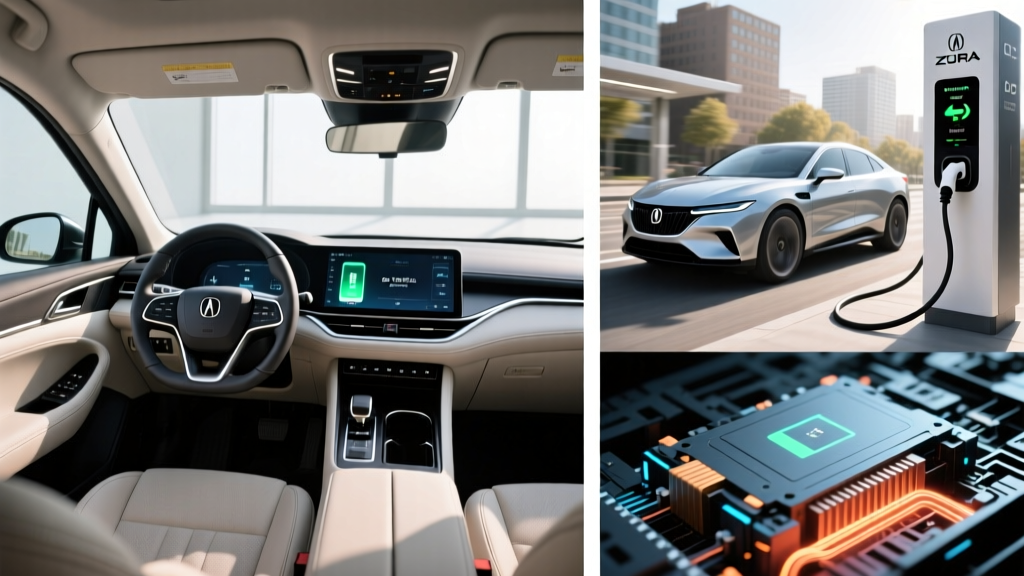
The Acura ZDX 2024 interior represents a clean break from Acura's previous design language, owing to the Ultium platform's skateboard architecture. The cabin features a wide, horizontal dashboard dominated by an 11.3-inch infotainment touchscreen running Google Built-In — meaning Google Maps, Google Assistant, and Play Store apps are native to the car. A 10.2-inch digital instrument cluster sits behind the steering wheel.
Materials on the A-Spec trim include leatherette upholstery with contrast stitching, heated and ventilated front seats, and a panoramic glass roof that floods the cabin with light. Step up to the Type S and you get Milano leather with microsuede inserts, a 16-speaker Bang & Olufsen sound system, and a head-up display. Ambient lighting with 27 color options runs across the dash and door panels.
Front legroom measures 42.4 inches, with rear legroom at 36.7 inches — adequate for adults but tighter than the Cadillac Lyriq's 39.6-inch rear. The sloping roofline cuts into rear headroom for taller passengers. Cargo volume behind the second row is 28.4 cubic feet, expanding to 58.7 cu ft with seats folded. Notably, there is no front trunk (frunk), which is a missed opportunity for the segment.
Notable Interior Drawbacks
- No frunk — the Ultium platform in this configuration doesn't offer front cargo storage
- Touch-capacitive climate controls on the center stack lack physical buttons, which some drivers find frustrating while driving
- Rear visibility is compromised by the aggressive roofline taper and thick C-pillars
- Rear legroom is tighter than key rivals like the Lyriq and BMW iX
Range and Efficiency: EPA vs. Real-World Expectations
The rear-wheel-drive A-Spec earns an EPA-estimated 313 miles of range, while the dual-motor Type S drops to 278 miles. Efficiency for the RWD model is rated at 94 MPGe combined (roughly 36 kWh/100 mi), with the AWD Type S at 84 MPGe.
Real-World Range Expectations
EPA sticker: 313 miles (A-Spec RWD) / 278 miles (Type S AWD)
Highway driving (70-75 mph): Expect ~250-270 miles for the A-Spec and ~225-240 miles for the Type S. The ZDX's bluff-front SUV shape creates more aerodynamic drag at speed than a sedan.
Cold weather (below 32°F): Plan for 20-30% range reduction, bringing the A-Spec to roughly 220-250 miles. The ZDX uses a heat pump for cabin heating, which helps mitigate losses compared to resistive heating systems.
City/commute driving: EPA numbers are most achievable in mixed suburban driving with regenerative braking. You may see 300+ miles in mild-weather city use.
The 102 kWh usable battery uses GM's Ultium NMC (nickel-manganese-cobalt) pouch cells arranged in a flat pack under the floor. NMC chemistry offers strong energy density but requires more careful state-of-charge management than LFP (lithium iron phosphate) — Acura recommends daily charging to 80-90% and reserving 100% for road trips.
Charging Speed: DC Fast Charging and Home Level 2
Charging performance is where the ZDX's GM DNA shows. The SUV supports a peak DC fast-charge rate of 190 kW on compatible CCS stations. In practice, the charge curve peaks near 190 kW at low states of charge (10-30% SoC) and tapers progressively — expect 10-80% in approximately 42 minutes under optimal conditions (battery preconditioned, warm ambient temperature).
Above 80% SoC, charging slows dramatically to protect the NMC battery. An 80-100% top-off can add another 30+ minutes, which is typical for this chemistry. Always plan fast-charging stops to 80% unless you specifically need the full battery.
| Charging Level | Power | Speed (approx.) | Use Case |
|---|---|---|---|
| Level 1 (120V) | 1.4 kW | ~3-4 miles/hour | Emergency/overnight trickle |
| Level 2 (240V, 48A) | 11.5 kW | ~28 miles/hour | Home/work daily charging |
| DC Fast (CCS) | Up to 190 kW | ~170 miles in 30 min (peak) | Road trips, quick top-ups |
For home Level 2 charging, the onboard charger accepts up to 11.5 kW (48 amps on a 60-amp circuit). A full 0-100% charge takes roughly 9.5 hours, making overnight charging practical. Home installation of a Level 2 charger (like a ChargePoint Home Flex or Emporia V2) typically costs $800-$2,500 depending on your electrical panel capacity and run length. A 200-amp panel is usually sufficient, but older homes may need a $1,500-$3,000 panel upgrade — consult a licensed electrician for your specific situation.
The ZDX uses the CCS1 connector for DC fast charging. With the industry shifting toward NACS (Tesla's connector), Acura has confirmed that future models will adopt NACS, and adapters will be available for current owners to access Tesla Supercharger stations.
Performance: 340 to 500 Horsepower on Tap
The base A-Spec RWD sends 340 horsepower to the rear wheels via a single motor, delivering a 0-60 mph time of approximately 6.0 seconds. That's quick for daily driving but not thrilling for the price point. The dual-motor Type S transforms the character entirely: 500 horsepower, torque-vectoring AWD, and a 0-60 time around 4.5 seconds.
The Type S also adds a sport-tuned air suspension, larger Brembo brakes, and a more aggressive steering calibration. Ride quality in the A-Spec is compliant and quiet — the Ultium platform's low center of gravity keeps body roll in check. Road noise isolation is strong, aided by acoustic laminated glass on the front windows.
One-pedal driving is available through the regen paddle selectors on the steering wheel, allowing you to modulate regeneration intensity from light coasting to near-full one-pedal operation. It's not as aggressive as Tesla's or Nissan's one-pedal mode, but it works well for city driving.
Pricing, Trims, and Federal Tax Credit Eligibility
The 2024 ZDX is offered in three main configurations:
- ZDX A-Spec (RWD): $65,850 MSRP (plus $1,195 destination) — 313 miles range
- ZDX A-Spec (AWD): $69,850 MSRP — 304 miles range
- ZDX Type S (AWD): $74,850 MSRP — 278 miles range
A fully loaded Type S with the Technology Package and premium paint approaches $80,000 out the door.
Federal EV Tax Credit (§30D) — Key Rules
| Requirement | 2024 Rule | ZDX Status |
|---|---|---|
| MSRP Cap (SUVs) | ≤ $80,000 | ✅ All trims qualify |
| Buyer Income Cap (joint) | ≤ $300,000 AGI | Varies by buyer |
| Buyer Income Cap (individual) | ≤ $150,000 AGI | Varies by buyer |
| Battery Component Sourcing | Phase-in % from N. America | Check current IRS list |
| Critical Minerals Sourcing | Phase-in % from FTA partners | Check current IRS list |
| Point-of-Sale Transfer | Available (dealer reduces price) | ✅ Eligible |
The ZDX's MSRP falls under the $80,000 SUV cap, making it potentially eligible for up to $7,500 in federal tax credits. However, the actual credit amount depends on battery-component and critical-minerals sourcing requirements that the IRS updates regularly. Some Ultium-platform vehicles have qualified for the full $7,500, while others received $3,750 depending on the production batch and sourcing timeline.
As of the current tax year, the credit can be transferred at the point of sale — meaning the dealer reduces your purchase price by the credit amount rather than you waiting to claim it on your tax return. Check the latest eligibility on IRS.gov's qualified vehicles list before purchasing, as sourcing rules change quarterly.
Warranty Coverage and Battery Longevity
Acura backs the ZDX with a competitive warranty package:
- Battery/Drive Unit: 8 years / 100,000 miles (whichever comes first)
- New Vehicle Limited: 4 years / 50,000 miles
- Powertrain: 6 years / 70,000 miles
- Roadside Assistance: 6 years / 70,000 miles
The battery warranty guarantees the pack will retain at least 60% of its original capacity during the coverage period. In practice, GM's Ultium NMC packs have shown modest degradation in early Lyriq data — roughly 5-8% loss over the first 50,000 miles, with the curve flattening afterward. Following best practices (avoiding prolonged 100% SoC, using DC fast charging sparingly, preconditioning before charging) should help the battery retain 85-90% capacity at 100,000 miles.
If out-of-warranty replacement is ever needed, Ultium battery packs are estimated at $15,000-$22,000 for parts and labor, though prices are expected to decline as the platform scales. Individual module replacement (rather than the full pack) may also be possible, reducing costs.
Driver Assistance and Safety Tech
Every ZDX comes with Acura's AcuraWatch suite, which includes:
- Adaptive cruise control with stop-and-go
- Lane keeping assist with lane centering
- Blind spot monitoring with rear cross-traffic alert
- Automatic emergency braking with pedestrian detection
- Traffic sign recognition
The Type S with the Technology Package adds a more advanced system with lane-change assist and a 360-degree camera. It's important to note this is a SAE Level 2 driver-assist system — you must keep your hands on the wheel and eyes on the road at all times. This is not autonomous driving.
The ZDX has not yet been crash-tested by the NHTSA or IIHS at the time of this review, but the Ultium platform's rigid battery enclosure and low center of gravity typically perform well in crash testing, as seen in the Lyriq's IIHS Top Safety Pick award.
How the ZDX Stacks Up Against Competitors
The ZDX competes in the luxury electric midsize SUV segment against familiar names:
- Cadillac Lyriq: Shares the Ultium platform, offers more rear legroom and a frunk option, starts ~$5,000 less, but lacks Acura's sporty tuning
- BMW iX: More refined ride and faster charging (up to 200 kW), but starts significantly higher (~$87,000)
- Tesla Model X: Faster, more Supercharger access, but aging interior and polarizing design
- Genesis Electrified GV70: More luxurious cabin, but only 236 miles of range and slower DC charging
- Mercedes EQE SUV: Excellent ride quality, but lower range (279 mi) and a much higher starting price
Pros
- 313-mile EPA range (RWD) is competitive for the class
- Google Built-In infotainment is fast and intuitive
- Type S offers genuine performance with 500 hp
- Heat pump standard for better cold-weather efficiency
- MSRP under $80K cap enables potential tax credit
- Quiet, well-isolated cabin at highway speeds
Cons
- No frunk reduces total cargo utility
- Rear legroom and headroom tighter than Lyriq
- 190 kW peak DC rate is mid-pack, not class-leading
- Touch-capacitive climate controls lack tactile feedback
- A-Spec RWD at $65,850 is priced above Lyriq equivalent
- CCS connector; NACS adapter needed for Supercharger access
Who the 2024 Acura ZDX Is For
Choose the ZDX A-Spec RWD if: You commute 30-60 miles daily, want maximum range, prefer a quiet luxury cabin, and can charge at home overnight. The 313-mile range and 94 MPGe make it an efficient daily driver.
Choose the ZDX Type S AWD if: You want performance-SUV acceleration, need all-weather traction, and don't mind sacrificing 35 miles of range for 500 hp and air suspension.
Look elsewhere if: You need maximum rear-seat space (check the Lyriq or BMW iX), want access to the Tesla Supercharger network without adapters (consider a Tesla or upcoming NACS-native models), or need a frunk for gear storage.
For road trippers, the 190 kW DC fast-charge rate means roughly 30-40 minute stops every 200-240 highway miles. That's acceptable but slower than Hyundai/Kia's 800V architecture (which charges at 240+ kW). Plan accordingly on longer routes and use the Google Maps EV routing feature, which factors in charging stops and battery preconditioning.
Frequently Asked Questions
What is the real-world range of the 2024 Acura ZDX?
The EPA rates the RWD A-Spec at 313 miles and the Type S AWD at 278 miles. In real-world highway driving at 70-75 mph, expect roughly 250-270 miles from the A-Spec and 225-240 miles from the Type S. Cold weather below freezing can reduce range by 20-30%. City driving with regenerative braking gets you closest to the EPA sticker.
How fast does the ZDX charge at home and on the road?
At home on a Level 2 (240V, 48A) charger, the ZDX accepts up to 11.5 kW, adding roughly 28 miles per hour — a full charge takes about 9.5 hours. On a DC fast charger, it peaks at 190 kW, reaching 10-80% in approximately 42 minutes under ideal conditions. Charging slows significantly above 80%.
Does the 2024 Acura ZDX qualify for the federal EV tax credit?
The ZDX's MSRP is below the $80,000 SUV cap, making it potentially eligible for up to $7,500 under IRS §30D. However, your eligibility depends on adjusted gross income limits ($150K individual / $300K joint) and the battery's critical-mineral and component sourcing, which the IRS updates periodically. The credit can be transferred at the point of sale. Verify current eligibility at IRS.gov.
Is the Acura ZDX worth buying over the Cadillac Lyriq?
If you value sportier driving dynamics, Google Built-In infotainment, and Acura's design language, the ZDX justifies its premium. If rear-seat space, a lower starting price, and a more comfort-oriented ride matter more, the Lyriq is a strong alternative. Both share the same 102 kWh Ultium battery and similar charging speeds.
What are the biggest pros and cons of the ZDX?
Top pros: strong 313-mile range (RWD), intuitive Google-based infotainment, Type S performance, heat pump for cold weather, and tax-credit-eligible pricing. Top cons: no frunk, tight rear seat, mid-pack 190 kW charging, touch-sensitive climate controls, and CCS connector requiring an adapter for Tesla Superchargers.
Does the ZDX have a front trunk (frunk)?
No. The 2024 ZDX does not offer a front trunk. All cargo storage is in the rear, with 28.4 cubic feet behind the second row and 58.7 cubic feet with the seats folded. This is a notable omission compared to rivals like the Ford Mustang Mach-E and Rivian R1S.
What battery chemistry does the ZDX use?
The ZDX uses GM's Ultium NMC (nickel-manganese-cobalt) pouch cells in a 102 kWh usable pack. NMC offers higher energy density than LFP (lithium iron phosphate) but benefits from daily charging limits of 80-90% to maximize longevity. The battery is warranted for 8 years / 100,000 miles with a 60% capacity retention floor.