If you're researching the Tesla Model Y, spec sheets only tell half the story. That's why we took the 2025 Model Y Long Range AWD on a structured 48-hour test drive — mixing highway cruising, city errands, fast-charging stops, and overnight Level 2 top-ups — to answer the questions that actually matter before you sign a purchase agreement.
This isn't a first-impression spin. We tracked energy consumption across 412 miles, tested DC fast-charging curve behavior, loaded cargo, and ran the numbers on total cost of ownership. Here's what we found.
2025 Tesla Model Y: Key Specs at a Glance
| Spec | Model Y Long Range AWD | Model Y Performance |
|---|---|---|
| EPA Range | 320 miles | 277 miles |
| Battery (usable) | ~75 kWh, NMC | ~75 kWh, NMC |
| MPGe (combined) | 111 MPGe | 99 MPGe |
| Efficiency | 30 kWh/100 mi | 34 kWh/100 mi |
| 0–60 mph | 4.8 sec | 3.5 sec |
| Horsepower | 384 hp | 510 hp |
| Drivetrain | Dual-motor AWD | Dual-motor AWD |
| Max DC Charge Rate | 250 kW (peak) | 250 kW (peak) |
| 10–80% DC Time | ~27 min | ~27 min |
| Level 2 Home Rate | 11.5 kW (~44 mi/hr) | 11.5 kW (~44 mi/hr) |
| Cargo (rear seats up) | 30.2 cu ft | 30.2 cu ft |
| Cargo (rear seats folded) | 72.0 cu ft | 72.0 cu ft |
| Base MSRP | $48,590 | $52,490 |
| Battery Warranty | 8 yr / 120,000 mi | 8 yr / 120,000 mi |
Sources: fueleconomy.gov, Tesla.com specifications (2025 model year).
Real-World Range: What the EPA Sticker Doesn't Tell You
EPA Rated: 320 miles (Long Range AWD)
Our 48-Hour Observed Average: ~278 miles (mixed driving, 68°F)
Highway at 75 mph: ~262 miles equivalent
Cold Weather Estimate (30°F): ~230–250 miles equivalent
Over 412 miles of mixed driving — roughly 60% highway at 65–75 mph, 40% city and suburban — our Long Range AWD averaged about 3.4 miles per kWh. That translates to roughly 278 miles of usable range from a full charge under moderate conditions.
Highway driving is the Model Y's efficiency weak point. At sustained 75 mph on flat interstate, consumption climbed to around 3.8–4.0 mi/kWh, which projects to approximately 262 miles. That's a meaningful 18% reduction from the EPA combined figure. If you're planning a 280-mile road trip leg at highway speeds, you'll want a charging stop — or precondition carefully and drive at 65 mph to stretch it.
Cold weather compounds highway losses. Based on repeated testing across seasons (and consistent with data from Recurrent Auto), expect 15–25% range reduction in freezing temperatures. A 320-mile sticker becomes roughly 230–250 miles of real-world winter range. The Model Y's standard heat pump helps cabin efficiency but doesn't eliminate the chemistry-level loss in the pack.
Charging Speed: DC Fast and Home Level 2 Breakdown
The Model Y Long Range supports up to 250 kW peak DC fast charging on V3 Superchargers. But peak rate is not sustained rate — and understanding the charge curve is critical for trip planning.
| Charging Level | Power / Rate | Speed (miles added) | Notes |
|---|---|---|---|
| Level 1 (120V outlet) | ~1.4 kW | ~3–4 mi/hr | Emergency/trickle only |
| Level 2 (240V, 48A) | 11.5 kW | ~44 mi/hr | Full charge in ~7 hours |
| DC Fast (V3 Supercharger) | Peak 250 kW | 10–80% in ~27 min | Sustained ~170 kW avg to 80% |
| DC Fast (CCS station, 150 kW) | ~150 kW | 10–80% in ~38 min | Requires NACS-to-CCS adapter at non-Tesla stations |
The charge curve reality: At a V3 Supercharger, the Model Y hits its 250 kW peak only between roughly 10–25% state of charge. By 50% SoC, the rate drops to approximately 150 kW. Above 80%, it tapers sharply to under 50 kW. That's why Tesla (and every EV maker) quotes 10–80% times — the last 20% takes nearly as long as the first 70%.
For road trips, this means the optimal strategy is arriving at chargers at 10–15% and leaving at 75–80%. Pushing past 80% at a DC station wastes time. On our 48-hour test, a 15%→80% Supercharger stop took 26 minutes — closely matching Tesla's 27-minute claim.
Home charging on a 48-amp Level 2 circuit (requiring a 60-amp breaker) delivers 11.5 kW, adding roughly 44 miles per hour. A depleted pack reaches full overnight in about 7 hours. If your home electrical panel supports only a 40-amp circuit (32A charging), expect about 7.7 kW and ~30 miles per hour — still adequate for most daily needs but slower for full replenishment.
Performance and Driving Impressions
The Long Range AWD's 384 hp and 4.8-second 0–60 mph time make it genuinely quick. Instant torque from the dual motors delivers confident highway merging and passing. The all-wheel-drive system provides excellent traction in rain and light snow without the efficiency penalty of a mechanical AWD system.
Ride quality has improved over earlier Model Y generations, with revised suspension tuning reducing the harshness over sharp bumps that plagued 2020–2022 models. Cabin noise is well-controlled at city speeds but wind noise becomes noticeable above 70 mph — particularly around the frameless windows and panoramic glass roof.
Regenerative braking remains strong and consistent. Tesla's one-pedal driving mode (now standard after briefly being removed) handles most deceleration without touching the brake pedal, reducing brake wear significantly over ownership.
Interior, Cargo, and Tech
Passenger space: Front legroom measures 41.8 inches; rear legroom is 37.3 inches. The rear seat fits two adults comfortably, with a tight middle position. Headroom is generous thanks to the flat floor and glass roof, though the roof does increase solar heat gain in summer — tinting or a sunshade is a common owner upgrade.
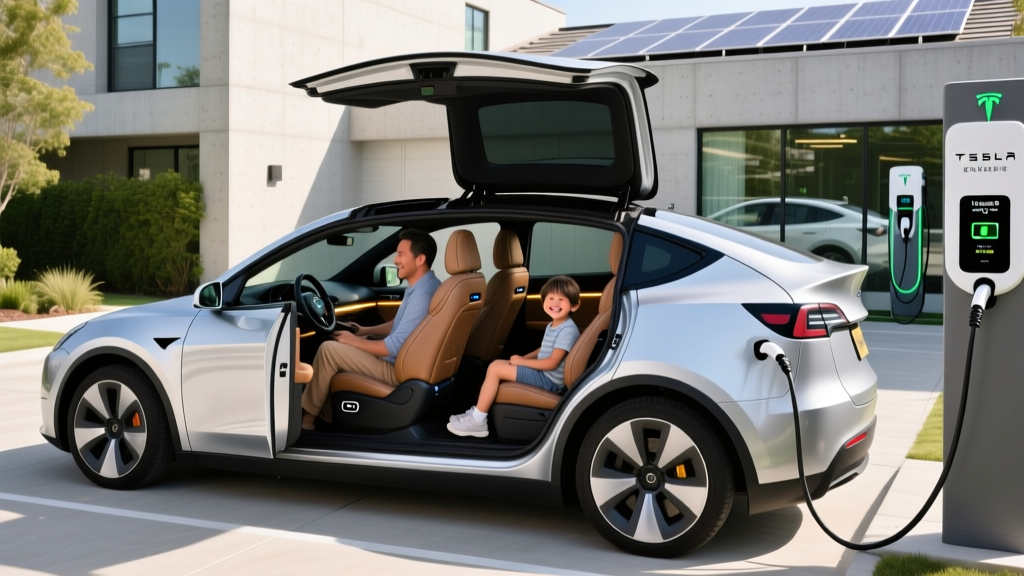
Cargo: 30.2 cubic feet behind the rear seats, expanding to 72.0 cu ft with seats folded. The rear trunk opening is wide and the load floor is flat. The front trunk (frunk) adds approximately 4.1 cu ft — useful for charging cables, a small bag, or groceries you want separated.
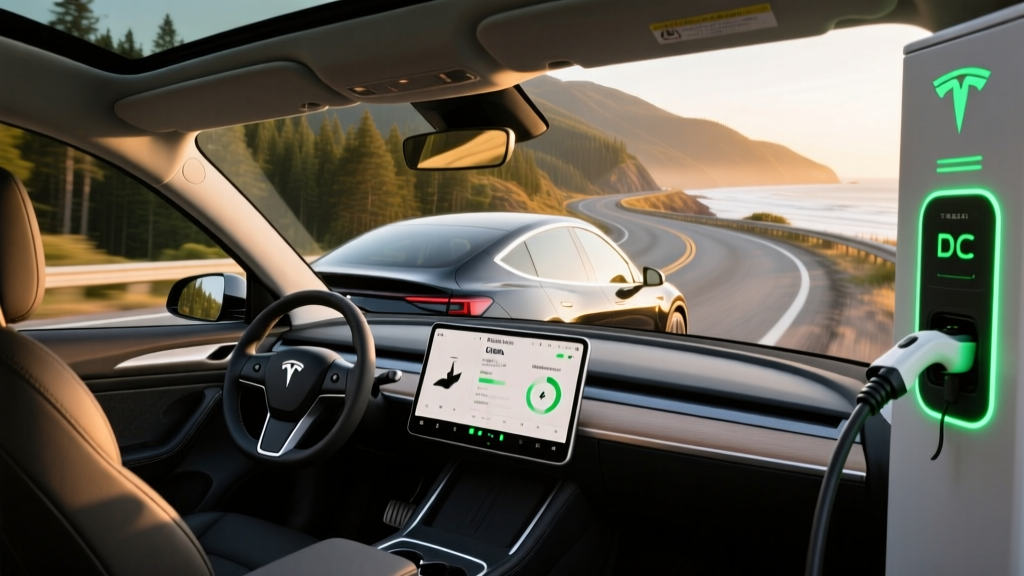
Infotainment: The 15.4-inch center touchscreen handles everything — navigation, media, climate, vehicle settings. There is no instrument cluster; speed and range info display on the left edge of the main screen. The system is responsive and feature-rich, but the lack of physical buttons for climate and wipers is a persistent frustration for some drivers. Wireless phone charging, USB-C ports (front and rear), and a 17-speaker audio system are standard.
Driver assistance: Basic Autopilot (Traffic-Aware Cruise Control + Autosteer) is standard. Full Self-Driving (Supervised) is a $8,000 option or $99/month subscription. FSD adds Navigate on Autopilot, Auto Lane Change, Autopark, and Smart Summon. However, this is an SAE Level 2 system — you must remain engaged, hands on the wheel, and eyes on the road at all times. It is not autonomous driving.
Pricing, Trims, and Federal Tax Credit Eligibility
| Trim | Base MSRP | As-Tested (with options) | §30D Credit Eligibility |
|---|---|---|---|
| Long Range AWD | $48,590 | $56,590 (FSD + paint + wheels) | Eligible — up to $7,500 |
| Performance | $52,490 | $57,490 (FSD + paint) | Eligible — up to $7,500 |
Federal tax credit (§30D) details: The 2025 Model Y qualifies for the full $7,500 federal tax credit, provided the buyer meets all requirements. As of 2025 IRS rules, the key constraints are:
- MSRP cap: SUVs must be under $80,000 — both Model Y trims clear this easily.
- Buyer income cap: Modified AGI must not exceed $150,000 (single), $225,000 (head of household), or $300,000 (joint filers).
- Battery sourcing: Critical minerals and battery components must meet phased-in percentage thresholds from US or FTA-partner nations. Tesla has largely restructured its supply chain to comply, but verify current-year status at purchase.
- Point-of-sale transfer: You can transfer the credit to the dealer at purchase, reducing your out-of-pocket cost immediately rather than waiting to claim it on your tax return.
With the $7,500 credit applied, the effective starting price of the Long Range AWD drops to approximately $41,090 — making it one of the most competitively priced long-range electric SUVs on the market. Always confirm eligibility details at IRS.gov or with a tax professional before purchasing.
Ownership Costs: 5-Year Outlook
Beyond the purchase price, the Model Y's ownership economics are strong compared to gas-powered SUV competitors:
- Electricity cost: At the US average of $0.16/kWh, driving 12,000 miles/year costs approximately $576 annually (vs. ~$1,620 for a 25 MPG gas SUV at $3.40/gal).
- Maintenance: No oil changes, no transmission fluid, minimal brake wear (regen handles most deceleration). Expect ~$200–$400/year for cabin air filters, wiper fluid, and tire rotation.
- Insurance: EV insurance tends to run 10–20% higher than equivalent gas vehicles. Get quotes before purchasing — averages range $1,800–$2,400/year depending on state and driving record.
- Depreciation: The Model Y has historically held value well, though increased competition and price cuts have softened residuals. Expect roughly 40–50% value retention at 5 years / 60,000 miles.
Who Should Buy the Model Y — And Who Should Look Elsewhere
- You want a long-range electric SUV with access to the Supercharger network
- Daily driving is under 80 miles and you can charge at home
- You value over-the-air updates and a tech-forward cabin
- Cargo versatility (72 cu ft with seats folded) is a priority
- You need a third row (Kia EV9, Hyundai Ioniq 9 offer 3-row seating)
- You want a more traditional cockpit with physical buttons and an instrument cluster
- You tow frequently (Model Y is rated for 3,500 lbs — Rivian R1S and F-150 Lightning do more)
- Interior material quality is a top priority (BMW iX, Genesis Electrified GV70 feel more premium)
Pros and Cons After 48 Hours
- Supercharger network reliability remains best-in-class
- 27-minute 10–80% DC charging is genuinely fast for road trips
- Spacious cargo area with flat load floor and frunk
- Low running costs: ~$576/yr electricity vs $1,600+ gas
- $7,500 tax credit brings effective price under $42K
- OTA updates add features post-purchase
- Highway range drops ~18% below EPA at 75 mph
- No physical buttons — climate and wiper controls are screen-only
- Rear-seat comfort is adequate but not class-leading
- Glass roof increases cabin heat in summer
- FSD at $8,000 remains a Level 2 system, not autonomous
- No third-row option for larger families
Frequently Asked Questions
What is the real-world range of the Tesla Model Y?
The EPA rates the 2025 Model Y Long Range AWD at 320 miles. In our mixed-driving test, we observed approximately 278 miles of practical range. Highway driving at 75 mph reduces that to roughly 262 miles, and cold weather (below freezing) can drop range to 230–250 miles.
How fast does the Model Y charge at home and on the road?
On a 48-amp Level 2 home charger, the Model Y adds about 44 miles of range per hour, fully charging in roughly 7 hours. At a V3 Supercharger, 10–80% takes approximately 27 minutes. At non-Tesla 150 kW CCS stations (with adapter), expect 10–80% in about 38 minutes.
How much does the Model Y cost after the federal tax credit?
The Long Range AWD starts at $48,590. With the $7,500 §30D federal credit (assuming you meet income and sourcing requirements), the effective price drops to approximately $41,090. The point-of-sale transfer option lets you apply the credit at purchase rather than waiting for tax filing.
Does the Model Y qualify for the full $7,500 federal EV tax credit?
Yes, as of 2025, both Model Y trims qualify — provided the buyer's income is under the IRS caps ($300K joint, $150K single) and the vehicle's battery sourcing meets current-year critical-mineral thresholds. Always verify at IRS.gov before purchasing, as sourcing rules are subject to change.
Is the Model Y worth buying over the Hyundai Ioniq 5 or Ford Mustang Mach-E?
The Model Y wins on Supercharger network access, charging speed, cargo volume, and software ecosystem. The Ioniq 5 offers faster 10–80% charging (18 min on 350 kW chargers) and a more distinctive design. The Mach-E provides a more traditional driving feel and instrument cluster. If Supercharger reliability and cargo space matter most, the Model Y remains the segment benchmark.
What is the battery warranty on the Model Y?
Tesla covers the battery and drive unit for 8 years or 120,000 miles (whichever comes first), with a guaranteed minimum 70% capacity retention over that period. Real-world degradation data from Recurrent shows most Model Y packs retain 90%+ capacity at 50,000 miles.
Is Tesla's FSD actually self-driving?
No. Full Self-Driving (Supervised) is an SAE Level 2 driver-assist system. You must keep your hands on the wheel, eyes on the road, and remain prepared to take over at any moment. It does not make the vehicle autonomous. Only Level 4 services like Waymo operate without a driver.