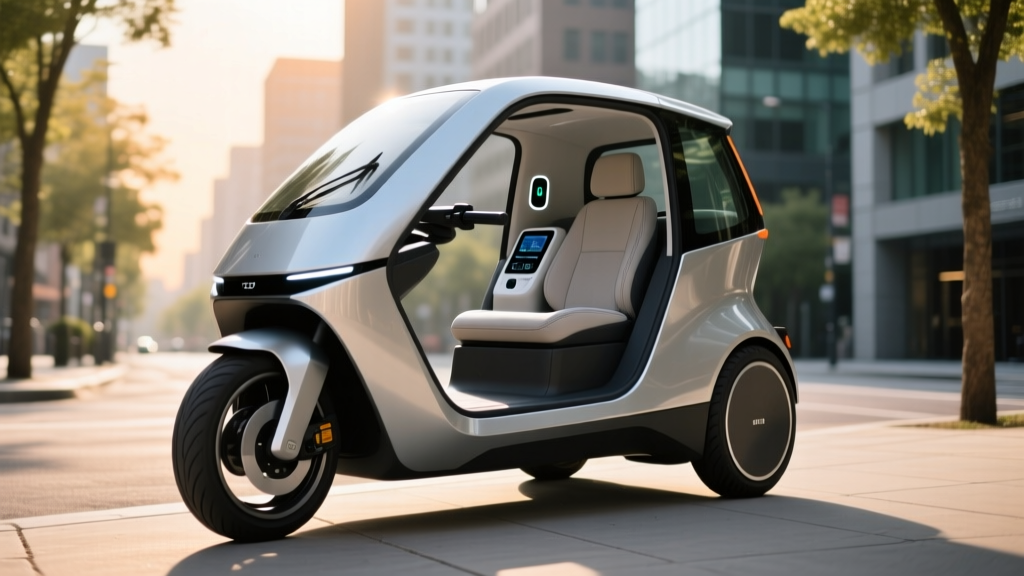
The search for a 3 wheel electric rickshaw usually starts with a simple goal: replacing a noisy, fuel-thirsty small vehicle with something cheaper to run and easier to maintain. Whether you are looking at passenger autos, cargo variants, or neighborhood electric vehicles (NEVs) built on a trike chassis, the practical questions are the same — how far will it really go, how long does a charge take, and does the math work against a gasoline alternative?
Quick Answer: Is a 3 Wheel Electric Rickshaw Worth It?
A 3 wheel electric rickshaw typically delivers 40–70 miles of real-world range from a 5–10 kWh battery pack (often LFP chemistry), with Level 2 charging completing a full cycle in 4–7 hours. Purchase prices range from $3,500 for basic cargo models to $12,000+ for enclosed passenger variants. Operating cost is roughly $0.03–0.05 per mile on grid electricity versus $0.18–0.25 per mile for a comparable gas rickshaw. The trade-off: limited highway capability (usually 25–45 mph top speed), sparse public charging support, and range that drops 20–30% in cold weather. Best suited for urban delivery routes, campus transport, or short-radius passenger service where daily mileage stays under 50 miles.
What Exactly Is a 3 Wheel Electric Rickshaw?
The term covers a wide spectrum of light electric vehicles (LEVs) sharing a three-wheel layout: one front wheel with two rear, or two front with one rear. In the US market, these generally fall into three regulatory buckets:
- Neighborhood Electric Vehicles (NEVs / LSVs): Federal Motor Vehicle Safety Standard 500 limits these to 20–25 mph top speed. They require basic safety equipment (headlights, turn signals, seatbelts, VIN) but are exempt from full crash-testing. Street-legal on roads posted 35 mph or lower in most states.
- Medium-Speed Electric Vehicles (MSEVs): Some states allow a 35 mph class with additional safety requirements.
- Off-road / private-property units: Cargo tugs, resort shuttles, and warehouse runabouts that are not street-legal.
Buyers coming from South Asian "e-rickshaw" markets should note that US-spec models must meet different safety and registration requirements. Imports without DOT/EPA certification cannot be legally registered for road use.
Range, Battery, and Charging: The Numbers That Matter
Range is where marketing claims diverge most sharply from reality. Manufacturers often quote "up to" figures based on flat terrain, warm weather, light loads, and 15 mph speeds. Here is what real-world testing and owner reports typically show:
| Spec | Budget Cargo Model | Mid-Range Passenger | Premium Enclosed |
|---|---|---|---|
| Battery capacity (usable) | 5–6 kWh (LFP) | 8–10 kWh (LFP) | 12–15 kWh (NMC or LFP) |
| EPA-equivalent range | 35–45 mi | 50–70 mi | 70–100 mi |
| Real-world range (mixed) | 25–35 mi | 40–55 mi | 55–80 mi |
| Cold-weather range (30°F) | 18–25 mi | 30–40 mi | 40–60 mi |
| Top speed | 20–25 mph | 25–35 mph | 35–45 mph |
| Motor output | 1.5–3 kW | 3–5 kW | 5–10 kW |
| Level 1 (120V) charge time | 8–12 hrs | 12–16 hrs | 16–20 hrs |
| Level 2 (240V) charge time | 3–5 hrs | 4–6 hrs | 5–8 hrs |
| DC fast charging | Not supported | Rarely supported | Some models, 1–2 hrs |
Battery Chemistry: LFP vs NMC
Most 3 wheel electric rickshaws use lithium iron phosphate (LFP) cells. LFP trades some energy density (heavier pack for the same kWh) for significantly longer cycle life — typically 2,000–3,000 full cycles before reaching 80% capacity, versus 1,000–1,500 for NMC. For a vehicle charged daily, that translates to 5–8 years of service before noticeable degradation. LFP is also more thermally stable, reducing fire risk — a meaningful factor in densely packed urban environments.
The trade-off: LFP packs are heavier and bulkier. If your application demands maximum payload on a light chassis, NMC may be specified, but expect a shorter useful life and more careful thermal management requirements.
EV vs Gas Rickshaw: Cost Comparison
The purchase price of an electric rickshaw is almost always higher than a gasoline equivalent. The question is whether operating savings close the gap. Here is a side-by-side using representative US-market figures:
| Cost Category | Electric (Mid-Range) | Gasoline Equivalent |
|---|---|---|
| Purchase price | $7,500 | $4,200 |
| Fuel / electricity (5 yrs, 25 mi/day) | $1,140 | $6,840 |
| Maintenance (5 yrs) | $600 | $2,400 |
| Insurance (5 yrs) | $3,000 | $3,000 |
| Battery replacement reserve | $1,500 | $0 |
| 5-year total | $13,740 | $16,440 |
| Cost per mile | $0.075 | $0.090 |
Assumptions: electricity at $0.14/kWh, gasoline at $3.80/gallon, gas rickshaw achieving 45 MPG (typical for a 150–200cc single-cylinder engine under load). Maintenance for gas includes oil changes, spark plugs, carburetor or fuel-injection service, and clutch work. Electric maintenance is largely limited to brake service, tire rotation, and occasional controller checks.
The breakeven point typically arrives around year 3 for daily-use commercial applications. For occasional or seasonal use, the gas option may remain cheaper over the vehicle's life.
Real-World Ownership: What First-Time Buyers Need to Know
Home Charging Access Is Non-Negotiable
Unlike full-size EVs that can use public DC fast-charging networks, most 3 wheel electric rickshaws lack DC fast-charge capability. You are effectively tethered to Level 1 (standard 120V outlet) or Level 2 (240V, requiring dedicated circuit installation). If you cannot charge at home or at your business premises, this vehicle class is impractical.
A Level 2 installation for a rickshaw is straightforward — a 20-amp, 240V circuit is usually sufficient, costing $400–1,200 installed depending on panel proximity and local permitting. This is a fraction of the $1,500–3,500 typical for a full-size EV charger installation, because the power draw is lower (1.5–3 kW versus 7.2–11.5 kW).
Climate Matters More Than You Think
LFP batteries lose capacity in cold weather — expect a 20–30% range reduction at 30°F and up to 40% below freezing. If your route is 40 miles round-trip in July, that same route may not be achievable in January without an opportunity charge. Models with battery preheating or active thermal management handle this better, but these features add cost and complexity.
Hot climates present the opposite problem: sustained high temperatures accelerate degradation. If ambient temperatures regularly exceed 95°F, look for packs with active cooling or at minimum, shaded parking and timed charging to avoid peak heat.
Registration, Insurance, and Street Legality
NEV/LSEV registration varies by state. Some states require a special license plate and restrict operation to roads with speed limits of 35 mph or less. Others allow operation on higher-speed roads but prohibit crossing them. Insurance is available through specialty carriers and typically costs $500–800 per year for commercial use — but not all mainstream insurers write NEV policies. Confirm insurability before purchasing.
Common Misconceptions About 3 Wheel Electric Rickshaws
| Myth | Fact |
|---|---|
| "They qualify for the $7,500 federal EV tax credit." | Most do not. The IRS §30D credit requires the vehicle to be a "qualified plug-in electric drive motor vehicle" with at least four wheels and a gross vehicle weight under 14,000 lbs. Three-wheel vehicles generally do not qualify. Some may be eligible for the §45W commercial credit if used in a business fleet — consult a tax professional. |
| "Range is the same year-round." | Cold weather reduces LFP capacity by 20–40%. Always plan routes using worst-case winter range, not summer figures. |
| "I can charge it anywhere." | Most 3 wheel rickshaws use proprietary or J1772 connectors at low power levels. Public DC fast chargers (CCS, NACS) are generally incompatible. You are limited to Level 1/Level 2 infrastructure. |
| "Maintenance-free means no maintenance." | Brakes, tires, suspension bushings, and electrical connections still require inspection. Neglect leads to costly failures, especially in commercial use. |
| "Any electrician can install a charger." | While the installation is simple, it must meet NEC code and local permitting requirements. An unpermitted installation can void insurance and create liability. |
Decision Framework: Is a 3 Wheel Electric Rickshaw Right for You?
Choose Electric If:
- Your daily route is under 40 miles (allowing for cold-weather reduction)
- You have access to overnight charging at home or your business
- You operate primarily on roads posted 35 mph or lower
- You drive daily — the fuel savings only justify the upfront cost with consistent use
- Noise and local emissions matter (campus, resort, dense urban neighborhood)
- You can absorb a higher purchase price for lower operating cost
Choose Gasoline If:
- Your daily mileage exceeds 60 miles or is highly variable
- You lack reliable overnight charging access
- You need to travel on roads posted above 35 mph regularly
- The vehicle will be used seasonally or infrequently
- Upfront budget is tight and you cannot finance the premium
- You operate in extreme cold (below 20°F) without heated storage
What to Look for When Shopping
If you have determined that a 3 wheel electric rickshaw fits your use case, prioritize these factors in order:
- Usable battery capacity (kWh), not advertised range. Range claims vary wildly based on testing conditions. A 10 kWh pack is a 10 kWh pack — calculate your own range estimate using 0.2–0.3 kWh/mile as a baseline for this vehicle class.
- Battery warranty and replacement cost. Look for at least 3 years / 30,000 miles on the pack. Confirm that replacement cells are available and priced — some import models have no US parts support.
- Charger compatibility. J1772 is the US standard for Level 2. Proprietary connectors limit your charging options and complicate resale.
- Payload capacity vs battery weight. A heavier pack reduces cargo capacity. Calculate your actual payload needs before spec'ing the largest available battery.
- Service network. Can the dealer or a local shop diagnose and repair controller, motor, or BMS issues? Orphan brands with no service infrastructure are a significant risk for commercial users.
Frequently Asked Questions
How long does a 3 wheel electric rickshaw battery last?
LFP batteries typically deliver 2,000–3,000 full charge cycles before degrading to 80% of original capacity. With daily charging, that translates to 5–8 years of service. NMC packs last 1,000–1,500 cycles (3–5 years). Actual life depends on depth of discharge, temperature exposure, and charging habits.
Can I use a 3 wheel electric rickshaw for commercial delivery?
Yes, and this is the strongest use case. Short-radius urban delivery (food, packages, laundry) aligns well with the vehicle's range and speed limits. Several fleet operators use electric trikes for last-mile delivery in dense city centers. Confirm that your local jurisdiction allows commercial operation of NEVs on your intended routes.
Do I need a special license to drive one?
In most US states, a standard driver's license is sufficient for NEV/LSEV operation. A few states have additional requirements or restrictions — check your state DMV. You do not need a motorcycle endorsement for a three-wheel NEV in most jurisdictions, but this varies.
What happens if the battery dies mid-route?
Unlike a gas rickshaw, you cannot walk to a station with a jerry can. Plan routes conservatively, maintaining a 20% range buffer. Some operators carry a portable generator as a range extender for emergencies, though this adds weight and complexity.
Are there any federal incentives available?
The §30D new clean vehicle credit generally does not apply to three-wheel vehicles. However, the §45W commercial clean vehicle credit may apply if the vehicle is used in a qualifying business application and meets weight and battery capacity requirements. State and local incentives vary widely — check AFDC's state incentive database for current programs in your area.