The Short Answer on a 20K EV Truck
No new electric pickup trucks carry a base MSRP of $20,000 in 2026. The most affordable new EV truck on the market is the Ford Maverick EV (announced for the 2026 model year) with an expected starting price around $33,000–$35,000 before incentives. The closest path to a net $20,000 electric truck is combining a mid-$30K base MSRP with the §30D federal tax credit (up to $7,500), potential state rebates, and aggressive dealer discounting — bringing effective cost into the low-to-mid $20K range for eligible buyers.
What Electric Trucks Actually Cost in 2026
The EV truck market has matured, but budget expectations need recalibration. Here is where the major electric and electrified pickups sit for the 2026 model year:
| Model | Base MSRP | EPA Range (est.) | Battery | Max DC Charge | §30D Credit Eligible |
|---|---|---|---|---|---|
| Ford Maverick EV (announced) | ~$33,000 | ~250 mi | ~70 kWh (NMC) | ~150 kW | Yes (if sourcing rules met) |
| Chevrolet Silverado EV (WT) | ~$39,900 | 280 mi | 100 kWh (NMC) | 200 kW | Yes (verify trim) |
| Rivian R1T (Standard) | ~$69,900 | 270 mi | 95 kWh (NMC) | 220 kW | Partial (MSRP cap issue) |
| Ford F-150 Lightning (XLT) | ~$54,990 | 240 mi | 98 kWh (NMC) | 150 kW | Yes (XLT trim under $80K cap) |
| Hyundai Santa Cruz EV (rumored) | TBD | TBD | TBD | TBD | TBD |
The §30D federal tax credit has strict rules under current IRS guidance: the vehicle MSRP must not exceed $80,000 for trucks/SUVs, the buyer's modified AGI must fall under income caps ($150K single / $300K joint), and the battery must meet critical-mineral and component sourcing thresholds. The credit can now be transferred at point of sale, effectively reducing your purchase price on the spot. Always verify current-year eligibility on irs.gov before committing.
The Math: Can You Net a 20K EV Truck?
Let's model the most realistic scenario using the anticipated Ford Maverick EV as our baseline:
| Cost Factor | Amount |
|---|---|
| Base MSRP (Maverick EV) | $33,000 |
| Destination & delivery | +$1,495 |
| §30D Federal Tax Credit (if eligible) | −$7,500 |
| State rebate (e.g., Colorado, California, varies) | −$2,500 to −$5,000 |
| Dealer negotiation / discount (varies) | −$1,000 to −$3,000 |
| Estimated Net Cost | $19,000–$23,500 |
This is how a "20K EV truck" becomes achievable — but only under a specific set of conditions: you qualify for the full federal credit, your state offers a meaningful rebate, and you negotiate effectively. If any of these conditions fail, your net price climbs quickly.
EV Truck vs Gas Truck: Real Ownership Costs Over 5 Years
The purchase price is only half the equation. Here is a five-year total cost of ownership comparison between a hypothetical $33K EV truck (net ~$22K after credits) and a comparable gas-powered compact truck (e.g., Ford Maverick Hybrid at ~$28,000 MSRP):
| Cost Category (5 Years / 75,000 Miles) | EV Truck (Net ~$22K) | Gas Compact Truck (~$28K) |
|---|---|---|
| Purchase price (after incentives) | $22,000 | $28,000 |
| Fuel / Electricity | $3,200 (home charging avg) | $8,100 (37 MPG combined, $3.20/gal) |
| Maintenance | $1,200 | $3,500 |
| Insurance (avg) | $7,800 | $6,500 |
| Depreciation (est. 5-yr) | $11,000 | $10,500 |
| Total 5-Year Cost | $45,200 | $56,600 |
The EV truck wins on operating costs — electricity at home averages roughly $0.13/kWh nationally, translating to about 3.5 cents per mile for a truck consuming ~27 kWh/100mi. Gas at $3.20/gallon in a 37 MPG truck runs about 8.6 cents per mile. That gap widens further if you drive more than 15,000 miles per year.
However, EV insurance premiums tend to run 15–25% higher than comparable gas vehicles due to repair cost structures and battery replacement risk. Get quotes before buying.
Real-World Range and Charging: What the Sticker Doesn't Tell You
A compact EV truck in the 70 kWh battery range will carry an EPA estimate around 240–260 miles. Here is what real-world conditions actually deliver:
EPA Sticker: ~250 miles
Highway driving (70+ mph): ~200–220 miles
Cold weather (below 30°F): ~170–200 miles
Towing a 2,000-lb trailer: ~130–160 miles
Charging speed is equally important. A truck with a 150 kW peak DC fast-charge rate will typically sustain that peak only between roughly 10–40% State of Charge (SoC). The charge curve tapers significantly above 80%. Expect a realistic 10–80% session in approximately 28–35 minutes at a properly rated station — not the 18 minutes some marketing materials suggest.
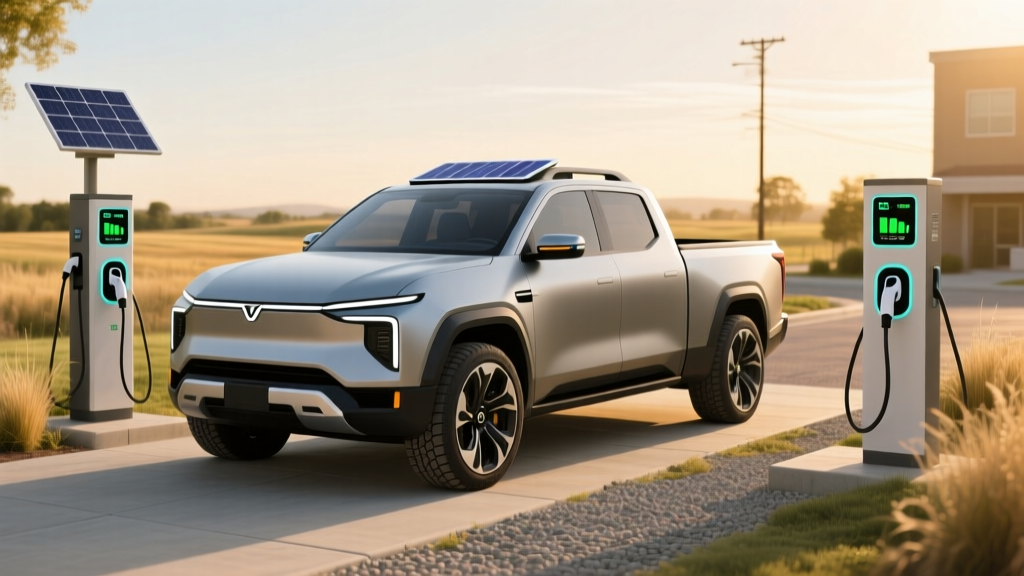
For Level 2 home charging (the backbone of EV ownership), a 70 kWh battery charging at 7.7 kW (32A on a 240V circuit) will take roughly 9 hours from empty to full. Most owners charge nightly, topping up 30–50% per session, which takes 3–5 hours and fits easily into an overnight window.
Home Charging Access: The Make-or-Break Factor
If you cannot charge at home, a budget EV truck becomes significantly harder to live with. Public DC fast charging costs roughly $0.35–$0.50/kWh depending on the network (Electrify America, EVgo, Tesla Supercharger), which pushes your per-mile cost to 9–13 cents — nearly erasing the fuel-cost advantage over gas.
Home Level 2 installation typically requires:
- A 240V / 40–50A dedicated circuit (NEMA 14-50 outlet or hardwired EVSE)
- Electrical panel capacity — many older homes with 100A panels need a $1,500–$3,000 panel upgrade to 200A
- Total install cost: $800–$2,500 for the circuit and EVSE, plus panel upgrade if needed
If you rent, live in a condo without charging infrastructure, or rely exclusively on street parking, an EV truck may not be practical until public charging reliability and cost improve in your area. Check your local charging network density on the Alternative Fuels Data Center before purchasing.
Common Misconceptions About Budget EV Trucks
| Myth | Fact |
|---|---|
| "You can buy a brand-new EV truck for $20,000." | No new EV truck lists at $20K MSRP. The path to a net $20K cost requires stacking federal + state incentives on a $33K+ vehicle. |
| "EV batteries need replacing every 5 years." | Modern NMC and LFP batteries are warranted for 8 years / 100,000 miles (minimum 70% capacity retention). Real-world degradation data shows most packs retain 85–90% at 100K miles. |
| "EV trucks can't tow or haul." | Compact EV trucks typically tow 1,500–2,000 lbs — sufficient for small utility trailers and light campers. Heavy towing, however, crushes range by 35–50%. |
| "Everyone qualifies for the $7,500 tax credit." | The §30D credit has income caps, MSRP caps, and battery sourcing requirements. Many buyers and some vehicle configurations do not qualify. Verify on irs.gov. |
| "Used EV trucks are easy to find at $20K." | The used EV truck market is thin. Early Ford F-150 Lightnings and Rivian R1Ts still command $35K–$50K+ on the used market. True $20K used EV trucks don't exist yet in meaningful supply. |
Decision Framework: Should You Wait or Buy Now?
Buy now if:
- You qualify for the full §30D credit and live in a state with additional rebates
- You have home charging access (garage or driveway with 240V circuit capability)
- Your daily driving is under 80 miles round-trip with occasional longer road trips
- You value low per-mile operating costs and reduced maintenance over the lowest possible purchase price
Wait or consider a hybrid if:
- You cannot install home charging and rely on public infrastructure
- You regularly tow more than 3,000 lbs or drive over 250 miles per day
- You live in a region with extreme cold (below 0°F) and no garage
- Your budget is a firm $20,000 all-in with no incentive stacking — a hybrid truck like the Ford Maverick Hybrid (42 MPG city, ~$28K MSRP) is a more realistic fit
Consider a PHEV truck (when available): Plug-in hybrid pickups are emerging as a bridge option — offering 30–40 miles of electric-only range for daily commuting with a gas engine for longer hauls. This eliminates range anxiety while capturing most of the fuel savings for drivers with predictable routines.
Frequently Asked Questions
Will there ever be a true $20,000 MSRP electric truck?
Possibly by 2028–2030 as battery costs continue declining and more compact platforms enter the market. Current battery pack costs (roughly $110–$130/kWh at the cell level in 2026) still make a 70 kWh pack alone a $7,700–$9,100 component cost, which constrains how low a full-size or compact truck MSRP can go while maintaining profitability.
Can I use the §30D credit at the point of sale?
Yes. As of 2024, buyers can transfer the credit to the dealer, reducing the purchase price directly at the dealership rather than waiting to claim it on a tax return. This effectively functions as an instant rebate, but you must still meet all income and sourcing requirements — the dealer will verify eligibility. See IRS §30D guidance for details.
What about the used EV truck tax credit?
The §25E credit offers up to $4,000 (or 30% of the sale price, whichever is less) on used EVs priced at $25,000 or less from a licensed dealer. However, used EV trucks rarely fall below $25K in 2026, making this credit largely inaccessible for truck buyers at present.
How long will an EV truck battery last?
Manufacturer warranties cover a minimum of 8 years / 100,000 miles with at least 70% capacity retention. Based on fleet data from earlier EVs, most modern NMC packs retain 85–92% capacity at 100,000 miles. Full battery replacement costs remain high — typically $10,000–$18,000 depending on the pack — but the need for replacement within the first 150,000 miles is statistically uncommon.
Is an EV truck practical for rural drivers?
It depends on your charging access and driving patterns. Rural drivers with home charging and daily routes under 100 miles benefit enormously from low per-mile costs. Rural drivers without home charging or who regularly drive 200+ miles between charging stations should strongly consider a hybrid truck instead. Check charging station density in your area before deciding.