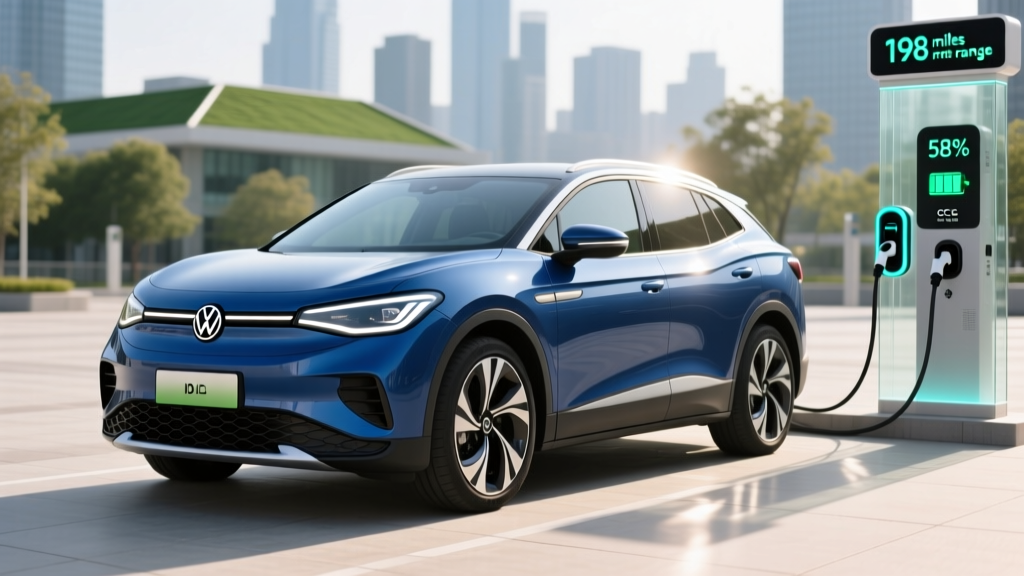
Volkswagen's ID.4 has been a steady seller in the compact electric SUV segment since its U.S. launch, offering practical cargo space, comfortable ride quality, and competitive range. The 2027 VW ID.4 arrives as Volkswagen continues to refine its MEB-platform SUV with updated software, potential battery chemistry improvements, and revised pricing. This preview covers everything announced and estimated so far — and where we fill in gaps with data from the outgoing 2026 model year.
Quick Verdict: Who Should Wait for the 2027 ID.4?
The 2027 VW ID.4 targets families and commuters who want a no-drama electric crossover with strong cargo utility, comfortable highway manners, and access to the growing NACS/Supercharger network. It is not the fastest-charging or longest-range option in its class — the Hyundai Ioniq 5 and Tesla Model Y still hold those crowns — but VW's formula of ride comfort, build quality, and practical packaging keeps it relevant. If you need a vehicle now, the 2026 ID.4 is a known quantity. If you can wait a few months, the 2027 model may bring incremental software and efficiency gains worth considering.
Estimated Range, Battery, and Efficiency
Volkswagen has been transitioning its MEB-platform vehicles toward a larger 82 kWh (gross) battery pack across more trims, and the 2027 ID.4 is expected to continue this strategy. The standard-range model is anticipated to retain the 62 kWh (gross) pack. Based on the outgoing 2026 model's EPA certification and VW's stated efficiency targets for the 2027 refresh:
| Specification | Standard Range (RWD) | Pro / Pro S (RWD) | AWD Pro / Pro S |
|---|---|---|---|
| Battery (gross / usable) | 62 kWh / ~58 kWh | 82 kWh / ~77 kWh | 82 kWh / ~77 kWh |
| Chemistry | NMC (nickel manganese cobalt) | NMC | NMC |
| EPA Est. Range | ~206 mi | ~275 mi | ~255 mi |
| Efficiency (est.) | ~104 MPGe / 32 kWh/100mi | ~107 MPGe / 31 kWh/100mi | ~98 MPGe / 34 kWh/100mi |
The EPA estimate of ~275 miles for the Pro RWD is measured on a mixed driving cycle. In real-world highway driving at 70-75 mph, expect approximately 235–250 miles before needing to charge. In cold weather (below 32°F), range can drop 20–30% due to battery heating demands and cabin climate use — meaning a winter highway range closer to 190–215 miles for the Pro RWD. The AWD variant will see slightly higher consumption year-round. Always plan road trips around ~200 miles between stops in mixed conditions to maintain a comfortable buffer.
Volkswagen has not confirmed whether any 2027 ID.4 trims will adopt LFP (lithium iron phosphate) chemistry. LFP offers longer cycle life and lower cost but sacrifices some energy density, which would reduce range in the same physical pack size. We expect NMC to remain standard across U.S. trims for 2027, though VW's European unified cell strategy may eventually bring LFP to lower-priced variants.
Charging Speed: DC Fast Charging and Home Level 2
Charging speed remains one of the ID.4's more competitive attributes. The 82 kWh models have historically supported strong DC fast-charge rates, and the 2027 model is expected to maintain or slightly improve on this. Here's what buyers should expect:
| Charging Level | Standard Range (62 kWh) | Pro / Pro S (82 kWh) |
|---|---|---|
| Level 1 (120V household) | ~1.4 kW / ~4 mi/hr | ~1.4 kW / ~3 mi/hr |
| Level 2 (240V home, 48A) | 11 kW / ~30 mi/hr | 11 kW / ~29 mi/hr |
| Level 2 full charge time | ~6 hours | ~7.5 hours |
| DC Fast Charge (peak) | ~135 kW | ~175 kW |
| DC 10–80% time | ~30 minutes | ~28–30 minutes |
| Connector (U.S.) | NACS (Tesla Supercharger compatible) | NACS (Tesla Supercharger compatible) |
A critical detail for prospective buyers: Volkswagen began equipping U.S. ID.4 models with the NACS (North American Charging Standard) port starting with the 2025 model year, granting native access to Tesla's Supercharger network without an adapter. The 2027 model continues this, which dramatically expands fast-charging availability on road trips. Electrify America's network — which VW owners have historically relied on through the free charging credits program — remains compatible via NACS-to-CCS adapters or native NACS stalls as EA continues its rollout.
One ownership note on the charge curve: the ID.4's peak 175 kW rate is achieved at low state-of-charge (roughly 10–30% SoC). As the battery fills past 60%, the rate tapers significantly — expect ~80–100 kW in the 60–80% window and a steep drop above 80%. This is normal for NMC lithium-ion packs managed conservatively for longevity, but it means charging from 80–100% on DC fast chargers is time-inefficient. For daily driving, set your charge limit to 80% and use Level 2 at home.
Performance and Drivetrain
The 2027 VW ID.4 is expected to carry over the powertrain options from the 2026 model year with minor software calibration updates:
- RWD (Standard Range): Single rear motor, ~201 hp, 229 lb-ft torque. 0–60 mph in approximately 7.8 seconds.
- RWD (Pro/Pro S): Single rear motor, ~282 hp, 339 lb-ft torque. 0–60 mph in approximately 6.7 seconds.
- AWD (Pro/Pro S): Dual-motor all-wheel drive, ~335 hp combined, 402 lb-ft torque. 0–60 mph in approximately 5.1 seconds.
The ID.4 has never positioned itself as a performance EV — that role belongs to the forthcoming ID. GTX variants or competitors like the Ford Mustang Mach-E GT. What the ID.4 delivers is composed, quiet highway cruising with adequate passing power. The rear-wheel-drive layout gives it a tighter turning radius than many competitors (approximately 31.5 feet curb-to-curb), which makes it surprisingly maneuverable in parking lots and city driving.
Towing capacity is rated at 2,700 pounds for AWD models with the factory tow package and 2,200 pounds for RWD — adequate for a small utility trailer or a pair of dirt bikes, but not for boat or camper towing.
Pricing, Trims, and Federal Tax Credit Eligibility
Official 2027 MSRP has not been released, but based on Volkswagen's recent pricing trajectory and competitive positioning against the Hyundai Ioniq 5 (~$42,500 base), Kia EV6 (~$42,900), and Tesla Model Y (~$44,990), here is our estimated pricing structure:
| Trim | Drivetrain | Est. MSRP | Est. Price After §30D Credit* |
|---|---|---|---|
| Standard | RWD | ~$39,990 | ~$32,490 |
| Pro | RWD | ~$44,490 | ~$36,990 |
| Pro S | RWD | ~$48,990 | ~$41,490 |
| AWD Pro | AWD | ~$47,490 | ~$39,990 |
| AWD Pro S Plus | AWD | ~$54,490 | ~$46,990 |
*Federal tax credit estimates assume full §30D eligibility. Actual credit depends on battery sourcing, income, and MSRP requirements. See checklist below.
Federal EV Tax Credit (§30D) Eligibility Checklist
- MSRP cap: SUVs/crossovers must have an MSRP at or below $80,000 — all ID.4 trims clear this.
- Buyer income cap: Modified AGI must not exceed $150,000 (single), $225,000 (head of household), or $300,000 (joint). Per IRS guidelines.
- Battery component sourcing: A percentage of battery components must be manufactured or assembled in North America, and critical minerals must meet sourcing thresholds. VW has been working to localize battery supply through its PowerCo subsidiary and partnerships, but final 2027 sourcing compliance has not been confirmed.
- Point-of-sale transfer: Eligible buyers can transfer the credit to the dealer at purchase, reducing the purchase price directly rather than waiting for a tax refund.
- Final assembly: Vehicle must undergo final assembly in North America. The ID.4 for the U.S. market is assembled in Chattanooga, Tennessee.
Interior, Cargo Space, and Technology
The ID.4's cabin prioritizes practicality over flash. Volkswagen's minimalist interior approach — centered around a 12.9-inch infotainment display (upgraded from the earlier 12-inch unit) — draws polarized opinions. The capacitive touch sliders for volume and temperature remain a frustration point for some owners, though VW's latest software revision (4.0+) has improved responsiveness and added back some physical shortcuts through the steering wheel controls.
Cargo and Passenger Dimensions
- Cargo volume (behind rear seats): 30.3 cubic feet
- Cargo volume (rear seats folded): 64.2 cubic feet
- Front legroom: 41.1 inches
- Rear legroom: 37.6 inches
- Front headroom: 41.0 inches (without panoramic roof)
- Rear headroom: 38.8 inches
Those cargo numbers put the ID.4 ahead of the Hyundai Ioniq 5 (27.2 cu ft behind rear seats) and competitive with the Tesla Model Y (30.2 cu ft, though Tesla's under-floor storage is more generous). The ID.4 does not have a front trunk (frunk) — the space under the hood houses HVAC and power electronics components. For buyers who prioritize cargo versatility, this is a minor disadvantage versus the Ioniq 5 and F-150 Lightning, which both offer usable frunks.
Driver Assistance and Tech
The 2027 ID.4 is expected to include Volkswagen's IQ.DRIVE suite as standard equipment across all trims:
- Adaptive cruise control with stop-and-go
- Lane centering assist (Travel Assist)
- Front and rear automatic emergency braking
- Blind-spot monitoring with rear cross-traffic alert
- Park Assist with surround-view camera (Pro S and above)
VW's IQ.DRIVE and Travel Assist are SAE Level 2 driver-assistance systems. This means the system can control steering and acceleration simultaneously under specific conditions, but the driver must remain fully attentive with hands on or near the wheel at all times. This is not autonomous or "self-driving" capability. VW does not currently offer a hands-free highway system comparable to GM's Super Cruise or Ford's BlueCruise.
Wireless Apple CarPlay and Android Auto are standard. A 15-watt wireless phone charging pad sits in the center console. The available panoramic fixed-glass roof floods the cabin with light but does not open — it includes a powered shade. Harman Kardon premium audio is available on Pro S Plus trims.
Warranty and Long-Term Ownership
Volkswagen's EV warranty coverage is competitive with the segment:
- Limited vehicle warranty: 4 years / 50,000 miles
- Battery and powertrain warranty: 8 years / 100,000 miles
- Battery capacity retention guarantee: VW warrants that the high-voltage battery will retain at least 70% of its original usable capacity over the 8-year/100,000-mile period
- Roadside assistance: 4 years / 50,000 miles
The 70% capacity threshold is industry-standard, matching what Hyundai, Kia, and Tesla offer. For context, real-world degradation data from MEB-platform vehicles in Europe suggests typical capacity loss of approximately 5–8% over the first 60,000 miles, with the curve flattening significantly afterward. The ID.4's active thermal management system (liquid cooling and heating) helps manage battery temperature during fast charging and extreme weather, which is critical for long-term health.
One ownership cost to budget for: EV insurance premiums. The ID.4 tends to carry insurance costs approximately 10–20% higher than a comparably priced gas-powered Tiguan, driven by higher repair costs for battery-adjacent collision damage. Get quotes from your insurer before committing.
How the 2027 ID.4 Compares to Key Rivals
The compact electric SUV segment is crowded. Here's how the ID.4 stacks up on the metrics that matter most:
| Metric | VW ID.4 Pro RWD | Hyundai Ioniq 5 SEL RWD | Tesla Model Y LR AWD | Kia EV6 Wind RWD |
|---|---|---|---|---|
| EPA Range | ~275 mi | 303 mi | 320 mi | 310 mi |
| DC Fast Charge Peak | ~175 kW | ~235 kW | ~250 kW | ~235 kW |
| 10–80% DC Time | ~28–30 min | ~18 min | ~20 min | ~18 min |
| Cargo (rear seats up) | 30.3 cu ft | 27.2 cu ft | 30.2 cu ft | 24.4 cu ft |
| 0–60 mph | ~6.7 sec | 7.2 sec | 4.8 sec | 7.2 sec |
| Est. Base MSRP | ~$44,490 | ~$46,500 | ~$44,990 | ~$46,900 |
- You prioritize ride comfort and quiet cabin over sporty dynamics
- Cargo space is a top priority (best-in-class with rear seats up)
- You want a physically smaller SUV that's easy to park
- Chattanooga-built and domestic assembly matters to you
- Fastest possible DC charging speed is critical (Ioniq 5 / EV6 win)
- You need maximum EPA range (Model Y and Ioniq 5 lead)
- You want hands-free highway driving (BlueCruise/Super Cruise)
- Frunk storage is important to your use case
Pros and Cons at a Glance
Pros
- Class-leading cargo volume behind rear seats
- Comfortable, well-damped ride quality
- Tight turning radius for easy city maneuvering
- NACS port with Supercharger network access
- U.S. assembly (Chattanooga, TN)
- Strong battery warranty with 70% capacity guarantee
- Competitive starting price within segment
Cons
- DC charging speed trails Ioniq 5 and EV6 by ~10 min (10–80%)
- No front trunk (frunk)
- Capacitive touch controls remain divisive
- Real-world highway range noticeably below EPA sticker
- No hands-free driving assist (only Level 2 lane centering)
- Infotainment learning curve; some menus are deeply nested
- AWD range penalty is significant (~20 miles less than RWD)
Frequently Asked Questions
What is the real-world range of the 2027 VW ID.4?
For the Pro RWD with the 82 kWh battery, the EPA estimate is approximately 275 miles. In real-world highway driving at 70–75 mph, plan for roughly 235–250 miles. In cold weather (below freezing), expect a 20–30% reduction, bringing usable range to approximately 190–215 miles on the highway. City and suburban driving with regenerative braking can match or slightly exceed the EPA number in mild weather.
How fast does the 2027 ID.4 charge at home and on the road?
At home on a 240V Level 2 charger (48 amps), the 82 kWh ID.4 charges at up to 11 kW, adding approximately 29 miles of range per hour and going from empty to full in roughly 7.5 hours. On a DC fast charger, it peaks at approximately 175 kW, reaching 10–80% in about 28–30 minutes. Charge speed tapers significantly above 80%, so plan to unplug and drive rather than wait for a full charge on road trips.
How much does the 2027 VW ID.4 cost after the federal tax credit?
Estimated pricing starts around $39,990 for the Standard RWD trim. If you qualify for the full $7,500 federal §30D credit (subject to income caps, MSRP limits, and battery-sourcing requirements), the effective price drops to approximately $32,490. The popular Pro RWD is estimated at ~$44,490 MSRP, or ~$36,990 after the credit. Verify eligibility with a tax professional before purchasing, as sourcing rules evolve annually.
Does the 2027 VW ID.4 qualify for the federal EV tax credit?
The ID.4 is assembled in Chattanooga, Tennessee, clearing the North American final assembly requirement. All trims fall well under the $80,000 MSRP cap for SUVs. However, eligibility for the full $7,500 credit depends on battery component and critical-mineral sourcing requirements that tighten each year, as well as buyer income limits ($150K single / $300K joint). Volkswagen has been localizing its battery supply chain, but check the IRS clean vehicle credit page for the definitive 2027 eligibility list before purchasing.
Is the 2027 ID.4 worth buying over the Ioniq 5 or Model Y?
It depends on your priorities. The ID.4 wins on cargo space behind the rear seats, ride comfort, and turning radius. The Hyundai Ioniq 5 charges significantly faster (~18 minutes vs ~30 minutes, 10–80%) and offers more EPA range. The Tesla Model Y leads in range, acceleration, and Supercharger network maturity (though the ID.4 now has Supercharger access via NACS). If you value comfort, practicality, and a quieter cabin over outright performance and charging speed, the ID.4 remains a strong pick.
What charging connector does the 2027 ID.4 use?
The U.S.-market 2027 ID.4 uses the NACS (North American Charging Standard / J3400) connector, the same plug used by Tesla vehicles. This provides native access to Tesla Supercharger stations without an adapter. For older CCS-equipped public chargers, VW provides or offers a CCS-to-NACS adapter.
How long will the ID.4 battery last?
Volkswagen warranties the high-voltage battery for 8 years or 100,000 miles, guaranteeing at least 70% capacity retention over that period. Based on data from MEB-platform vehicles in European fleets, typical degradation is approximately 5–8% in the first 60,000 miles, with the rate slowing considerably afterward. With proper care — avoiding frequent 100% charges, minimizing DC fast charging in extreme heat, and using preconditioning — many owners can expect the battery to remain functional well beyond the warranty period with 80%+ capacity.
Sources: EPA Fuel Economy, IRS Clean Vehicle Credit, Volkswagen USA. Specifications are estimated based on available preliminary data and 2026 carryover information. Final 2027 figures will be updated upon EPA certification and VW's official U.S. announcement.