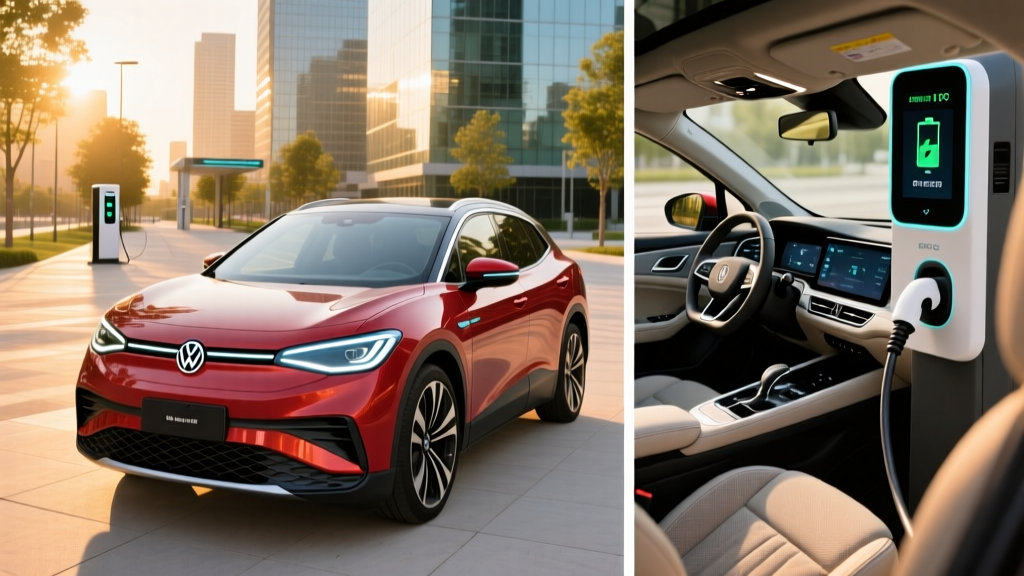
What the 2027 Volkswagen ID.4 Redesign Means for VW's Electric SUV
Volkswagen's ID.4 has been a steady seller since its U.S. launch, but the compact electric SUV segment has moved fast. The Hyundai Ioniq 5, Kia EV6, and Tesla Model Y have all leapfrogged the ID.4 in charging speed and software polish. The 2027 Volkswagen ID.4 redesign aims to close those gaps with a larger battery, faster DC charging, a revamped interior, and VW's next-generation software platform. Because this vehicle is not yet on sale, all figures below are based on VW's announced preliminary specifications, European-market previews, and informed estimates from VW's recent product briefings. We will update this profile with confirmed EPA data once the U.S.-spec ID.4 begins deliveries.
Preliminary Specs: Battery, Range, and Efficiency
The headline change for the 2027 ID.4 is the adoption of VW's upgraded MEB+ (Modular Electric Drive Matrix) platform, which accommodates a larger, more energy-dense battery pack. The outgoing 2026 ID.4 offers a 77 kWh usable (82 kWh gross) NMC lithium-ion pack; the redesigned model is expected to adopt an 86 kWh usable battery using an updated NMC chemistry with higher nickel content for improved energy density.
VW has also confirmed that a base trim with LFP (lithium iron phosphate) chemistry will be offered for the first time in North America. LFP sacrifices some energy density but gains cycle life, thermal stability, and the ability to charge to 100% daily without accelerated degradation — a practical trade-off for commuters who don't need maximum range.
| Spec | Standard Range (LFP est.) | Extended Range (NMC est.) |
|---|---|---|
| Battery (usable) | ~62 kWh (LFP) | ~86 kWh (NMC) |
| EPA Range (est.) | ~220 mi | ~310 mi |
| Max DC Fast Charge | ~175 kW | ~200 kW |
| 10–80% DC Time (est.) | ~25 min | ~22 min |
| Level 2 Home Charge | 11 kW (~37 mi/hr) | 11 kW (~37 mi/hr) |
| Drivetrain | RWD / AWD | RWD / AWD |
| Horsepower (AWD est.) | ~295 hp | ~335 hp |
| 0–60 mph (AWD est.) | ~6.7 sec | ~5.8 sec |
| Efficiency (est.) | ~105 MPGe | ~107 MPGe |
Charging Speed: A Meaningful Upgrade
The outgoing ID.4's biggest competitive weakness has been its DC fast-charging speed — capped at 170 kW with a charge curve that tapers early, resulting in 10–80% times around 30 minutes. The 2027 redesign's move to an estimated 200 kW peak (Extended Range) with a flatter charge curve is the single most impactful improvement for road-trippers.
| Charging Level | Power | Rate / Time | Best For |
|---|---|---|---|
| Level 1 (120V outlet) | ~1.4 kW | ~4 mi/hr | Overnight top-up |
| Level 2 (240V home) | 11 kW | ~37 mi/hr; 0–100% in ~9 hrs | Daily home charging |
| DC Fast Charge | Up to 200 kW | 10–80% in ~22 min | Road trips |
The key nuance here is the charge curve. Peak kW is the maximum rate the battery accepts, but it only sustains that rate at lower states of charge (typically 10–40% SoC). Above 60%, the rate tapers to protect battery health. VW's MEB+ platform reportedly uses improved thermal management to hold higher rates longer — the estimated 22-minute 10–80% time would represent a roughly 25% improvement over the current model. For context, Hyundai's E-GMP platform (Ioniq 5/EV6) achieves ~18 minutes at up to 240 kW, so the ID.4 still trails the segment leaders, but the gap has narrowed significantly.
On the connector front, VW has confirmed the 2027 ID.4 will ship with the NACS (North American Charging Standard) port, granting native access to Tesla Supercharger stations without an adapter. This is a major practical upgrade given that Tesla's Supercharger network remains the most reliable DC fast-charging infrastructure in the U.S., according to J.D. Power's EV charging satisfaction studies.
Performance and Drivetrain
The 2027 ID.4 will continue to offer both rear-wheel-drive (single motor) and all-wheel-drive (dual motor) configurations. The updated APP550 rear motor — already introduced on late-production 2026 models — delivers more torque and efficiency than the original APP310 unit. The AWD variant pairs this with a new front asynchronous motor for an estimated combined output of up to 335 horsepower on the Extended Range model.
The 0–60 mph time of approximately 5.8 seconds for the AWD Extended Range puts the ID.4 in the same ballpark as the Ford Mustang Mach-E Select AWD (5.6 sec) and slightly behind the Hyundai Ioniq 5 AWD (5.1 sec). It's brisk enough for confident highway merging and passing, if not sports-sedan quick.
Towing capacity is expected to remain at 2,700 pounds for AWD models — adequate for a small utility trailer or a pair of dirt bikes, but below the Mach-E's and Model Y's towing ratings. If towing is a priority, the ID.4 is not the segment leader here.
Interior, Cargo, and Technology
VW has acknowledged widespread criticism of the outgoing ID.4's capacitive-touch steering wheel controls and sluggish infotainment software. The 2027 redesign addresses both:
- Physical controls return: The steering wheel switches revert to tactile buttons, and the climate controls gain dedicated physical sliders — a direct response to owner feedback.
- Next-gen infotainment: A larger 12.9-inch touchscreen runs VW's ID. Software 4.0, promising faster response times, wireless Apple CarPlay and Android Auto, and over-the-air update capability.
- Larger head-up display: An augmented-reality HUD projects navigation arrows and speed onto the windshield with improved brightness and field of view.
- Improved materials: Soft-touch surfaces replace some of the harder plastics that drew criticism in the current cabin.
Cargo and passenger space should see modest gains thanks to the MEB+ platform's slightly longer wheelbase:
| Measurement | 2026 ID.4 (Current) | 2027 ID.4 (Est.) |
|---|---|---|
| Cargo (behind 2nd row) | 30.3 cu ft | ~32 cu ft |
| Cargo (seats folded) | 64.2 cu ft | ~67 cu ft |
| Rear legroom | 37.6 in | ~38.5 in |
| Front legroom | 41.1 in | ~41.5 in |
On the driver-assistance front, the 2027 ID.4 will ship with VW's IQ.DRIVE suite including adaptive cruise control with stop-and-go, lane centering, automatic emergency braking, and blind-spot monitoring. VW has previewed a higher-tier Travel Assist with swarm data option that uses anonymized fleet data to improve lane-keeping on poorly marked roads. This remains a SAE Level 2 system — the driver must keep hands on the wheel and eyes on the road at all times. It is not a self-driving system.
Pricing, Trims, and Federal Tax Credit Eligibility
VW has not released official U.S. MSRP figures for the 2027 ID.4, but based on the current model's pricing trajectory and VW's competitive positioning statements, we estimate the following trim structure:
| Trim | Est. MSRP | Est. After §30D Credit* |
|---|---|---|
| Standard (LFP, RWD) | ~$38,000 | ~$30,500–$34,250 |
| Pro (NMC, RWD) | ~$43,000 | ~$35,500–$39,250 |
| Pro S (NMC, AWD) | ~$48,000 | ~$40,500–$44,250 |
| Pro S Plus (NMC, AWD) | ~$53,000 | ~$45,500–$49,250 |
*Tax credit estimates assume partial to full $3,750–$7,500 eligibility under IRS §30D. Actual credit depends on battery sourcing, critical minerals compliance, buyer income, and MSRP caps. See details below.
- MSRP Cap: SUVs must have an MSRP at or below $80,000 to qualify. All 2027 ID.4 trims should clear this threshold comfortably.
- Buyer Income Cap: Modified adjusted gross income must not exceed $150,000 (single), $225,000 (head of household), or $300,000 (joint filers). Check IRS §30D guidelines for current-year limits.
- Battery Sourcing: The full $7,500 credit requires meeting both critical-minerals ($3,750) and battery-component ($3,750) requirements. VW's LFP base trim may face sourcing challenges given China's dominance in LFP supply chains — this could reduce the credit to $3,750 or zero for that trim. The NMC trims, potentially using cells from VW's North American supply chain, are more likely to qualify for the full amount.
- Point-of-Sale Transfer: Under current rules, eligible buyers can transfer the credit to the dealer at purchase, reducing the purchase price directly rather than waiting for a tax refund.
- Consult a Tax Professional: Eligibility rules change and interact with state incentives. Always verify with a qualified tax advisor before relying on credit estimates.
Warranty and Ownership Costs
Volkswagen is expected to carry forward its current EV warranty structure for the 2027 ID.4:
- Battery warranty: 8 years / 100,000 miles, guaranteeing at least 70% capacity retention over that period
- Powertrain warranty: 8 years / 100,000 miles (covers motors, power electronics, reduction gear)
- Bumper-to-bumper: 4 years / 50,000 miles
- Roadside assistance: 4 years / 50,000 miles
The 70% battery retention threshold is industry-standard, matching Hyundai, Kia, and Ford. Tesla's warranty uses the same threshold. If you plan to keep the ID.4 beyond 100,000 miles, note that out-of-warranty battery replacement currently runs $12,000–$18,000 for an NMC pack of this size, though prices are expected to decline as cell costs fall. LFP packs, while cheaper per kWh, have fewer replacement-market precedents in the U.S.
Estimated 5-year total cost of ownership for the ID.4 Pro (NMC, RWD) — assuming 15,000 miles/year, home charging at $0.14/kWh, and no major repairs:
| Category | Estimated Cost |
|---|---|
| Purchase (after est. credit) | ~$37,500 |
| Electricity (75,000 mi) | ~$3,200 |
| Insurance (5 years) | ~$9,500 |
| Maintenance | ~$1,200 |
| Estimated depreciation | ~$14,000 |
| Total (est.) | ~$65,400 |
EV insurance premiums tend to run 15–25% higher than comparable gas vehicles. Get quotes from your insurer before committing — this is an often-overlooked line item that can shift the economics meaningfully.
Who the 2027 ID.4 Is For — and Who Should Look Elsewhere
- You want a comfortable, practical compact SUV with a European driving feel — composed ride quality and quiet cabin are VW strengths
- You value native NACS access to Tesla Superchargers without carrying an adapter
- The LFP base option appeals to you for daily commuting with 100% charge flexibility
- You prefer physical controls over all-touchscreen interfaces
Look elsewhere if:
- You need the fastest DC charging in the segment (Hyundai Ioniq 5 / Kia EV6 still lead)
- You tow more than 2,700 lbs regularly (consider the Model Y or Rivian R2)
- You want a front trunk (frunk) — the ID.4 historically has only a small storage compartment up front, not a true frunk
- You want cutting-edge Level 2+ driver assist with hands-free highway capability (GM's Super Cruise or Ford's BlueCruise offer this today)
Pros, Cons, and Verdict
✓ Pros
- Estimated 310-mile EPA range (Extended Range) is competitive
- NACS port = native Supercharger access
- Return of physical buttons and climate sliders
- LFP option for budget-conscious, daily-charge commuters
- Comfortable ride quality and refined cabin acoustics
- Strong battery and powertrain warranty (8yr/100k mi)
✗ Cons
- DC charging still trails Hyundai/Kia E-GMP by 3–5 minutes
- No true frunk for additional cargo
- 2,700-lb towing capacity lags some competitors
- IQ.DRIVE is capable but not hands-free — no Level 2+ option at launch
- LFP base trim may not qualify for full federal tax credit
- Final U.S. specs and pricing not yet confirmed
The 2027 Volkswagen ID.4 redesign shapes up as a comprehensive mid-cycle correction rather than a ground-up reinvention. VW listened to the most common complaints — slow charging, frustrating touch controls, and laggy software — and addressed each one. The result should be a more competitive compact EV SUV that trades segment-leading specs in any single category for well-rounded practicality, European refinement, and broad trim/price coverage from ~$38,000 to ~$53,000.
For buyers who prioritize comfort, build quality, and Supercharger access over outright charging speed or autonomous-driving aspirations, the redesigned ID.4 deserves a spot on the shortlist. Wait for confirmed EPA figures and a test drive before signing — the gap between preliminary estimates and production reality can matter.
Frequently Asked Questions
What is the real-world range of the 2027 VW ID.4?
Based on preliminary estimates, the Extended Range (NMC, AWD) variant targets an EPA rating of approximately 310 miles. Real-world highway driving at 70+ mph will likely yield 260–280 miles. In cold weather below 30°F, expect 220–240 miles. The Standard Range LFP variant is estimated at ~220 miles EPA, with proportionally lower real-world figures.
How fast does the 2027 ID.4 charge at home and on the road?
At home on a 240V Level 2 charger (11 kW), the Extended Range model adds approximately 37 miles of range per hour, with a full charge taking about 9 hours. On a DC fast charger, the estimated peak rate is 200 kW, with a 10–80% charge in approximately 22 minutes. Actual charge times vary with battery temperature, station output, and state of charge.
Does the 2027 VW ID.4 qualify for the federal EV tax credit?
It is expected to, but the amount varies. Under current IRS §30D rules, the ID.4's MSRP falls well under the $80,000 SUV cap. Buyer income limits apply ($150K single / $300K joint). The NMC trims are more likely to qualify for the full $7,500 credit depending on battery-component and critical-minerals sourcing. The LFP base trim may qualify for a reduced credit ($3,750) or none at all, given LFP supply chain concentration. Always verify eligibility with a tax professional before purchase.
Is the 2027 ID.4 worth buying vs. the Hyundai Ioniq 5 or Tesla Model Y?
It depends on priorities. The Ioniq 5 charges faster (~18 min 10–80%) and offers a more distinctive design. The Model Y has superior cargo space, a frunk, and the largest Supercharger network advantage (though the ID.4's NACS port narrows this gap). The ID.4's strengths are ride comfort, cabin quietness, physical controls, and a broad price range with an LFP entry option. Test-drive all three before deciding — comfort and ergonomics are personal.
What are the biggest changes in the 2027 ID.4 redesign?
The five most significant changes are: (1) larger battery (~86 kWh usable for Extended Range), (2) faster DC charging (up to 200 kW), (3) NACS charging port for native Supercharger access, (4) return of physical steering wheel and climate controls, and (5) upgraded ID. Software 4.0 with a 12.9-inch display and faster processing.
When will the 2027 VW ID.4 be available in the U.S.?
VW is expected to begin U.S. deliveries in late 2026 as an early 2027 model year. Exact timing varies by market and trim. We recommend contacting your local VW dealer for allocation updates as the launch approaches.