Quick Answer: Can You Tow a Camper With an EV?
Yes — but expect your EV's range to drop 40–60% when towing a typical travel trailer. A Ford F-150 Lightning rated for 320 miles EPA will realistically deliver 130–180 miles while pulling a 5,000-lb camper at highway speeds. The math works for weekend trips within ~150 miles of home or along well-served DC fast-charging corridors, but cross-country towing in an EV remains impractical in 2026 due to sparse heavy-duty charger availability and long charge times under load.
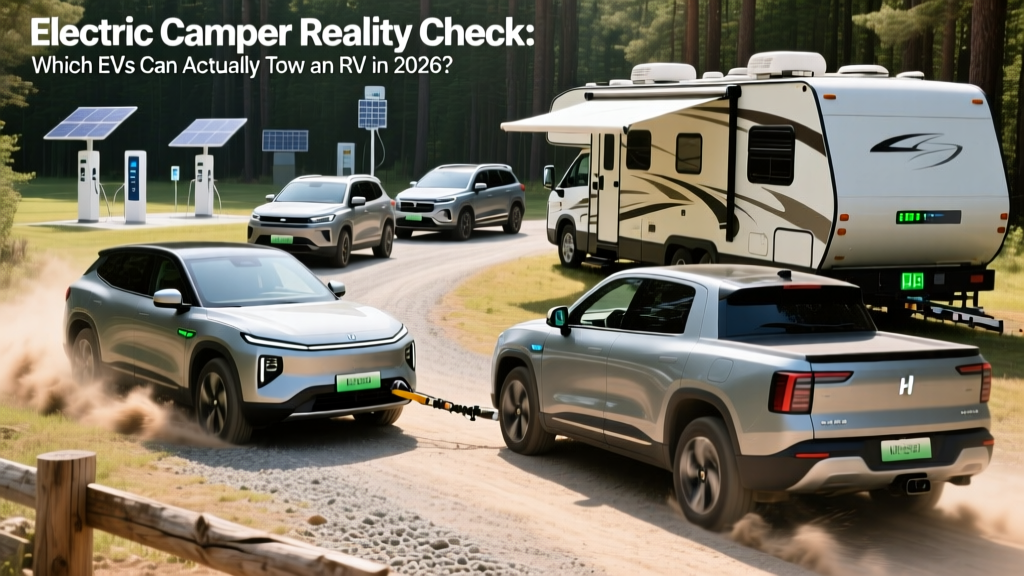
The idea of an electric camper setup — pairing a battery-electric truck or SUV with a travel trailer — has moved from fantasy to partial reality. Automakers now advertise impressive tow ratings: the Rivian R1T can pull 11,000 lbs, the Chevrolet Silverado EV tops 10,000 lbs, and the F-150 Lightning handles 10,000 lbs on higher trims. But tow capacity is only half the equation. The real question buyers need answered is: how far can you actually go, how long does charging take with a trailer attached, and what does it cost compared to a gas or diesel truck?
This guide breaks down the physics, the economics, and the practical ownership reality of towing a camper with an EV in 2026 — with real numbers, not marketing promises.
The Physics Problem: Why Towing Destroys EV Range
Electric vehicles are remarkably efficient in daily driving because they recover energy through regenerative braking and don't waste energy idling. Towing a camper eliminates both advantages.
Here's what happens to energy consumption when you hitch up:
- Aerodynamic drag increases dramatically — a boxy travel trailer acts like a parachute at 65 mph, and EVs are especially sensitive to drag because they're optimized for low coefficients.
- Rolling resistance doubles or triples with the added weight of a loaded trailer (typically 3,500–7,000 lbs for travel trailers).
- Regenerative braking becomes far less effective — you're adding kinetic energy with a heavy rig, and the motor can't recover as much on gentle highway deceleration.
- Elevation changes hit harder. Climbing a 6% grade with 10,000 lbs of combined vehicle and trailer requires massive energy; while regen recovers some on the descent, it's typically 20–30% of what you expended going up.
The result: where a Ford F-150 Lightning Extended Range might achieve 2.0–2.2 kWh/mile in normal driving, expect 3.5–4.5 kWh/mile when towing a 5,000-lb travel trailer at 65 mph on flat terrain. In mountainous terrain or cold weather, that figure can push past 5.0 kWh/mile.
Real-World Towing Range Expectations (2026 Models)
| Vehicle | Battery (kWh usable) | EPA Range (mi) | Est. Towing Range — 5,000 lb trailer (mi) | Est. Towing Range — 7,500 lb trailer (mi) |
|---|---|---|---|---|
| Ford F-150 Lightning Ext. Range | 131 | 320 | 140–180 | 110–140 |
| Rivian R1T Dual-Motor Max Pack | 141 | 352 | 160–200 | 130–160 |
| Chevrolet Silverado EV 4WT | 200+ | 440 | 200–260 | 170–210 |
| Tesla Cybertruck AWD | 123 | 340 | 150–190 | 120–150 |
Note: Towing ranges are estimates based on real-world owner reports and independent testing. Cold weather (below 40°F) reduces these figures an additional 15–25%. Source: fueleconomy.gov for EPA figures.
The Charging Infrastructure Gap for Towing
Range loss is manageable if you can charge quickly and conveniently. Here's the problem: most DC fast-charging stations are designed for passenger vehicles pulling into standard parking spots. When you're towing a 25-foot travel trailer, you face serious logistical challenges.
Pull-through charging is rare. As of early 2026, only a small fraction of public DC fast-charging sites offer pull-through lanes that let you charge without unhitching. Tesla Supercharger stations with pull-through stalls remain limited, and Electrify America and EVgo locations are primarily designed for single-vehicle parking. Love's Travel Stops and Pilot/Flying J have begun adding EV charging with pull-through access, but coverage along rural Interstate corridors is still sparse.
Charging speed under tow-load matters. Here's what a typical charging session looks like:
| Charging Method | Power (kW) | Miles of Towing Range Added per Hour | Practical Use Case |
|---|---|---|---|
| Level 1 (120V standard outlet) | 1.4 kW | ~2–3 miles/hr | Emergency only — unusable for trip charging |
| Level 2 (240V home charger) | 11.5–19.2 kW | ~20–35 miles/hr | Overnight at home or campground with 240V hookup |
| DC Fast Charge (150 kW station) | 150 kW peak | ~150–200 miles/hr (to 80%) | Mid-trip stop — expect 30–45 min for meaningful range |
| DC Fast Charge (350 kW station) | 350 kW peak | ~250–350 miles/hr (to 80%) | Fastest option — Silverado EV can accept 350 kW; F-150 Lightning peaks ~150 kW |
Key distinction: kW (kilowatts) measures charging power — how fast energy flows. kWh (kilowatt-hours) measures battery capacity — how much energy is stored. A 150 kW charger delivers energy faster than a 50 kW charger, but your vehicle's maximum acceptance rate determines actual speed.
A critical factor often overlooked is the charge curve taper. Most EVs peak at their maximum charge rate only between roughly 10–40% state of charge. Above 60%, charging slows significantly, and above 80%, it drops to a trickle. When towing, you'll want to charge from ~15% to ~80% to minimize stop time — but that 80% ceiling means you're leaving range on the table and will need more frequent stops.
EV vs Gas Truck: Towing Cost Comparison
The financial case for an electric camper setup hinges on fuel savings. Let's compare real numbers using a Ford F-150 Lightning Extended Range versus a comparable gas-powered Ford F-150 with the 3.5L EcoBoost V6, both towing a 5,000-lb travel trailer.
| Cost Factor | F-150 Lightning Ext. Range (EV) | F-150 EcoBoost 3.5L (Gas) |
|---|---|---|
| MSRP (2026 base, comparable trim) | ~$72,000 | ~$55,000 |
| Fuel/Energy Cost per Mile (towing) | $0.18–$0.28/mi (DC fast charging at $0.40–$0.55/kWh) | $0.35–$0.45/mi (10–12 mpg at $3.50/gal) |
| Fuel/Energy Cost per Mile (home charging) | $0.06–$0.12/mi (at $0.13–$0.18/kWh) | $0.35–$0.45/mi (same) |
| Estimated Annual Fuel/Energy (5,000 towing miles + 10,000 daily miles) | ~$1,800–$2,600 | ~$3,800–$4,800 |
| Annual Maintenance | ~$300–$500 (no oil changes, less brake wear) | ~$800–$1,200 |
| 5-Year Total Energy + Maintenance | ~$10,500–$15,500 | ~$23,000–$30,000 |
| Federal Tax Credit (§30D) | Up to $7,500 (subject to MSRP, income, and sourcing rules) | $0 |
Assumes home charging for ~70% of non-towing miles. DC fast charging costs vary by network and region. Gas prices based on national average. Tax credit eligibility depends on buyer income, vehicle MSRP caps, and battery sourcing requirements per IRS §30D rules. Consult a tax professional.
The EV wins on per-mile energy cost, especially if you charge at home. Over five years, the Lightning can save $8,000–$15,000 in combined fuel and maintenance. However, the higher purchase price (~$17,000 more upfront) means the break-even point comes around year 3–4 for most owners, depending on how much you tow and your electricity rates.
Which 2026 EVs Are Best for Towing a Camper?
Not all electric trucks and SUVs are equally suited for towing. Battery capacity, charge acceptance rate, and available tow features vary significantly.
Ford F-150 Lightning Extended Range
The 131 kWh (usable) battery and proven 10,000-lb tow rating make this the most mainstream option. Peak DC charging tops out around 150 kW, meaning a 15–80% session takes roughly 40 minutes. The onboard scales and Pro Power Onboard (up to 9.6 kW of 240V output) are genuinely useful at campsites — you can run a microwave, lights, or charge devices without a generator. MSRP starts around $72,000 for the Extended Range XLT.
Rivian R1T (Dual-Motor Max Pack)
With 141 kWh usable and a 352-mile EPA rating, the R1T Max Pack offers the best towing range among currently available EVs. Its 11,000-lb tow rating exceeds the Lightning, and the quad-motor variant provides exceptional traction on unpaved campsite roads. DC fast charging peaks around 220 kW. The gear tunnel is a unique storage advantage. Pricing starts around $87,000 for the Max Pack configuration. The R1T is not currently eligible for the §30D federal tax credit due to MSRP cap limits on pickup trucks ($80,000 threshold).
Chevrolet Silverado EV (4WT / Trail Boss)
The Silverado EV's massive 200+ kWh battery delivers the longest range under load, and its 350 kW peak DC charge acceptance is the fastest in this group — potentially adding 100+ miles of towing range in 15 minutes at a compatible station. The 10,000-lb tow rating and available 4-Wheel Steer aid low-speed maneuvering at tight campsites. MSRP for the 4WT starts around $74,800. The larger battery does mean longer charge times at slower stations.
Tesla Cybertruck AWD
The Cybertruck's 123 kWh battery and 340-mile EPA rating (AWD) provide reasonable towing range, and Tesla's Supercharger network remains the most extensive for road trips. However, the Supercharger network's pull-through availability for trailers is limited, and the Cybertruck's polarizing design makes some campgrounds… interesting. The 11,000-lb tow rating is competitive. Base MSRP is around $80,000 for the AWD model. NACS connector means no adapter needed at Superchargers.
Common Electric Camper Misconceptions
| Myth | Fact |
|---|---|
| "EVs can't tow — they'll run out of battery in 50 miles." | Real-world towing range for a 5,000-lb trailer is 130–260 miles depending on the vehicle, terrain, and weather. That's enough for many weekend trips with one charging stop. |
| "You need a special charger at your campsite." | Most campgrounds offer 30A or 50A 240V outlets (NEMA 14-50). With the right EVSE adapter, you can add 20–35 miles of range per hour while parked overnight — often enough to replenish a day's towing. |
| "Towing will destroy the battery." | High-load towing generates more heat, but modern battery thermal management systems (liquid cooling) handle this well. Long-term degradation from occasional towing is minimal. All major manufacturers warranty batteries for 8 years / 100,000 miles minimum. |
| "Electric trucks cost more to tow with because electricity is expensive." | Even at DC fast-charging rates of $0.48/kWh, EV towing costs $0.20–$0.28/mile versus $0.35–$0.45/mile for gas. Home charging drops that to $0.06–$0.12/mile. |
| "You can't use an EV camper setup for boondocking." | The F-150 Lightning's Pro Power Onboard provides up to 9.6 kW of 240V AC output — enough to power tools, campsite lights, and appliances. This actually makes EVs superior to gas trucks for off-grid power, since you don't need to idle the engine. |
Real-World Ownership: What First-Time EV Towing Buyers Need to Know
If you're considering an electric camper setup, these practical factors will determine whether it works for your lifestyle:
Home Charging Is Nearly Mandatory
Without a Level 2 home charger (240V, 40–80A), you'll rely entirely on public charging — which is slower, more expensive, and logistically harder with a trailer. Budget $500–$2,000 for a quality Level 2 EVSE (like a ChargePoint Home Flex or Tesla Wall Connector) and $800–$3,000 for professional installation by a licensed electrician. If your electrical panel needs an upgrade to 200A service, add $1,500–$4,000.
Map Your Routes Before You Tow
Before any trip, use tools like A Better Routeplanner (ABRP) to simulate your route with trailer weight and expected energy consumption. Identify DC fast-charging stations with pull-through access or wide parking. Apps like PlugShare let you filter for stations that accommodate trailers. Plan to charge more often than you think — arriving at a charger with 10% remaining is stressful when your next option is 80 miles away.
Cold Weather Compounds the Problem
Battery efficiency drops 15–30% in temperatures below 40°F due to increased internal resistance and cabin/trailer heating demands. If you tow in winter, reduce your expected range by an additional 20–25% on top of the towing penalty. Preconditioning the battery before fast charging (most EVs do this automatically when you navigate to a charger) helps maintain charge speed.
Insurance Costs More for EVs
EV insurance premiums run 15–25% higher than equivalent gas vehicles due to higher repair costs and battery replacement values. Towing adds liability exposure. Get quotes before purchasing — the annual premium difference ($300–$600/year) affects your total cost of ownership calculation.
Decision Framework: Is an Electric Camper Setup Right for You?
Choose an EV Towing Setup If:
- Your typical towing trips are within 150 miles of home (round-trip ~300 miles with one charge stop)
- You have or can install a Level 2 home charger (240V / 50A+)
- You camp at established campgrounds with electrical hookups (30A/50A)
- You tow 3–8 times per year rather than every weekend
- You value off-grid power capability (Pro Power Onboard / V2L) for running campsite equipment
- Your daily driving (non-towing) is under 250 miles and benefits from home charging savings
Stick With a Gas or Diesel Truck If:
- You regularly tow 300+ miles one-way through rural areas with sparse DC fast-charging
- You tow heavy fifth-wheel trailers (8,000+ lbs) on long cross-country trips
- You cannot install a home charger (apartment living, no dedicated parking)
- You frequently tow in extreme cold (below 20°F) over mountain passes
- Your budget can't absorb the $15,000–$25,000 price premium over a comparable gas truck
The Hybrid Alternative
If you're not ready for full electric towing, consider that no mainstream PHEV trucks currently offer meaningful tow ratings. The hybrid option in 2026 is primarily the Ford F-150 PowerBoost hybrid, which delivers ~22 mpg combined while towing (versus ~10–12 mpg for the EcoBoost gas model) without range anxiety. It's a strong middle ground: lower fuel cost than gas, no charging infrastructure dependency, and a lower purchase price than EV.
Frequently Asked Questions
Can I charge my EV at a campground?
Most campgrounds with 30A or 50A electrical hookups can provide Level 2 charging if you bring a compatible EVSE with the right adapter (NEMA 14-50 is most common). Expect to add 20–35 miles of range per hour at 50A/240V. That's typically enough to fully recharge overnight for your drive home. Confirm the campground's outlet type before your trip.
Does towing a camper void my EV warranty?
No. Towing within the manufacturer's rated capacity is a normal use case covered under the standard vehicle warranty and the 8-year/100,000-mile battery and powertrain warranty required for all EVs sold in the US. However, damage from exceeding the tow rating or improper hitch setup is not covered.
What's the lightest camper I can tow with an EV?
Teardrop trailers and small pop-up campers weighing 1,500–2,500 lbs impose the least range penalty — expect only a 20–30% range reduction rather than 50%. Brands like nuCamp TAB, Scamp, and Aliner offer models in this range. If maximizing EV towing range is your priority, go as light and aerodynamic as possible.
Do I qualify for the $7,500 federal tax credit on an electric truck?
Eligibility for the §30D Clean Vehicle Credit depends on multiple factors: the vehicle's MSRP must be under $80,000 for trucks/vans/SUVs, your modified adjusted gross income must fall below IRS thresholds ($150,000 single / $300,000 joint), and the vehicle must meet battery critical-mineral and component sourcing requirements. The credit can now be transferred to the dealer at point of sale as an immediate price reduction. Check current eligibility at fueleconomy.gov and consult a tax professional for your specific situation.
How does a gas generator at a campsite compare to an EV's onboard power?
A Honda EU2200i generator produces 2.2 kW of continuous power and requires gasoline, produces noise (53–59 dB), and emits exhaust. The F-150 Lightning's Pro Power Onboard delivers up to 9.6 kW silently with zero on-site emissions. For most campsite needs — lights, a small fridge, laptop charging, even an electric grill — the EV's battery is vastly superior. You'd need multiple generators to match 9.6 kW.
Will towing reduce my EV battery's lifespan?
Occasional towing within rated limits has negligible impact on long-term battery health. Modern liquid-cooled battery packs manage thermal loads effectively. Data from high-mileage EVs shows typical degradation of 8–12% over 100,000 miles with mixed use including towing. The 8-year battery warranty provides protection against premature failure.
The electric camper lifestyle is no longer theoretical — it's a workable reality for a specific type of camper: the weekend warrior who stays within ~150 miles of home, charges at home between trips, and values silent, emission-free campsite power. For long-haul RV enthusiasts who regularly cover 400+ miles with a heavy trailer, gas and diesel trucks remain the pragmatic choice in 2026. The infrastructure will improve, battery energy density will increase, and pull-through charging will expand — but today, honest range expectations and route planning are the difference between a great EV camping experience and a stressful one.