Quick Answer: Should You Wait for the 2027 Toyota Highlander EV?
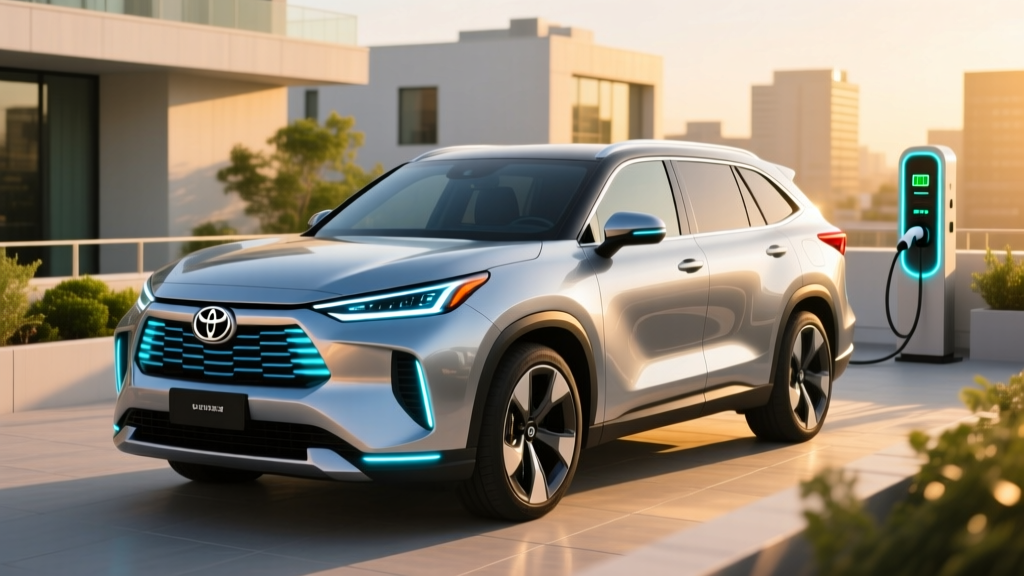
The 2027 Toyota Highlander EV is not yet on sale. Toyota has confirmed a battery-electric three-row SUV is in development for the North American market, expected to ride on the company's next-generation EV platform. Based on Toyota's published roadmap and competitive positioning, we project 270–310 miles of EPA range, a base MSRP between $50,000–$55,000, and a potential debut in late 2026 as a 2027 model. If you need a three-row EV now, the Kia EV9 and Hyundai Ioniq 9 are already available. If you can wait 12–18 months and want Toyota's reliability reputation plus a likely competitive price, the Highlander EV is worth tracking — but no final specs are confirmed.
Families shopping the three-row SUV segment have watched Toyota dominate with the gas Highlander and the hybrid Grand Highlander for years. But in the battery-electric space, Toyota has been conspicuously quiet. That's about to change. The 2027 Toyota Highlander EV represents the company's most significant electric family hauler yet — and search interest is already surging as buyers anticipate how it will stack up against established players.
Here's what we know from Toyota's official announcements, industry reporting, and competitive analysis — and what remains to be confirmed before production begins.
Projected Specs: Range, Battery, and Charging for the Highlander EV
Toyota has not published final specifications for the Highlander EV. However, the company's next-generation EV platform — previewed in concept form and discussed in multiple investor briefings — gives us strong indicators of what to expect. Toyota has committed to a new dedicated EV architecture with improved energy density and a target range of over 600 km (approximately 370 miles) on its most advanced models, though a three-row SUV carrying more weight will likely land below that ceiling.
| Spec | Projected Figure | Notes |
|---|---|---|
| EPA Range | 270–310 mi (est.) | Varies by trim/drivetrain; real-world highway likely 230–270 mi |
| Battery Capacity | ~90–100 kWh usable | Expected NMC chemistry for energy density in a large SUV |
| Peak DC Fast Charge | ~200–250 kW | 10–80% in est. 22–28 min; charge curve tapers significantly above 80% |
| Level 2 Charging | ~11 kW (est.) | Full charge overnight (~9–10 hours from empty) |
| Horsepower | ~300–400 hp (AWD) | Dual-motor AWD expected as standard or widely available |
| 0–60 mph | ~5.5–6.5 sec (est.) | Competitive with gas V6 Highlander but not a performance EV |
| Towing Capacity | 3,500–5,000 lb (est.) | Towing will reduce range by 30–50% |
| Base MSRP | $50,000–$55,000 (est.) | Final pricing TBD; subject to §30D SUV MSRP cap of $80,000 |
How the Highlander EV Compares to Gas and Hybrid Alternatives
The Highlander EV won't exist in a vacuum. Toyota's own lineup already offers the gas Highlander and the Grand Highlander Hybrid — both proven sellers. Here's how the projected EV stacks up against its stablemates and key EV competitors using available data.
| Metric | 2027 Highlander EV (Proj.) | Grand Highlander Hybrid | Kia EV9 (AWD) | Gas Highlander (V6) |
|---|---|---|---|---|
| EPA Range / Tank Range | ~270–310 mi | ~530 mi | 270–304 mi | ~480 mi |
| Efficiency | ~85–95 MPGe | 36 MPG combined | 85–89 MPGe | 24 MPG combined |
| Base MSRP | ~$50,000–$55,000 | ~$46,000 | $56,395 | ~$40,000 |
| Fuel/Energy Cost per Mile | $0.04–$0.06 (home) | $0.10–$0.12 | $0.04–$0.06 (home) | $0.14–$0.17 |
| Federal Tax Credit | Up to $7,500 (if eligible) | N/A | Up to $7,500 (if eligible) | N/A |
| Maintenance (5-yr est.) | $1,500–$2,000 | $3,000–$3,500 | $1,500–$2,000 | $3,500–$4,500 |
Sources: fueleconomy.gov for EPA data on current models; Kia USA for EV9 pricing. Highlander EV figures are projected estimates and subject to change.
Real Costs and Savings: 5-Year Ownership Breakdown
Sticker price is only part of the equation. The case for the Highlander EV — or any EV — depends on total cost of ownership. Below is a projected 5-year/75,000-mile comparison assuming home Level 2 charging, 15,000 miles per year, and a national average electricity rate of $0.16/kWh.
| Cost Category | Highlander EV (est.) | Gas Highlander V6 |
|---|---|---|
| Purchase Price (base) | $53,000 | $40,000 |
| Federal Tax Credit (§30D) | −$7,500 (if eligible) | $0 |
| Effective Purchase | $45,500 | $40,000 |
| Energy/Fuel (75k mi) | $3,400 (home charging) | $11,250 ($3.50/gal, 24 MPG) |
| Maintenance | $1,800 | $4,000 |
| Insurance (5-yr est.) | $9,500 | $7,500 |
| Home Charger Install | $1,200 | $0 |
| 5-Year Total | ~$61,400 | ~$62,750 |
The numbers suggest the EV roughly breaks even or saves modestly over five years if you qualify for the full federal tax credit and charge primarily at home. If you rely on public DC fast charging (which averages $0.35–$0.50/kWh at networks like Electrify America), your energy costs could double to $6,000–$7,000, tipping the balance toward gas.
Federal Tax Credit Eligibility: §30D Rules for 2026–2027
The IRS §30D Clean Vehicle Credit can reduce the effective price by up to $7,500 — but eligibility hinges on several requirements that change and should be verified at the time of purchase:
- MSRP Cap: SUVs must have a base MSRP at or below $80,000. The Highlander EV is expected to clear this comfortably.
- Buyer Income Limits: Modified AGI must not exceed $300,000 (joint), $225,000 (head of household), or $150,000 (single).
- Battery Sourcing: Critical minerals and battery components must meet escalating domestic/free-trade-partner sourcing thresholds. Toyota's supply chain compliance for this specific model is unconfirmed.
- Point-of-Sale Transfer: As of 2024, eligible buyers can transfer the credit to the dealer for an immediate price reduction at purchase rather than waiting to claim it on their tax return.
- Final Assembly: The vehicle must be assembled in North America. Toyota's planned production location for the Highlander EV has not been officially confirmed, though the company's major US plants (Kentucky, Indiana) are likely candidates.
Important: Always verify current-year eligibility on IRS.gov and consult a tax professional. Rules have shifted annually and may change again before the Highlander EV goes on sale.
Real-World Ownership: What First-Time EV Buyers Should Know
If you've never owned an EV, the transition involves practical shifts that spec sheets don't capture. Here's what matters for a family-sized electric SUV:
Home Charging Is Non-Negotiable for Most Buyers
Public DC fast charging works for road trips, but 80–90% of EV charging happens at home. For the Highlander EV, expect to install a Level 2 home charger (240V, 40–48 amps) to add roughly 30–35 miles of range per hour of charging. A full overnight charge from 20% to 100% would take approximately 8–10 hours.
Installation costs vary dramatically: $500–$1,200 if your electrical panel is close to the garage with capacity to spare, but $2,000–$4,000+ if you need a panel upgrade (common in older homes with 100-amp service). Get a licensed electrician's quote before committing to the vehicle.
Road Trips Require Planning
A three-row family SUV will inevitably see highway miles. With a projected 270–310 miles of EPA range, expect 220–260 miles of real-world highway range before needing a charge stop. DC fast charging at 200–250 kW peak can add 150+ miles in 15–20 minutes — but the charge curve tapers significantly above 80% SoC, so the last 20% takes nearly as long as the first 60%.
Toyota's charging network partnerships (currently including EVgo and others) will be critical. Check whether your common routes have reliable DC fast chargers before buying.
Cold Weather Hits Range Hard
Lithium-ion batteries lose efficiency in freezing temperatures, and cabin heating draws substantial energy. In sustained sub-30°F conditions, expect 15–30% range reduction. A 300-mile EPA rating could drop to 210–250 miles in a Minnesota January. A heat pump (which Toyota has been adopting on newer EVs) helps but doesn't eliminate the loss.
Common Misconceptions About the Highlander EV
| Myth | Fact |
|---|---|
| "It will get 400 miles of range like a Tesla." | Extremely unlikely for a heavy three-row SUV at Toyota's projected price point. Expect 270–310 miles EPA. Only premium-priced large EVs (Rivian R1S Max, Lucid Gravity) approach 400 miles. |
| "I'll save $10,000 over gas in five years." | Savings are real but modest: approximately $1,000–$2,000 over 5 years after accounting for higher purchase price, insurance, and home charger installation. The tax credit is what makes the math work. |
| "Toyota's EV will be as reliable as their gas cars." | Toyota's gas reliability is legendary, but their EV track record is thin (the bZ4X had a rocky launch with a recall). Wait for early reliability data and warranty terms before assuming parity. |
| "I can charge it on any public charger." | Connector type matters. Toyota has been transitioning to NACS (Tesla's connector) for future models, but final connector spec for the Highlander EV is unconfirmed. This determines whether you'll need adapters for CCS or Supercharger networks. |
| "The battery will need replacing in a few years." | Modern EV batteries are engineered for 200,000+ miles with 70–80% capacity retention. Federal law mandates a minimum 8-year/100,000-mile battery warranty. Toyota is expected to match or exceed this. |
Decision Framework: Should You Wait, Buy Now, or Choose Hybrid?
If/Then Buying Guide
Wait for the 2027 Highlander EV if:
- You have reliable home charging access (garage or driveway with panel capacity)
- You drive 12,000+ miles per year (high mileage maximizes fuel savings)
- You can wait 12–18 months for availability and early-production unknowns
- You qualify for the §30D tax credit based on income limits
- You value Toyota's dealer network and long-term resale reputation
Buy the Kia EV9 or Hyundai Ioniq 9 now if:
- You need a three-row EV today and can't wait
- You want confirmed specs, EPA ratings, and real-world reviews to base your decision on
- The EV9's 270–304 mile EPA range and ~$56,000 starting price work for your budget
Choose the Grand Highlander Hybrid instead if:
- You don't have home charging access or your apartment/condo doesn't allow charger installation
- You regularly drive 400+ mile road trips in areas with sparse charging infrastructure
- You live in extreme cold (sustained below 10°F) where range loss compounds
- Your budget is under $45,000 and you want maximum range per dollar
- You tow frequently (towing with an EV can cut range in half)
Stick with the gas Highlander if:
- You drive fewer than 8,000 miles per year (fuel savings won't offset EV premium)
- You plan to keep the vehicle only 2–3 years (EV depreciation is still uncertain)
Frequently Asked Questions
When will the 2027 Toyota Highlander EV be available to buy?
Toyota has not announced an exact on-sale date. Based on the company's EV roadmap and typical production timelines, a late-2026 reveal with early-2027 deliveries is a reasonable projection. Reservations and pre-order windows may open several months before first deliveries.
Will the Highlander EV have three rows of seating?
Yes — the Highlander EV is positioned as a three-row family SUV to compete with the Kia EV9 and the gas Highlander. Expect seating for 6–7 passengers, though third-row space in EV SUVs tends to be tighter than in body-on-frame vehicles due to battery packaging.
What battery chemistry will Toyota use?
Unconfirmed. For a large, range-focused SUV, NMC (nickel manganese cobalt) chemistry is most likely due to its higher energy density. LFP (lithium iron phosphate) is cheaper and more durable over thousands of cycles but is heavier per kWh — better suited to smaller vehicles or base trims where cost matters more than maximum range. Toyota may offer both chemistries across different trims.
Will the Highlander EV support Tesla Superchargers?
Toyota has announced adoption of the NACS (North American Charging Standard) connector for future EVs. If the Highlander EV ships with a native NACS port, it will access Tesla's Supercharger network directly. If it ships with CCS, an adapter will be required. This is a critical detail to confirm before purchase — NHTSA and Toyota's official channels will have final word.
How does the Highlander EV compare to the Toyota bZ4X?
The bZ4X is a smaller, two-row crossover with ~222–252 miles of EPA range and a ~$43,000 base price. The Highlander EV will be significantly larger, more powerful, longer-ranged, and more expensive — targeting a completely different buyer. Think of it as the difference between a RAV4 and a Highlander in gas terms.
What will insurance cost for the Highlander EV?
EV insurance premiums typically run 15–25% higher than comparable gas vehicles due to higher repair costs, specialized parts, and elevated vehicle values. For a ~$53,000 SUV, expect annual premiums of $1,800–$2,400 depending on your driving record, location, and coverage levels. Get quotes from multiple insurers before purchasing.
Is Toyota's EV warranty competitive?
Toyota's current EV battery warranty (on the bZ4X) covers 8 years/100,000 miles with a 70% capacity retention threshold — the federal minimum. Some competitors offer 10 years or higher retention guarantees. Toyota's final warranty terms for the Highlander EV have not been announced and are worth comparing carefully against rivals when they're published.
Disclaimer: All specifications, pricing, and availability for the 2027 Toyota Highlander EV are preliminary projections based on Toyota's public roadmap, industry analysis, and competitive positioning as of early 2026. Final specs, MSRP, and tax credit eligibility will be determined by Toyota and the IRS at time of sale. Always verify with official sources before making a purchase decision.