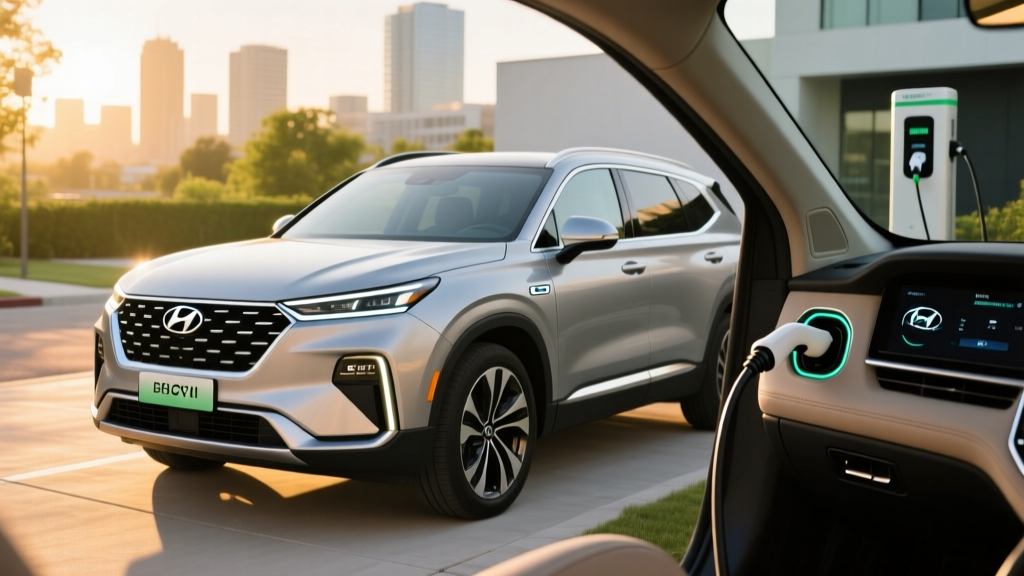
What Is the 2027 Hyundai Santa Fe EREV?
The 2027 Hyundai Santa Fe EREV (Extended-Range Electric Vehicle) represents a new propulsion strategy for Hyundai in the North American market. Unlike a plug-in hybrid where both the electric motor and gasoline engine can mechanically drive the wheels, an EREV uses a gasoline engine solely as a generator to recharge the battery or supply electricity to the drive motors. The wheels are always driven by electricity. Think of it as an EV that carries its own power plant, eliminating range anxiety while preserving the smooth, instant-torque driving feel of a battery-electric vehicle.
Hyundai has confirmed the Santa Fe EREV for the 2027 model year, with U.S. sales expected to begin in late 2026. Final EPA certification numbers are not yet published, but Hyundai's Korean-market disclosures and powertrain announcements give us a solid basis for projected specifications. This preview is built on those announced figures, Hyundai's existing EREV technology deployed in other markets, and the regulatory framework buyers will face at launch.
Projected Range, Battery, and Efficiency
The core appeal of the EREV architecture is a large battery that covers most daily driving on electricity alone, with a gasoline range-extender that kicks in for longer trips. Hyundai has indicated the Santa Fe EREV will carry a battery pack in the range of 30–35 kWh (usable), targeting an electric-only EPA range of approximately 60–70 miles. That's roughly double the electric-only range of most current PHEVs in this segment and enough to cover the average American commute (approximately 35 miles round-trip) with margin to spare.
Projected EPA electric-only range: ~65 miles
Real-world expectation (mixed driving): ~50–58 miles
Highway-heavy at 75 mph: ~42–48 miles electric-only
Cold weather (below 32°F): ~35–45 miles electric-only (LFP chemistry is more resistant to cold degradation, but cabin heating still draws heavily from the pack)
Total range (electric + full tank): Projected 500+ miles combined
Once the battery depletes to its buffer threshold, the 1.5-liter turbocharged range-extender engine activates to generate electricity. Hyundai projects combined fuel economy in range-extender mode at approximately 33–36 MPG — competitive with the conventional Santa Fe Hybrid. In electric mode, efficiency is expected around 95–105 MPGe (approximately 32–35 kWh per 100 miles), though final EPA testing will confirm these numbers.
Hyundai has not confirmed battery chemistry for the U.S.-market Santa Fe EREV. Given Hyundai's increasing adoption of NMC (nickel-manganese-cobalt) chemistry in its larger PHEV and EV platforms for energy density reasons, NMC is the likely choice here — though an LFP variant for lower trims is possible given the industry trend. We will update when Hyundai confirms.
| Specification | Projected Figure |
|---|---|
| Battery Capacity (usable) | ~30–35 kWh |
| Battery Chemistry | Likely NMC (unconfirmed) |
| Electric-Only EPA Range | ~60–70 miles (projected) |
| Total Range (EV + Gas) | ~500+ miles |
| Range Extender Engine | 1.5L Turbo I4 (generator only) |
| Combined MPG (EREV mode) | ~33–36 MPG |
| Electric Efficiency | ~95–105 MPGe |
| Drivetrain | AWD (dual-motor expected) |
| Horsepower (combined) | ~270–290 hp (projected) |
| 0–60 mph | ~6.5–7.0 seconds (est.) |
| Base MSRP | ~$47,000–$50,000 (projected) |
| Battery Warranty | 10 yr / 100,000 mi (expected) |
Charging Speed: DC Fast Charge and Home Level 2
Charging an EREV is where the architecture shows both its strength and its compromise. Because the battery is roughly one-third the size of a full BEV's pack, DC fast charging times are shorter in absolute terms — but the peak charge rate is also lower because there are fewer cells to absorb current.
Based on Hyundai's EREV platform disclosures, expect a peak DC fast-charge rate of approximately 50–70 kW. That sounds modest next to a 250 kW BEV, but applied to a ~33 kWh battery, it translates to a 10–80% charge in roughly 25–30 minutes. The charge curve on a smaller NMC pack will taper noticeably above 70% state of charge, so plan for the last 10–20% to add time on longer road trips if you're topping off.
| Charging Level | Power / Rate | 10–80% Time / Miles Added |
|---|---|---|
| Level 1 (120V household) | ~1.4 kW | ~4–5 miles of EV range per hour |
| Level 2 (240V, 32A) | ~7.7 kW | Full EV range in ~4–5 hours |
| Level 2 (240V, 48A) | ~11.5 kW | Full EV range in ~3 hours |
| DC Fast Charge | ~50–70 kW peak | 10–80% in ~25–30 min |
Practical charging insight: For daily use, a home Level 2 charger is ideal. Overnight charging will easily replenish the full 60–70 miles of electric range, meaning most owners will rarely visit a gas station during the work week. The smaller battery actually makes home charging more practical — you don't need a 48-amp hardwired unit to wake up to a full "tank." A standard 32-amp Level 2 unit on a NEMA 14-50 outlet handles this pack comfortably.
On road trips, the EREV's advantage is that you never need to stop to charge. Fill the gas tank in five minutes and keep driving. The DC fast-charge capability is there for opportunistic top-ups — at a rest stop, a grocery store, or while the kids are at soccer practice — but it's not the lifeline it is for a pure BEV.
Performance and Drivetrain
The EREV powertrain sends all drive force through electric motors. Hyundai is expected to offer the Santa Fe EREV with a dual-motor all-wheel-drive configuration, combining a front motor and rear motor for a projected system output of 270–290 horsepower. Because the gasoline engine is decoupled from the wheels, it can run at its most efficient RPM regardless of vehicle speed — which is the fundamental efficiency advantage of the series-hybrid/EREV layout.
Acceleration should land in the 6.5–7.0 second range for 0–60 mph, putting it in line with the current Santa Fe Hybrid and a beat behind the torque-rich instant response of Hyundai's Ioniq 5. The trade-off for carrying both a battery pack and a generator engine is weight — expect a curb weight north of 4,600 pounds, which will be noticeable in cornering but contributes to a planted, comfortable highway ride.
Regenerative braking will offer multiple levels, likely controlled via steering-wheel paddles (a Hyundai signature), allowing drivers to dial in anything from mild coasting to aggressive one-pedal-style deceleration. The transition between regen and friction braking in EREV platforms is generally seamless, though we'll evaluate the calibration in our full drive review once production vehicles are available.
Interior Space, Cargo, and Technology
The Santa Fe EREV is expected to share the redesigned Santa Fe's boxy, upright exterior and its three-row, up-to-seven-passenger cabin. The EREV battery pack will be mounted under the floor, and Hyundai's engineers have indicated that packaging preserves the same cargo and passenger dimensions as the conventional Santa Fe:
- Cargo volume (behind 3rd row): ~14.5 cu ft
- Cargo volume (behind 2nd row): ~40.5 cu ft
- Cargo volume (max, seats folded): ~79.6 cu ft
- Second-row legroom: ~40.4 inches
- Third-row legroom: ~30.0 inches (best for children or short trips)
The EREV powertrain does not intrude on cargo space because the engine-generator module occupies the same engine bay as the conventional turbo four-cylinder, and the underfloor battery is packaged within the existing platform's structure. This is a key advantage over some PHEVs that sacrifice cargo room to battery placement.
Infotainment and Driver Assistance
Expect Hyundai's latest dual-screen setup: a 12.3-inch digital instrument cluster paired with a 12.3-inch touchscreen infotainment display, wireless Apple CarPlay and Android Auto, and over-the-air (OTA) software update capability. The EREV will feature a dedicated energy-flow display showing real-time power routing between the battery, motors, and range-extender engine — useful for drivers who want to maximize electric operation.
Hyundai's Highway Driving Assist 2 (HDA2) will be standard, combining adaptive cruise control with stop-and-go, lane-centering, and lane-change assist. HDA2 is a SAE Level 2 driver-assistance system — it requires the driver to remain attentive with hands on the wheel at all times. It is not autonomous driving, and Hyundai does not market it as such.
Hyundai is expected to carry forward its industry-leading electrified powertrain coverage: 10 years / 100,000 miles for the high-voltage battery and EREV drive components, and 5 years / 60,000 miles for the new-vehicle limited warranty. The battery warranty typically guarantees capacity retention above 70% of original capacity over the warranty period. Final terms will be confirmed at launch.
Pricing, Trims, and Federal Tax Credit Eligibility
Hyundai has not published official MSRP for the 2027 Santa Fe EREV, but based on positioning above the Santa Fe Hybrid ($39,000–$47,000 range) and below the Ioniq 5 ($42,000+), we project the following trim structure:
| Trim | Projected MSRP | Key Features |
|---|---|---|
| SEL | ~$47,000 | AWD, HDA2, 12.3" displays, heated seats |
| Limited | ~$52,000 | Leather, panoramic sunroof, premium audio |
| Calligraphy | ~$56,000 | Nappa leather, HUD, digital mirrors, captain's chairs |
Does the Santa Fe EREV Qualify for the §30D Federal Tax Credit?
Under current IRS §30D rules, the Santa Fe EREV faces a nuanced eligibility picture. The §30D credit applies to plug-in electric vehicles with a battery capacity of at least 7 kWh — the EREV's ~33 kWh pack clears this bar. However, several conditions apply:
- MSRP cap: SUVs must have an MSRP at or below $80,000. All projected Santa Fe EREV trims fall well under this threshold.
- Buyer income cap: Modified adjusted gross income must not exceed $150,000 (single), $225,000 (head of household), or $300,000 (joint filing).
- Battery component and critical mineral sourcing: The credit is split into two halves ($3,750 each) based on battery component manufacturing and critical mineral sourcing requirements that tighten annually. The exact credit amount — $0, $3,750, or $7,500 — depends on Hyundai's supply chain at time of purchase.
- Point-of-sale transfer: Eligible buyers can transfer the credit to the dealer at purchase, reducing the out-of-pocket price immediately rather than waiting for tax filing.
Because Hyundai manufactures the Santa Fe in both South Korea and (for some trims) at its Montgomery, Alabama plant, North American assembly and battery sourcing compliance will determine the exact credit. We recommend consulting the fueleconomy.gov tax credit lookup tool closer to launch for confirmed eligibility by trim. Tax situations vary — consult a tax professional for your specific case.
Who Should Buy the Santa Fe EREV — and Who Shouldn't?
The EREV architecture serves a specific buyer profile very well, but it isn't the right answer for everyone. Here's a decision framework:
- You want EV driving feel but lack reliable home charging for a full BEV
- Your daily commute is under 60 miles but you take frequent road trips
- You need three rows and AWD without range anxiety
- You live in a cold climate where BEV range drops significantly in winter
- You want to reduce gas consumption without committing to full electrification
- You have reliable home charging and mostly drive under 250 miles — a BEV like the Ioniq 5 or EV9 will have lower running costs
- You want the lowest possible maintenance — EREVs still require oil changes and engine service for the generator
- You want the maximum federal tax credit — BEVs with compliant supply chains may offer a more certain $7,500
- You prioritize sporty handling — the dual powertrain adds weight
Competitor Comparison
The EREV segment is still small in the U.S., but the Santa Fe EREV will compete against both extended-range and plug-in hybrid three-row SUVs:
| Attribute | Hyundai Santa Fe EREV | Toyota Grand Highlander Hybrid MAX | Kia Sorento PHEV |
|---|---|---|---|
| Powertrain Type | EREV (series hybrid) | HEV (parallel hybrid) | PHEV (parallel) |
| Electric-Only Range | ~65 mi | 0 mi (no plug-in) | ~32 mi |
| Total Range | ~500+ mi | ~530 mi | ~420 mi |
| Seating | Up to 7 | Up to 7 | Up to 6 |
| Base Price (est.) | ~$47,000 | ~$54,000 | ~$51,000 |
| Plug-In Capable | Yes | No | Yes |
The Santa Fe EREV's key differentiator is offering roughly double the electric-only range of the Sorento PHEV while maintaining the three-row utility and total-range confidence that neither a pure BEV nor a conventional hybrid can match for this use case.
Frequently Asked Questions
What is the real-world electric range of the 2027 Santa Fe EREV?
Hyundai projects approximately 60–70 miles of EPA-rated electric-only range. In real-world mixed driving, expect 50–58 miles. Highway-heavy driving at 75+ mph will reduce that to roughly 42–48 miles, and cold weather below freezing can drop it to 35–45 miles due to cabin heating demand and reduced battery efficiency. The gasoline range-extender eliminates any range anxiety once the battery buffer is reached.
How fast does the Santa Fe EREV charge?
On DC fast charging, expect a peak rate of 50–70 kW and a 10–80% charge in approximately 25–30 minutes. On a home Level 2 charger (240V, 32A), the full electric range replenishes in about 4–5 hours — easily accomplished overnight. Level 1 (120V) trickle charging adds roughly 4–5 miles of range per hour and can serve as a backup option.
Does the 2027 Santa Fe EREV qualify for the federal EV tax credit?
It is eligible for consideration under IRS §30D as a plug-in vehicle with a battery exceeding 7 kWh. However, the actual credit amount ($0 to $7,500) depends on battery component sourcing, critical mineral requirements, buyer income limits, and the vehicle's MSRP relative to the $80,000 SUV cap. Hyundai's North American production and supply chain decisions will determine the final credit. Check fueleconomy.gov at time of purchase and consult a tax professional.
Is the EREV better than a PHEV or full BEV for a family?
For families with a commute under 60 miles who also take road trips, the EREV offers a compelling middle ground: more electric-only range than a PHEV (meaning more gas-free driving days) without the range limitations of a BEV. However, if you have reliable home charging and rarely drive more than 250 miles between stops, a full BEV will have lower long-term fuel and maintenance costs. The EREV still requires oil changes and engine service for the generator.
What are the biggest pros and cons of the Santa Fe EREV?
- 60+ miles of electric range covers most commutes
- 500+ mile total range eliminates road-trip anxiety
- EV-like smooth acceleration and quiet operation
- Three-row seating with no cargo compromise
- AWD standard with dual electric motors
- Hyundai's 10-year/100,000-mile powertrain warranty
- Heavier than a pure BEV or conventional hybrid
- DC fast-charge rate modest (~50–70 kW)
- Engine-generator requires ongoing maintenance (oil, filters)
- Tax credit eligibility uncertain until supply chain is finalized
- Third-row space is tight for adults
- Higher base price than the Santa Fe Hybrid
Will the range-extender engine be noisy?
In EREV platforms, the generator engine typically runs at a constant, optimized RPM rather than revving with acceleration, which keeps noise levels lower than a conventional engine. Hyundai has indicated active noise cancellation and enhanced sound insulation for the EREV variant. That said, under heavy load (steep grades, full battery depletion, high speed), you will hear the engine — it's a trade-off of the architecture.
This preview is based on manufacturer announcements and projected specifications as of 2026. Final EPA-certified figures, pricing, and tax credit eligibility will be confirmed closer to the vehicle's on-sale date. AutoEdgeView will update this article with verified data upon release.