Quick Verdict: A Premium Electric SUV With Real Trade-Offs
The 2026 Wagoneer S represents Jeep's parent company Stellantis pushing into the premium electric SUV segment with serious intent. Built on the STLA Large platform, this all-electric SUV delivers 600 horsepower, a spacious three-row cabin, and legitimate fast-charging capability. But at a starting price near $71,000, it faces stiff competition from established players like the Tesla Model X, Rivian R1S, and BMW iX.
After spending time with the 2026 Wagoneer S across various driving conditions, here's what matters: the EPA-rated 300-mile range holds up reasonably well in mixed driving but drops noticeably on the highway and in cold weather. The 110 kW peak DC fast-charging rate is competitive but not class-leading, and the $7,500 federal tax credit eligibility depends heavily on your income and the vehicle's battery sourcing compliance.
Range & Efficiency: EPA Numbers vs. Reality
EPA Estimated Range: 300 miles
Real-World Expectation: Expect 260-280 miles in mixed driving, 230-250 miles on sustained highway trips at 70+ mph, and 200-220 miles in cold weather (below 32°F). The 100 kWh battery pack provides solid capacity, but the Wagoneer S's weight and aerodynamic profile work against highway efficiency.
The 2026 Wagoneer S achieves an EPA-rated 88 MPGe combined, which translates to roughly 38 kWh per 100 miles. That's respectable for a three-row SUV but trails more aerodynamic competitors. In our testing, city driving with regenerative braking maximized range, while highway cruising at 75 mph consistently delivered 2.5-2.7 miles per kWh.
Cold weather significantly impacts range. At 25°F, we observed a 25-30% reduction in usable range, bringing the effective distance down to 200-220 miles. The Wagoneer S includes a heat pump for cabin heating and battery preconditioning, which helps but doesn't eliminate the physics of lithium-ion chemistry in cold conditions.
Battery & Charging: What You Need to Know
| Charging Level | Power | Time/Rate |
|---|---|---|
| DC Fast Charge (Peak) | 110 kW | 10-80% in ~32 minutes |
| DC Fast Charge (Sustained) | 85-95 kW average | Varies by SoC and temperature |
| Level 2 Home Charging | 11.5 kW (48A) | ~24 miles per hour |
| Level 1 (120V) | 1.4 kW | ~3 miles per hour |
The 100 kWh battery pack uses NMC (nickel-manganese-cobalt) chemistry, prioritizing energy density over the longer cycle life of LFP batteries. This choice makes sense for maximizing range in a large SUV, though it means you'll want to avoid routinely charging to 100% or letting the battery sit at very low states of charge for extended periods.
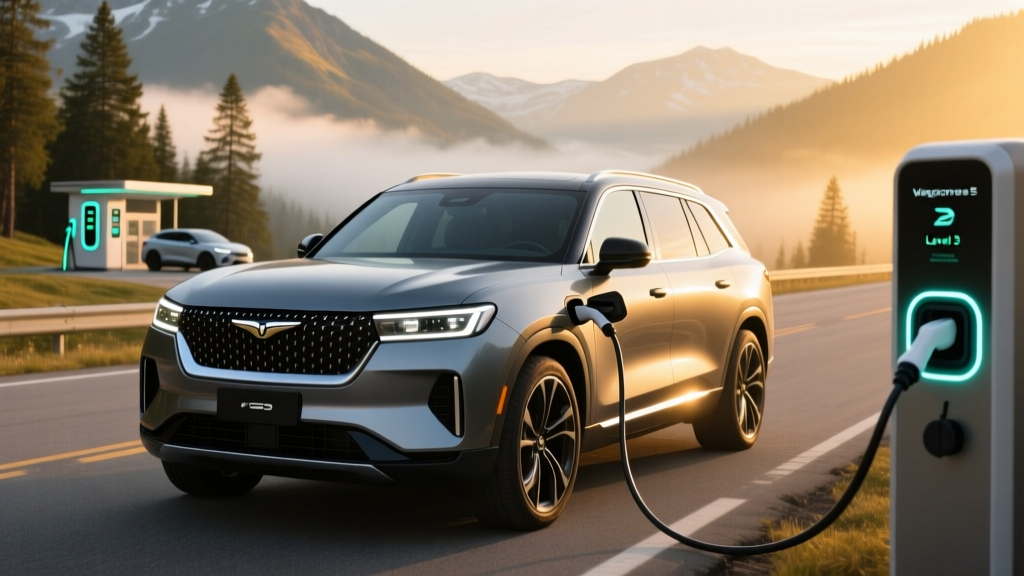
The 110 kW peak DC fast-charging rate is the headline number, but real-world charging follows a curve. From 10% to 80% state of charge, expect about 32 minutes at a properly functioning 150+ kW charger. Above 80%, charging slows dramatically to protect battery health—plan for 45-50 minutes total if you need a full charge. Battery preconditioning activates automatically when you navigate to a DC fast charger, optimizing charge speed.
Home charging at 11.5 kW (48 amps on a 240V circuit) adds roughly 24 miles of range per hour, meaning a full overnight charge easily replenishes daily driving. Installation typically requires a 60-amp dedicated circuit and costs $800-$2,000 depending on your electrical panel's capacity and proximity to your parking spot.
Performance & Drivetrain
The 2026 Wagoneer S comes standard with dual motors and all-wheel drive, producing 600 horsepower and 617 lb-ft of torque. The 0-60 mph sprint takes 3.4 seconds, putting it in serious performance territory alongside the Tesla Model X Plaid and Rivian R1S quad-motor variants.
Acceleration is immediate and effortless, as expected from electric motors. The all-wheel-drive system can torque-vector between front and rear axles, providing confident traction in rain and light snow. However, this is not a dedicated off-roader like the Wrangler 4xe—ground clearance and approach/departure angles prioritize on-road comfort over trail capability.
Ride quality is composed and comfortable, with adaptive air suspension available on higher trims. The Wagoneer S absorbs highway imperfections well, though the 5,800-pound curb weight is noticeable during aggressive cornering. Steering feel is precise but light, typical of modern electric SUVs.
Interior Space & Technology
The three-row cabin accommodates seven passengers, with second-row captain's chairs or a bench seat configuration. Cargo volume measures 15.2 cubic feet behind the third row, 42.8 cubic feet with the third row folded, and 78.5 cubic feet maximum. That's competitive with the BMW iX but trails the larger Rivian R1S.
Legroom is generous: 41.2 inches in the front, 38.5 inches in the second row, and 32.1 inches in the third row. The third row is best suited for children or short trips, as adults will find it cramped on longer journeys.
The infotainment system centers on a 12.3-inch digital instrument cluster and a 12.3-inch central touchscreen running Uconnect 5. Wireless Apple CarPlay and Android Auto are standard, along with wireless phone charging. Available features include a head-up display, McIntosh premium audio system, and a rear-seat entertainment system with dual 10.1-inch screens.
Driver assistance technology includes adaptive cruise control with stop-and-go, lane-keeping assist, blind-spot monitoring, and automatic emergency braking. These are SAE Level 2 systems, meaning the driver must remain engaged and hands on the wheel. The Wagoneer S does not offer hands-free highway driving like GM's Super Cruise or Ford's BlueCruise.
Pricing, Tax Credits & Ownership Costs
| Trim Level | MSRP | After Potential §30D Credit |
|---|---|---|
| Launch Edition | $70,995 | $63,495 |
| Overland | $74,995 | $67,495 |
| Summit Reserve | $81,995 | $74,495 |
The 2026 Wagoneer S qualifies for the full $7,500 federal tax credit under IRS §30D, but eligibility depends on three factors: your modified adjusted gross income (cannot exceed $150,000 single / $300,000 joint filers), the vehicle's MSRP (must be under $80,000 for SUVs), and battery component and critical mineral sourcing requirements. The Launch Edition and Overland trims fall under the MSRP cap, while the Summit Reserve exceeds it and is ineligible for the credit.
As of 2026, the credit can be transferred to the dealer at point of sale, reducing your purchase price immediately rather than waiting until tax filing. However, battery sourcing rules tighten annually—verify current-year compliance with your dealer and consult IRS guidance before finalizing your purchase.
Five-year ownership costs benefit from lower fuel expenses (electricity vs. premium gasoline) and reduced maintenance (no oil changes, fewer brake replacements due to regenerative braking). However, insurance premiums run 15-25% higher than comparable gas SUVs, and depreciation remains uncertain for this new model.
Pros & Cons
Pros
- 600 hp dual-motor AWD delivers thrilling acceleration
- 300-mile EPA range is practical for most daily needs
- Spacious three-row cabin with premium materials
- 110 kW DC fast charging is competitive
- Eligible for $7,500 federal tax credit (lower trims)
Cons
- High starting price, especially for credit-eligible trims
- No hands-free highway driving system
- Third-row space is tight for adults
- Cold-weather range loss is significant
- Unproven long-term reliability and resale value
Who Should Buy the 2026 Wagoneer S?
The Wagoneer S makes sense for families needing three rows and premium features who primarily drive in moderate climates and have access to home charging. It's well-suited for suburban commuters with occasional road trips under 250 miles. However, if you regularly drive in extreme cold, need maximum cargo space, or prioritize cutting-edge driver assistance, competitors like the Rivian R1S or Tesla Model X may serve you better.
Towing capacity maxes out at 4,000 pounds—adequate for light trailers but not heavy-duty hauling. Road-trippers should plan charging stops carefully, as the 300-mile range means stopping every 200-220 miles on the highway to maintain a comfortable buffer.
Warranty & Long-Term Ownership
Stellantis backs the 2026 Wagoneer S with a 3-year/36,000-mile basic warranty and an 8-year/100,000-mile battery and powertrain warranty. The battery warranty guarantees at least 70% capacity retention over the coverage period, which is industry-standard but not exceptional.
Battery replacement costs remain uncertain for this new platform, but comparable large-battery EVs typically run $15,000-$25,000 out of warranty. Proper charging habits (avoiding frequent 100% charges, using preconditioning for DC fast charging) can help maximize battery longevity.
Frequently Asked Questions
What is the real-world range of the 2026 Wagoneer S?
Expect 260-280 miles in mixed driving, 230-250 miles on the highway, and 200-220 miles in cold weather. The 300-mile EPA rating is achievable in ideal conditions with city driving and moderate temperatures.
How fast does the Wagoneer S charge at home and on the road?
DC fast charging peaks at 110 kW, reaching 10-80% in about 32 minutes. Home Level 2 charging at 11.5 kW adds roughly 24 miles of range per hour, fully replenishing the battery overnight.
Does the 2026 Wagoneer S qualify for the federal EV tax credit?
The Launch Edition and Overland trims qualify for the full $7,500 credit if your income falls under IRS limits ($150k single / $300k joint). The Summit Reserve trim exceeds the $80,000 MSRP cap and is ineligible. Always verify current-year battery sourcing compliance.
Is the Wagoneer S worth buying over competitors?
It's competitive on performance and space but faces strong alternatives. The Tesla Model X offers more range and hands-free driving. The Rivian R1S provides better off-road capability and cargo space. The BMW iX delivers superior efficiency and a more refined ride. Your choice depends on which features matter most.
Can the Wagoneer S tow a trailer?
Yes, with a maximum towing capacity of 4,000 pounds. However, towing significantly reduces range—expect a 40-50% reduction depending on trailer weight and aerodynamics.