Quick Verdict: Is the 2026 ID.4 Pro Lease Worth It?
The 2026 Volkswagen ID.4 Pro occupies a specific niche in the compact electric SUV segment: a practical, comfort-oriented daily driver with competitive range, usable fast charging, and strong lease incentives that often undercut purchase pricing. With an EPA-estimated 291 miles of range on its 82 kWh (usable) battery pack, the Pro trim sits as the volume seller in VW's ID.4 lineup — and leasing one through Volkswagen Credit frequently unlocks the full $7,500 federal credit regardless of buyer income, thanks to the commercial lessor loophole under IRS §45W.
But the ID.4 Pro isn't for everyone. Its infotainment software, while improved for 2026, still lags Hyundai/Kia's native systems in responsiveness. And its 175 kW peak DC fast-charging rate, while adequate, trails the 240+ kW capability of rivals like the Ioniq 5 and EV6. If you prioritize comfort, cargo space, and a smooth ride over sporty dynamics and ultra-fast charging, the ID.4 Pro lease deserves serious consideration.
Range, Battery & Real-World Efficiency
Real-World Expectation: 240–270 miles highway (70-75 mph); 200–230 miles in sub-freezing cold weather; 275–290 miles mixed city/suburban driving
The 2026 ID.4 Pro uses an 82 kWh usable (91 kWh gross) lithium-ion battery pack with NMC (nickel-manganese-cobalt) chemistry. VW has carried over this pack architecture from the 2024 refresh, which added thermal management improvements for more consistent charging in cold weather.
On the EPA cycle, the rear-wheel-drive Pro achieves 291 miles. In our experience and aggregated owner data, real-world highway driving at sustained speeds of 70-75 mph yields approximately 240-270 miles before needing a charge. Cold-weather driving (below 32°F) with cabin heating active can drop range to 200-230 miles — a 20-30% reduction typical of NMC packs without a heat pump (the Pro trim does not include VW's optional heat pump; the Pro S adds it).
Efficiency figures from fueleconomy.gov rate the 2026 ID.4 Pro at 104 MPGe combined (city: 111 / highway: 96), translating to approximately 32 kWh per 100 miles. That's competitive with the Ford Mustang Mach-E but trails the Hyundai Ioniq 5's 114 MPGe combined.
| Spec | Value |
|---|---|
| EPA Range (RWD Pro) | 291 miles |
| Battery (Usable / Gross) | 82 kWh / 91 kWh (NMC) |
| MPGe (City / Hwy / Combined) | 111 / 96 / 104 |
| Energy Consumption | ~32 kWh/100 mi |
| Motor / Drivetrain | Single motor RWD |
| Horsepower / Torque | 282 hp / 339 lb-ft |
| 0-60 mph | 7.7 seconds |
| Max DC Fast Charge Rate | 175 kW |
| 10-80% DC Fast Charge | ~28 minutes |
| Level 2 Home Charging Rate | 11 kW (~37 mi/hr) |
| Cargo Volume (rear seats up / down) | 30.3 / 64.2 cu ft |
| Rear Legroom | 37.6 inches |
| Base MSRP (Pro RWD) | $44,195 |
| Battery Warranty | 8 yr / 100,000 mi (70% capacity) |
Charging Speed: DC Fast & Home Level 2
Charging capability is where the ID.4 Pro shows its pragmatic engineering — adequate for most use cases, but not class-leading.
| Charging Level | Power (kW) | Rate | Time / Notes |
|---|---|---|---|
| Level 1 (120V household) | ~1.4 kW | ~4 mi/hr | ~70 hrs for full charge; emergency/trickle only |
| Level 2 (240V home) | 11 kW (48A) | ~37 mi/hr | ~8-9 hrs 10-100%; overnight capable |
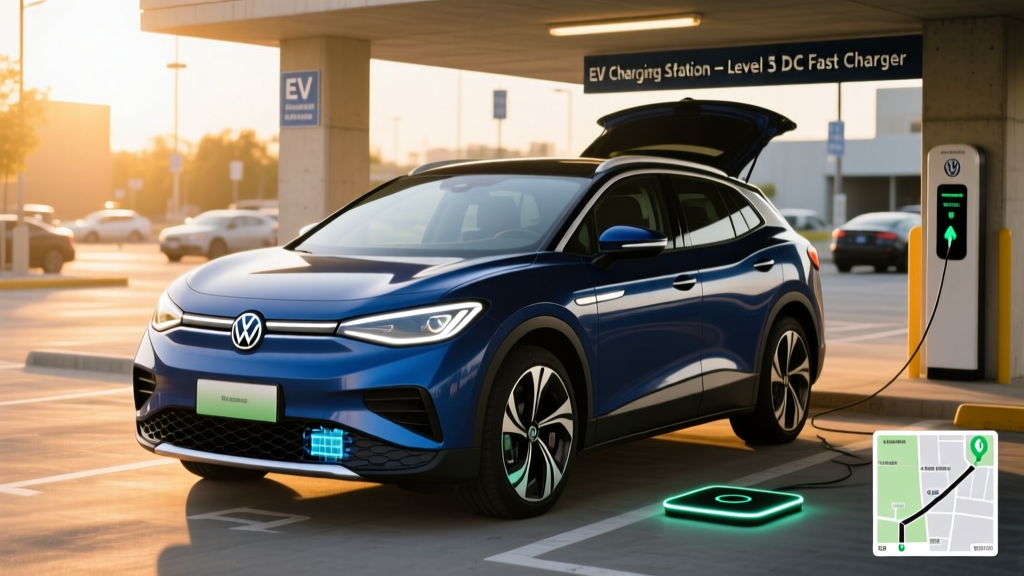
| DC Fast Charge (peak) | 175 kW | ~230 mi/hr at peak | 10-80% in ~28 min; tapers above 80% |
The 175 kW peak DC fast-charge rate means the ID.4 Pro can add roughly 70 miles of range in 10 minutes under ideal conditions at a 180+ kW station. However, the charge curve tapers noticeably after 60% State of Charge (SoC), and charging from 80-100% adds another 25-30 minutes. On a road trip, plan your stops around 10-80% sessions for the best time efficiency.
At home, the onboard 11 kW AC charger is a strong point — it can replenish the full 82 kWh usable pack in about 8-9 hours on a 48-amp Level 2 circuit. Most owners will arrive home, plug in, and wake up to a full battery every morning. Home Level 2 installation typically costs $800-$2,000 depending on panel capacity and run length (consult a licensed electrician for your specific setup).
The ID.4 Pro uses the CCS1 connector for DC fast charging. VW has confirmed that 2026 model-year ID.4 vehicles will ship with NACS (Tesla-style) charge ports in the North American market, granting native access to the Tesla Supercharger network — a significant advantage over 2024-2025 models that required an adapter.
Performance & Driving Dynamics
The 2026 ID.4 Pro sends 282 horsepower and 339 lb-ft of torque to the rear wheels via a single permanent-magnet synchronous motor. The 0-60 mph time of 7.7 seconds is respectable for a family crossover — it merges onto highways confidently and passes without drama — but it won't win stoplight drag races against the 340-hp Hyundai Ioniq 5 or the 480-hp Ford Mach-E GT.
Where the ID.4 Pro excels is ride quality. VW tuned the suspension for comfort over sportiness, and the result is a composed, quiet highway cruiser that absorbs bumps with a maturity that rivals luxury crossovers. Steering is light and precise, if devoid of feedback. The turning circle of 31.5 feet makes it surprisingly maneuverable in urban environments.
Regenerative braking is adjustable via steering-wheel paddles (D, B, and intermediate levels), but the ID.4 does not offer true one-pedal driving to a full stop in its default mode — a notable omission compared to Nissan, Chevrolet, and Tesla implementations. You'll still use the brake pedal regularly.
Interior, Tech & Cargo Space
The ID.4 Pro's cabin prioritizes spaciousness and simplicity. Rear-seat legroom of 37.6 inches beats most compact SUV competitors, and the flat floor (thanks to VW's MEB skateboard platform) makes the middle seat genuinely usable for adults. Cargo volume of 30.3 cubic feet behind the rear seats expands to 64.2 cubic feet with seats folded — competitive with the RAV4 Hybrid and Mach-E.
The 12.9-inch center touchscreen runs VW's latest ID. Software 4.0 for 2026, which brings faster processing, improved voice recognition, and wireless Apple CarPlay/Android Auto. The interface is more responsive than the widely criticized 2022-2023 software, though some users still find the capacitive touch sliders for volume and temperature less intuitive than physical knobs. A 5.3-inch digital driver display sits behind the steering wheel, supplemented by an available augmented-reality head-up display (standard on Pro S and above, optional on Pro).
Standard driver-assistance features on the Pro include:
- Adaptive cruise control with stop-and-go
- Lane-keeping assist (Travel Assist)
- Automatic emergency braking with pedestrian detection
- Blind-spot monitoring with rear cross-traffic alert
Notable drawbacks: The ID.4 Pro lacks a front trunk (frunk) — VW uses that space for HVAC components. Rear drum brakes (rather than discs) are used to reduce drag and cost, which may concern some buyers despite VW's claim that regen braking reduces wear. And the capacitive touch controls on the steering wheel and climate bar continue to draw criticism from owners accustomed to tactile buttons.
Pricing, Lease Value & Federal Tax Credit
The 2026 VW ID.4 Pro RWD carries a base MSRP of $44,195 (including destination). Adding popular options like the panoramic fixed glass roof ($1,200) and the Pro convenience package brings a typical as-tested price to approximately $46,500-$47,500.
| Scenario | Amount |
|---|---|
| Base MSRP (Pro RWD) | $44,195 |
| Typical As-Tested (with options) | ~$46,500 |
| Federal §30D Credit (Purchase) | Up to $7,500 (see eligibility below) |
| Effective Purchase Price (after max credit) | ~$36,695 - $39,000 |
| Typical Lease (36 mo / 10K mi/yr) | ~$349-$429/mo (varies by region & incentives) |
| Lease Credit Pass-Through | Up to $7,500 as cap reduction via §45W |
Federal Tax Credit Eligibility (§30D): The 2026 ID.4 qualifies for up to $7,500 under the federal EV tax credit, but eligibility depends on multiple IRS requirements:
- MSRP Cap: The ID.4 is classified as an SUV — the $80,000 MSRP cap applies (easily met at ~$44-47K)
- Buyer Income Cap (Purchase): AGI must not exceed $150K single / $225K head of household / $300K joint filers
- Battery Sourcing: Critical minerals and battery component requirements phase in more strictly each year under the Inflation Reduction Act — verify current-year compliance on the IRS qualified vehicles list
- Point-of-Sale Transfer: As of 2024, buyers can transfer the credit to the dealer for an immediate price reduction at purchase
The Lease Advantage: When you lease an ID.4 Pro, Volkswagen Credit (the lessor) claims the commercial clean vehicle credit under IRS §45W — which has no income cap and no battery-sourcing restrictions. Most VW dealers pass this $7,500 through as a capitalized-cost reduction, effectively lowering your monthly payment. This is why ID.4 lease deals frequently appear more attractive than purchase deals, even for buyers who would otherwise qualify for the purchase credit. Confirm with your dealer that the full $7,500 is being applied as a cap-cost reduction before signing.
Warranty & Long-Term Ownership
Volkswagen backs the 2026 ID.4 with competitive warranty coverage:
- Battery Warranty: 8 years / 100,000 miles (whichever comes first), guaranteeing minimum 70% state of health (SoH). If the pack degrades below 70% capacity within this period, VW will repair or replace it.
- Powertrain Warranty: 8 years / 100,000 miles covering the electric motor and power electronics
- Bumper-to-Bumper: 4 years / 50,000 miles
- Roadside Assistance: 4 years / 50,000 miles
- Complimentary Maintenance: 2 years / 20,000 miles (covers cabin air filter, brake fluid, tire rotation)
NMC battery degradation data from 2023-2025 ID.4 owners shows an average capacity loss of approximately 5-8% over the first 50,000 miles, with the curve flattening significantly thereafter. This is within normal expectations for NMC chemistry and suggests most packs will comfortably exceed the 70% threshold at the 8-year/100,000-mile warranty boundary. For lease customers on a 36-month term, degradation is a non-issue.
ID.4 Pro vs. Key Competitors
How does the ID.4 Pro stack up against the compact EV SUV competition? Here's how it compares on the metrics that matter most:
- vs. Hyundai Ioniq 5 (SEL RWD): The Ioniq 5 charges faster (240 kW peak, 10-80% in ~18 min) and has slightly better efficiency (114 MPGe). But the ID.4 Pro offers more rear legroom (37.6" vs 39.4" for Ioniq 5 — comparable) and a more compliant ride. The Ioniq 5's 800V architecture gives it a clear road-trip charging advantage.
- vs. Ford Mustang Mach-E (Select RWD): The Mach-E is sportier to drive and has a more intuitive infotainment system. The ID.4 Pro counters with a quieter cabin, more cargo space (30.3 vs 29.7 cu ft), and a more comfortable ride quality.
- vs. Tesla Model Y (Long Range RWD): The Model Y dominates on Supercharger network access and efficiency but costs significantly more at ~$46K base, has a firmer ride, and its minimalist interior polarizes. The ID.4 Pro lease often undercuts Model Y lease payments by $100-$150/month.
Pros
- 291-mile EPA range covers most commutes and day trips comfortably
- Lease deals frequently include full $7,500 credit as cap reduction
- Excellent ride comfort and cabin quietness for the class
- Spacious rear seat and competitive cargo volume
- Strong battery and powertrain warranty (8yr/100K mi)
- NACS charge port (2026) grants native Supercharger access
Cons
- 175 kW peak charging trails Ioniq 5/EV6 (240 kW) and Sierra EV (350 kW)
- No true one-pedal driving to a full stop
- Capacitive touch controls frustrate some drivers
- No frunk (front trunk)
- Heat pump not standard on Pro trim (Pro S and above)
- Infotainment still a step behind Hyundai/Kia/Tesla in responsiveness
Who Should Lease the ID.4 Pro?
Choose the ID.4 Pro if: You're a daily commuter with home Level 2 charging who values ride comfort, cabin space, and straightforward usability. The lease structure with the $7,500 credit pass-through makes it one of the most affordable ways into a 290+ mile EV. Ideal for families who need rear-seat room and cargo capacity but don't regularly tow or take 500-mile road trips.
Look elsewhere if: You take frequent long road trips (the Ioniq 5's faster charging saves 30+ minutes per stop), you live in extreme cold without garage parking (consider the Pro S with heat pump), or you prioritize sporty handling (the Mach-E or BMW iX better suit that preference).
Frequently Asked Questions
What is the real-world range of the 2026 ID.4 Pro?
The EPA rates it at 291 miles, but expect 240-270 miles in real-world highway driving and 200-230 miles in cold weather (below freezing). City and suburban driving with regenerative braking gets you closest to the EPA figure, around 275-290 miles.
How fast does the ID.4 Pro charge?
At a DC fast charger, it peaks at 175 kW and charges from 10-80% in approximately 28 minutes. At home on a Level 2 (240V, 48A) charger, it charges at 11 kW, adding roughly 37 miles per hour — a full overnight charge in 8-9 hours.
Does the 2026 ID.4 Pro qualify for the $7,500 federal tax credit?
Yes, but with caveats. For purchases under §30D, you must meet income caps ($150K single / $300K joint), the vehicle must meet battery-sourcing requirements (check the IRS qualified list), and MSRP must be under $80,000 (SUV classification). For leases, the lessor claims the credit under §45W with no income or sourcing restrictions, and most dealers pass the $7,500 to you as a cap-cost reduction.
Is it better to buy or lease the ID.4 Pro?
For most buyers in 2026, leasing offers the better financial deal because the $7,500 credit passes through without income or battery-sourcing restrictions. Purchasing makes sense if you plan to keep the vehicle 6+ years, drive fewer than 10,000 miles annually (lease mileage limits apply), and qualify for the purchase credit based on your income.
Does the 2026 ID.4 have a heat pump?
The Pro trim does not include a heat pump as standard equipment — it uses resistive cabin heating, which draws more energy from the battery in cold weather. The Pro S and higher trims include VW's heat pump, which improves cold-weather range by approximately 10-15%. If you live in a climate with extended sub-freezing temperatures, the Pro S is worth the upgrade.
What is the ID.4 Pro's towing capacity?
The 2026 ID.4 Pro RWD is rated to tow up to 2,200 pounds when properly equipped with the factory hitch. The AWD Pro variants increase this to 2,700 pounds. This is sufficient for a small utility trailer or a pair of jet skis, but not for a full-size camper.