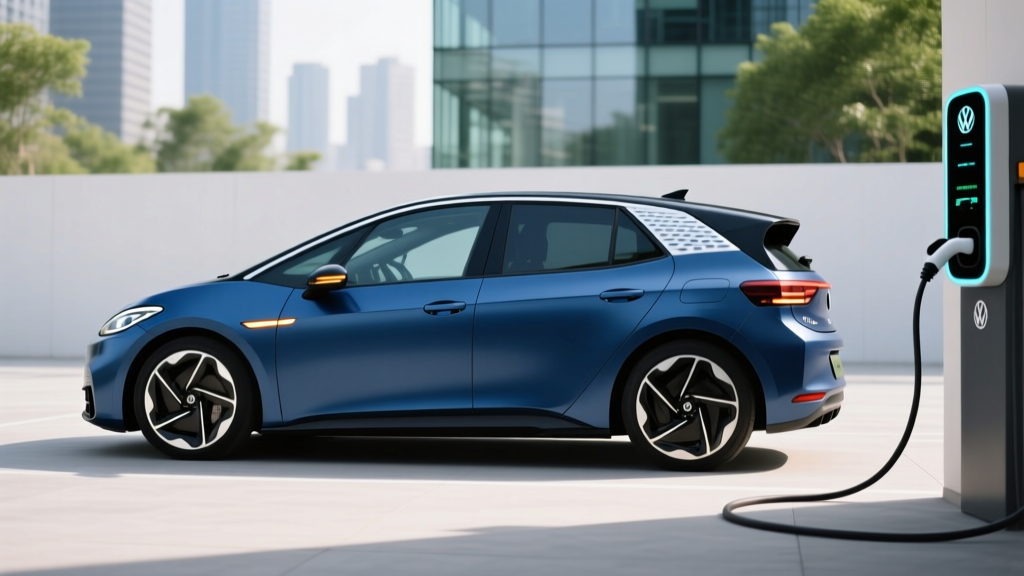
The Volkswagen ID.3 has been one of Europe's best-selling electric hatchbacks since its 2019 debut, but for US buyers searching for an id3 vw, the story remains complicated. As of the 2026 model year, Volkswagen has not brought the ID.3 to North America — and confirmed plans still point to the larger ID.4 crossover as VW's volume EV play in the States. This review breaks down everything we know about the current-generation ID.3 (the facelifted model sold in Europe), what its specs would translate to under EPA testing, and whether importing or cross-shopping one makes sense against US-market alternatives.
2026 VW ID.3 at a Glance: Specs Table
| Specification | ID.3 Pro (58 kWh) | ID.3 Pro S (77 kWh) |
|---|---|---|
| Usable Battery | 58 kWh (NMC) | 77 kWh (NMC) |
| WLTP Range | 263 mi (423 km) | 348 mi (560 km) |
| Est. EPA Range | ~220–235 mi | ~290–310 mi |
| Motor / Drivetrain | 201 hp / RWD | 228 hp / RWD |
| 0–62 mph (0–100 km/h) | 7.3 sec | 7.1 sec |
| Peak DC Charge Rate | 100 kW (CCS2) | 135 kW (CCS2) |
| 10–80% DC Time | ~35 min | ~30 min |
| AC Level 2 Charge | 11 kW (~37 mi/hr) | 11 kW (~37 mi/hr) |
| Efficiency (WLTP) | ~3.6 mi/kWh | ~3.7 mi/kWh |
| EU Base Price | ~€36,000 (~$39,200) | ~€44,000 (~$47,900) |
| Battery Warranty | 8 yr / 100,000 mi (70% SoH) | 8 yr / 100,000 mi (70% SoH) |
Source: Volkswagen Newsroom. EPA range estimates derived by applying a typical 15–20% WLTP-to-EPA reduction factor observed on comparable VW MEB-platform vehicles (ID.4, ID.5).
Range Reality: What to Expect Beyond the Sticker
WLTP Rating: 348 miles (560 km)
Estimated EPA Equivalent: ~290–310 miles
Real-World Highway (70 mph): ~245–265 miles
Cold Weather (below 32°F / 0°C): ~210–235 miles
VW's MEB platform lacks a standard heat pump in base trims — a resistive heater draws significant battery power in winter. Spec the optional heat pump to recover roughly 10–15% of cold-weather range.
The WLTP testing cycle used in Europe is considerably more generous than the US EPA cycle. Based on how the ID.4 (which shares the same platform and powertrain architecture) saw its WLTP range reduced by roughly 18% under EPA testing, we estimate the 77 kWh ID.3 Pro S would sticker around 290–310 miles EPA if sold in the US. The smaller 58 kWh Pro model would land near 220–235 miles EPA.
On sustained highway driving at 70+ mph — where EVs are least efficient due to aerodynamic drag and the absence of regenerative braking opportunities — expect to see roughly 245–265 miles from the Pro S before needing a charger. In freezing temperatures without a heat pump, that number drops to around 210–235 miles. The ID.3's relatively compact frontal area helps it somewhat versus the boxier ID.4, but physics still governs: higher speeds and colder air mean less range.
Charging Speed: DC Fast Charge and Home Level 2
| Charging Level | Power / Rate | ID.3 Pro (58 kWh) | ID.3 Pro S (77 kWh) |
|---|---|---|---|
| Level 1 (120V household) | ~1.4 kW | ~5 mi/hr | ~5 mi/hr |
| Level 2 (240V / 48A) | 11 kW (onboard limit) | ~37 mi/hr; full in ~6 hr | ~37 mi/hr; full in ~8 hr |
| DC Fast Charge | 100 kW peak (Pro) 135 kW peak (Pro S) |
10–80% in ~35 min | 10–80% in ~30 min |
The ID.3 uses the CCS2 connector in Europe (equivalent to CCS1 in North America). Its DC fast-charging speeds are adequate but not class-leading. The 77 kWh Pro S peaks at 135 kW, which on a 350 kW Electrify America or Ionity station means you'll see a strong initial ramp that tapers noticeably above 60% state of charge. The charge curve holds around 120–135 kW from roughly 10% to 45% SoC, then drops to ~80 kW through 65%, and falls further to ~40 kW from 80% onward. This taper is typical of NMC chemistry in the MEB platform and is why VW quotes 10–80% times rather than 10–100%.
At home on a Level 2 wallbox, the 11 kW onboard charger is solid. A full overnight charge from 10% takes roughly 6 hours for the Pro and 8 hours for the Pro S — more than enough for any daily commute. Note that kW (power, the rate of energy flow) and kWh (energy, the battery's total capacity) are different metrics: an 11 kW charger delivers 11 kWh of energy per hour into a 77 kWh battery.
Performance and Driving Dynamics
The ID.3 is a rear-wheel-drive hatchback built on VW's MEB platform, with the electric motor mounted on the rear axle. The Pro trim delivers 201 horsepower (150 kW) while the Pro S bumps that to 228 hp (170 kW). Neither variant offers all-wheel drive — the ID.3 is strictly RWD, which gives it a tight 33.5-foot turning circle and a playful rear-drive character unusual for a compact hatch.
The 0–62 mph sprint takes 7.3 seconds in the Pro and 7.1 seconds in the Pro S. Translate that to 0–60 mph and you're looking at roughly 6.9–7.1 seconds — quick enough for confident highway merging but not in the same league as a Tesla Model 3 RWD (5.8 seconds). Top speed is electronically limited to 99 mph (160 km/h).
Where the ID.3 shines is low-speed maneuverability. Its rear-drive layout and compact dimensions (177.8 inches long, 71.2 inches wide) make it genuinely nimble in urban environments. The suspension tuning favors comfort over sportiness — expect compliant ride quality over rough pavement but noticeable body roll in aggressive cornering.
Interior, Cargo, and Technology
Inside, the post-facelift ID.3 (2024 onward) addressed many of the original model's complaints. VW upgraded materials with soft-touch surfaces on the dashboard and door uppers, replaced the frustrating touch-sensitive steering wheel controls with physical buttons, and improved the infotainment system's responsiveness.
Cargo space: 13.6 cu ft (385 liters) behind the rear seats, expanding to 44.7 cu ft (1,267 liters) with the 60/40 split rear seats folded. That's competitive with a Golf and adequate for weekly groceries or a couple of suitcases, but smaller than the Tesla Model 3's trunk (23 cu ft) and far less than the Hyundai Ioniq 5 (27.2 cu ft).
Passenger space: Front headroom is generous thanks to the flat MEB floor, and rear legroom measures approximately 37.6 inches — adequate for adults on shorter trips. The flat floor (no transmission tunnel) makes the middle rear seat more usable than in most ICE hatchbacks.
Infotainment: A 12.9-inch touchscreen runs VW's ID.Software 4.0, which supports wireless Apple CarPlay and Android Auto, over-the-air updates, and improved voice recognition. A 5.3-inch digital instrument cluster sits behind the steering wheel. The available Travel Assist package provides SAE Level 2 driver assistance — adaptive cruise control with lane centering — but requires continuous driver supervision and is not autonomous driving.
Pricing, Tax Credits, and the US Availability Question
The VW ID.3 is not available for purchase in the United States as of 2026. Therefore, it does not qualify for the federal §30D Clean Vehicle Credit. Even if VW were to import it, the credit would depend on meeting IRS requirements including:
- MSRP cap: ≤ $55,000 for sedans/hatchbacks
- Buyer income cap: ≤ $150,000 (single) / $300,000 (joint)
- Battery critical-mineral and component sourcing thresholds (phased annually)
- Final assembly in North America (required for new-vehicle credit)
Source: IRS §30D Guidelines. Consult a tax professional for personal eligibility.
In Europe, the 2026 ID.3 Pro starts around €36,000 (~$39,200 USD), while the Pro S lists near €44,000 (~$47,900 USD). These prices include VAT, which varies by country. If VW were to bring the ID.3 to the US, pricing would likely land in the $35,000–$48,000 range before incentives — competitive with the Chevrolet Bolt EV/EUV successors and the Nissan Leaf replacement, but undercut by aggressive Chinese-market EVs that have yet to reach US shores.
The critical barrier for US availability is the §30D tax credit's North American final-assembly requirement. VW's US EV production is concentrated at its Chattanooga, Tennessee plant (ID.4). Unless VW retools a North American line for the ID.3, buyers would forfeit the $7,500 federal credit — a significant disadvantage against competitors like the Tesla Model 3 (Fremont/Austin built) and domestically assembled options.
How It Compares: ID.3 vs US-Market Alternatives
| Metric | VW ID.3 Pro S (EU) | Tesla Model 3 RWD | Hyundai Ioniq 5 SE | Chevrolet Equinox EV 2LT |
|---|---|---|---|---|
| EPA Range | ~300 mi (est.) | 272 mi | 303 mi | 319 mi |
| Battery | 77 kWh NMC | ~60 kWh LFP | 77.4 kWh NMC | 85 kWh NMC |
| Peak DC Charge | 135 kW | 170 kW | 240 kW | 190 kW |
| 10–80% Time | ~30 min | ~25 min | ~18 min | ~24 min |
| 0–60 mph | ~7.0 sec | 5.8 sec | 7.4 sec | 7.9 sec |
| Base MSRP (US) | Not sold | $38,990 | $42,600 | $33,600 |
| US Tax Credit | N/A | $7,500* | $7,500* | $7,500* |
*Tax credit eligibility subject to IRS §30D income, MSRP, and battery-sourcing requirements. Verify at fueleconomy.gov.
The comparison makes the US availability gap clear. The Hyundai Ioniq 5 demolishes the ID.3 on charging speed (240 kW peak, 10–80% in 18 minutes vs the ID.3's 30 minutes), thanks to its 800V architecture. The Tesla Model 3 offers faster acceleration, access to the Supercharger network (now open to NACS-equipped non-Teslas, but CCS adapters add friction), and a more mature software ecosystem. The Chevrolet Equinox EV undercuts on price while delivering more range, though it's a larger crossover rather than a hatchback.
The ID.3's advantage is its European-urban footprint: compact, easy to park, rear-drive fun. But that advantage doesn't overcome the practical barriers for US buyers — no dealer network, no federal credit, no local service infrastructure, and CCS2-to-CCS1 adapter needs.
Who the ID.3 Is For — and Who Should Look Elsewhere
✅ Choose the ID.3 If…
- You live in Europe or a right-hand-drive market where it's sold
- You want a compact, city-friendly EV hatchback under €45,000
- Daily commutes are under 50 miles with home Level 2 charging
- You prefer VW's driving dynamics and build quality
- You don't need frequent 300+ mile road trips
❌ Look Elsewhere If…
- You're a US or Canadian buyer (it's not sold here)
- Fast DC charging is a priority (Ioniq 5 is 78% faster)
- You need AWD for snow-belt winters
- You want the federal $7,500 tax credit
- Cargo capacity matters (Model 3, Ioniq 5 offer more)
Frequently Asked Questions
Is the VW ID.3 available in the United States?
No. As of 2026, Volkswagen does not sell the ID.3 in the US or Canada. VW's North American EV lineup centers on the ID.4 (built in Chattanooga, TN) and the upcoming ID.7 sedan. VW has not announced plans to import the ID.3, likely due to the §30D tax credit's North American assembly requirement and the US market's preference for crossovers over hatchbacks.
What is the real-world range of the VW ID.3?
The 77 kWh Pro S achieves 348 miles on the European WLTP cycle, which translates to an estimated 290–310 miles EPA. In real-world mixed driving, expect 260–280 miles. Sustained highway driving at 70+ mph drops this to around 245–265 miles, and freezing winter temperatures can reduce range to 210–235 miles without a heat pump.
How fast does the ID.3 charge at home and on DC fast chargers?
On a Level 2 home charger (240V, 11 kW), the Pro S gains roughly 37 miles of range per hour and charges fully in about 8 hours. On a DC fast charger, the Pro S peaks at 135 kW and reaches 10–80% in approximately 30 minutes. The smaller Pro model peaks at 100 kW and takes about 35 minutes for the same 10–80% session.
Does the VW ID.3 qualify for the US federal EV tax credit?
No. The ID.3 is not sold in the US and would not qualify for the §30D Clean Vehicle Credit regardless, because it is assembled in Germany (Zwickau plant), not North America. The credit requires final assembly in North America, among other criteria including buyer income limits and battery-sourcing thresholds. See IRS guidelines for details.
What battery chemistry does the ID.3 use, and how long will it last?
The ID.3 uses NMC (nickel manganese cobalt) lithium-ion battery cells supplied primarily by LG Energy Solution and SK On. NMC offers higher energy density than LFP (lithium iron phosphate) but is more sensitive to sustained high states of charge. VW warrants the battery for 8 years or 100,000 miles, guaranteeing at least 70% state of health (SoH) retention. For longevity, VW recommends daily charging to 80% and only using 100% for long trips.
Is the ID.3 better than the Tesla Model 3?
They serve different priorities. The Model 3 is faster (5.8 sec 0–60), charges quicker on DC (170 kW vs 135 kW), offers access to the Supercharger network, and qualifies for the US tax credit. The ID.3 is more compact, has a tighter turning circle, and offers a more traditional hatchback form factor — but it isn't available in the US. For American buyers, the Model 3, Ioniq 5, and Equinox EV are all stronger choices based on availability, charging infrastructure, and incentive eligibility.
This review reflects specifications and pricing as of early 2026 for the European-market VW ID.3. US-market EV pricing and tax credit rules are subject to change. Always verify current eligibility on fueleconomy.gov and irs.gov before purchasing.