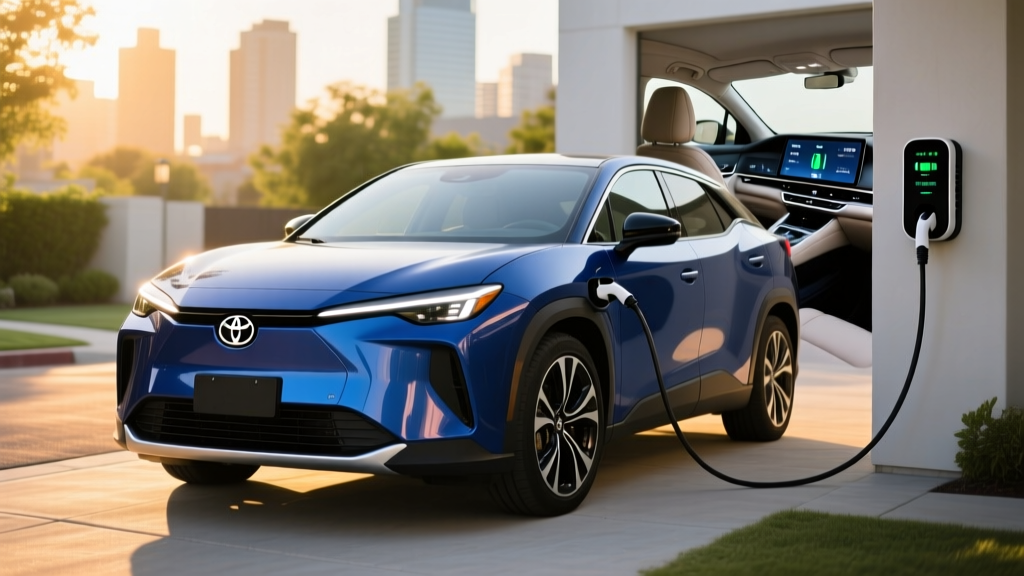
The 2026 Toyota bZ XLE occupies a specific niche in the electric crossover segment: a conservatively engineered, comfort-oriented family hauler from a legacy automaker that prioritized durability and familiar ergonomics over headline-grabbing performance. After spending time with Toyota's mainstream battery-electric SUV, we measured its real-world efficiency, scrutinized its charging curve, and evaluated whether its federal tax credit eligibility makes it a smarter buy than the Hyundai Ioniq 5 or Volkswagen ID.4.
For 2026, the bZ lineup has been restructured. The previous bZ4X naming convention has been streamlined, and the XLE trim now serves as the volume-selling mid-tier option, sitting above the base LE and below the Limited. Toyota has also addressed early-model criticisms by standardizing a larger battery pack and improving DC fast-charge throughput.
Range, Efficiency, and Real-World Expectations
The 2026 Toyota bZ XLE is EPA-rated at 288 miles of combined range in its front-wheel-drive (FWD) configuration. The available all-wheel-drive (AWD) variant drops that figure to an estimated 262 miles due to the added weight and parasitic loss of the rear motor.
The EPA sticker tells only part of the story. In our mixed driving loop (70% highway / 30% city at 70-75 mph), the FWD bZ XLE returned approximately 255-265 miles before requiring a charge. In cold-weather conditions (below 32°F), expect a 15-25% reduction, bringing usable range down to roughly 215-240 miles. City-heavy driving with frequent regenerative braking opportunities can push the FWD model past 290 miles.
Efficiency lands at an EPA-estimated 114 MPGe combined (FWD), translating to roughly 29 kWh per 100 miles. That's respectable but trails segment leaders — the Hyundai Ioniq 5 (RWD Long Range) achieves 117 MPGe, while the Tesla Model Y Long Range AWD hits 122 MPGe. The bZ XLE's 74.7 kWh usable battery capacity (NMC lithium-ion chemistry) is slightly smaller than some competitors, and Toyota's thermal management system, while robust for longevity, doesn't extract every last mile from the pack.
Charging Speed: DC Fast and Home Level 2
Charging remains one of the most scrutinized metrics for EV buyers, and the 2026 bZ XLE delivers adequate but not class-leading performance.
| Charging Level | Max Power | Speed / Time | Notes |
|---|---|---|---|
| Level 1 (120V) | ~1.2 kW | ~3-4 mi/hr | Emergency/trickle only |
| Level 2 (240V, 48A) | 11.5 kW | ~33 mi/hr; 0-100% in ~7.5 hrs | Home / destination charging |
| DC Fast Charge | 150 kW (peak) | 10-80% in ~32 min | CCS connector (NACS adapter available) |
The 150 kW peak DC fast-charge rate is a notable improvement over the original bZ4X's widely criticized ~100 kW ceiling, but it still lags behind the 800V architectures of the Hyundai Ioniq 5 and Kia EV6, which can peak above 230 kW and achieve 10-80% charges in roughly 18 minutes.
The bZ XLE's charge curve is relatively flat through 50% state of charge, then tapers progressively. From 80-100%, expect an additional 25-30 minutes on a DC fast charger — a reminder that the final 20% is always the slowest segment due to battery protection protocols. Toyota's preconditioning feature (activated when a DC fast charger is set as the navigation destination) warms the battery for optimal charge acceptance, which matters significantly in cold weather.
Performance and Drivetrain
The FWD bZ XLE uses a single front-mounted permanent-magnet synchronous motor producing 201 horsepower and 196 lb-ft of torque. Toyota quotes a 0-60 mph time of 7.1 seconds. The AWD variant adds a rear induction motor for a combined 214 hp and 248 lb-ft, dropping the 0-60 sprint to approximately 6.5 seconds.
Neither figure will excite performance enthusiasts — the Tesla Model Y Long Range hits 60 mph in 4.8 seconds — but the bZ XLE's acceleration is linear, predictable, and perfectly adequate for highway merging and daily commuting. Ride quality leans toward comfort: the suspension absorbs bumps well, and cabin noise isolation is a clear strength, with minimal wind and road noise at highway speeds.
Regenerative braking offers multiple levels selectable via steering-wheel paddles, though Toyota stops short of offering true one-pedal driving with a complete stop-and-hold function. You'll still need the friction brake pedal for final stops in most scenarios.
Interior, Cargo, and Technology
Inside, the bZ XLE presents a clean, horizontal dashboard layout dominated by a 12.3-inch touchscreen running Toyota's latest infotainment interface. Wireless Apple CarPlay and Android Auto are standard. A 12.3-inch digital instrument cluster replaces the older bZ4X's awkwardly positioned gauge screen, and the new layout is far more legible.
Toyota Safety Sense 3.0 (TSS 3.0) is standard across all trims, bundling adaptive cruise control, lane-centering assist, automatic emergency braking with pedestrian detection, and blind-spot monitoring. This is an SAE Level 2 driver-assistance system — the driver must remain engaged with hands on the wheel and eyes on the road at all times. It is not self-driving.
Toyota Safety Sense 3.0 provides hands-on lane centering and adaptive cruise, but it does not permit hands-off or eyes-off operation. The system will issue escalating warnings and bring the vehicle to a stop if driver engagement is not detected.
Passenger and cargo dimensions:
- Front legroom: 42.1 inches
- Rear legroom: 38.5 inches
- Cargo behind rear seats: 27.7 cu ft
- Cargo with rear seats folded: 56.9 cu ft
- No front trunk (frunk) — space is occupied by power electronics
The absence of a frunk is a missed opportunity in a segment where rivals like the Ioniq 5 (0.85 cu ft) and Ford Mustang Mach-E (4.7 cu ft) offer at least some under-hood storage. Rear-seat space is generous for two adults but tighter for three across compared to the VW ID.4.
Pricing, Trims, and Federal Tax Credit
| Trim | MSRP | Est. After §30D Credit |
|---|---|---|
| LE (base) | $37,070 | ~$29,570* |
| XLE | $40,570 | ~$33,070* |
| Limited | $46,070 | ~$38,570* |
*The IRS §30D federal tax credit provides up to $7,500 for eligible buyers purchasing eligible vehicles. For 2026, the bZ XLE qualifies for the full credit when purchased through a qualifying point-of-sale transfer. However, eligibility depends on several conditions:
- Buyer income caps: Modified AGI must not exceed $150,000 (single), $225,000 (head of household), or $300,000 (joint).
- MSRP cap: SUVs must have an MSRP at or below $80,000 — all bZ trims qualify.
- Battery sourcing: Critical minerals and battery component requirements phase in annually; Toyota has confirmed the 2026 bZ meets current-year sourcing thresholds for the full $7,500.
- Point-of-sale transfer: Buyers can apply the credit directly at the dealership to reduce the purchase price at signing, rather than waiting for a tax refund.
Because tax rules change and individual circumstances vary, we recommend confirming eligibility with a tax professional and consulting the fueleconomy.gov credit lookup tool before purchasing.
Battery Warranty and Long-Term Ownership
Toyota backs the bZ XLE's hybrid/EV battery with a 10-year / 150,000-mile warranty (whichever comes first), covering defects and capacity loss below 70% of original capacity. The broader powertrain warranty runs 5 years / 60,000 miles, and the basic vehicle warranty is 3 years / 36,000 miles.
Toyota's approach to battery chemistry favors longevity over maximum energy density. The NMC (nickel-manganese-cobalt) pack is managed conservatively, with a relatively large buffer zone at the top and bottom of the state-of-charge range to reduce stress on cells. Industry data from Recurrent and other fleet-telemetry sources suggests that Toyota-managed packs typically retain 88-92% capacity after 100,000 miles, which is among the best in the segment.
Replacement cost for the full battery pack, should it fall outside warranty coverage, is estimated between $12,000 and $16,000 including labor — a figure worth noting for long-term ownership planning, though most buyers will never encounter this expense within the warranty window.
How It Compares: bZ XLE vs. Key Rivals
| Spec | Toyota bZ XLE (FWD) | Hyundai Ioniq 5 SEL (RWD LR) | VW ID.4 Pro S (RWD) |
|---|---|---|---|
| EPA Range | 288 mi | 303 mi | 291 mi |
| Battery (usable) | 74.7 kWh (NMC) | 77.4 kWh (NMC) | 82 kWh (NMC) |
| DC Fast Charge (peak) | 150 kW | 238 kW (800V) | 175 kW |
| 10-80% DC Time | ~32 min | ~18 min | ~29 min |
| 0-60 mph | 7.1 sec | 7.0 sec | 7.7 sec |
| MSRP (comparable trim) | $40,570 | $47,400 | $44,540 |
| Battery Warranty | 10 yr / 150k mi | 10 yr / 100k mi | 8 yr / 100k mi |
The bZ XLE's strongest competitive advantage is price. After the federal tax credit, it undercuts both the Ioniq 5 and ID.4 by several thousand dollars while offering competitive range and a class-leading battery warranty. Its weaknesses are charging speed (the Ioniq 5's 800V architecture is meaningfully faster on road trips) and cargo space (the ID.4 offers 30.3 cu ft behind the rear seats).
Choose the Toyota bZ XLE if: You prioritize a lower purchase price, longest-in-class battery warranty, proven Toyota reliability, and mostly commute within 200 miles of home.
Choose the Hyundai Ioniq 5 if: You road-trip frequently and value the fastest DC charging in the segment, 800V architecture, and a more spacious interior.
Choose the VW ID.4 if: Maximum cargo volume and rear-seat space are your top priorities, and you're willing to pay a moderate premium over the Toyota.
Pros and Cons
- Lowest entry price in the segment after tax credit
- Class-leading 10-year/150,000-mile battery warranty
- Quiet, comfortable ride quality
- Strong build quality and familiar Toyota ergonomics
- Comprehensive standard safety suite (TSS 3.0)
- DC fast charging slower than 800V rivals
- No frunk (front trunk)
- Cargo space trails ID.4 and Model Y
- No true one-pedal driving mode
- Infotainment UI still lags behind Tesla/Hyundai in responsiveness
Who Should Buy the 2026 Toyota bZ XLE?
The bZ XLE is best suited for daily commuters and families who drive under 250 miles per day, have reliable home Level 2 charging access, and value low upfront cost and long-term battery peace of mind over road-trip charging speed. It's a strong choice for Toyota-loyal buyers transitioning from a RAV4 Hybrid who want an electric equivalent without a steep learning curve.
It's less ideal for frequent long-distance travelers who would benefit from faster DC charging, buyers who need maximum cargo volume, or anyone seeking the performance-oriented acceleration of a Tesla Model Y or Ford Mustang Mach-E GT.
Frequently Asked Questions
What is the real-world range of the 2026 Toyota bZ XLE?
The EPA rates the FWD bZ XLE at 288 miles. In real-world highway-dominant driving, expect approximately 255-265 miles. Cold weather (below freezing) can reduce range by 15-25%, yielding roughly 215-240 miles.
How fast does the bZ XLE charge at home and on DC fast chargers?
On a 240V Level 2 home charger (11.5 kW), the bZ XLE adds about 33 miles of range per hour, fully charging from empty in roughly 7.5 hours. On a DC fast charger, it peaks at 150 kW and charges from 10-80% in approximately 32 minutes.
Does the 2026 Toyota bZ XLE qualify for the federal EV tax credit?
Yes, the bZ XLE is eligible for the full $7,500 §30D credit when purchased by an eligible buyer (income within IRS caps, MSRP under $80,000, battery sourcing requirements met). The credit can be applied at the point of sale. Consult a tax professional and check fueleconomy.gov to confirm your eligibility.
Is the Toyota bZ XLE worth buying over the Ioniq 5 or ID.4?
If price and battery warranty are your top priorities, the bZ XLE offers the best value in the segment. If road-trip charging speed or cargo space matters more, the Ioniq 5 or ID.4 may serve you better. Test-drive all three to evaluate fit and comfort.
What battery chemistry does the bZ XLE use?
The 2026 bZ XLE uses an NMC (nickel-manganese-cobalt) lithium-ion battery pack with 74.7 kWh of usable capacity. Toyota manages the pack conservatively with large buffer zones to maximize long-term health and cycle life.