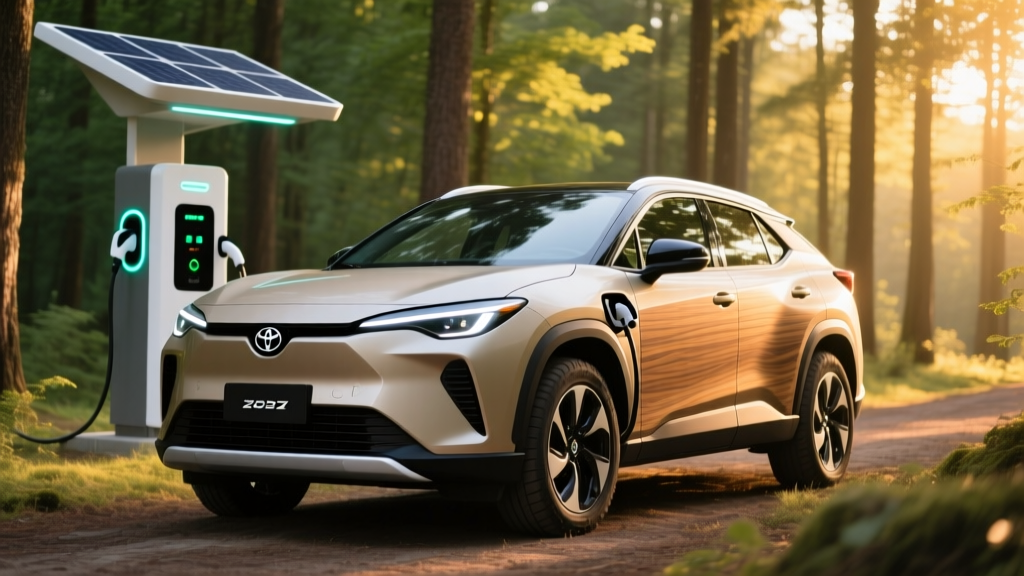
The 2026 Toyota bZ Woodland arrives as Toyota's answer to the rugged-electric-SUV segment — a dual-motor, all-wheel-drive crossover built on the e-TNGA platform and aimed squarely at buyers who want off-road credibility without the tailpipe. Slotted above the bZ4X in Toyota's electric lineup, the Woodland adds ground clearance, body cladding, and a more trail-oriented suspension tune. But beyond the adventure styling, the question that matters to EV buyers is whether its range, charging speed, and pricing hold up against rivals like the Subaru Solterra Wilderness, Hyundai Ioniq 5 AWD, and Ford Mustang Mach-E Select AWD.
We spent time with the 2026 bZ Woodland to break down every spec that counts — from real-world highway range to the charging curve taper that no brochure mentions. Here's the full data-driven profile.
2026 Toyota bZ Woodland Quick Verdict
The bZ Woodland is a competent, honest electric SUV that prioritizes durability and all-weather confidence over maximum range or blistering charge speeds. Its 280-mile EPA estimate is respectable for a boxy AWD crossover, and Toyota's 8-year/100,000-mile battery warranty provides long-term peace of mind. However, its 150 kW peak DC fast-charge rate and NMC battery chemistry place it a generation behind class leaders on charging infrastructure efficiency. If you need a trail-capable daily driver with strong resale and dealership support, the Woodland earns a serious look. If 10-80% charging in under 20 minutes is a dealbreaker, you'll want to cross-shop carefully.
| Spec | Value |
|---|---|
| EPA Range (est.) | 280 miles |
| Battery Capacity | 72.8 kWh usable (NMC lithium-ion) |
| Drivetrain | Dual-motor AWD (X-MODE) |
| Horsepower | 214 hp combined |
| 0–60 mph | ~5.8 seconds |
| Peak DC Fast Charge | 150 kW (CCS1 / NACS adapter available) |
| 10–80% DC Charge Time | ~32 minutes |
| Level 2 Home Charge Rate | 7.2 kW (~23 mi/hr) |
| Efficiency | 107 MPGe combined / 31 kWh/100 mi |
| Ground Clearance | 8.3 inches |
| Cargo Volume (rear seats up) | 27.7 cu ft |
| Cargo Volume (rear seats folded) | 56.9 cu ft |
| Base MSRP | $43,400 (Woodland trim) |
| Battery Warranty | 8 years / 100,000 miles |
Range and Efficiency: EPA vs. Real World
The 2026 bZ Woodland carries a 72.8 kWh usable battery pack using NMC (nickel-manganese-cobalt) chemistry. Toyota rates it at 280 miles EPA combined. That figure represents a blended city/highway cycle under mild conditions — useful for comparison shopping, but rarely what you'll see on a road trip or a cold January morning.
- City / mild-weather commuting: 270–290 miles (regen braking in stop-and-go traffic helps recover energy)
- Highway cruising (70–75 mph): 235–255 miles (aerodynamic drag and the boxy profile reduce efficiency by 10–15%)
- Cold weather (below 30°F, highway): 195–220 miles (battery heating demands and cabin HVAC draw cut usable capacity 20–25%)
- Trail / low-speed off-road: Range varies widely; low-speed crawling is efficient per mile but terrain and elevation change consume energy unpredictably
Toyota equips the Woodland with a heat pump for cabin climate, which mitigates cold-weather range loss compared to resistive heaters. Still, plan for roughly 200 miles of confident range in freezing highway conditions.
Efficiency lands at an estimated 107 MPGe combined (31 kWh per 100 miles), according to fueleconomy.gov preliminary data. That's competitive with the Subaru Solterra Wilderness but trails the more aerodynamic Hyundai Ioniq 5 AWD (114 MPGe). The Woodland's taller ride height and all-terrain tires create the drag penalty you'd expect from a trail-oriented design.
Charging Speed: DC Fast, Level 2, and the Curve Reality
Charging is where the bZ Woodland reveals its most significant competitive gap. The SUV supports a peak 150 kW DC fast-charge rate via its CCS1 port (a NACS adapter for Tesla Supercharger access is available as dealer-installed equipment for 2026). On a 350 kW Electrify America or EVgo stall, the Woodland will accept its maximum rate — but only briefly.
| Charging Level | Power / Rate | Speed | Typical Use Case |
|---|---|---|---|
| Level 1 (120V household) | 1.2 kW | ~4 miles/hour | Emergency top-up, overnight trickle |
| Level 2 (240V home/public) | 7.2 kW | ~23 miles/hour | Daily home charging — full charge in ~10 hours |
| DC Fast Charge | 150 kW peak | 10–80% in ~32 min | Road-trip stops; tapers significantly above 80% |
The charging curve matters. The 150 kW peak is reached between roughly 15% and 45% state of charge. From 45–65%, the rate drops to approximately 100–110 kW. Above 80%, the vehicle throttles charging to protect battery longevity, falling below 50 kW. This means a 10–90% session takes closer to 48–52 minutes — a detail worth knowing if your road-trip plan relies on quick top-ups.
For home charging, a Level 2 wallbox at 7.2 kW (30-amp circuit, 240V) replenishes the battery from empty in roughly 10 hours. Most owners charging overnight from 20–80% will wake to a full daily range. We recommend a hardwired 48-amp Level 2 charger on a 60-amp breaker for future-proofing, even though the Woodland's onboard charger caps at 7.2 kW.
Performance, Drivetrain, and Trail Capability
The bZ Woodland uses Toyota's dual-motor X-MODE AWD system with 214 combined horsepower. The front motor contributes 80 kW and the rear 134 kW, with torque vectoring directed primarily rearward for trail traction. The 0–60 mph time of approximately 5.8 seconds is brisk enough for confident highway merging but not sportscar territory — Toyota tuned this SUV for composure, not drag-strip times.
Where the Woodland distinguishes itself is off-pavement. The 8.3 inches of ground clearance, reinforced underbody skid plates, and all-terrain tires give it genuine light-trail capability. X-MODE includes hill-descent control, snow/dirt and deep-snow/mud settings, and a grip-control crawl feature. This isn't a rock crawler, but for forest service roads, snow-covered driveways, and campsite access, it outperforms most electric crossovers in its price bracket.
Towing capacity is rated at 2,200 pounds — sufficient for a small utility trailer or a pair of dirt bikes, but not a camper. Buyers needing 3,500+ pounds of tow rating should look at the Rivian R1S or Ford F-150 Lightning.
Interior, Cargo, and Technology
Inside, the Woodland shares the bZ family's 12.3-inch touchscreen running Toyota's latest infotainment OS with wireless Apple CarPlay and Android Auto. Physical climate knobs return for 2026 — a welcome correction from the touch-capacitive sliders that frustrated early bZ4X owners. The digital instrument cluster sits high on the dash for a sightline-friendly layout.
Passenger space is generous for the segment:
- Front legroom: 42.1 inches
- Rear legroom: 38.5 inches
- Front headroom: 39.9 inches
- Rear headroom: 38.2 inches
Cargo capacity measures 27.7 cubic feet behind the second row and 56.9 cubic feet with the 60/40 split rear seats folded. There is no front trunk (frunk) — the space is occupied by power electronics and the HVAC heat-pump assembly. A removable cargo tray and integrated tie-down hooks come standard.
On the driver-assistance front, Toyota Safety Sense 3.0 is standard across all trims. This includes:
- Pre-Collision System with pedestrian detection
- Full-Speed Range Dynamic Radar Cruise Control
- Lane Tracing Assist (centering)
- Road Sign Assist
- Proactive Driving Assist (gentle braking when approaching slower vehicles or curves)
Notable drawbacks: The rear visibility is compromised by thick C-pillars (a rear camera mirror is available to compensate). The infotainment system, while improved, still lags behind Hyundai/Kia's UX in responsiveness. And the absence of a frunk means less total sealed storage than competitors like the Ioniq 5 or Mustang Mach-E.
Pricing, Trims, and Federal Tax Credit Eligibility
The 2026 Toyota bZ Woodland is offered in a single well-equipped trim with option packages, simplifying the buying process:
| Configuration | MSRP | Est. Federal Credit | Effective Price |
|---|---|---|---|
| Woodland (base) | $43,400 | Up to $7,500* | ~$35,900* |
| Woodland + Premium Pkg (panoramic roof, JBL audio, heated rear seats) | $46,800 | Up to $7,500* | ~$39,300* |
| Woodland + Weather Pkg (heated steering, radiant heaters, all-weather mats) | $44,950 | Up to $7,500* | ~$37,450* |
*Federal tax credit eligibility depends on buyer income, battery component sourcing, and MSRP caps under IRS §30D. See details below.
The federal EV tax credit under IRS §30D can reduce the effective purchase price by up to $7,500, but eligibility is not automatic. For 2026, the following rules apply:
- MSRP cap: SUVs must have a base MSRP at or below $80,000 — the Woodland qualifies easily.
- Buyer income cap: Modified adjusted gross income must not exceed $150,000 (single), $225,000 (head of household), or $300,000 (joint filers).
- Battery sourcing: The $7,500 credit splits into two halves — $3,750 for critical-mineral sourcing and $3,750 for battery-component manufacturing. Toyota has been progressively shifting bZ battery supply chains to comply; check the specific VIN on the IRS qualified vehicles list before purchasing.
- Point-of-sale transfer: For 2026, buyers can transfer the credit to the dealer at purchase, reducing the out-of-pocket cost immediately rather than waiting for a tax refund.
Because battery-sourcing compliance can change by production batch, always verify your specific vehicle's eligibility on irs.gov or consult a tax professional before finalizing the purchase.
Warranty and Long-Term Ownership
Toyota backs the bZ Woodland with one of the strongest warranty packages in the EV mainstream:
- Battery: 8 years / 100,000 miles (covers capacity loss below 70% of original)
- Electric powertrain components: 8 years / 100,000 miles
- Basic vehicle: 3 years / 36,000 miles
- Corrosion perforation: 5 years / unlimited miles
- Roadside assistance: 2 years / 25,000 miles
The 70% capacity-retention threshold is standard for the industry. Based on NMC battery degradation data from Toyota's bZ4X fleet (now three model years in), owners typically see 5–8% capacity loss in the first 60,000 miles, with the curve flattening afterward. Toyota's battery management system includes active thermal conditioning and a conservative top/bottom buffer (approximately 6 kWh reserved) to slow degradation. Expect the pack to retain 80–85% of original capacity at 100,000 miles under normal use.
Insurance costs for the Woodland are estimated at $1,800–$2,200 annually depending on region and driving record — slightly above the segment average due to the AWD drivetrain and higher MSRP.
How It Compares: bZ Woodland vs. Key Rivals
| Spec | Toyota bZ Woodland | Subaru Solterra Wilderness | Hyundai Ioniq 5 AWD | Ford Mach-E Select AWD |
|---|---|---|---|---|
| EPA Range | 280 mi | 270 mi | 290 mi | 290 mi |
| Battery (kWh) | 72.8 (NMC) | 72.8 (NMC) | 77.4 (NMC) | 75.7 (NMC) |
| Peak DC Charge | 150 kW | 150 kW | 240 kW | 150 kW |
| 10–80% Time | ~32 min | ~32 min | ~18 min | ~34 min |
| 0–60 mph | 5.8 sec | 6.0 sec | 5.1 sec | 5.6 sec |
| Ground Clearance | 8.3 in | 9.3 in | 6.1 in | 5.7 in |
| Base MSRP | $43,400 | $44,995 | $50,100 | $43,995 |
| Cargo (seats up) | 27.7 cu ft | 25.8 cu ft | 27.2 cu ft | 29.7 cu ft |
The Hyundai Ioniq 5 AWD dominates on charging speed thanks to its 800V architecture — if road-trip charging time is your top priority, it's the clear winner. The Subaru Solterra Wilderness offers more ground clearance (9.3 inches) for serious trail use, though at the cost of 10 miles of range and a higher starting price. The Mach-E Select AWD provides the most cargo space and a slightly lower base price, but with less ground clearance and no trail-oriented driving modes.
The bZ Woodland sits in a deliberate middle ground: more trail-capable than the Ioniq 5 or Mach-E, more affordable than the Solterra Wilderness, and backed by Toyota's dealer network and historically strong resale values.
- You want genuine light-trail and snow capability without stepping to a truck-based EV
- You value Toyota's dealer network, resale value, and conservative engineering
- Your daily commute is under 100 miles round-trip and you charge at home
- You want a heat pump and all-weather features as standard or low-cost options
- You road-trip frequently and need the fastest possible DC charging (choose Ioniq 5)
- You need maximum cargo volume or a frunk (choose Mach-E or Ioniq 5)
- You want serious off-road clearance for technical trails (choose Solterra Wilderness or Rivian R1S)
- Genuine trail capability with X-MODE AWD and 8.3" ground clearance
- Heat pump standard — better cold-weather range retention
- Strong 8-year/100,000-mile battery warranty
- Physical climate controls return for 2026
- Competitive pricing under $44K base; eligible for up to $7,500 federal credit
- Toyota Safety Sense 3.0 standard on all trims
- 150 kW peak DC charging is below class-leading 240–350 kW competitors
- No front trunk (frunk) — total sealed storage trails some rivals
- Rear visibility hampered by thick C-pillars
- Infotainment UX still a step behind Hyundai/Kia
- Towing limited to 2,200 lbs
- Single trim limits configuration choices (must use packages)
Who Should Buy the 2026 Toyota bZ Woodland?
This SUV is best suited for the all-weather commuter and weekend adventurer — someone who drives 30–80 miles daily, charges at home on Level 2, and occasionally tackles dirt roads, ski-resort parking lots, or rain-soaked campsites. It's a strong pick for buyers in the Mountain West, Pacific Northwest, and Northeast who need AWD traction and cold-weather range confidence but don't want to pay Rivian or Tesla prices.
It's less ideal for high-mileage road-trippers who log frequent 300+ mile drives and need the fastest DC charging available, or for families who prioritize maximum cargo flexibility and a frunk for gear.
Frequently Asked Questions
What is the real-world range of the 2026 Toyota bZ Woodland?
The EPA rates the bZ Woodland at 280 miles combined. In real-world highway driving at 70–75 mph, expect 235–255 miles. In cold weather (below 30°F) on the highway, plan for 195–220 miles. City driving with regenerative braking can approach or slightly exceed the EPA figure in mild temperatures.
How fast does the bZ Woodland charge at home and on the road?
At home on a Level 2 (240V, 7.2 kW) charger, it adds roughly 23 miles per hour, reaching a full charge in about 10 hours. On a DC fast charger, it peaks at 150 kW and charges from 10–80% in approximately 32 minutes. Above 80%, the charge rate tapers significantly to protect the battery — a 10–90% session takes closer to 50 minutes.
Does the 2026 bZ Woodland qualify for the $7,500 federal EV tax credit?
It can, but eligibility depends on multiple factors under IRS §30D: your income must fall below the caps ($150K single / $300K joint), the vehicle's MSRP is under the $80K SUV limit (it qualifies), and the battery must meet critical-mineral and component-sourcing requirements for the specific VIN. Always verify on the IRS qualified clean vehicles list before purchasing. The credit can be transferred to the dealer at point of sale for 2026.
Is the bZ Woodland worth buying vs. the Subaru Solterra Wilderness?
It depends on your priority. The Woodland costs roughly $1,600 less at base, offers 10 more miles of EPA range, and benefits from Toyota's larger dealer network. The Solterra Wilderness provides 9.3 inches of ground clearance (1 inch more), which matters on technical trails. If you need maximum off-road capability, choose the Subaru. If you want a more balanced daily driver with lighter trail use, the Toyota is the better value.
What is the battery warranty on the bZ Woodland?
Toyota covers the high-voltage battery for 8 years or 100,000 miles, whichever comes first. The warranty guarantees the battery will retain at least 70% of its original capacity. Based on early bZ4X fleet data, most owners see only 5–8% degradation at 60,000 miles, suggesting the 70% threshold is unlikely to be reached under normal use.
Does the bZ Woodland have a frunk (front trunk)?
No. The space under the hood houses power electronics, the onboard charger, and the heat-pump HVAC assembly. All cargo must go in the rear area, which offers 27.7 cubic feet behind the second row.
Can the bZ Woodland use Tesla Superchargers?
Yes, with a dealer-installed NACS adapter. The Woodland ships with a CCS1 charge port. Toyota offers a NACS adapter for 2026 that enables access to the Tesla Supercharger network (V3 stalls limited to the vehicle's 150 kW peak). This significantly expands road-trip charging options in areas where CCS networks are sparse.
What does it cost to charge the bZ Woodland at home vs. gasoline?
At the U.S. average residential electricity rate of ~$0.16/kWh, fully charging the 72.8 kWh battery costs roughly $11.65, or about $0.04 per mile. A comparable gas SUV getting 25 MPG at $3.40/gallon costs ~$0.14 per mile. Over 15,000 annual miles, that's a fuel savings of approximately $1,500 per year with home charging. Public DC fast charging at $0.35–$0.50/kWh narrows the gap to roughly $0.09–$0.13 per mile.