If you've ever arrived at a Supercharger in sub-freezing temperatures only to find your Tesla refusing to accept a charge or trickling at a fraction of its rated speed, you've experienced the exact problem Tesla's charge port heater was designed to solve. This small but critical thermal management component has become essential infrastructure for EV owners in cold climates — and understanding how it works across the 2026 Tesla lineup can save you time, range, and frustration when temperatures plummet.
This guide breaks down the charge port heater system across every current Tesla model, pairs it with real-world cold-weather charging and range data, and gives you the exact specs, prices, and ownership considerations you need before buying or optimizing a Tesla for winter driving.
What Is the Tesla Charge Port Heater and Why It Matters
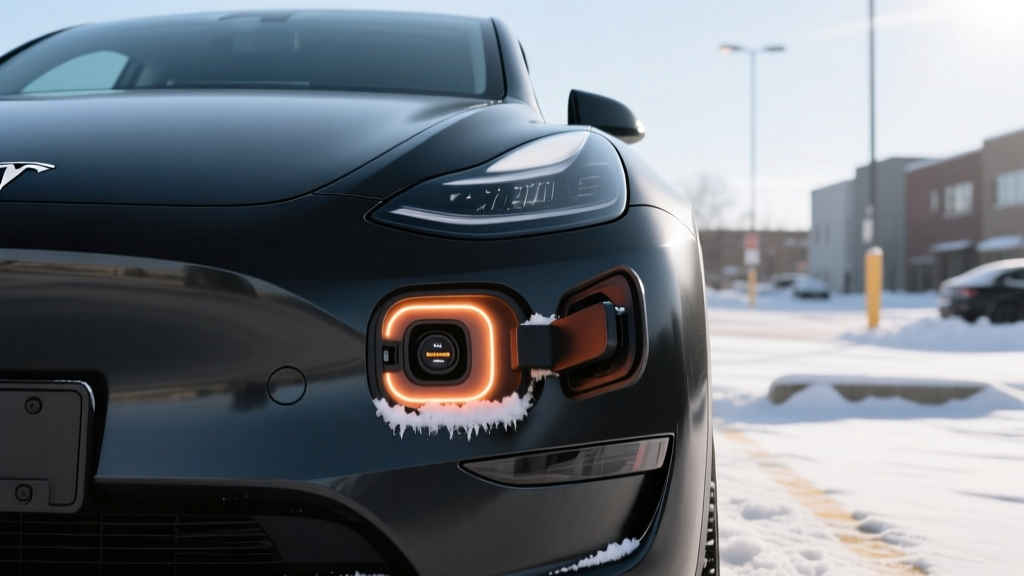
The charge port heater is a resistive heating element integrated into the charge port assembly on every Tesla vehicle. Its primary job is twofold: first, it prevents the charge port door and latch mechanism from freezing shut in icy conditions — a problem that can physically prevent you from plugging in. Second, it helps maintain the charge port connector area at a temperature that allows the vehicle's Battery Management System (BMS) to authorize full charging current.
When a Tesla's battery pack is cold — typically below roughly 50°F (10°C) at the cell level — the BMS restricts DC fast charging power to protect the lithium-ion cells from lithium plating, a degradation mechanism where metallic lithium deposits on the anode instead of intercalating into it. The charge port heater works in tandem with the broader thermal management system, which includes a liquid cooling/heating loop that circulates warmed glycol through the battery pack. The charge port heater ensures the physical connection point doesn't become the bottleneck.
In practice, this means a Tesla that has been preconditioning — either via navigation to a Supercharger or through the mobile app — will arrive at the charger with both the battery pack warmed and the charge port area free of ice. The result is dramatically faster charging. A cold-soaked Model Y at 20°F might initially accept only 30-50 kW at a 250 kW V3 Supercharger, while a properly preconditioned one will ramp to 200+ kW within minutes.
How the Charge Port Heater Works Across the 2026 Tesla Lineup
Every 2026 Tesla sold in the United States includes a charge port heater as standard equipment. However, the broader thermal architecture differs between the highland/refresh platforms and the legacy platforms, which affects how quickly the system brings everything up to temperature.
Model 3 (Highland refresh, 2024-present): The current Model 3 uses Tesla's latest heat pump system (introduced with the Model Y) that scavenges waste heat from the drive unit, battery, and ambient air. The charge port heater activates automatically when ambient temperature drops below a threshold (approximately 35°F/2°C) and the car detects that charging is imminent — either because you've navigated to a charger or manually initiated preconditioning. The Highland Model 3's improved insulation and more efficient heat pump mean preconditioning typically takes 15-25 minutes in 20°F weather, compared to 30-45 minutes in the pre-2024 Model 3.
Model Y (2025 refresh): The refreshed Model Y follows the same thermal architecture as the Highland Model 3, sharing the updated heat pump and charge port heater design. The larger battery pack in the Long Range variant takes slightly longer to fully precondition but benefits from the same charge port anti-icing protection.
Model S and Model X (2026): The S and X continue on their 2021-refresh platform with a slightly different thermal loop but an equivalent charge port heater. These vehicles also feature the heat pump (added during the 2021 refresh) and precondition identically when navigating to a Supercharger. The larger packs in the S and X require more total energy to warm, so preconditioning in extreme cold may take 30-45 minutes.
| Spec | Model 3 RWD | Model 3 Long Range AWD | Model Y Long Range AWD | Model S LR | Model X LR |
|---|---|---|---|---|---|
| EPA Range | 272 mi | 363 mi | 320 mi | 402 mi | 348 mi |
| Battery (usable kWh) | ~57.5 (LFP) | ~75 (NMC) | ~75 (NMC) | ~95 (NMC) | ~95 (NMC) |
| Charge Port Heater | Standard | Standard | Standard | Standard | Standard |
| Heat Pump | Yes | Yes | Yes | Yes | Yes |
| Max DC Fast Charge | 170 kW | 250 kW | 250 kW | 250 kW | 250 kW |
| 10-80% DCFC Time | ~25 min | ~27 min | ~27 min | ~30 min | ~31 min |
| Level 2 Rate (kW) | 11.5 kW | 11.5 kW | 11.5 kW | 11.5 kW | 11.5 kW |
| Level 2 Miles/Hr | ~32 mi/hr | ~44 mi/hr | ~37 mi/hr | ~41 mi/hr | ~34 mi/hr |
| 0-60 mph | 5.8 sec | 4.2 sec | 4.8 sec | 3.1 sec | 3.8 sec |
| Horsepower | 271 hp | 384 hp | 384 hp | 670 hp | 670 hp |
| Drivetrain | RWD | AWD (Dual) | AWD (Dual) | AWD (Dual) | AWD (Dual) |
| MPGe (Combined) | 132 MPGe | 131 MPGe | 122 MPGe | 120 MPGe | 109 MPGe |
| Base MSRP | $38,990 | $44,990 | $46,990 | $79,990 | $84,990 |
Cold-Weather Range: Real-World Numbers vs. EPA Stickers
The EPA range figures above assume moderate temperatures and mixed driving. In cold weather, every EV loses range — and Teslas are no exception. The charge port heater itself consumes a negligible amount of energy (roughly 50-100 watts when active), but the broader battery heating system, cabin heating, and reduced regenerative braking efficiency all contribute to range loss.
Model 3 Long Range AWD (EPA 363 mi): Expect approximately 280-310 miles in 30-40°F highway driving at 70 mph. In severe cold (0-15°F), range may drop to 230-260 miles. City driving with frequent stops (allowing regen to partially recover) performs somewhat better proportionally.
Model Y Long Range AWD (EPA 320 mi): Expect roughly 245-275 miles in moderate cold highway driving, and 200-230 miles in extreme cold.
LFP vs. NMC cold behavior: The Model 3 RWD's LFP (lithium iron phosphate) battery is more sensitive to cold temperatures than the NMC (nickel manganese cobalt) packs in Long Range and Performance trims. LFP cells have higher internal resistance at low temperatures, meaning range loss can be more pronounced — roughly 35-40% in severe cold vs. 25-30% for NMC. The charge port heater and pack preconditioning mitigate this, but LFP owners in northern climates should precondition more aggressively.
Source data from fueleconomy.gov confirms EPA test-cycle figures, but the EPA's 5-cycle testing includes a cold-temperature adjustment that still tends to overestimate real-world cold-weather highway range by 15-25%. Plan your winter road trips accordingly.
Charging Speed in Cold Weather: What the Charge Port Heater Actually Changes
This is where the charge port heater earns its keep. Without preconditioning, a cold Tesla battery will severely curtail DC fast charging speeds — sometimes to the point where a Level 2 charger would be nearly as fast. Here's what that looks like in practice:
| Scenario | Initial Charge Rate | 10-80% Time | Notes |
|---|---|---|---|
| Preconditioned (navigated to Supercharger), 25°F ambient | 150-200 kW | ~28-32 min | BMS authorizes high current quickly; charge port heater keeps connector clear |
| Cold-soaked (no preconditioning), 25°F ambient | 30-60 kW | ~55-70 min | BMS restricts current until cells warm; pack heating consumes power during charge |
| Preconditioned, 70°F ambient (baseline) | 200-250 kW | ~25-27 min | Optimal conditions; full charge curve available |
| Cold-soaked, 0°F ambient | 10-30 kW | ~75-90+ min | Severe restriction; charge port heater critical to prevent latch freeze |
The charge curve on a preconditioned Tesla at a V3 Supercharger (250 kW max) typically peaks in the 200-250 kW range between 10-30% State of Charge (SoC), then tapers progressively. At 50% SoC, expect roughly 120-150 kW; at 80%, roughly 50-70 kW. This taper is normal and protects cell longevity. In cold weather, even with preconditioning, the peak may be 10-20% lower and the taper more aggressive.
Level 2 home charging is largely unaffected by the charge port heater because the slower charge rate (11.5 kW maximum on Tesla's onboard charger) generates less thermal stress. However, in extreme cold, the vehicle may divert some incoming Level 2 power to battery heating before adding range, meaning your effective "miles per hour of charging" may be lower for the first 30-60 minutes of a cold-soaked Level 2 session.
Pricing, Tax Credits, and Total Cost for 2026 Tesla Models
Tesla's 2026 pricing remains aggressive, particularly for the Model 3 and Model Y, which are the volume sellers. Here's how the numbers stack up, including federal tax credit eligibility under IRS §30D rules.
| Model/Trim | Base MSRP | Federal Credit (§30D) | Effective Price | Credit Eligibility Notes |
|---|---|---|---|---|
| Model 3 RWD | $38,990 | Up to $7,500 (point-of-sale) | ~$31,490 | Subject to income caps, battery sourcing rules; LFP battery may affect critical mineral qualification |
| Model 3 LR AWD | $44,990 | Up to $7,500 | ~$37,490 | MSRP under $55K cap; verify current sourcing compliance on irs.gov |
| Model Y LR AWD | $46,990 | Up to $7,500 | ~$39,490 | MSRP under $80K SUV cap; income caps apply |
| Model S LR | $79,990 | $0 (exceeds MSRP cap) | $79,990 | Over $55K sedan cap — ineligible for §30D |
| Model X LR | $84,990 | $0 (exceeds MSRP cap) | $84,990 | Over $80K SUV cap — ineligible for §30D |
Critical §30D caveats: The federal EV tax credit has three major gating requirements beyond MSRP caps ($55,000 for sedans; $80,000 for SUVs/trucks). First, buyer income must not exceed $150,000 (single), $225,000 (head of household), or $300,000 (joint). Second, the vehicle's battery must meet critical mineral and battery component sourcing thresholds that tighten annually — as of 2026, these requirements are stringent, and eligibility can change mid-year. Third, the credit can now be transferred at the point of sale, meaning you receive it as a purchase-price reduction rather than waiting for a tax refund. Always verify current eligibility on IRS.gov before purchasing, as battery sourcing compliance can shift with supply chain changes.
Interior, Cargo, and Tech: What You Live With Every Day
The charge port heater is invisible during daily use, but the cabin and cargo space are what you interact with. Here's how the 2026 lineup compares on practicality:
Model 3 (Highland): The refreshed interior features a 15.4-inch center touchscreen, ventilated front seats, ambient lighting, and improved acoustic glass. Rear legroom is 35.2 inches — adequate for adults on shorter trips but tight for tall passengers on long hauls. Cargo space is 23 cu ft (rear seats up) with an additional front trunk (frunk) of roughly 3.1 cu ft. Total with seats folded: approximately 44 cu ft.
Model Y (Refreshed): The Model Y's crossover form factor delivers substantially more utility. Rear legroom is 40.5 inches, and cargo volume is 30 cu ft behind the second row, expanding to roughly 72 cu ft with seats folded. The frunk adds about 4.1 cu ft. An optional third row (very small, best for children) is available but eats into cargo space.
Model S: Premium luxury interior with a 17-inch center display, 12.3-inch instrument cluster, and a yoke or round steering wheel option. Rear legroom is 35.4 inches. Cargo is generous at roughly 28 cu ft (hatchback design) plus a large frunk.
Model X: Falcon-wing rear doors provide dramatic access and excellent headroom. Cargo space is approximately 88 cu ft with both rear rows folded (in 5-seat config, roughly 44 cu ft behind the second row). The frunk adds about 6.5 cu ft. Third row is more usable than the Model Y's optional seat.
Standout tech across all models: Tesla's infotainment remains class-leading for responsiveness and feature depth — native navigation with real-time Supercharger routing, streaming entertainment, Sentry Mode dashcam recording, and over-the-air updates. Autopilot (basic lane-keeping and adaptive cruise) is standard; Full Self-Driving (Supervised) is an $8,000 option. Important: FSD is an SAE Level 2 driver-assist system — it requires continuous driver supervision and is not autonomous driving.
Warranty Coverage and Battery Longevity in Cold Climates
Tesla's warranty structure covers the charge port heater as part of the vehicle's broader electrical system, but the key protection for cold-climate owners is the battery and drive unit warranty:
- Model 3 RWD (LFP): 8 years / 100,000 miles, whichever comes first, with minimum 70% capacity retention.
- Model 3 Long Range / Performance (NMC): 8 years / 120,000 miles, minimum 70% retention.
- Model Y Long Range / Performance: 8 years / 120,000 miles, minimum 70% retention.
- Model S / Model X: 8 years / 150,000 miles, minimum 70% retention.
Cold weather itself does not void the battery warranty. However, consistently DC fast charging from a cold-soaked state without preconditioning can accelerate degradation — the BMS restricts current precisely to prevent this, but the practice still puts more stress on cells than preconditioned charging. Tesla's preconditioning system (triggered by navigating to a Supercharger) is your best defense against both slow charging and long-term capacity loss.
Real-world degradation data from fleet studies and owner reports suggests Tesla NMC packs lose approximately 5-8% capacity over the first 50,000 miles, then degrade more slowly. LFP packs in the Model 3 RWD tend to show slightly more initial degradation (7-10%) but then flatten out, and LFP chemistry offers a longer overall cycle life — meaning the pack may outlast an NMC pack at high mileages despite a steeper early drop.
Who Should Buy a Tesla (and Who Should Look Elsewhere)
- Best-in-class Supercharger network reliability — over 50,000 V3/V4 stalls globally, with excellent uptime
- Charge port heater + heat pump + preconditioning make cold-weather charging practical with minimal driver effort
- Class-leading efficiency (MPGe) across the lineup — fewer kWh per mile means lower charging costs
- Over-the-air updates continuously add features and improve thermal management algorithms
- Model 3 and Model Y offer strong value after §30D credit — Model 3 RWD at ~$31,490 effective price
- LFP battery in Model 3 RWD has more pronounced cold-weather range loss and slower cold charging
- No physical buttons for climate or volume — everything runs through the touchscreen
- Repair costs and insurance premiums remain higher than some competitors (check quotes before buying)
- Model S and Model X are ineligible for the federal tax credit due to MSRP caps
- FSD (Supervised) is expensive ($8,000) and remains a Level 2 system requiring full driver attention
- You live in a cold climate and want the most mature thermal management system with automatic preconditioning and a charge port heater that prevents freeze-ups
- You road-trip regularly and need access to the Supercharger network — still the most reliable and widespread DC fast-charging network in North America
- You want maximum efficiency (lowest cost per mile) in a BEV
- The Model 3 or Model Y fits your budget and qualifies for the §30D credit in your situation
- You need more rear-seat room than the Model 3 offers — consider the Hyundai Ioniq 5 or Kia EV6
- You want a traditional interior with physical controls — the BMW i4 or Polestar 2 may suit you better
- You need a truck or larger SUV — the Rivian R1S, Ford F-150 Lightning, or Chevrolet Silverado EV fill segments Tesla doesn't
- You want NMC chemistry at the lowest price point — the Model 3 RWD's LFP pack trades cold performance for lower cost and longer cycle life
Frequently Asked Questions
Does every 2026 Tesla have a charge port heater?
Yes. Every current-production Tesla — Model 3, Model Y, Model S, and Model X — includes a charge port heater as standard equipment. It activates automatically in cold conditions when charging is anticipated or initiated.
Can the charge port heater unfreeze a frozen charge port door?
Yes, but it takes time. If your charge port door has frozen shut, activating preconditioning via the Tesla app will engage the charge port heater and gradually melt the ice. This typically takes 5-15 minutes depending on ice thickness and ambient temperature. Manually activating the "Defrost Car" feature in the app also helps. Avoid prying the door open, as the latch mechanism can be damaged.
How much energy does the charge port heater consume?
The charge port heater itself draws roughly 50-100 watts when active — a negligible amount compared to the battery pack heater (which can draw 2-5 kW during cold preconditioning) and cabin heating. Its impact on range is essentially zero; the broader thermal preconditioning system does consume energy but pays for itself through faster charging and reduced cell stress.
Does preconditioning for a Supercharger activate the charge port heater automatically?
Yes. When you navigate to any Supercharger in cold weather, the vehicle automatically begins preconditioning the battery pack and activates the charge port heater as ambient temperatures warrant. You don't need to take any additional action — simply entering the Supercharger as your destination triggers the entire thermal preparation sequence.
Will my Tesla charge at full speed in winter if I precondition?
Preconditioning dramatically improves cold-weather charging speed, but you may still see a slightly lower peak rate and a more aggressive taper compared to warm-weather charging. In 25°F weather with proper preconditioning, expect peak rates of 150-200 kW on a V3 Supercharger (vs. 200-250 kW in ideal conditions) and a 10-80% time of roughly 28-32 minutes (vs. 25-27 minutes in warm weather). The gap narrows further as the pack warms during the session.
Is the charge port heater covered under warranty?
Yes. The charge port heater is part of the vehicle's electrical system and is covered under Tesla's New Vehicle Limited Warranty (4 years / 50,000 miles). If the charge port assembly requires replacement due to a heater failure outside of this period, it would be an out-of-pocket repair — but charge port heater failures are uncommon based on owner reports.
Does the charge port heater work with NACS and CCS adapters?
Yes. All 2026 Teslas sold in North America use the NACS (North American Charging Standard) connector natively. The charge port heater functions identically regardless of whether you're plugging into a Tesla Supercharger or a third-party NACS charger. For older Teslas with CCS adapters, the heater still operates on the vehicle's charge port side — the adapter itself has no heating element.
Sources: EPA / fueleconomy.gov for range and efficiency data; IRS.gov for §30D tax credit rules; Tesla.com for current MSRP and specification data. All pricing and credit eligibility current as of the 2026 model year and subject to change — verify before purchase.