Quick Verdict: The Benchmark Compact Electric SUV Gets Sharper
The 2026 Tesla Model Y remains the best-selling electric vehicle in the United States for good reason: it pairs a usable 320-mile EPA range with access to the most reliable DC fast-charging network in North America, all starting under $45,000 before incentives. The Juniper refresh brought a quieter cabin, ventilated front seats, a rear touchscreen for passengers, and ambient lighting — addressing the most common complaints from the previous generation. But with rivals like the Hyundai Ioniq 5, Ford Mustang Mach-E, and Chevrolet Equinox EV closing the gap on price and comfort, buyers need to run the numbers carefully. Below, we break down the 2026 Model Y's specs, real-world efficiency, and use a Tesla finance calculator framework to show what monthly ownership actually costs.
| Spec | Long Range RWD | Long Range AWD | Performance |
|---|---|---|---|
| EPA Range | 320 mi | 308 mi | 277 mi |
| Battery (usable) | 75 kWh (est.) NMC | 75 kWh (est.) NMC | 75 kWh (est.) NMC |
| Efficiency | 26 kWh/100mi (130 MPGe) | 27 kWh/100mi (125 MPGe) | 30 kWh/100mi (112 MPGe) |
| 0–60 mph | 5.8 sec | 4.8 sec | 3.5 sec |
| Horsepower | 295 hp | 384 hp | 456 hp |
| Drivetrain | RWD (single motor) | AWD (dual motor) | AWD (dual motor) |
| Peak DC Fast Charge | 250 kW | 250 kW | 250 kW |
| 10–80% DC Time | ~27 min | ~27 min | ~27 min |
| Level 2 Home Charge | 11.5 kW (~44 mi/hr) | 11.5 kW (~44 mi/hr) | 11.5 kW (~44 mi/hr) |
| Cargo (rear seats up) | 30.2 cu ft (76.2 cu ft folded) | ||
| Rear Legroom | 41.6 in | ||
| Base MSRP | $44,990 | $47,990 | $52,490 |
| Battery Warranty | 8 yr / 120,000 mi (70% retention) | ||
Range & Efficiency: EPA Numbers vs. the Real World
The Long Range RWD Model Y posts a 320-mile EPA estimate — competitive within the compact electric SUV segment. But EPA testing uses a blended city/highway cycle at moderate temperatures. Real-world driving tells a more nuanced story.
- EPA Sticker: 320 miles
- City / suburban mixed driving (55–65 mph): ~300–315 miles — regen braking recovers energy in stop-and-go traffic
- Sustained highway (75 mph, flat terrain): ~260–280 miles — aerodynamic drag dominates at higher speeds
- Cold weather (below 32°F, highway): ~220–250 miles — battery resistance and cabin heating reduce efficiency 20–30%
- Worst case (cold + highway + headwind): ~200–220 miles
The Model Y's heat pump helps mitigate cold-weather losses compared to older resistance-heater EVs, but plan for roughly a 25% range reduction in freezing conditions on long trips.
Efficiency lands at roughly 26 kWh per 100 miles for the Long Range RWD — translating to about 130 MPGe combined per EPA data. That's strong for the segment, though the lighter Chevrolet Equinox EV and Hyundai Ioniq 5 RWD edge slightly ahead at 24–25 kWh/100mi. Tesla's advantage isn't raw efficiency — it's pairing good efficiency with a dense, reliable Supercharger network that reduces range anxiety on road trips.
Charging Speed: Supercharger Network Advantage
Charging speed is where Tesla still holds a structural edge. The 2026 Model Y supports up to 250 kW peak DC fast charging on V3 and V4 Superchargers. The 400-volt architecture means the charge curve tapers significantly above 80% State of Charge — a 10–80% session takes roughly 27 minutes, but pushing from 80–100% adds another 20+ minutes. On road trips, charge to 80% and keep moving.
| Charging Level | Power / Rate | Speed | Best Use Case |
|---|---|---|---|
| Level 1 (120V outlet) | ~1.4 kW | ~5 mi/hr | Emergency top-ups, overnight for low-mileage commuters |
| Level 2 (240V, 48A Wall Connector) | 11.5 kW | ~44 mi/hr | Daily home charging — full charge in ~7 hours |
| DC Fast Charge (Supercharger V3/V4) | Up to 250 kW | ~162 mi in 15 min (peak) | Road trips — 10–80% in ~27 min |
| DC Fast Charge (CCS adapter at 3rd-party) | Up to 150–250 kW | Varies by station | Non-Tesla networks (EA, ChargePoint) with included CCS adapter |
Home charging with the Tesla Wall Connector on a 60-amp circuit delivers 11.5 kW — enough to add ~44 miles of range per hour, or fully replenish the battery overnight. A professional Level 2 installation typically costs $800–$2,000 depending on your panel capacity and run length. If your home has a 200-amp panel with spare capacity, expect the lower end; older 100-amp panels may require a $1,500–$3,000 upgrade.
Tesla now includes a CCS adapter with new vehicles, opening access to Electrify America, ChargePoint, and other networks. However, the Supercharger network's reliability — consistently 95%+ uptime per third-party surveys — remains the strongest charging argument for Tesla ownership.
Performance & Driving Dynamics
The Long Range AWD's 4.8-second 0–60 mph time is more than adequate for merging and passing. The Performance trim drops that to 3.5 seconds with 456 hp from its dual-motor setup — sports-car territory in a family crossover. The RWD model's 5.8-second sprint feels perfectly competent for daily driving.
The Juniper update improved ride quality with revised damper tuning, reducing the crashy ride that plagued pre-2025 Model Ys over rough pavement. Road noise is noticeably lower thanks to acoustic glass and additional insulation. Steering remains precise but heavy — Tesla doesn't offer a truly light steering mode, which some drivers find fatiguing in parking lots.
Regenerative braking offers two modes: Standard (strong, enabling one-pedal driving in most situations) and Low (coasting feel closer to a gas car). There's no blended brake pedal feel to speak of — the transition from regen to friction braking is well-calibrated.
Interior, Tech & Driver Assistance
The Juniper interior is a meaningful step up: soft-touch materials, ambient lighting strips, ventilated front seats, and a rear 8-inch touchscreen for passengers to control climate, entertainment, and view navigation. The 15.4-inch center display runs Tesla's latest software with responsive navigation, streaming apps, and an integrated trip planner that factors in Supercharger stops and battery preconditioning.
Driver Assistance — SAE Level 2 Only:
They provide lane centering, adaptive cruise control, and automatic lane changes, but the driver must remain fully engaged — hands on the wheel, eyes on the road. Tesla's cabin camera monitors attention. These are not self-driving systems. Only Level 4 services like Waymo operate without driver supervision in geofenced areas.
Basic Autopilot (lane centering + adaptive cruise) is standard. Full Self-Driving (Supervised) remains an $8,000 option or $99/month subscription. FSD handles city streets, stop signs, and traffic lights, but still requires constant oversight and occasionally makes conservative or hesitant decisions in construction zones. For most buyers, the included Autopilot is sufficient for highway commuting.
Cargo & Practicality: The Model Y offers 30.2 cubic feet behind the rear seats and 76.2 cu ft with seats folded — class-leading for the segment. The rear hatch opening is wide and low, making loading easy. A small front trunk (frunk) adds ~4.1 cu ft for charging cables or a small bag. Rear-seat passengers get 41.6 inches of legroom, adequate for adults on longer trips.
Pricing, Tax Credits & Tesla Finance Calculator Breakdown
The 2026 Model Y Long Range RWD starts at $44,990, with the AWD at $47,990 and Performance at $52,490 (all before destination). Adding FSD, premium paint, or 20-inch wheels can push the as-tested price $5,000–$13,000 higher.
| Trim | Base MSRP | Federal Tax Credit (§30D) | Effective Price |
|---|---|---|---|
| Long Range RWD | $44,990 | Up to $7,500* | ~$37,490 |
| Long Range AWD | $47,990 | Up to $7,500* | ~$40,490 |
| Performance | $52,490 | Up to $7,500* | ~$44,990 |
*Under IRS §30D, the full $7,500 credit requires meeting both critical-mineral and battery-component sourcing thresholds, plus buyer income caps ($150K single / $300K joint MAGI) and MSRP caps ($80K for SUVs). The Model Y qualifies as an SUV. The credit can now be transferred to the dealer at point of sale, reducing your purchase price directly. Verify current eligibility at IRS.gov before purchasing — sourcing rules tighten annually.
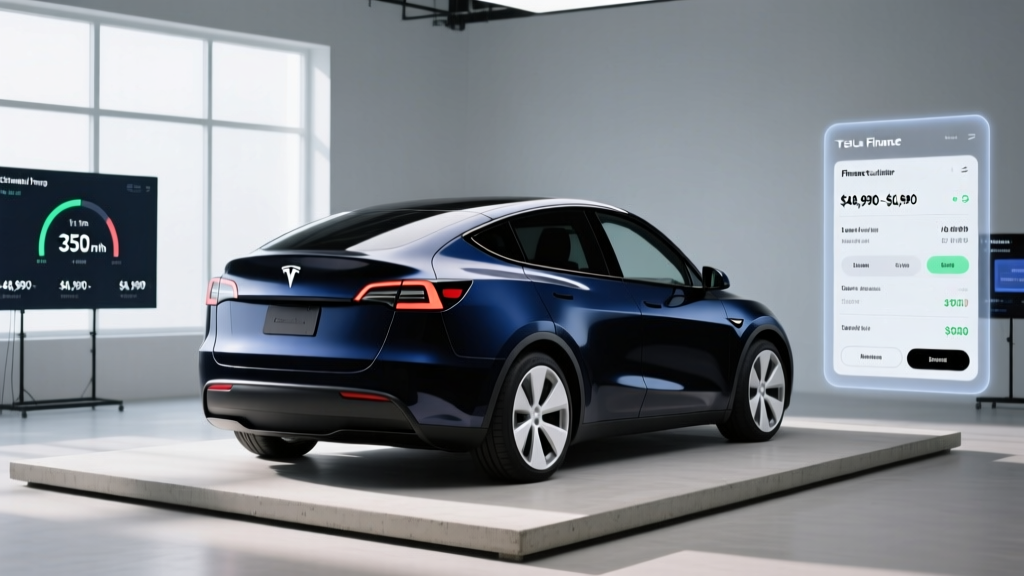
Tesla Finance Calculator — Monthly Payment Estimate:
Using a Tesla finance calculator framework with typical 2026 terms for a Long Range AWD ($47,990 MSRP, $7,500 credit applied, $40,490 financed):
- 60 months at 4.49% APR (Tesla's current promotional rate for qualified buyers): ~$753/month
- 72 months at 5.99% APR (standard rate): ~$670/month
- 84 months at 6.49% APR: ~$600/month
These figures assume zero down payment and exclude state/local incentives, trade-in value, taxes, and registration fees. Putting $5,000 down on the 60-month term drops payments to approximately $660/month. Tesla also offers leasing (typically 36 months) with monthly payments often $100–$150 lower than financing, but you forfeit equity and the tax credit transfers to the lessor (Tesla typically passes this through as a lease reduction).
Total 5-Year Ownership Cost Estimate (Long Range AWD, 15K miles/year):
- Financing cost (60-month, 4.49%): ~$5,190 in interest
- Electricity (home charging at $0.14/kWh, 27 kWh/100mi): ~$2,835 over 75,000 miles
- Insurance (national EV average): ~$9,000–$12,000 over 5 years
- Maintenance (no oil changes; cabin filters, tire rotation, wiper fluid): ~$800–$1,200
- Estimated 5-year depreciation: ~$15,000–$18,000
- Total estimated 5-year cost: ~$33,000–$39,000 (before incentives)
For comparison, a similarly equipped gas-powered compact SUV (e.g., Toyota RAV4 AWD at ~$38,000) would cost roughly $6,500 in fuel over the same period at 28 MPG combined and $3.20/gallon, plus ~$2,500 in maintenance. The Model Y's lower fuel and maintenance costs partially offset its higher purchase price, and the tax credit tips the scale further in Tesla's favor for eligible buyers.
Pros, Cons & Who Should Buy
- Class-leading Supercharger network access — most reliable DC charging in North America
- 320-mile EPA range covers most commutes and day trips without charging
- Spacious cargo area (76.2 cu ft) and strong efficiency (26 kWh/100mi)
- Over-the-air updates continuously add features and improve performance
- Juniper refresh meaningfully improves ride comfort, cabin noise, and interior quality
- Point-of-sale tax credit transfer reduces upfront cost for eligible buyers
- No Apple CarPlay or Android Auto — Tesla's proprietary interface only
- FSD (Supervised) remains Level 2 and requires constant driver attention despite its name
- Insurance premiums run 15–30% higher than comparable gas SUVs
- Turn-signal stalks removed in Juniper — steering-wheel buttons take adjustment
- 400V architecture limits peak DC charge speed vs. 800V rivals (Ioniq 5, EV6)
- Minimal dealer/service network compared to legacy brands — mobile service fills some gaps
Best For: Tech-forward commuters and small families who can charge at home, take 2–4 road trips per year, and value access to the most reliable public charging network. The Model Y's combination of range, cargo space, and Supercharger infrastructure makes it the most practical EV for buyers who don't want to plan charging stops meticulously.
Consider Instead If: You prioritize ride comfort over tech (Hyundai Ioniq 5 or Kia EV6 ride more smoothly), need Apple CarPlay, want the cheapest possible entry point (Chevy Equinox EV starts ~$8,000 lower), or live in an area with limited Tesla service center access.
Warranty & Long-Term Battery Outlook
Tesla covers the Model Y battery and drive unit for 8 years or 120,000 miles (whichever comes first) with a guaranteed minimum 70% capacity retention. The limited vehicle warranty is 4 years / 50,000 miles. These terms are standard for the segment — Hyundai and Kia offer 10-year/100,000-mile battery warranties, which provide additional peace of mind for high-mileage drivers.
Tesla uses NMC (nickel manganese cobalt) chemistry in the Long Range and Performance trims, which offers higher energy density than LFP (lithium iron phosphate) but is more sensitive to prolonged high-State-of-Charge storage. For daily use, Tesla recommends charging to 80% and only going to 100% before long trips. Real-world degradation data from fleet operators shows NMC packs losing roughly 8–12% capacity over the first 100,000 miles, with the curve flattening significantly afterward — most owners will never approach the 70% warranty threshold under normal use.
FAQ: 2026 Tesla Model Y Ownership Questions
What is the real-world range of the 2026 Tesla Model Y?
The Long Range RWD posts a 320-mile EPA estimate. In real-world driving, expect ~300–315 miles in mixed city/suburban use, ~260–280 miles on sustained highway trips at 75 mph, and ~220–250 miles in freezing cold weather. The AWD and Performance trims see 10–15% lower figures due to the second motor's weight and power consumption.
How fast does the Model Y charge at home and on road trips?
At home on a Level 2 Wall Connector (11.5 kW), the Model Y adds ~44 miles of range per hour — a full charge takes about 7 hours. On a Tesla V3/V4 Supercharger, it peaks at 250 kW and charges from 10–80% in approximately 27 minutes. Plan road-trip stops around the 10–80% window; charging above 80% slows dramatically due to the battery management system protecting cell health.
How much does the 2026 Model Y cost after federal tax credits?
The Long Range RWD starts at $44,990 and drops to approximately $37,490 with the full $7,500 federal tax credit applied at point of sale. The AWD falls to ~$40,490. Eligibility depends on your modified adjusted gross income (under $150K single / $300K joint), the vehicle's MSRP (under $80K for SUVs — the Model Y qualifies), and battery-sourcing requirements that tighten each year. Confirm eligibility at IRS.gov before purchasing.
Is the Model Y worth buying vs. the Hyundai Ioniq 5 or Ford Mach-E?
The Model Y wins on charging infrastructure reliability, cargo space, and software integration. The Ioniq 5 offers faster peak DC charging (800V architecture, ~18 min 10–80%), a more comfortable ride, and Apple CarPlay. The Mach-E provides a more traditional SUV driving feel and a growing dealer service network. If Supercharger access matters to you — especially for road trips — the Model Y remains the strongest choice. If ride comfort and charging speed at non-Tesla stations matter more, test-drive the Ioniq 5.
What are the biggest drawbacks of the 2026 Model Y?
The main compromises are the lack of Apple CarPlay/Android Auto, higher-than-average insurance premiums (budget $150–$220/month depending on your profile), the removal of turn-signal stalks in the Juniper refresh (replaced by steering-wheel buttons that require a learning curve), and a 400V charging architecture that can't match the 800V peak speeds of Hyundai/Kia rivals at compatible stations.
Does the 2026 Model Y qualify for the federal EV tax credit?
Yes — the Model Y is classified as an SUV (MSRP cap: $80,000) and is assembled in the U.S., making it eligible for up to $7,500 under IRS §30D, provided you meet income caps and the battery meets current-year critical-mineral and component-sourcing thresholds. The credit can be applied at point of sale as a direct price reduction. Always verify current-year rules on IRS.gov or with a tax professional, as sourcing requirements become stricter each calendar year.