The Tesla Model Y remains one of the best-selling electric vehicles in the United States, but behind the strong sales numbers, a quieter story has been unfolding on factory floors and in engineering bays. Recent reports of Tesla employee morale concerns — spanning production-line turnover, engineering departures, and internal dissatisfaction with shifting corporate priorities — raise a legitimate question for prospective buyers: does workforce sentiment affect the product you drive home?
This review evaluates the 2026 Tesla Model Y on its technical merits — range, charging speed, performance, pricing, and tax credit eligibility — while also examining what documented morale issues mean for build quality, software reliability, and long-term ownership. If you're cross-shopping the Model Y against the Hyundai Ioniq 5, Ford Mustang Mach-E, or Chevrolet Equinox EV, you need the full picture.
2026 Tesla Model Y: Core Specifications at a Glance
| Spec | Long Range RWD | Long Range AWD | Performance |
|---|---|---|---|
| EPA Range | 320 mi | 303 mi | 277 mi |
| Battery (usable) | ~75 kWh, NMC | ~75 kWh, NMC | ~75 kWh, NMC |
| MPGe (combined) | 123 MPGe | 117 MPGe | 111 MPGe |
| Efficiency | 27 kWh/100 mi | 29 kWh/100 mi | 30 kWh/100 mi |
| 0-60 mph | 5.8 sec | 4.8 sec | 3.5 sec |
| Horsepower | 346 hp | 384 hp | 456 hp |
| Drivetrain | RWD (single motor) | AWD (dual motor) | AWD (dual motor) |
| Max DC Fast Charge | 250 kW | 250 kW | 250 kW |
| 10-80% DC Time | ~25 min | ~25 min | ~25 min |
| Level 2 Home Charge | 11.5 kW (~44 mi/hr) | 11.5 kW (~44 mi/hr) | 11.5 kW (~44 mi/hr) |
| Cargo (rear seats up) | 30.2 cu ft | 30.2 cu ft | 30.2 cu ft |
| Cargo (rear seats folded) | 72.0 cu ft | 72.0 cu ft | 72.0 cu ft |
| Rear Legroom | 38.0 in | 38.0 in | 38.0 in |
| Base MSRP | $44,990 | $47,990 | $52,490 |
| Battery Warranty | 8 yr / 120,000 mi | 8 yr / 120,000 mi | 8 yr / 120,000 mi |
Real-World Range: What the EPA Sticker Doesn't Tell You
Real-World Expectation: 260–285 miles on mixed highway driving at 70-80 mph; 220–250 miles in sub-freezing winter conditions with cabin heat active. City/regenerative driving can approach or slightly exceed the EPA figure.
The Model Y Long Range RWD's 320-mile EPA rating is competitive for the compact electric SUV segment, but the number demands context. Tesla's NMC (nickel manganese cobalt) battery chemistry offers strong energy density — enabling that 320-mile figure from a roughly 75 kWh usable pack — but is more sensitive to extreme temperatures than LFP chemistry.
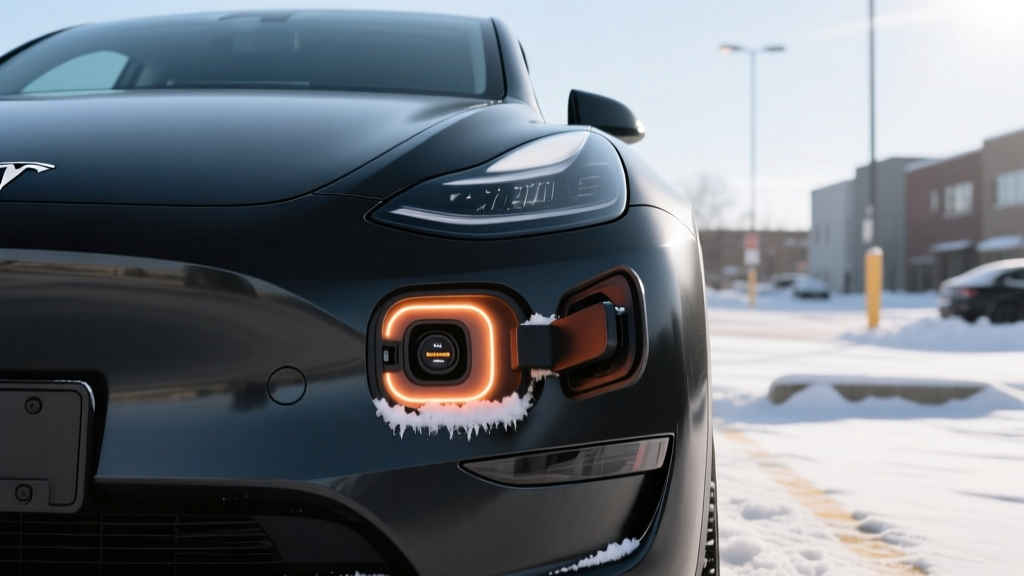
In sustained highway driving at 75 mph with moderate climate control, expect to use roughly 28–30 kWh per 100 miles, translating to approximately 260–280 miles before you'll want to stop. In winter conditions below 30°F, battery preconditioning and cabin heating can reduce effective range by 15–25%, putting real-world winter highway range closer to 220–250 miles. This isn't unique to Tesla — all EVs lose range in cold weather — but buyers in northern climates should plan charging stops accordingly.
For comparison, the Hyundai Ioniq 5 Long Range AWD posts a 304-mile EPA rating with slightly better cold-weather retention thanks to its heat pump (standard on all trims). The Model Y's heat pump is also standard on 2026 models, which helps, but Tesla's cabin heating system remains energy-intensive in deep cold.
Charging Speed: Supercharger Network Advantage
| Charging Level | Power | Rate / Time | Notes |
|---|---|---|---|
| Level 1 (120V) | ~1.4 kW | ~5 mi/hr | Emergency/trickle only |
| Level 2 (240V, 48A) | 11.5 kW | ~44 mi/hr | Full charge in ~7-8 hours |
| DC Fast (Supercharger V3) | 250 kW peak | 10-80% in ~25 min | Peak rate tapers above 60% SoC |
| DC Fast (Supercharger V4) | Up to 350 kW | 10-80% in ~20 min (est.) | V4 rollout ongoing; Model Y may not pull full 350 kW |
The Model Y's 250 kW peak DC fast-charging rate on V3 Superchargers is respectable but no longer class-leading. The Hyundai Ioniq 5 and Kia EV6, built on 800-volt architectures, can accept up to 350 kW and achieve 10-80% charges in roughly 18 minutes under optimal conditions. The Model Y's 400-volt architecture limits it to about 25 minutes for the same 10-80% session.
However, Tesla's Supercharger network remains the most reliable and geographically comprehensive DC fast-charging ecosystem in North America. According to Tesla's official Supercharger page, the network includes over 6,500 V3/V4 stations in the U.S. alone, with plug-and-charge simplicity that third-party networks like Electrify America and EVgo still struggle to match consistently.
A critical nuance: the 250 kW peak rate is only sustained between roughly 10–40% State of Charge. Above 60%, the charge curve tapers significantly — you may see rates drop below 80 kW as the battery management system protects cell longevity. This means the last 20% (80-100%) can add 15-20 minutes. For road trips, plan to charge from 10-80% and move on rather than waiting for a full top-off.
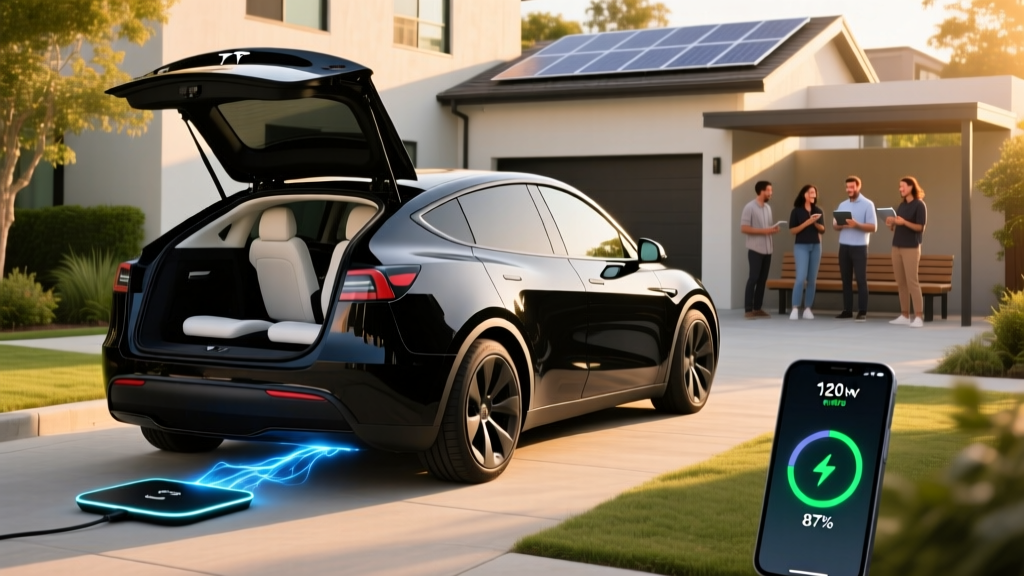
For home charging, the Model Y's onboard charger accepts up to 11.5 kW on a Level 2 (240V/48A) circuit, adding approximately 44 miles of range per hour. A full overnight charge from 20% to 100% takes roughly 7-8 hours. Most owners installing a Tesla Wall Connector will need a 60-amp dedicated circuit — factor in $500–$2,000 for professional electrical installation depending on your panel capacity and run distance.
Performance, Efficiency, and Daily Driving
The 2026 Model Y Long Range AWD delivers 384 horsepower and a 4.8-second 0-60 mph time — quick enough for confident highway merging and genuinely fun on back roads. The Performance trim drops that to 3.5 seconds with 456 hp, putting it in sports-car acceleration territory. The RWD Long Range, at 5.8 seconds and 346 hp, is the efficiency-oriented choice, squeezing out the maximum 320-mile rating.
Efficiency figures hover around 27–30 kWh per 100 miles depending on trim, which translates to 111–123 MPGe combined per EPA fueleconomy.gov data. These are strong numbers for a compact SUV, though the Hyundai Ioniq 5 and the lighter Chevrolet Equinox EV post slightly better efficiency in some trims.
Ride quality has improved in the 2026 refresh compared to earlier Model Y years, with revised damper tuning that reduces the crashy feel over sharp bumps that plagued 2020–2023 models. Cabin noise is also reduced, though still not as isolated as the Ford Mustang Mach-E or Ioniq 5 at highway speeds. The minimalist interior — dominated by a 15.4-inch center touchscreen with no physical instrument cluster — remains polarizing. Some buyers love the simplicity; others miss physical controls for climate and mirrors.
Pricing, Tax Credits, and Total Cost
| Trim | Base MSRP | Est. §30D Credit | Effective Price |
|---|---|---|---|
| Long Range RWD | $44,990 | Up to $7,500* | ~$37,490* |
| Long Range AWD | $47,990 | Up to $7,500* | ~$40,490* |
| Performance | $52,490 | Up to $7,500* | ~$44,990* |
*Federal tax credit eligibility under IRS §30D is subject to buyer income caps ($150K single / $300K joint MAGI), vehicle MSRP caps ($80K for SUVs), and battery critical-mineral and component sourcing requirements that change annually. As of 2026, Tesla has restructured portions of its battery supply chain to maintain eligibility, but buyers should verify current-year qualification on IRS.gov before purchase. The credit can be transferred to the dealer at point of sale as an instant discount under current rules.
Destination fees ($1,390), paint upgrades ($1,000–$2,500), Enhanced Autopilot ($6,000), and FSD Supervised ($8,000) can push as-tested prices well above base MSRP. A Long Range AWD with premium paint and Enhanced Autopilot lands around $55,380 before any credit — still under the $80K SUV cap but eroding the value proposition against well-equipped competitors.
For total cost of ownership, the Model Y benefits from low electricity costs (roughly $0.13/kWh national average for home charging, or about $3.50 per 100 miles), no oil changes, and strong resale value. However, Tesla insurance premiums tend to run 15–30% higher than segment averages due to repair cost data, and out-of-warranty battery replacement costs range from $12,000–$16,000 if needed beyond the 8-year/120,000-mile warranty period.
Tesla Employee Morale Concerns: What Buyers Should Know
Multiple reports from 2024 through early 2026 have documented Tesla employee morale concerns across several dimensions:
- Production-line turnover: Tesla's Fremont and Austin factories have experienced higher-than-average hourly worker turnover compared to legacy automakers. This can manifest as inconsistent panel gaps, paint defects, and interior trim alignment issues — problems that have been historically associated with Tesla build quality.
- Engineering departures: Key Autopilot and battery engineers have departed for competitors and startups, raising questions about the pace of FSD (Supervised) development and next-generation battery cell timelines.
- Corporate direction uncertainty: Internal dissatisfaction with shifting priorities between consumer vehicles, robotaxi ambitions, and AI/Optimus robotics has reportedly created a distracted engineering culture.
- Compensation and layoff cycles: Periodic layoffs followed by aggressive rehiring have created job-security anxiety, particularly at Gigafactory Texas and among software teams.
For buyers, the practical implications are twofold. First, build quality variability remains a real concern — always inspect your Model Y carefully at delivery, checking panel gaps, paint consistency, and interior fitment. Second, software update cadence and FSD capability improvements may face delays if key talent continues to leave. The FSD (Supervised) system, while impressive in capability, remains an SAE Level 2 driver-assist system requiring full driver engagement — it is not autonomous driving.
Tech, Safety, and Standout Features
The Model Y's technology suite remains a strong selling point:
- Infotainment: 15.4-inch center touchscreen with navigation, streaming, gaming, and over-the-air updates. No Apple CarPlay or Android Auto — Tesla's proprietary system is the only option.
- Driver Assist: Basic Autopilot (adaptive cruise + lane centering) is standard. Enhanced Autopilot ($6,000) adds auto lane change, autosteer on city streets, and smart summon. FSD Supervised ($8,000) adds traffic light/stop sign recognition and more aggressive city navigation.
- Safety: The 2026 Model Y carries a 5-star NHTSA overall rating and IIHS Top Safety Pick+ designation, with standard automatic emergency braking, blind-spot monitoring, and lane-departure prevention.
- Unique features: Sentry Mode (360° parking surveillance), Dog Mode (climate-maintained pet waiting), camp mode, and a front trunk (frunk) adding 4.1 cu ft of cargo space.
Notable drawbacks include the absence of Apple CarPlay/Android Auto, the lack of physical buttons for common controls, the camera-only Tesla Vision system (no radar or ultrasonic sensors, which some drivers find less reliable in heavy rain or fog), and the steep add-on cost for Autopilot features that competitors include standard or at lower prices.
Who Should Buy the 2026 Tesla Model Y?
Choose the Model Y if: You prioritize access to the Supercharger network, want strong performance and cargo versatility, value OTA software updates, and live in an area with reliable Tesla service center access.
Consider alternatives if: You need Apple CarPlay/Android Auto, want physical controls, prioritize consistent build quality, prefer a standard heat pump with better cold-weather efficiency, or are concerned about Tesla's corporate stability and employee retention affecting long-term support.
The Model Y is best suited for tech-forward commuters and small families who can charge at home, take occasional road trips on Supercharger routes, and tolerate the minimalist interior. It's less ideal for buyers who want traditional luxury fit-and-finish, who live far from Tesla service centers, or whose primary concern is getting the most standard features per dollar.
Pros and Cons
Pros
- Supercharger network reliability (best in North America)
- Strong efficiency (27-30 kWh/100 mi)
- Class-leading cargo space (72 cu ft max)
- Quick acceleration across all trims
- Over-the-air updates continuously add features
- 5-star NHTSA safety rating
- Strong resale value
Cons
- Build quality inconsistency (employee morale/turnover factor)
- No Apple CarPlay or Android Auto
- 400V architecture limits DC charge speed vs 800V rivals
- Autopilot/FSD features cost $6K-$8K extra
- Camera-only vision system struggles in heavy rain/fog
- Higher insurance premiums than segment average
- Minimalist interior not for everyone
Frequently Asked Questions
What is the real-world range of the 2026 Tesla Model Y?
The EPA rates the Long Range RWD at 320 miles, but expect 260–285 miles in real-world highway driving and 220–250 miles in cold winter conditions. The AWD and Performance trims rate lower at 303 and 277 miles EPA, respectively.
How fast does the Model Y charge at home and on DC fast chargers?
On a Level 2 home charger (240V/48A), the Model Y charges at 11.5 kW, adding about 44 miles per hour for a full overnight charge. On a V3 Supercharger, it peaks at 250 kW and achieves 10-80% in approximately 25 minutes, though the rate tapers significantly above 60% State of Charge.
How much does the 2026 Model Y cost after the federal tax credit?
The Long Range RWD starts at $44,990 and may qualify for up to $7,500 under IRS §30D, bringing the effective price to approximately $37,490. However, eligibility depends on buyer income ($150K single / $300K joint MAGI caps), vehicle MSRP (under $80K for SUVs), and battery sourcing requirements. Always verify on IRS.gov before purchasing.
Does the Model Y qualify for the federal EV tax credit in 2026?
As of early 2026, Tesla has structured battery sourcing to maintain §30D eligibility for the Model Y. However, critical-mineral and battery-component requirements tighten annually under the Inflation Reduction Act. Confirm current-year eligibility at IRS.gov or with your tax professional before finalizing a purchase.
Is the Tesla Model Y worth buying vs the Hyundai Ioniq 5 or Ford Mach-E?
The Model Y wins on Supercharger network access, cargo space, and software ecosystem. The Ioniq 5 wins on DC charge speed (800V architecture, 10-80% in ~18 min), standard features per dollar, and CarPlay/Android Auto support. The Mach-E wins on interior comfort and traditional controls. Your priority — charging network, features, or comfort — determines the best choice.
How do Tesla employee morale concerns affect me as a buyer?
Higher factory turnover can result in inconsistent build quality (panel gaps, paint, trim alignment). Engineering departures may slow FSD development and battery technology timelines. Always do a thorough delivery inspection, and consider whether Tesla's corporate trajectory aligns with your long-term ownership expectations.
What is the battery warranty on the 2026 Model Y?
Tesla covers the Model Y battery and drive unit for 8 years or 120,000 miles (whichever comes first), with a guaranteed minimum 70% capacity retention over that period. Out-of-warranty battery replacement costs range from $12,000–$16,000 based on current service pricing.