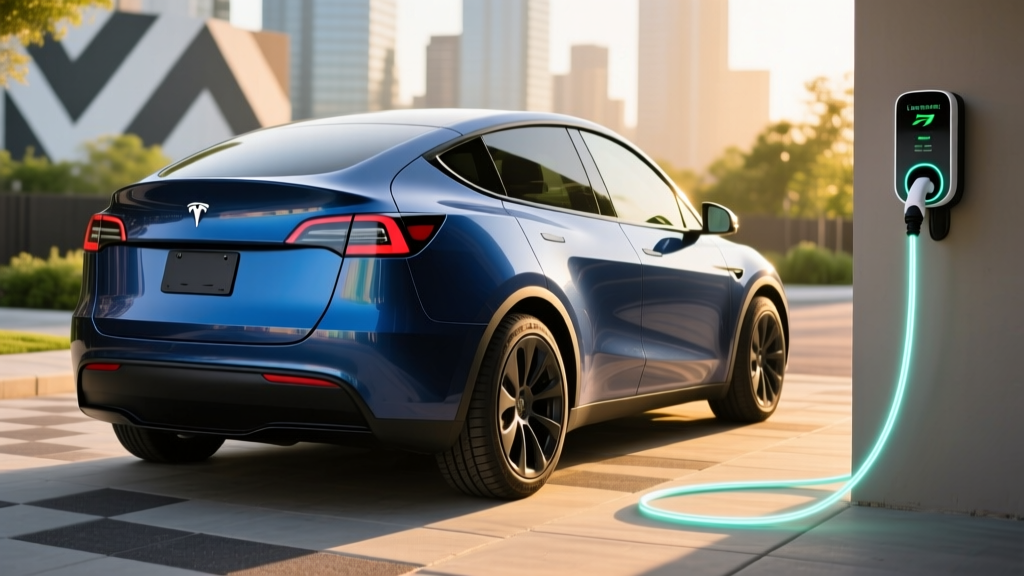
The 2026 Tesla Model Y Rear-Wheel Drive (often listed simply as the "Model Y" base trim) remains the entry point into Tesla's best-selling crossover — and one of the most consequential EVs on the road. After the significant "Juniper" refresh that debuted for the 2025 model year, the 2026 RWD variant carries forward with the updated styling, ventilated front seats, ambient lighting, power-folding second row, and a quieter cabin that transformed what was already a strong package. But with the starting price hovering near $45,000 before incentives and a growing field of competitors undercutting it on price, the question for 2026 buyers is whether the RWD Model Y's efficiency, Supercharger network access, and software ecosystem still justify the premium.
We spent time with the 2026 Model Y RWD to break down the real-world range you can expect (versus the EPA sticker), what charging actually looks like on road trips, how the §30D federal tax credit applies this year, and where this trim stands against the Hyundai Ioniq 5, Ford Mustang Mach-E, and Chevrolet Equinox EV. If you're cross-shopping the most popular EV in America, here's the data you need.
2026 Tesla Model Y RWD: Core Specifications at a Glance
| Specification | 2026 Model Y Rear-Wheel Drive |
|---|---|
| Base MSRP (incl. destination) | $44,990 |
| EPA-estimated range | 321 miles |
| Battery capacity (usable) | ~60 kWh (LFP chemistry) |
| Drivetrain | Rear-wheel drive, single motor |
| Horsepower | 295 hp |
| 0–60 mph | 6.6 seconds |
| Top speed | 135 mph |
| EPA efficiency | 122 MPGe combined / 27 kWh/100 mi |
| Max DC fast-charge rate | 170 kW peak |
| 10–80% DC charge time | ~25 minutes |
| Level 2 home charging | 11.5 kW (~37 mi/hr) |
| Cargo volume (rear seats up / folded) | 30.2 / 72.1 cu ft |
| Front trunk (frunk) | 4.1 cu ft |
| Seating capacity | 5 passengers |
| Rear legroom | 41.6 inches |
| Battery & drive unit warranty | 8 years / 100,000 miles (70% retention) |
| Basic vehicle warranty | 4 years / 50,000 miles |
Range and Efficiency: EPA vs. Real World
The 2026 Model Y RWD carries an EPA-estimated 321 miles of range — identical to the refreshed 2025 model, reflecting the same LFP battery pack and improved aero from the Juniper redesign. That figure puts it at the top of its class for single-motor electric crossovers, edging past the Hyundai Ioniq 5 Standard Range (290 mi) and the Ford Mustang Mach-E Select RWD (250 mi with standard battery). Only the Long Range AWD Model Y (337 mi) and a few luxury competitors go further — at considerably higher prices.
EPA sticker: 321 miles
Mixed driving (city/suburban, mild weather): 300–320 miles — LFP packs paired with Tesla's heat pump deliver strong efficiency in stop-and-go conditions.
Sustained highway (70–80 mph): 255–280 miles — aerodynamic drag at speed cuts into the 60 kWh usable pack noticeably.
Cold weather (below 32°F, highway): 210–240 miles — expect 25–35% range loss in deep winter, even with preconditioning and the heat pump engaged.
Efficiency is where this trim earns its keep. At 122 MPGe combined (roughly 27 kWh per 100 miles), the RWD Model Y is among the most energy-efficient vehicles in its segment. That translates directly into lower charging costs: at the U.S. average residential electricity rate of ~$0.17/kWh (per EIA data), a full home charge costs approximately $10.20, or about $0.045 per mile — roughly a third of what a comparable gas crossover costs to fuel.
One nuance worth flagging: because this is an LFP (lithium iron phosphate) battery, Tesla recommends charging to 100% at least once per week for accurate state-of-charge calibration. That's a departure from the NMC chemistry in the Long Range model, where daily charging to 80% is standard practice. For home-charging owners, this is actually an advantage — you get full usable range every morning without degradation anxiety, since LFP chemistry handles full-state-of-charge storage far better than NMC.
Charging Speed: DC Fast Charging and Home Level 2
Charging speed is a frequent concern for first-time EV buyers, and the 2026 Model Y RWD presents a mixed picture. The peak DC fast-charge rate is 170 kW, down from the 250 kW peak available on the Long Range AWD variant. This is a direct consequence of the smaller LFP battery pack — smaller packs accept lower peak charge rates due to C-rate limitations (the ratio of charge power to battery capacity).
| Charging Method | Power | Speed / Time | Best For |
|---|---|---|---|
| Level 1 (120V household) | ~1.4 kW | ~4 miles per hour | Overnight top-ups, emergencies |
| Level 2 (240V, 48A Wall Connector) | 11.5 kW | ~37 miles per hour | Daily home charging |
| DC Fast Charge (Supercharger V3/V4) | Up to 170 kW | 10–80% in ~25 min | Road trips |
| DC Fast Charge (CCS adapter, third-party) | Up to 150 kW (varies) | 10–80% in ~28–30 min | Non-Tesla network travel |
On a Tesla Supercharger V3 or V4 station, you'll see the charge curve ramp quickly to ~170 kW up to about 40% state of charge, then taper progressively. The 10–80% session takes approximately 25 minutes — adequate for a rest stop, but noticeably longer than the ~18 minutes a Long Range AWD Model Y achieves at 250 kW. If you regularly take road trips exceeding 300 miles, this 7-minute-per-stop difference adds up.
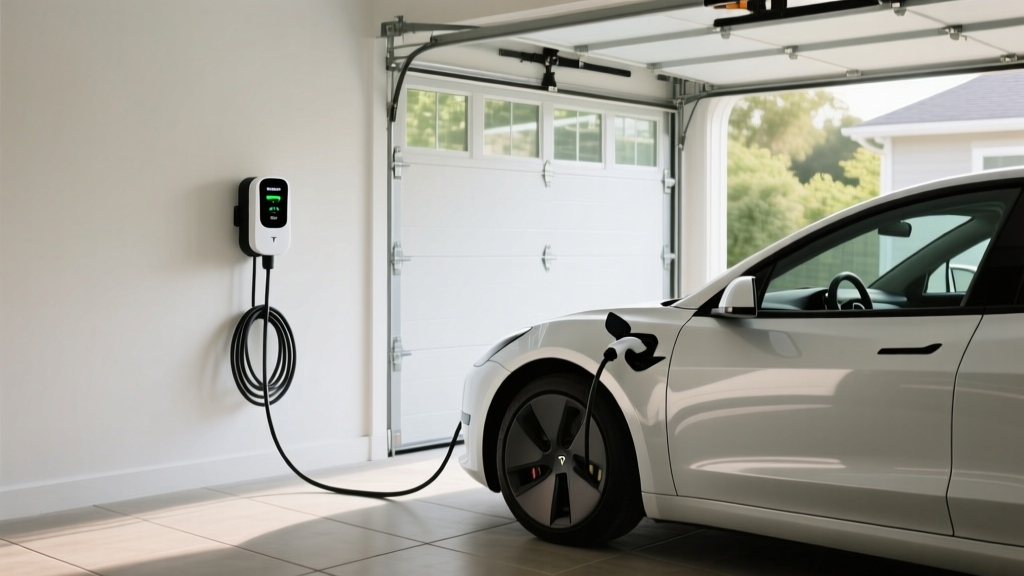
For home charging, the 11.5 kW onboard charger is excellent. A Tesla Wall Connector (or any hardwired Level 2 station on a 60A circuit) will replenish roughly 37 miles of range per hour, meaning a full 10–100% charge completes in about 6 hours — easily overnight. Installation costs for a 240V/60A circuit typically range from $800 to $2,000 depending on panel proximity and local permitting, though a panel upgrade to 200A service can push that to $3,000–$5,000 if your home has older 100A service.
Tesla's NACS (North American Charging Standard) connector is now the industry standard adopted by Ford, GM, Rivian, Volvo, and most other major automakers through 2025–2026. This means the Model Y RWD charges natively at every Supercharger without an adapter — and the expanding network of 400+ kW V4 Supercharger stalls is available to you from day one. For Electrify America, EVgo, and ChargePoint networks, Tesla sells a CCS adapter (~$175) that unlocks those stations, though reliability on non-Tesla networks remains inconsistent in many regions.
Performance and Driving Dynamics
The single rear-mounted motor produces 295 horsepower and propels the Model Y RWD from 0 to 60 mph in 6.6 seconds. That's brisk by any commuter standard — quicker than a base Toyota RAV4 Hybrid by over two seconds — but it's the slowest Model Y in the lineup. The Long Range AWD hits 60 mph in 4.8 seconds, and the Performance variant does it in 3.5 seconds.
For daily driving, the RWD model's instant torque delivery makes it feel punchy around town, and the single-motor layout reduces weight over the front axle, giving it slightly better ride compliance than the AWD variants. The Juniper refresh improved the suspension tuning substantially — the 2026 Model Y absorbs potholes and expansion joints with a composure that the pre-2025 models lacked. Road noise is dramatically reduced thanks to acoustic glass and additional insulation, though the 19-inch Goodyear all-season tires still generate some hum on coarse-grain highway surfaces.
Regenerative braking is strong and offers one-pedal driving in most scenarios, though Tesla removed the adjustable regen setting several years ago — you get one calibrated level, and it's aggressive enough to bring the car to a full stop without touching the brake pedal in normal traffic.
Interior, Technology, and Cargo Space
The Juniper interior overhaul that debuted in 2025 carries forward unchanged for 2026. The minimalist cabin now includes ventilated front seats (a long-requested feature), ambient LED lighting strips across the dash and doors, a power-folding second-row seat, and an 8-inch rear touchscreen for rear passengers to control climate and media. The 15.4-inch center touchscreen remains the primary interface for everything — navigation, media, climate, vehicle settings, and the optional FSD (Supervised) visualization.
On the tech front, the Model Y RWD includes:
- Autopilot (standard): Adaptive cruise control, lane centering, and automatic emergency braking. This is an SAE Level 2 driver-assistance system — the driver must remain engaged with hands on the wheel and eyes on the road at all times.
- FSD (Supervised) ($8,000 option or $99/month): Adds automatic lane changes, Navigate on Autopilot, traffic light and stop sign recognition, and enhanced parking features. Despite the name, this remains an SAE Level 2 system requiring full driver supervision. It is not autonomous driving.
- Over-the-air updates: Tesla continues to push software improvements that add features post-purchase — everything from UI refinements to efficiency optimizations.
- Sentry Mode and Dashcam: Uses the external camera suite to record incidents and monitor the vehicle when parked.
- Tesla app integration: Remote preconditioning, location tracking, charging status, and phone-as-key functionality.
Cargo space is a genuine strength. With the rear seats upright, you get 30.2 cubic feet — more than a BMW X3 or Audi Q5. Fold the 60/40 split rear seats (now power-folding via a button in the cargo area) and capacity expands to 72.1 cubic feet. The 4.1-cubic-foot frunk adds secure storage for charging cables or a small bag. Rear legroom at 41.6 inches is generous enough for adults on long trips, a meaningful advantage over the tighter rear quarters of the Hyundai Ioniq 5.
Pricing, Trims, and Federal Tax Credit Eligibility
The 2026 Tesla Model Y Rear-Wheel Drive starts at $44,990 including the $1,390 destination charge. That positions it roughly $4,000–$8,000 above the base trims of key competitors, though the range and efficiency advantages are significant.
| Configuration | MSRP | Est. After §30D Credit* |
|---|---|---|
| Model Y RWD (base, solid paint) | $44,990 | $37,490 |
| Model Y RWD + Metallic paint ($1,000) | $45,990 | $38,490 |
| Model Y RWD + FSD Supervised ($8,000) | $52,990 | $45,490 |
| Model Y Long Range AWD (for comparison) | $48,990 | $41,490 |
*Federal tax credit estimates assume buyer eligibility under current IRS §30D rules. See eligibility details below.
- Credit amount: Up to $7,500 ($3,750 for critical minerals + $3,750 for battery components).
- MSRP cap: SUVs, vans, and pickups must be ≤ $80,000. The Model Y qualifies on all trims.
- Buyer income cap (modified AGI): $150,000 single / $225,000 head of household / $300,000 joint filers.
- Battery sourcing requirements: Critical minerals and battery components must meet escalating domestic/FIT-partner thresholds. Tesla's Fremont and Austin-built Model Y has historically qualified for the full $7,500, but sourcing rules tighten annually — verify current eligibility at fueleconomy.gov before purchasing.
- Point-of-sale transfer: As of 2024, you can transfer the credit to the dealer at purchase, reducing your out-of-pocket cost immediately rather than waiting to claim it on your tax return.
- Important: Consult a tax professional for your specific situation. Rules are subject to change, and FEOC (foreign entity of concern) restrictions on battery sourcing continue to evolve.
The 2026 Model Y lineup is streamlined: RWD (base), Long Range AWD, Long Range AWD Performance, and the returning Performance trim. There is no "Standard Range" designation anymore — the RWD is the standard-range model. Tesla eliminated most standalone options; you choose paint color, wheels (19" standard, 20" available), interior color (black standard, black-and-white optional), and FSD. That simplicity is either refreshing or limiting, depending on your preference for personalization.
How It Compares: Model Y RWD vs. Key Competitors
| 2026 Tesla Model Y RWD | 2026 Hyundai Ioniq 5 SE (Std Range RWD) | 2026 Ford Mach-E Select RWD | |
|---|---|---|---|
| EPA Range | 321 mi | 290 mi | 250 mi |
| Battery (usable) | ~60 kWh LFP | 58 kWh NMC | 70 kWh NMC |
| DC Fast Charge (peak) | 170 kW | 150 kW | 150 kW |
| 10–80% Time | ~25 min | ~28 min | ~30 min |
| 0–60 mph | 6.6 sec | 7.5 sec | 6.3 sec |
| Base MSRP | $44,990 | $42,600 | $42,995 |
| After $7,500 Credit | $37,490 | $35,100 | $35,495 |
| MPGe (combined) | 122 | 114 | 101 |
| Cargo (seats up) | 30.2 cu ft | 27.2 cu ft | 29.7 cu ft |
The numbers reveal a clear pattern: the Model Y RWD costs more upfront but delivers meaningfully more range and better efficiency than either competitor. The Ioniq 5 undercuts it by ~$2,400 before incentives and offers 800V charging architecture (though with a lower peak rate due to its smaller standard-range battery). The Mach-E Select is a compelling driver's car with strong handling, but its 250-mile range is a significant deficit for road-trippers. Neither competitor offers native Supercharger access — both require adapters for Tesla stations, which now represent the largest and most reliable DC fast-charging network in North America.
Pros, Cons, and Who Should Buy the Model Y RWD
- Best-in-class range (321 mi EPA) at this price point
- Outstanding efficiency — 122 MPGe combined keeps charging costs minimal
- Native Supercharger network access (no adapter needed)
- LFP battery tolerates daily 100% charging without accelerated degradation
- Class-leading cargo space and practicality
- Strong OTA software support and Tesla app ecosystem
- Excellent safety ratings (NHTSA 5-star overall)
- 170 kW peak DC charge rate is slower than Long Range and some competitors on 800V platforms
- Higher base MSRP than Ioniq 5 and Mach-E equivalents
- FSD (Supervised) remains Level 2 at a steep $8,000 — questionable value for most buyers
- No physical buttons or stalks — all controls via touchscreen (turn signals on steering wheel buttons)
- Rear visibility is limited; relies heavily on backup camera
- Insurance premiums run 15–25% higher than comparable gas crossovers in most states
Who it's best for: The Model Y RWD is ideal for daily commuters and small families who charge primarily at home, value maximum range per dollar, and take occasional road trips where Supercharger infrastructure matters. It's the efficiency-maximizing choice in the Tesla lineup — if you don't need AWD or sub-5-second acceleration, the RWD model saves money upfront and at every charging session.
Who should look elsewhere: If you live in a region with harsh winters and regularly drive more than 200 miles in cold conditions, the 25–35% range loss on the RWD's smaller LFP pack may leave you wanting the Long Range AWD's larger NMC battery. If you prioritize the fastest possible road-trip charging, the Long Range's 250 kW peak rate is worth the $4,000 step-up. And if budget is paramount, the Ioniq 5 or Equinox EV delivers strong value at a lower entry price.
Frequently Asked Questions
What is the real-world range of the 2026 Tesla Model Y Rear-Wheel Drive?
The EPA rates it at 321 miles, but expect roughly 300–320 miles in mixed city driving, 255–280 miles on sustained highway trips at 70–80 mph, and 210–240 miles in cold weather (below freezing) with highway driving. Preconditioning the battery via the Tesla app or navigation routing to a Supercharger helps mitigate cold-weather losses.
How fast does the 2026 Model Y RWD charge?
On a Tesla Supercharger, it peaks at 170 kW and charges from 10–80% in approximately 25 minutes. At home on a Level 2 Wall Connector (11.5 kW), it adds about 37 miles of range per hour, completing a full charge overnight in roughly 6 hours. Level 1 (standard 120V outlet) adds about 4 miles per hour — useful for topping off but not practical as a primary charging method.
Does the 2026 Tesla Model Y RWD qualify for the $7,500 federal EV tax credit?
The Model Y RWD has historically qualified for the full $7,500 under IRS §30D, but eligibility depends on your income (≤$150K single / ≤$300K joint), the vehicle's MSRP (must be ≤$80K for SUVs — the Model Y clears this easily), and current battery-sourcing rules, which tighten each year. The credit can be transferred at point of sale, reducing your purchase price immediately. Always verify current eligibility on fueleconomy.gov and consult a tax professional before relying on the credit.
Is the Model Y RWD worth buying over the Long Range AWD?
If you live in a mild climate, charge at home, and rarely drive more than 250 miles in a single day, the RWD is the smarter financial choice — you save $4,000 and gain efficiency. The Long Range AWD earns its premium with 337 miles of range, 250 kW DC fast charging, all-wheel drive traction, and a 4.8-second 0–60 time. For cold-climate buyers or frequent road-trippers, the Long Range is worth the step-up.
Is LFP battery chemistry a concern for long-term ownership?
LFP (lithium iron phosphate) actually has advantages for longevity: it tolerates repeated full charges better than NMC, has a longer cycle life (typically 3,000+ cycles vs. ~1,500–2,000 for NMC), and is less prone to thermal runaway. The trade-off is lower energy density (hence the smaller pack and lower range vs. Long Range) and reduced cold-weather performance. Tesla warranties the battery for 8 years or 100,000 miles with a minimum 70% capacity retention threshold.
How much does it cost to insure the 2026 Model Y RWD?
Insurance premiums for the Model Y typically run 15–25% higher than a comparable gas-powered crossover like the Toyota RAV4, averaging $1,800–$2,400 annually depending on your state, driving record, and coverage level. Tesla offers its own insurance product in many states that uses real-time driving data to set rates, which can be competitive for safe drivers. Always get quotes from multiple providers before purchasing.