Quick Answer: Can an Electric Car Be Charged at Home?
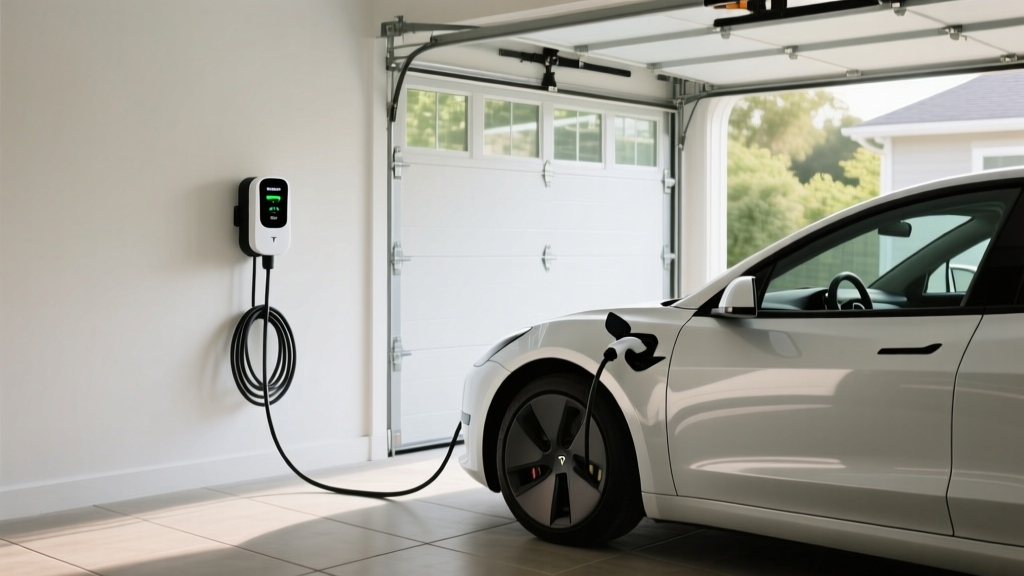
Yes. Every electric vehicle sold in the U.S. can be charged at home using a standard 120V household outlet (Level 1). For faster charging, a 240V Level 2 home charger adds 25–44 miles of range per hour and costs between $500 and $2,500 installed, depending on your electrical panel and wiring run. Most EV owners do 80% or more of their charging at home, waking up to a full battery every morning — the single biggest ownership advantage over gas cars.
Home charging is the foundation of practical EV ownership. But the real question isn't whether you can charge at home — it's what level of charging you need, what it will cost to set up, and whether your daily driving pattern makes home charging sufficient. Let's work through each of those with real numbers.
Level 1 vs Level 2 Home Charging: Speed, Cost, and When Each Makes Sense
Before comparing hardware, it's critical to understand the difference between kW (kilowatts — the rate of power delivery, like water pressure) and kWh (kilowatt-hours — the total energy stored in your battery, like gallons in a tank). A charger's kW rating determines how fast it fills your battery's kWh capacity.
| Charging Level | Voltage | Power (kW) | Miles of Range Per Hour | Full Charge Time (75 kWh Battery) | Equipment Cost |
|---|---|---|---|---|---|
| Level 1 (standard outlet) | 120V | 1.2–1.4 kW | 3–5 mi/hr | ~50–60 hours | $0 (cord included) |
| Level 2 (240V, 32A) | 240V | 7.7 kW | 25–30 mi/hr | ~9–10 hours | $300–$700 + install |
| Level 2 (240V, 48A) | 240V | 11.5 kW | 37–44 mi/hr | ~6.5–7 hours | $400–$800 + install |
When Level 1 is enough: If your daily round-trip commute is under 30 miles and your car sits parked at home for 10+ hours overnight, a standard outlet can replenish your daily use. A typical EV uses about 0.3 kWh per mile, so 30 miles requires roughly 9 kWh — achievable in about 7–8 hours on Level 1.
When you need Level 2: If you drive 40+ miles daily, regularly take road trips, live in a cold climate (where cabin heating increases consumption 20–30%), or own a larger-battery vehicle like the Ford F-150 Lightning (131 kWh extended range), Level 2 is practically mandatory. It also enables off-peak time-of-use charging schedules that maximize utility savings.
Real-World Home Charging Costs: Equipment, Installation, and Electricity
The total cost of setting up home charging depends on three variables: the charger unit, the electrical work required, and your local electricity rate. Here's a realistic breakdown for a 240V / 48A Level 2 installation in 2026.
| Cost Component | Low End | Typical | High End | Notes |
|---|---|---|---|---|
| Level 2 charger (hardware) | $300 | $550 | $800 | Brands: Emporia, ChargePoint, Wallbox, Tesla Wall Connector |
| Electrician labor | $300 | $600 | $1,500 | Depends on wiring run length and complexity |
| Electrical panel upgrade (if needed) | $0 | $0 | $2,500 | Required if panel is at capacity (older 100A panels) |
| Permit & inspection | $50 | $150 | $400 | Varies by municipality |
| Total installed cost | $650 | $1,300 | $5,200 | Most homes with 200A panels fall in the $800–$1,800 range |
The panel-upgrade gotcha: Homes built before 1990 often have 100-amp electrical panels that may not support a 48A continuous load (which draws 60A from the panel per NEC 125% derating rules). If your panel is already near capacity — running electric heat, a dryer, and an electric stove — an upgrade to 200A may be required. Get a licensed electrician to evaluate this before buying hardware.
Utility rebates can help: Many utilities offer $200–$500 rebates for Level 2 charger installations, and some provide free or discounted time-of-use (TOU) rate plans that make overnight charging significantly cheaper. Check with your local utility before purchasing equipment.
Home Charging vs. Gas: Real Cost Per Mile Compared
The strongest economic argument for home charging is fuel cost. Let's compare a 2026 Tesla Model Y Long Range (120 MPGe combined, ~3.0 miles/kWh) against a 2026 Toyota RAV4 AWD gas model (30 MPG combined) across different scenarios.
| Metric | Tesla Model Y (Home Charging) | Toyota RAV4 (Gas) |
|---|---|---|
| Fuel/Energy source | Electricity @ $0.14/kWh (national avg.) | Regular unleaded @ $3.40/gal |
| Efficiency | 3.0 mi/kWh (120 MPGe) | 30 MPG combined |
| Cost per mile | $0.047/mi | $0.113/mi |
| Annual fuel cost (12,000 mi/yr) | $564 | $1,360 |
| 5-year fuel cost | $2,820 | $6,800 |
| 5-year fuel savings (EV) | $3,980 saved | |
At a typical residential rate of $0.14/kWh, home-charged electricity costs roughly $0.047 per mile — less than half the per-mile cost of gasoline at $3.40/gallon. If your utility offers off-peak TOU rates (often $0.06–$0.09/kWh overnight), that drops to $0.02–$0.03/mile, widening the gap further.
However, public DC fast charging is a different story. At Electrify America or EVgo rates of $0.40–$0.55/kWh, your cost per mile jumps to $0.13–$0.18 — comparable to or exceeding gas. Home charging access is what unlocks EV economics; relying solely on public charging erases the fuel-cost advantage.
What First-Time EV Buyers Need to Know About Home Charging
Home charging introduces ownership dynamics that don't exist with gas cars. Here's what matters based on real-world experience:
Connector compatibility has shifted
As of 2025–2026, most major automakers have adopted the NACS (North American Charging Standard) connector — the same plug Tesla uses. If you're buying a 2025+ Ford, GM, Rivian, Volvo, or Hyundai model, it likely ships with a NACS inlet. Older models and some 2025 vehicles still use CCS1. For Level 2 home charging, both connector types use the J1772 standard or NACS, and adapters are widely available. Confirm your vehicle's inlet before ordering a wall charger.
Cold weather increases home charging demand
In sub-freezing climates, EV energy consumption rises 20–35% due to battery heating and cabin climate demands. A commute that uses 9 kWh in July may require 12–13 kWh in January. Level 1 charging may not keep pace with winter consumption if you drive more than 25 miles daily. Plan for a Level 2 install if you live in the northern U.S. or mountain regions.
Preconditioning saves range and charge time
Most EVs allow you to set a departure time via their app, which warms the battery and cabin while still plugged in. This means you leave with a warm battery (more efficient) and a full charge — using grid power instead of battery power for heating. It's one of the biggest practical advantages of home charging that new owners frequently overlook.
The §30D federal tax credit can offset purchase cost
For 2026, the IRS §30D clean vehicle credit provides up to $7,500 for qualifying new EVs, but eligibility depends on battery critical-mineral sourcing, MSRP caps ($55,000 for sedans, $80,000 for SUVs/trucks), and buyer income limits ($150K single / $300K joint). The credit can now be transferred to the dealer at point of sale, reducing your purchase price directly. Always verify current-year eligibility on the IRS website or with a tax professional — sourcing requirements have tightened annually.
Common Misconceptions About Home EV Charging
| Myth | Fact |
|---|---|
| "You need a special outlet to charge an EV." | Every EV ships with a Level 1 cord that plugs into a standard 120V household outlet. No modification needed — it just charges slowly. |
| "Home charging will overload my electrical panel." | A 48A Level 2 charger draws about 11.5 kW — similar to an electric dryer. Most modern 200A panels handle it without issue. An electrician can verify capacity before install. |
| "Charging overnight damages the battery." | Modern EV battery management systems (BMS) prevent overcharging. Most manufacturers recommend setting a daily charge limit of 80% for NMC batteries and 100% for LFP chemistry. Scheduled charging with an 80% limit is optimal for longevity. |
| "I need to charge every night." | With EPA ranges of 250–350+ miles on most 2026 models, most drivers only need to top up 2–3 times per week. Set your charger to maintain a 60–80% window and plug in as needed. |
| "Home electricity isn't clean enough to make EVs worthwhile." | Even on coal-heavy grids, EVs produce fewer lifecycle emissions than gas cars per EPA analysis. As grids add renewables, EVs get cleaner over time — gas cars don't. |
Decision Framework: Do You Need Level 2 Home Charging?
Answer these questions to determine your setup:
- Daily driving under 30 miles + 10+ hours parked at home?
→ Level 1 (standard outlet) is likely sufficient. Try it for a month before investing in Level 2. - Daily driving 30–80 miles?
→ Level 2 strongly recommended. A 48A charger replenishes 37–44 miles per hour — an overnight charge fully covers your needs. - Live in a cold climate (sustained sub-30°F winters)?
→ Level 2 is essential. Winter consumption increases 20–35%, and battery preconditioning requires plugged-in power for best results. - Road trips more than once a month?
→ Level 2 at home ensures you always leave with 100% charge, maximizing your highway range before switching to DC fast charging on the road. - Electrical panel under 150A or already near capacity?
→ Budget $1,500–$2,500 for a panel upgrade, or consider a lower-amperage 32A Level 2 charger (7.7 kW) that works on existing panels. - No garage or dedicated parking with outlet access (apartment/street parking)?
→ Home charging may not be feasible. Look into workplace charging, public Level 2 networks (ChargePoint, EVgo), or consider a PHEV (plug-in hybrid) as an alternative that doesn't require daily charging.
Frequently Asked Questions
Can I use an extension cord for Level 1 EV charging?
Manufacturers universally advise against it. The EV charging cord draws a sustained 12A for many hours, which can overheat standard extension cords. If your outlet is too far from your parking spot, have an electrician install a dedicated 20A outlet closer to where you park — typically a $200–$400 job.
Does home charging degrade my EV battery faster?
No — home Level 1 and Level 2 charging is actually gentler on batteries than DC fast charging. Slow charging generates less heat and stress on cells. Battery degradation is driven primarily by sustained high states of charge (above 90%), extreme temperatures, and frequent DC fast charging. Setting your charge limit to 80% for daily use and reserving 100% for road trips maximizes long-term battery health.
How much does home charging add to my electric bill?
At the national average rate of $0.14/kWh, charging a 75 kWh battery from 10% to 80% (52.5 kWh) costs about $7.35. If you drive 12,000 miles per year at 3 mi/kWh efficiency, you'll consume roughly 4,000 kWh annually — adding about $560/year or $47/month to your electric bill. Compare that to $1,360/year in gasoline at 30 MPG and $3.40/gallon.
Can solar panels power my EV charger?
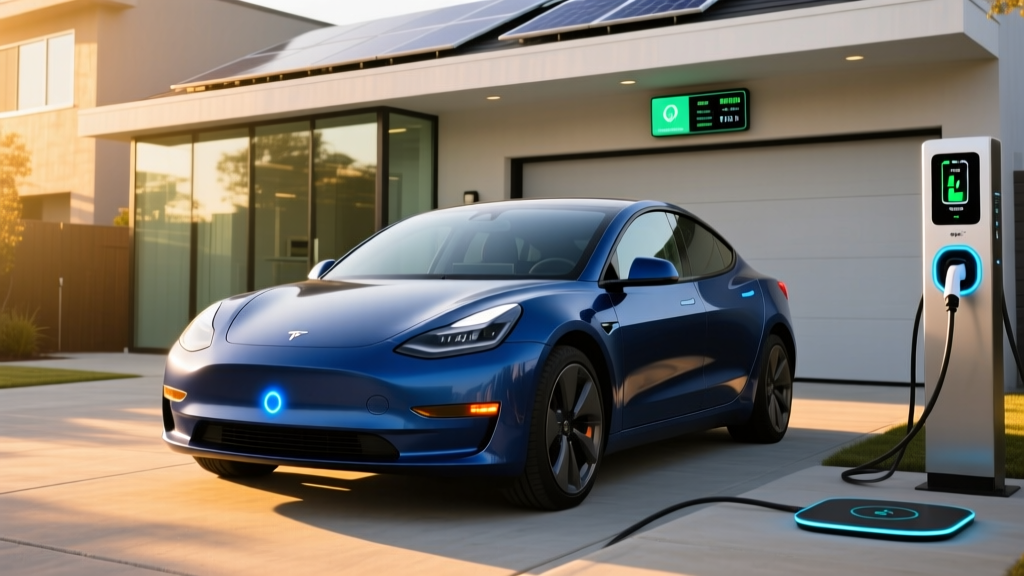
Yes, but indirectly. Solar panels feed your home's electrical system; your EV charger draws from that system. A typical 8 kW residential solar array produces about 30–40 kWh per day in good sun — enough to cover both household loads and EV charging for a 30–40 mile daily commute. Net metering or a home battery (like Tesla Powerwall) lets you store daytime solar for overnight charging.
What if I rent or live in an apartment — can I still charge at home?
It's more complicated but not impossible. Some apartment complexes are installing shared Level 2 chargers. A few portable Level 1 chargers can plug into any standard outlet with landlord permission. If home charging isn't viable, assess your access to workplace charging or reliable public Level 2 stations within 5 minutes of your home. If neither exists, a plug-in hybrid (PHEV) like the Toyota RAV4 Prime (42 miles electric range, then gas) may be a more practical electrified option.