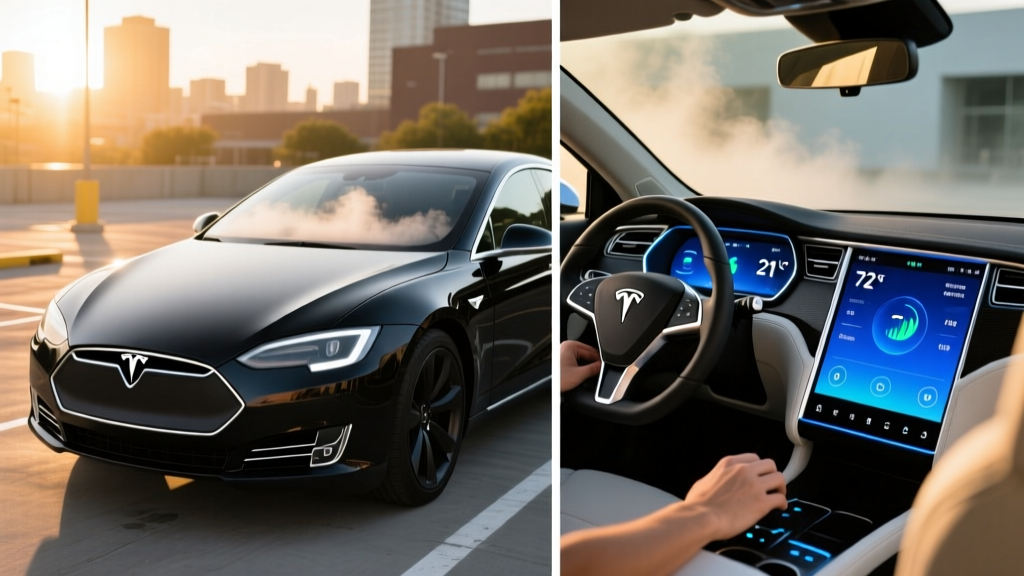
When EV buyers obsess over battery size and motor output, one system quietly dictates how far you'll actually drive on a cold January morning: the HVAC. Tesla's thermal management architecture—centered on its octovalve heat pump—has become a benchmark in the industry, but the real-world implications for range, charging speed, and daily comfort are rarely quantified. This profile breaks down exactly how Tesla's HVAC system performs across the 2026 lineup and what it means for your efficiency numbers.
Tesla's Heat Pump Architecture: The Octovalve Advantage
Since the 2021 Model Y refresh, Tesla has deployed its patented octovalve thermal management system across the fleet. Unlike older resistive heater setups (PTC heaters that consume 3-5 kW directly from the traction battery), the octovalve heat pump scavenges waste heat from the battery, drive motors, and even ambient air, compressing it to warm the cabin at a fraction of the energy cost.
The system integrates eight coolant flow paths into a single manifold, allowing Tesla to redirect thermal energy between the battery pack, drive unit, and cabin HVAC loop simultaneously. In practical terms: when you're driving in 30°F weather, the heat pump might draw 1-2 kW to maintain a 70°F cabin, where a resistive system would pull 4-6 kW. That difference translates directly to preserved range.
Key distinction: A heat pump's coefficient of performance (COP) typically ranges from 2.0 to 4.0 in moderate cold, meaning it delivers 2-4 units of heat for every 1 unit of electricity consumed. Resistive heaters have a COP of exactly 1.0. Below approximately -10°F (-23°C), heat pump efficiency drops and supplemental resistive heating may engage.
Real-World Range Impact: HVAC On vs. Off
Tesla's EPA range figures are measured under controlled conditions that partially account for HVAC load, but real-world variance is substantial. Here's what testing and owner data reveal across the 2026 lineup:
2026 Model 3 Long Range AWD: EPA 341 miles. Real-world with HVAC in moderate climate (60-80°F): ~310-325 miles. In cold weather (20-35°F) with heat pump active: ~270-295 miles. Below 10°F: expect ~240-265 miles as supplemental heating engages and battery internal resistance increases.
2026 Model Y Long Range AWD: EPA 308 miles. Real-world moderate: ~280-295 miles. Cold weather (20-35°F): ~240-265 miles. Extreme cold (below 10°F): ~215-235 miles.
2026 Model S Long Range: EPA 402 miles. Real-world moderate: ~365-380 miles. Cold weather: ~310-340 miles. The larger 100 kWh battery provides more thermal mass and buffer.
The HVAC system's energy draw isn't the only cold-weather penalty. Battery chemistry becomes less efficient at low temperatures, increasing internal resistance and reducing the usable energy window. Tesla's thermal management mitigates this by preconditioning the battery—warming it using grid power while plugged in or using drive energy on the road. The EPA's fueleconomy.gov data shows Tesla models maintaining some of the lowest cold-weather range-loss percentages in the segment.
Full Specs: Tesla 2026 Lineup at a Glance
| Spec | Model 3 LR AWD | Model Y LR AWD | Model S LR | Model X LR |
|---|---|---|---|---|
| EPA Range | 341 mi | 308 mi | 402 mi | 335 mi |
| Battery (usable) | ~79 kWh (NMC) | ~79 kWh (NMC) | ~100 kWh (NMC) | ~100 kWh (NMC) |
| Peak DC Charge | 250 kW | 250 kW | 250 kW | 250 kW |
| 10-80% DC Time | ~25 min | ~27 min | ~30 min | ~32 min |
| Level 2 Rate | 11.5 kW (~44 mi/hr) | 11.5 kW (~44 mi/hr) | 11.5 kW (~34 mi/hr) | 11.5 kW (~30 mi/hr) |
| 0-60 mph | 4.2 sec | 4.8 sec | 3.1 sec | 3.8 sec |
| Horsepower | 384 hp | 384 hp | 670 hp | 670 hp |
| MPGe (combined) | 134 MPGe | 122 MPGe | 120 MPGe | 102 MPGe |
| kWh/100mi | 25 | 28 | 28 | 33 |
| Cargo (rear seats up) | 23 cu ft | 30 cu ft | 28 cu ft | 88 cu ft |
| Cargo (seats folded) | 65 cu ft | 76 cu ft | 80 cu ft | 92 cu ft |
| Base MSRP | $47,740 | $48,240 | $79,990 | $84,990 |
Note: Model 3 RWD uses an LFP (lithium iron phosphate) battery at ~60 kWh with 272 miles EPA range and a lower MSRP of $38,990. LFP chemistry handles 100% daily charging better than NMC but offers less energy density and slightly worse cold-weather performance.
Charging Performance: How HVAC Preconditioning Changes Everything
Tesla's HVAC system plays a direct role in DC fast-charging speed through battery preconditioning. When you navigate to a Supercharger, the car's thermal management system actively warms or cools the battery to its optimal charging temperature (roughly 95-104°F / 35-40°C) before you arrive.
Without preconditioning—say, if you pull into a charger without routing through the navigation—a cold battery might accept only 50-80 kW initially, gradually ramping as it self-heats. With proper preconditioning, Tesla models consistently hit their 250 kW peak within the first few minutes of a session.
| Charging Level | Power (kW) | Speed | Notes |
|---|---|---|---|
| Level 1 (120V) | ~1.4 kW | ~3-5 mi/hr | Emergency/trickle only |
| Level 2 (240V, 48A) | 11.5 kW | 30-44 mi/hr | Home Wall Connector |
| DC Fast (V3 Supercharger) | Up to 250 kW | 10-80% in ~25-32 min | Preconditioning required for peak |
| DC Fast (V4 Supercharger) | Up to 250 kW (CCS adapter) | Similar to V3 | Newer stalls; NACS native |
The charge curve tapers significantly above 80% state of charge. On a Model 3 Long Range, you'll see 250 kW from roughly 10-30% SoC, dropping to ~150 kW by 50%, ~75 kW by 70%, and ~40 kW by 85%. This is normal lithium-ion behavior—charging speed is a curve, not a flat number. For road trips, charging from 10-80% and driving again is faster than waiting for 100%.
Efficiency Deep Dive: kWh/100mi and HVAC Load
The EPA's MPGe metric converts electricity consumption into a gasoline-equivalent figure (33.7 kWh = 1 gallon). But for daily ownership, kWh per 100 miles is more actionable.
A 2026 Model 3 Long Range consuming 25 kWh/100mi at $0.14/kWh (national average residential rate) costs roughly $3.50 per 100 miles. The HVAC load shifts this figure seasonally:
- Summer (A/C active): ~27-29 kWh/100mi — the heat pump running in cooling mode adds modest load
- Mild spring/fall (HVAC minimal): ~23-25 kWh/100mi — peak efficiency window
- Winter (heat pump + battery conditioning): ~30-35 kWh/100mi in moderate cold, potentially 38+ kWh/100mi in extreme cold below 10°F
Cabin preheating while plugged in (using the Tesla app's scheduled departure feature) eliminates the initial high-draw warmup phase from your battery. This single habit can recover 15-25 miles of range on a cold commute.
Pricing, Trims, and Federal Tax Credit Eligibility
| Model/Trim | MSRP | Est. §30D Credit | Effective Price |
|---|---|---|---|
| Model 3 RWD (LFP) | $38,990 | $0-$7,500* | $31,490-$38,990 |
| Model 3 Long Range AWD | $47,740 | $7,500* | $40,240 |
| Model Y Long Range AWD | $48,240 | $7,500* | $40,740 |
| Model Y Performance | $52,490 | $7,500* | $44,990 |
| Model S Long Range | $79,990 | $0† | $79,990 |
| Model X Long Range | $84,990 | $0† | $84,990 |
*The IRS §30D federal tax credit for 2026 requires: buyer AGI under $150K single / $300K joint; vehicle MSRP under $55K for sedans (Model 3) or $80K for SUVs/trucks (Model Y qualifies); battery components and critical minerals meeting phased-in domestic-sourcing thresholds. The credit can be transferred to the dealer as a point-of-sale discount. Verify eligibility at purchase time—sourcing rules tighten annually.
†Model S and Model X exceed the $55K sedan MSRP cap and do not qualify for the new-vehicle §30D credit.
Tech, Comfort, and Standout HVAC Features
Tesla's infotainment remains a 15.4-inch (Model 3/Y) or 17-inch (Model S/X) center touchscreen running Tesla OS, with no physical instrument cluster. HVAC controls are entirely screen-based—swipe to direct airflow, tap to adjust temperature. This minimalist approach frustrates some buyers who prefer physical knobs but enables features competitors can't easily match:
- Camp Mode: Maintains HVAC and airflow overnight, drawing from the traction battery for climate-controlled sleeping
- Dog Mode: Keeps cabin at a set temperature while displaying a message on-screen for passersby
- Sentry Mode + Cabin Overheat Protection: Monitors surroundings and prevents interior temperatures from exceeding 105°F
- Bioweapon Defense Mode (Model S/X): A HEPA-grade filtration system that pressurizes the cabin and filters outside air at hospital-grade levels
- Scheduled Departure Preconditioning: Warms battery and cabin on grid power before your commute
On the driver-assistance front, Tesla's Autopilot (included) provides adaptive cruise control and lane centering—a solid Level 2 system. Full Self-Driving (Supervised) at $8,000 adds automatic lane changes, traffic light recognition, and city-street navigation, but remains SAE Level 2—you must supervise at all times. It is not autonomous driving.
SAE Automation Level Reminder: Tesla Autopilot and FSD (Supervised) are Level 2 driver-assistance systems. The driver must remain fully engaged, hands on or near the wheel, eyes on the road. Only Level 4 services like Waymo operate without a human driver in defined geofenced areas.
Notable Drawbacks
- No physical HVAC controls—screen-only adjustment while driving requires more glance time than knob-based systems
- Model 3/Y rear-seat passengers lack dedicated climate zone controls (single-zone rear vent)
- Heat pump effectiveness diminishes significantly below -10°F; supplemental resistive heating engages and range loss accelerates
- FSD (Supervised) remains an expensive add-on that does not eliminate driver responsibility
- Build quality variance—panel gaps and trim inconsistencies still reported, though improved from 2022-2023
Warranty Coverage
Tesla's warranty structure is straightforward but slightly below some competitors in duration:
- Basic Vehicle: 4 years / 50,000 miles
- Battery & Drive Unit (Model 3 RWD): 8 years / 100,000 miles, minimum 70% capacity retention
- Battery & Drive Unit (Model 3 LR, Model Y, Model S, Model X): 8 years / 120,000 miles, minimum 70% capacity retention
The 70% retention threshold is standard for the industry. Real-world degradation data from Tesla's fleet suggests most NMC packs lose approximately 10-12% capacity over the first 100,000 miles, with the curve flattening significantly afterward. LFP packs (Model 3 RWD) show slightly slower degradation and tolerate regular 100% charging without accelerated wear.
Who Should Buy a Tesla in 2026?
Choose Model 3 if: You want the most affordable entry into Tesla's Supercharger network, prioritize efficiency (25 kWh/100mi), and don't need cargo space. Ideal for commuters and single professionals.
Choose Model Y if: You need family cargo space (76 cu ft with seats folded), want the same efficiency architecture in a crossover, and your budget fits the ~$40K effective price after credits.
Choose Model S if: Range is paramount (402 mi EPA), you want 670 hp performance, and you're comfortable paying $79,990 without a federal credit.
Choose Model X if: You need three-row seating, falcon-wing rear doors for tight parking access, and maximum cargo volume (92 cu ft).
The Tesla HVAC and thermal management system is a genuine competitive advantage in cold climates. If you live where winters regularly drop below freezing, Tesla's heat pump and battery preconditioning will preserve more of your EPA range than most competitors using older resistive heating. In warm climates, the advantage narrows—any modern EV's A/C system is relatively efficient.
Pros
- Best-in-class heat pump efficiency preserves cold-weather range
- Supercharger network reliability (17,000+ stalls in North America)
- OTA updates continuously improve thermal algorithms
- Lowest kWh/100mi in class for Model 3
- Strong resale value relative to EV segment average
Cons
- No physical HVAC controls
- Model S/X ineligible for federal tax credit
- FSD (Supervised) is expensive and still Level 2
- Service center wait times can stretch weeks in some markets
- Heat pump loses efficiency advantage below -10°F
Frequently Asked Questions
What is the real-world range of a Tesla with HVAC running?
In moderate temperatures (60-80°F), expect 90-95% of EPA range with A/C active. In cold weather (20-35°F) with the heat pump running, expect 80-87% of EPA range. Below 10°F, plan for 70-78% of EPA range due to combined HVAC load and battery chemistry limitations.
How fast does a Tesla charge at home and on the road?
At home on a Level 2 Wall Connector (11.5 kW), a Model 3 gains roughly 44 miles of range per hour—enough for a full overnight charge. On a V3 Supercharger, 10-80% takes approximately 25-32 minutes depending on the model, provided the battery is preconditioned via navigation routing.
How much does a Tesla cost after tax credits?
A 2026 Model 3 Long Range AWD at $47,740 MSRP can drop to approximately $40,240 after the full $7,500 §30D credit, assuming you meet income caps (under $300K joint AGI) and the vehicle meets battery-sourcing requirements. Model S and X do not qualify due to MSRP caps.
Is Tesla worth buying vs. Hyundai Ioniq 5, BMW i4, or Ford Mustang Mach-E?
Tesla's advantages are the Supercharger network, heat pump efficiency, and software ecosystem. The Ioniq 5 charges faster (10-80% in ~18 min at 350 kW chargers), the i4 offers a more traditional luxury interior, and the Mach-E provides competitive range at similar pricing. If charging infrastructure access and cold-weather efficiency are top priorities, Tesla's thermal management remains the segment benchmark.
Does a Tesla qualify for the federal EV tax credit?
The Model 3 and Model Y qualify for up to $7,500 under IRS §30D, subject to buyer income limits ($150K single / $300K joint), MSRP caps ($55K sedans / $80K SUVs), and battery critical-mineral sourcing thresholds that tighten each year. Always verify current eligibility on irs.gov before purchase. The credit can be applied as a point-of-sale reduction through the dealer.
Does Tesla's heat pump work in extreme cold?
The octovalve heat pump operates effectively down to approximately -10°F (-23°C). Below that threshold, its coefficient of performance drops and supplemental resistive heating engages, increasing energy draw. Owners in northern Minnesota, Alaska, or similar climates should plan for 25-30% range loss in extreme cold and consider garage parking to reduce the initial warmup energy penalty.